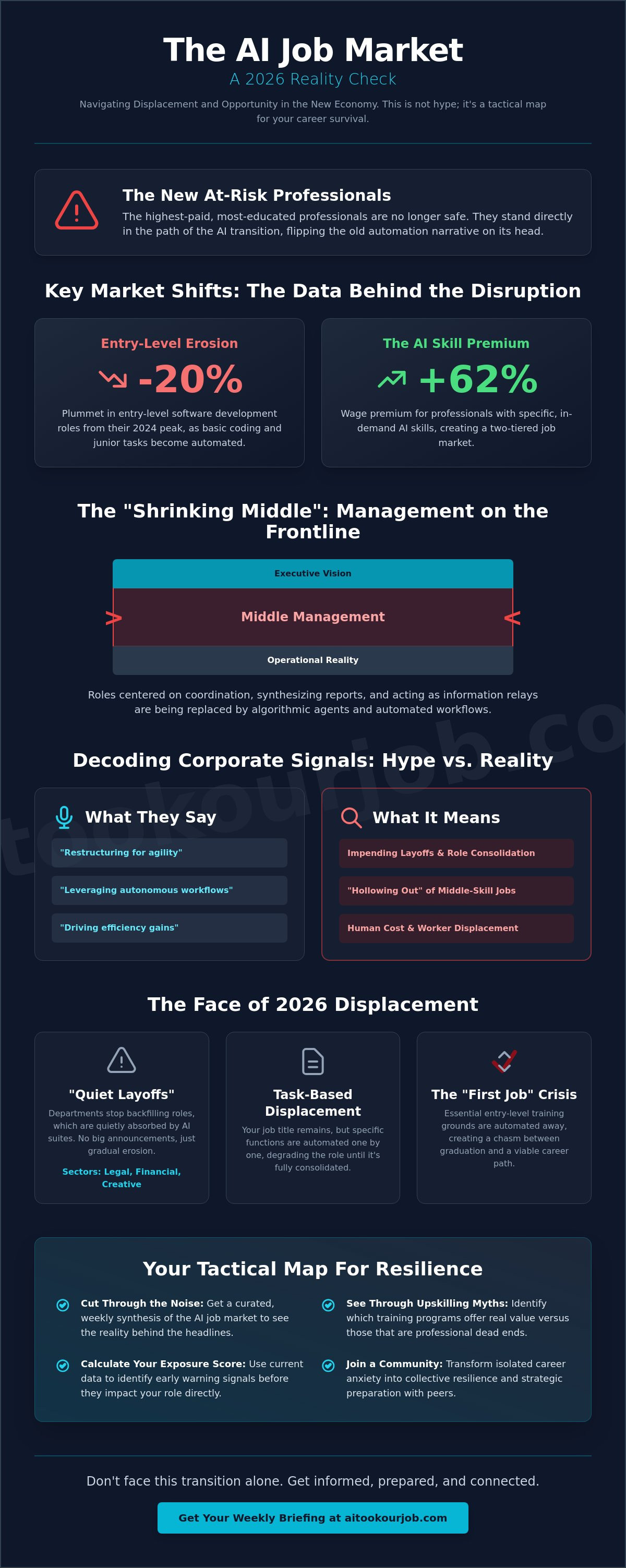
The highest-paid, most-educated professionals are now the ones standing directly in the path of the AI transition. It's a sobering reality that flips the old automation narrative on its head. You've probably felt the weight of this shift already, perhaps as you've watched entry-level software development roles plummet nearly 20 percent from their 2024 peak. This weekly briefing AI job market guide exists because you deserve more than corporate spin or tech-optimist hype. We're here to offer a grounded, honest look at where the industry is actually moving.
We know the anxiety of feeling like a passenger in your own career. It's isolating to face these changes alone. That's why we're cutting through the noise to provide a tactical map for 2026. You'll learn how to navigate the "seniorization" of junior roles and how to capture the 62 percent wage premium currently available for those with specific AI skills. We'll explore the rise of internal mobility and the early warning signs of displacement, ensuring you stay informed, prepared, and connected to a community that understands exactly what's at stake.
Key Takeaways
- Understand why standard tech news often masks the displacement reality and how a weekly briefing AI job market synthesis provides the clarity you need to act.
- Recognize the "Shrinking Middle" and learn why middle management has become the primary frontline for AI-driven restructuring.
- See through the corporate upskilling myth to identify which training programs offer real value and which are professional dead ends.
- Learn to calculate your personal Exposure Score using current data to identify early warning signals before they impact your role.
- Connect with a community of peers to transform isolated career anxiety into collective resilience and strategic preparation.
What is a Weekly Briefing for the AI Job Market?
It isn't just a news feed. It’s a shield. A weekly briefing AI job market report serves as a curated synthesis of labor shifts, automation trends, and policy changes that directly affect your livelihood. While major financial outlets obsess over how generative models might boost global GDP by trillions, we focus on the quiet closures of mid-sized departments and the sudden shifts in hiring requirements that leave experienced professionals wondering where they fit. This is the difference between "AI hype" and "displacement reality." We don't trade in optimism; we trade in radical honesty because professional survival requires seeing the world as it is, not as we wish it to be.
Corporate newsletters often read like press releases for the future. They celebrate efficiency gains while glossing over the human cost. Our approach is different. We acknowledge that the impact of AI on workers is complex, often involving a mix of increased wage premiums for some and sudden obsolescence for others. By stripping away the corporate veneer, we provide a space for collective resilience. You aren't just consuming data. You're gaining a tactical map designed to help you navigate a landscape that feels increasingly unfamiliar.
The Signal vs. The Noise in 2026
Identifying corporate-speak is a vital skill in 2026. When a CEO mentions "restructuring for agility" or "leveraging autonomous workflows," it's often a masked signal for impending layoffs. The market is accelerating at a pace that makes standard monthly reports feel like ancient history. We filter the noise to find the actual signals; the specific industries where entry-level roles are vanishing or where middle management is being hollowed out. The cost of being uninformed isn't just a missed opportunity. It's the risk of being caught off guard by a shift that was visible weeks before it hit your desk.
The Mental Load of Staying Informed
Tracking the decline of your own industry is exhausting. We understand the "automation anxiety" that comes with every new model release or policy shift. It's a heavy psychological weight to carry alone, which is why community-led briefings are essential. They turn a solitary fear into a shared strategic conversation. We focus on setting boundaries so you can stay informed without burning out. You don't need to track every headline; you just need the right ones. By focusing on essential, actionable truths, we reduce the mental load and replace isolation with a sense of solidarity and proactive preparation.
Decoding 2026: Key Indicators in the AI Job Market
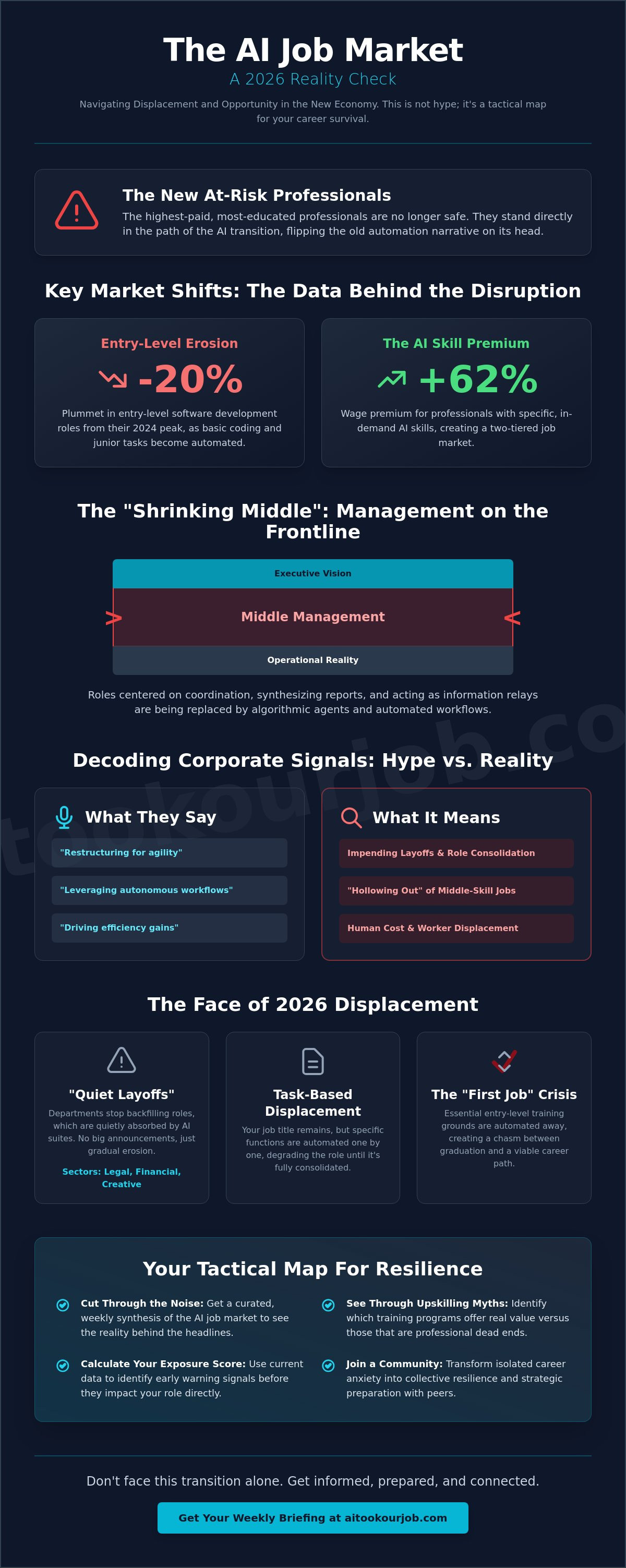
The middle is disappearing. For decades, middle management served as the connective tissue of the corporate world, translating executive vision into operational reality. Today, that coordination is increasingly handled by algorithmic agents. This "Shrinking Middle" is the current frontline of the transition. If your role involves synthesizing reports, scheduling complex workflows, or acting as a relay for information, the risk is no longer theoretical. It is active. We track these hollowing-out trends in our weekly briefing AI job market reports to ensure you aren't the last to know when your sector begins to consolidate.
The "first job" landscape has also shifted violently. Entry-level roles that once served as essential training grounds for junior professionals are being automated out of existence. Data from the Economic Policy Institute regarding AI's impact on the job market for new graduates suggests a widening gap between degree attainment and actual employment opportunity. Companies now use "Human-in-the-loop" systems as a temporary bridge. These roles require humans to supervise AI outputs, but they often lack the career progression of traditional paths. They are stopgaps, not destinations.
White-Collar Displacement Trends
Legal, financial, and creative sectors are currently experiencing "Quiet Layoffs." These aren't the explosive, headline-grabbing events of the past. Instead, they manifest as departments that simply stop hiring, or roles that are quietly absorbed into automated suites. Task-Based Displacement is the primary 2026 risk, where specific functions are automated while the job title remains, eventually leading to total role consolidation. Staying ahead of these subtle shifts requires a community focused on resilience rather than corporate optimism.
Blue-Collar Resilience and Risks
Physical dexterity remains a formidable moat. While an algorithm can write a contract, it still struggles to navigate a cluttered warehouse or repair a burst pipe. This "Physical Edge" provides a temporary sanctuary, but it isn't immune. Computer vision is rapidly transforming logistics and manufacturing, turning once-complex manual sorting into automated routines. Resilience in the blue-collar sector now depends on identifying tasks that require high-stakes human judgment and unpredictable physical movement, as these remain the hardest for current systems to replicate.
Corporate Hype vs. Worker Reality: Seeing Through the Fog
Corporate earnings calls are currently echoing with a single word: efficiency. For shareholders, this is a promise of higher margins. For you, it is often a euphemism for doing more with less, or perhaps doing nothing at all. The weekly briefing AI job market landscape is frequently painted in broad, optimistic strokes by tech giants, yet the view from the ground is far more precarious. While firms that leverage AI effectively report labor productivity gains of up to 163 percent, these gains rarely trickle down to the individual's paycheck. Instead, we see a widening gap where the human worker is expected to manage a growing fleet of AI agents while their own compensation remains stagnant or declines.
The "Upskilling" narrative is the most pervasive myth in this fog. You are told that learning to use a specific AI tool will "future-proof" your career. This is a half-truth. Many corporate training programs are designed to turn you into a more efficient operator of the very systems that will eventually automate your primary tasks. It is a treadmill. True professional survival requires looking past the tool-specific training and focusing on the high-level judgment and leadership skills that AI cannot yet replicate. Corporate briefings ignore this human impact because their priority is the bottom line, not your long-term resilience.
Questioning the "New Employment" Promise
We are told that AI will create millions of new jobs. We must ask: what is the quality of these roles? We are seeing a rapid gig-ification of professional services. Roles that were once stable, salaried positions are being broken down into discrete, algorithmic tasks. If AI creates more jobs, why are salaries for those roles trending down? The reality is that "AI-enhanced" job descriptions often demand senior-level expertise, such as complex stakeholder management and creative problem-solving, while offering entry-level pay. It is a fundamental devaluation of human experience.
Radical Honesty in Career Planning
Accepting the possibility of displacement is not an act of despair. It is a tactical starting point. When you move beyond the hope of "AI-proofing"-which implies you can somehow become immune to change-you begin to build "AI-resilience." This means diversifying your skill set and building a network of peers who share real-world data rather than corporate PR. Collective intelligence is your greatest asset. By sharing the truth about which departments are hollowing out and which skills are actually commanding a premium, we can navigate this transition with our eyes open and our careers protected.
How to Use the Weekly Briefing for Career Resilience
Information is only as good as the action it triggers. A weekly briefing AI job market report shouldn't be passive reading; it should be your weekly audit. Start by identifying your "Exposure Score." This involves looking at your primary tasks through the lens of current automation capabilities. If 40 percent of your daily output can now be generated by an autonomous agent, your exposure is high. Tracking these "Early Warning" signals within your specific industry allows you to pivot before the "Quiet Layoffs" reach your specific department. You must move from being a company asset to being a market asset.
Preparation requires a tactical approach to your professional identity. Resilience is built through five specific steps:
- Audit your tasks: Use weekly data to see which of your functions are becoming commoditized.
- Monitor industry shifts: Watch for sudden drops in job postings for your specific title.
- Externalize your network: Build connections outside your current firm to avoid being trapped in a sinking silo.
- Fortify your moat: Focus on high-value, human-centric skills that AI cannot replicate.
- Exchange intel: Share real-world observations with peers to bypass corporate PR.
Building Your Professional Moat
A moat is your defense against automation. It’s built from skills that algorithms struggle to replicate. In 2026, this means doubling down on high-stakes negotiation, complex emotional intelligence, and cross-functional leadership. You need to create a "Defensive Portfolio." This isn't just a resume; it's a collection of wins that required human judgment, ethical navigation, and creative problem-solving. These are the traits that command the 62 percent wage premium currently seen in the market. Focus on the work that requires you to be human.
Networking as a Survival Strategy
The "Hidden Job Market" is the only market that matters when external hiring slows. LinkedIn data shows that internal mobility has increased by 6 percent as companies prefer reskilling over new hires. You cannot rely on public job boards alone. Survival depends on peer-to-peer intel. You need to know which firms are actually hiring and which are merely "ghost posting" to satisfy shareholders. To gain this level of granular insight, you should join our community of resilient professionals and start trading real-world strategies for the 2026 landscape.
The AI Job Loss Weekly Briefing: Your Community Hub
The transition is here. It's happening now. You don't have to face it in silence. The AI Job Loss Weekly Briefing is more than a weekly briefing AI job market update; it's a tactical survival map for the displaced and the vulnerable. We track the numbers, yes. But we also hold space for the human stories that corporate spreadsheets ignore. Every issue combines hard displacement statistics with the lived experiences of professionals navigating the same fog you are. We look at which industries are hollowing out and which are seeing the quiet layoffs we identified earlier. This collective intelligence is our greatest defense. By sharing our reality, we strip away the power of corporate uncertainty.
We believe that transparency is the antidote to isolation. Our briefing provides a curated view of the market that prioritizes the worker over the shareholder. You'll find data on wage premiums for specific skills alongside interviews with peers who've successfully pivoted after a role consolidation. This isn't about superficial optimism. It's about grounded, collective resilience. When you understand the true scope of the shift, you can make decisions from a place of power rather than fear. You're invited to contribute your own story, helping others navigate the same challenges you've overcome.
Beyond the Newsletter: The Community Advantage
Membership offers more than just text. You gain access to our educational media content, including podcasts and deep-dive discussions that center the worker's perspective. It's a space to connect with peers through our community membership, where expert-led discussions replace top-down instruction. In a world that feels increasingly automated, finding solidarity is a radical act of professional preservation. Your insights help others identify early warning signs, creating a feedback loop of resilience that benefits every member of the collective. We're stronger when we share the truth of our professional realities.
Taking the First Step Toward Resilience
Anxiety is a natural response to the 2026 job landscape, but it's a poor strategy. Moving from anxiety to action is the only way to protect your future. Subscribing is a commitment to your own career advocacy. It means you refuse to be a passive consumer of change. You're choosing to be an active participant in a community that values radical honesty over corporate hype. It's time to stop guessing and start preparing. You deserve a clear view of the road ahead. Join the Weekly Briefing and find your map.
Reclaiming Your Professional Future
The 2026 job landscape is shifting beneath our feet. We've explored the "Quiet Layoffs" hitting professional services and the "Shrinking Middle" that threatens established career paths. However, we've also identified the human-centric skills and tactical moats that allow professionals to thrive. You don't have to navigate this transition based on corporate guesswork or tech-optimist noise. A consistent weekly briefing AI job market perspective gives you the data needed to move from anxiety to advocacy. It's about seeing the market as it is, not as shareholders wish it to be.
This resource is built by workers, for workers. It provides no-nonsense analysis of 2026 labor trends that you won't find in mainstream media. By joining a community of thousands navigating this same transition, you gain the collective intelligence necessary to protect your livelihood and your peace of mind. You are more than a line item on a corporate spreadsheet. It's time to reclaim your professional narrative through radical honesty and shared strategy. We are stronger when we move together.
Subscribe to the Weekly Briefing: Your Honest Survival Map.
Stay informed, stay connected, and remember that our collective resilience is the ultimate hedge against automation. You've got this, and we've got you.
Frequently Asked Questions
Is the AI job market apocalypse actually happening in 2026?
It isn't a single, explosive event. It is a steady hollowing out of specific roles and tasks. While aggregate unemployment hasn't spiked, entry-level hiring in fields like software development has dropped significantly. We're seeing a fundamental shift in how work is valued rather than a cinematic collapse. It's a transition that requires active preparation rather than panic. Don't wait for a headline to tell you the market has changed.
How can I tell if my job is at high risk of AI displacement?
You can identify your risk by auditing your daily tasks. If your primary output involves synthesizing data, drafting standard reports, or following predictable workflows, your "Exposure Score" is likely high. Roles that act as information relays are currently the most vulnerable. This is why our weekly briefing AI job market reports focus on identifying these hollowing-out signals before they reach your specific department.
What are the most AI-proof career paths for the next five years?
Career paths that require high-stakes human judgment, complex emotional intelligence, or navigation of unpredictable physical environments remain the most resilient. Skilled trades and roles involving intricate stakeholder management are harder to automate than data-centric professions. Focus on work that demands accountability and creative problem-solving. These human-centric skills currently command a significant wage premium in an increasingly automated landscape that values what machines cannot replicate.
Does the weekly briefing cover both white-collar and blue-collar jobs?
Yes, we track displacement trends across both white-collar and blue-collar sectors. While the "Shrinking Middle" primarily impacts professional services, computer vision and algorithmic management are rapidly changing logistics and manufacturing. Every issue of our weekly briefing AI job market guide provides a comprehensive view of how these technologies are reshaping the entire labor force. We ensure no worker is left in the dark, regardless of their industry.
How much time should I spend tracking AI job market news?
You don't need to spend hours every day tracking every headline. We recommend spending 15 to 30 minutes once a week with a curated, worker-centric briefing. This allows you to stay informed about critical industry shifts without succumbing to "automation anxiety." Your goal is tactical awareness, not constant exposure to the hype cycle. Use your remaining time to build your professional moat and connect with your peers.
Can I share my own layoff story with the AI Took Our Job community?
We encourage you to share your story. Our community membership is built on the principle of collective intelligence. Your lived experience helps others identify early warning signs and understand the reality behind corporate restructuring. Sharing your story isn't just about catharsis; it's a vital contribution to our shared survival map. We are stronger when we replace isolation with radical honesty and support those navigating difficult transitions.
What is the difference between AI displacement and traditional automation?
Traditional automation focused on repetitive physical labor. AI displacement is different because it targets cognitive tasks, creativity, and professional judgment. It often impacts the highest-paid and most-educated workers first. This shift is faster and more pervasive than previous industrial transitions. It requires a different set of defensive strategies centered on high-level human oversight and complex interpersonal navigation. It isn't just about robots; it's about algorithms.
How do I explain an AI-related layoff on my resume?
Frame the layoff as a result of organizational restructuring or role consolidation. Instead of focusing on the loss, emphasize your experience managing AI-enhanced workflows or your success in high-stakes, human-centric projects. Show that you understand the technology but offer the judgment it lacks. Highlighting your "Human-in-the-loop" experience demonstrates that you are a resilient professional who can thrive in a high-automation environment. Focus on the value only you provide.