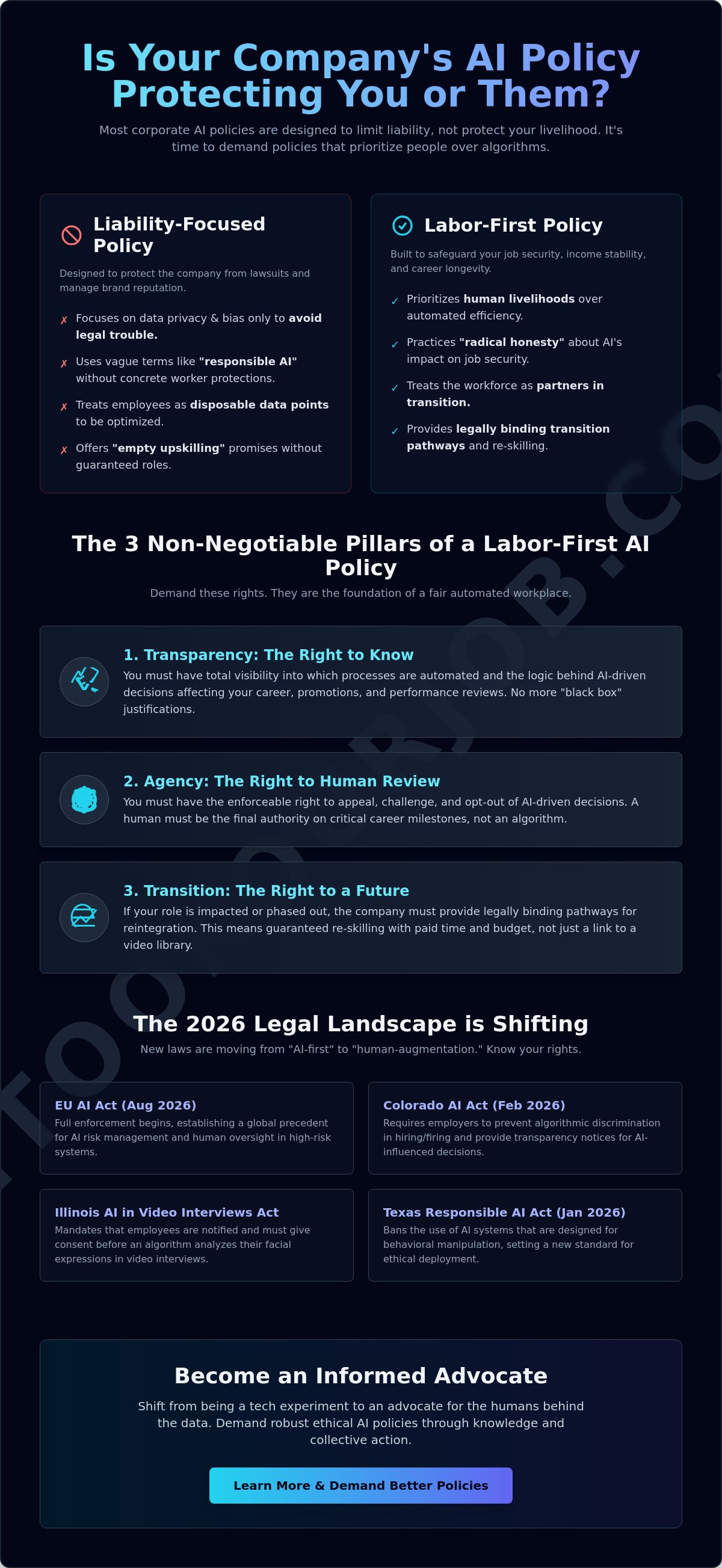
Most corporate AI policies are designed to protect the company from a lawsuit, not to protect your job from an algorithm. As we navigate the rollout of the EU AI Act and the Colorado AI Act in 2026, the gap between corporate compliance and true ethical AI workplace policies has never been wider. It's unsettling to feel like a guinea pig for new technology while receiving nothing but vague promises about future upskilling. You deserve to know how these systems make decisions about your hiring, your performance, and your eventual exit.
We understand the anxiety of watching transparency disappear behind a digital curtain. It's time to demand more than just legal jargon. This guide will teach you how to identify, demand, and evaluate AI policies that prioritize your livelihood over corporate liability. We'll provide a clear checklist of non-negotiable policy clauses and show you exactly how to spot "ethics-washing" so you can regain a sense of agency in this shifting landscape.
Key Takeaways
- Learn to distinguish between policies designed for corporate liability and those that actually safeguard human livelihoods.
- Identify the three non-negotiable pillars of transparency and agency that should exist in every modern employee handbook.
- Develop a sharp eye for "ethics-washing" and the vague corporate jargon used to mask displacement strategies.
- Gain the knowledge needed to demand robust ethical AI workplace policies through collective action rather than individual negotiation.
- Shift your perspective from feeling like a tech experiment to becoming an informed advocate for the humans behind the data.
Beyond the Buzzwords: Defining Ethical AI Workplace Policies
AI is no longer a distant forecast. It is in the room. It is reviewing your emails, scoring your productivity, and quietly reshaping your job description. For most of us, the phrase "AI ethics" feels like a corporate shield. It is often used to discuss the foundational principles of AI ethics like data privacy or algorithmic bias. While these are critical, they only tell half the story. A truly meaningful framework for ethical AI workplace policies must go deeper. It must prioritize human livelihoods over corporate efficiency. Radical honesty is the starting point. If a policy does not explicitly state how AI affects your job security, it is not ethical. It is just PR.
We have moved past the era of voluntary guidelines. In 2026, the stakes are too high for "best intentions." We need frameworks that acknowledge the friction between automated efficiency and human value. This means moving beyond vague promises of upskilling and into concrete agreements about how technology is deployed. A labor-centric policy assumes that your expertise has value that cannot be reduced to a training set. It treats the workforce as partners in transition rather than obstacles to be optimized.
The Difference Between Corporate Ethics and Worker Protection
Corporate ethics usually focus on brand reputation and avoiding legal trouble. When a company talks about "responsible AI," they often mean they do not want to get sued for discrimination. Worker protection is different. It focuses on your income stability and career longevity. You cannot rely on a company to self-regulate when their primary incentive is cutting costs. True protection requires external pressure and transparent rules that prevent employees from being treated as disposable data points. If the policy does not protect you during a layoff, it is not working for you.
The Evolution of Workplace AI Regulations in 2026
The legal landscape shifted significantly this year. As of January 1, 2026, the Texas Responsible AI Governance Act began banning AI systems designed for behavioral manipulation. By February 2026, the Colorado AI Act required employers to prevent algorithmic discrimination in high-risk decisions like hiring and firing. In Illinois, the AI in Video Interviews Act now mandates that you are notified and give consent before an algorithm analyzes your facial expressions. Even the EU AI Act reached its full enforcement phase as of August 2, 2026. These laws are moving the needle from "AI-first" to "human-augmentation" language. The "Right to Human Review" is no longer a polite request; it is becoming a standard legal expectation. We are seeing a transition where humans must remain the final authority on critical career milestones.
The Three Pillars of a Labor-First AI Policy
A policy that only protects the company is a liability for the worker. True ethical AI workplace policies must be built on three non-negotiable pillars: transparency, agency, and transition. These aren't just technical checkboxes. They are the floor of a fair workplace. While organizations often look to the AI Risk Management Framework to secure their systems, workers must use these same standards to secure their livelihoods. We need to know where the AI is, we need the power to challenge its decisions, and we need a bridge to what comes next when the software takes over our tasks.
- Transparency: Total visibility into which processes are automated and how those systems influence your career path.
- Agency: The enforceable right to appeal or opt-out of AI-driven performance metrics that don't account for human nuance.
- Transition: Legally binding pathways for workers whose roles are being phased out, moving beyond severance and into actual reintegration.
Algorithmic Transparency and the Right to Know
The black box is a trap. When management hides behind an algorithm to justify a firing or a denied promotion, they are abdicating their responsibility to the people who built the company. Under the Colorado AI Act, which took effect in February 2026, deployers must provide transparency notices when AI influences employment decisions. You have a right to know the "logic" behind management tools. If an algorithm says you are less productive than your peers, you deserve to see the data points it used to reach that conclusion. Anything less is just automated gaslighting.
Guaranteed Re-skilling vs. "Empty Upskilling"
We see "upskilling" mentioned in almost every corporate memo, but it's often a hollow promise. Empty upskilling provides access to a library of videos with no budget, no paid time to study, and no guarantee of a job once you finish. It's a "parting gift" given during a layoff. A real re-skilling clause in ethical AI workplace policies looks very different. It includes paid training hours, certified courses paid for by the employer, and a priority placement program for internal roles. If you want to stay ahead of these corporate shifts, subscribing to an AI job loss weekly briefing can help you see the changes before they hit your desk. Resilience isn't just about learning a new skill; it's about having the structural support to do so without losing your paycheck.
How to Spot "Ethics-Washing" in Your Employee Handbook
Your employee handbook is a contract. It is not a suggestion. When companies draft ethical AI workplace policies, they often hide the sharpest edges behind soft, comforting language. You need to read between the lines. If you see words like "optimization" or "streamlining," ask what is being removed. Usually, it is a person. Efficiency is often corporate code for displacement. We must stop accepting these terms as neutral business goals. They are choices made about your future.
The "Future-Proofing" trap is another common tactic. Companies love to blame "the market" or "technological inevitability" for their AI choices. They suggest that AI adoption is an inevitable force of nature, like the weather. It isn't. It is a calculated investment. If your handbook claims to be "future-proofing" the business without guaranteeing your place in that future, it is ethics-washing. A policy with no enforcement mechanism is just a list of wishes. If there are no penalties for the company when they violate their own "ethical" standards, the policy has no teeth. Look for these red flag phrases in your 2026 contract:
- "Dynamic workforce rightsizing": This is code for AI-driven layoffs.
- "Algorithmic productivity benchmarks": This means a machine, not a person, decides if you are working hard enough.
- "Self-directed career pivot pathways": This is empty upskilling. It puts the entire burden of transition on you.
The "Human-in-the-Loop" Illusion
It sounds reassuring. It suggests a person is still steering the ship. But in practice, many managers suffer from "automation bias." They treat AI data as gospel because challenging it is too much work. This is the "Rubber Stamp" problem. If a manager simply clicks "approve" on an AI's recommendation to deny your promotion, the human isn't in the loop. They are just a witness to a machine's decision. You must demand a "Meaningful Human Oversight" clause. This requires a person to explain the reasoning behind a decision in their own words, using evidence the AI might have missed.
Privacy as a Distraction
This is a classic bait-and-switch. A company might spend three pages detailing how they protect your biometric data under the Illinois AI in Video Interviews Act. It sounds responsible. But notice what they aren't saying. They focus on "Safe Data" to avoid promising "Safe Jobs." They talk about encryption so they don't have to talk about termination. True ethical AI workplace policies don't just protect your data. They protect your right to work. Don't let a conversation about privacy mask the reality of increased surveillance and productivity tracking.
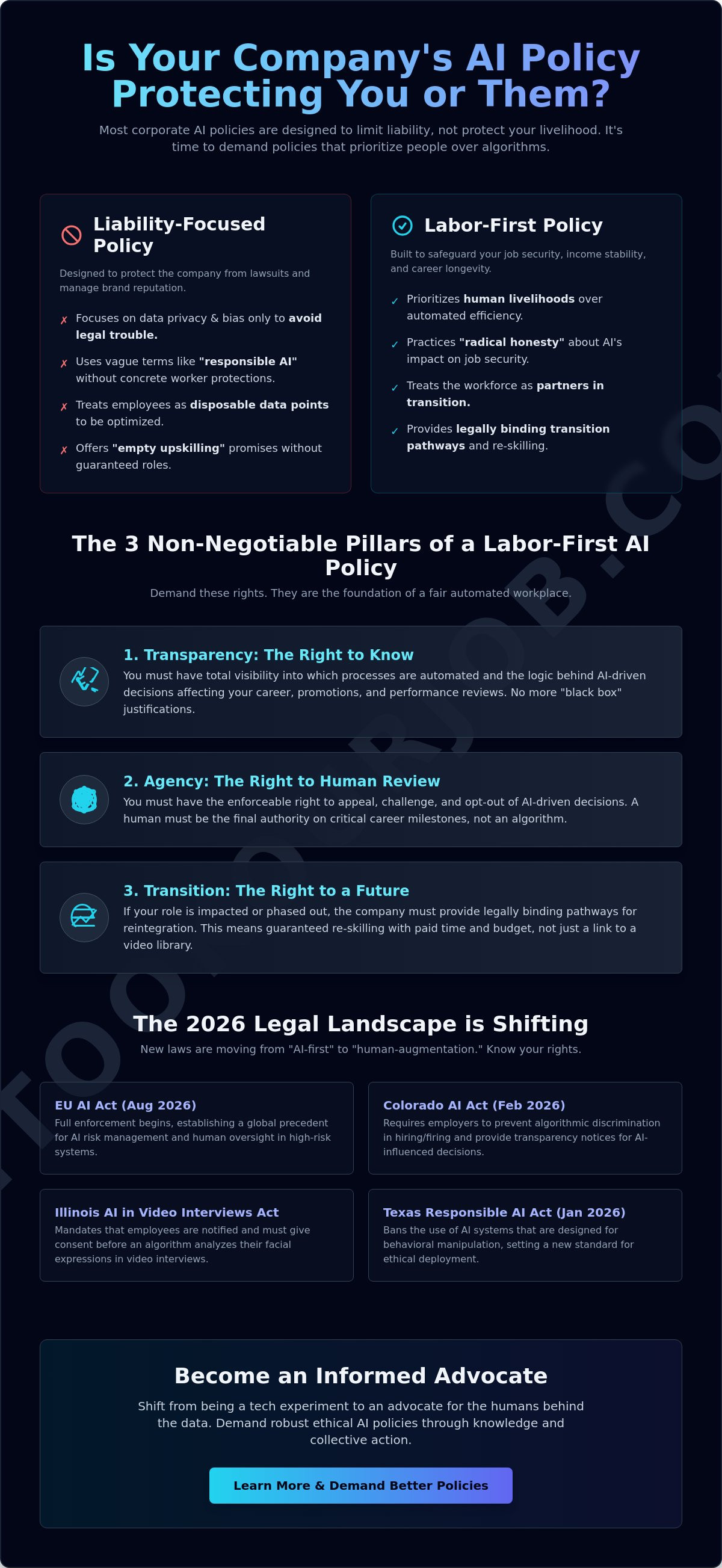
Advocating for Change: How to Demand Better AI Policies
Demanding change is exhausting. It is even harder when you are standing alone against a multi-million dollar software suite. Individual negotiation rarely works against the tide of AI implementation because these systems are deployed across entire departments, not just one desk. To secure ethical AI workplace policies, we must shift our focus toward collective strength. This means forming "Worker AI Councils" or working with modern unions that treat algorithmic management as a labor rights issue. You are not just a user of these tools. You are the subject of their decisions.
Leveraging existing transparency laws is your most effective tool for forcing corporate disclosure. In 2026, legislation like the Colorado AI Act and the EU AI Act provide a legal foothold to demand audits. Use these laws to ask for the data behind the decisions. If your company refuses to share how an AI determines your "risk score," they may be in violation of state or federal regulations. Collective knowledge is the only way to ensure these rules are actually enforced. To stay informed about these shifting rights, consider joining a community membership where workers share real-world strategies for policy advocacy.
Steps for Individual Negotiation
While collective action is the goal, you still have moves to make during your annual review. Start by defining your "Human Moat." These are the complex, relational, and creative skills that AI cannot replicate. Ask for specific AI-protection clauses in your contract. One essential demand is "Automation Severance." If your role is ever significantly altered or eliminated by a machine, you should be entitled to a higher payout than a standard layoff. This creates a financial incentive for the company to keep you and invest in your transition rather than simply replacing you with a script.
The Power of Shared Stories
Silence helps the machine. When you notice an algorithm producing biased results or making errors that humans have to fix, document it immediately. Shared stories are the fuel for industry-wide change. Whistleblowing on unethical AI usage isn't just about being a hero. It is about using community data to prove that "optimized" systems are often broken systems. When workers across different companies share their experiences, it becomes impossible for corporations to claim that AI failures are isolated incidents. Documentation is your first line of defense. Keep a log of every time you have to "save" an AI's mistake. That log is proof of your continued value.
Joining the Collective: Resilience Through Solidarity
Don't wait for the pink slip. The time to scrutinize your company's stance on automation is today. Waiting for a layoff notice to start questioning ethical AI workplace policies is a defensive strategy that rarely pays off. By the time a decision reaches your desk, the algorithm has already processed your history and calculated your "rightsizing" potential. We advocate for the humans behind the training sets. Our mission at "AI Took Our Job" is to ensure that while technology evolves, human dignity remains non-negotiable. We believe in radical honesty about what is happening in our offices and our industries.
You are more than an efficiency metric. As we see more states like Texas and Colorado enforce AI governance throughout 2026, the opportunity for collective action grows. But you need the facts. You need to know which clauses are being won in union contracts and which "ethics" promises are being broken. Information is your first line of defense. You need to know which companies are actually adopting "Labor-First" frameworks and which are just checking boxes. Staying informed on global advocacy efforts allows you to speak from a position of authority. Knowledge is the foundation of resilience, but community is the power that makes that knowledge effective.
The AI Job Loss Weekly Briefing
Our briefing isn't a corporate newsletter. It's a survival guide for the modern professional. We track real-time updates on legislative shifts and highlight organizations that are setting higher standards for worker protection. You'll get the facts without the sugar-coating. We cover the shift from "AI-first" to "human-augmentation" language and the real-world impact of the EU AI Act. Subscribe to the Weekly Briefing for radical honesty in your inbox.
Finding Your Tribe in the Displaced Collective
Transition is lonely. It's even harder when you feel like you're being watched. We provide a safe space where you can share strategies and stories away from the prying eyes of corporate surveillance. This is where you find your tribe. Whether you're currently navigating a shift or preparing for one, collective wisdom is your greatest asset. We help you move from broad observations to direct action. Join our community and help us demand better AI policies.
Policy is a tool, but community is the power. When we stand together, we move from being passive subjects of technology to active architects of our own future. Resilience isn't a solo act. It's something we build, day by day, together. We won't settle for superficial optimism. We opt for grounded, collective resilience. Together, we can ensure that the future of work still has a place for the people who do the work.
Reclaiming Your Agency in an Automated World
The transition is happening now. We've explored how to peel back the layers of corporate "ethics-washing" to find the truth about your job security. You now have the tools to identify the three pillars of real protection: transparency, agency, and transition. Don't let vague promises of upskilling replace concrete, enforceable rights. By demanding robust ethical AI workplace policies, you're doing more than just protecting a paycheck; you're asserting your value as a human in a landscape designed for data.
You don't have to navigate these shifts alone. Our Weekly Briefing reaches over 50,000 subscribers who value radical honesty over corporate hype. We offer expert-led discussions on labor shifts that prioritize your livelihood. It's time to move from being a subject of technology to an advocate for your own future. Join the AI Took Our Job Community and Advocate for Human Rights. Together, we can build a resilient, informed collective that refuses to be left behind. Your voice matters. Let's use it.
Frequently Asked Questions
What is an ethical AI policy in the workplace?
An ethical AI policy is a formal framework that prioritizes human dignity and labor rights over automated efficiency. It sets clear, enforceable rules for how algorithms are used in hiring, performance management, and termination. These policies ensure you aren't just a data point. They move beyond mere legal compliance to focus on transparency and your non-negotiable right to meaningful human oversight in every career-altering decision.
Can my employer use AI to monitor my productivity ethically?
Yes, but only with full disclosure and narrow limits on how that data is used. Ethical monitoring shouldn't feel like a digital panopticon. It requires that you know exactly what is being tracked and have the right to challenge metrics that don't reflect the complexity of your work. If the data is used to justify discipline without a human review process, it isn't ethical. It's just automated surveillance.
Does an AI policy protect me from being laid off?
Not necessarily, but it provides a roadmap for how those transitions should happen. A strong policy includes clauses for "Automation Severance" and guaranteed re-skilling. It ensures that if your role is automated, the company has a financial and moral obligation to help you transition. It's about a soft landing rather than a sudden exit. You deserve a bridge to your next role, not just a door.
What should I do if my company implements AI without a policy?
Start by documenting every interaction you have with the new system immediately. Ask your manager for written clarification on how the AI affects your performance reviews and job security. You can also look into state-level protections like the Colorado AI Act. If the company won't provide a policy, it's a sign that you need to start organizing with your colleagues to demand collective disclosure and transparency.
Are there laws that require companies to have ethical AI policies?
Yes, several landmark laws took effect in 2026 that mandate transparency. The EU AI Act and the Colorado AI Act require companies to disclose when high-risk AI systems influence employment decisions. In Illinois, employers must get consent before using AI to analyze video interviews. While we don't have a single federal law in the U.S., state-level regulations are filling the gap. These laws provide the legal teeth that workers need.
How can I tell if my company’s AI policy is actually "ethics-washing"?
Look for vague language that lacks specific enforcement penalties or financial commitments. If the policy uses buzzwords like "innovation" or "optimization" without defining how your job security is protected, it's likely ethics-washing. True ethical AI workplace policies include clear, non-negotiable rights for workers. If there's no way to hold the company accountable for a violation, the policy is just PR designed to protect their brand, not your job.
Can I negotiate an AI-protection clause into my employment contract?
You can and should ask for AI-protection clauses during your next annual review. Request specific language that guarantees human review for any decision regarding your termination or promotion. Negotiating for "Automation Severance" is also becoming a standard practice in 2026. It's about creating a "Human Moat" around your role. This makes you too valuable or too expensive to simply replace with a script without a proper transition plan.
What role do unions play in ethical AI policy advocacy?
Unions are the primary drivers of enforceable labor protections in the age of automation. They negotiate for "algorithmic transparency" and ensure that AI is used to augment, not replace, human workers. In 2026, modern unions are focusing on data rights as a core part of collective bargaining. They provide the strength in numbers needed to force corporate leaders to adopt real protections. Solidarity is your best defense against automated displacement.