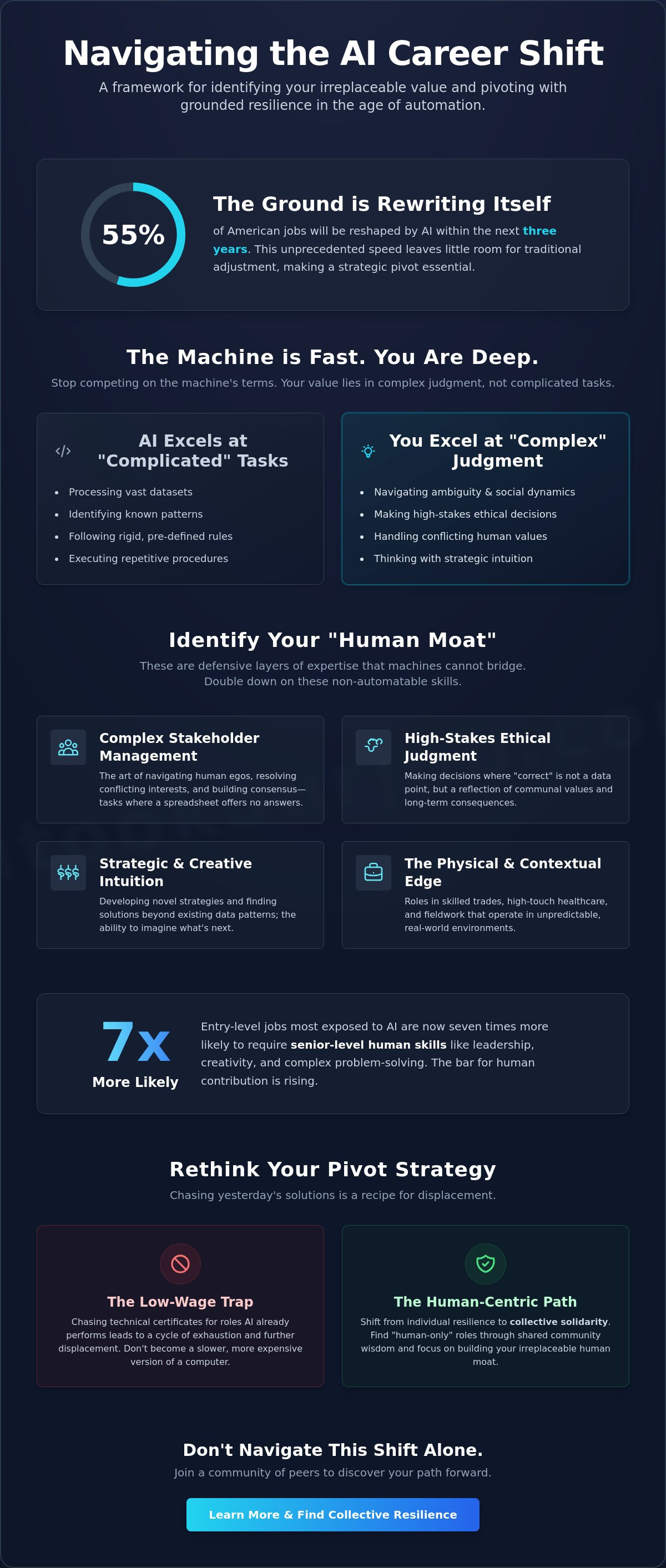
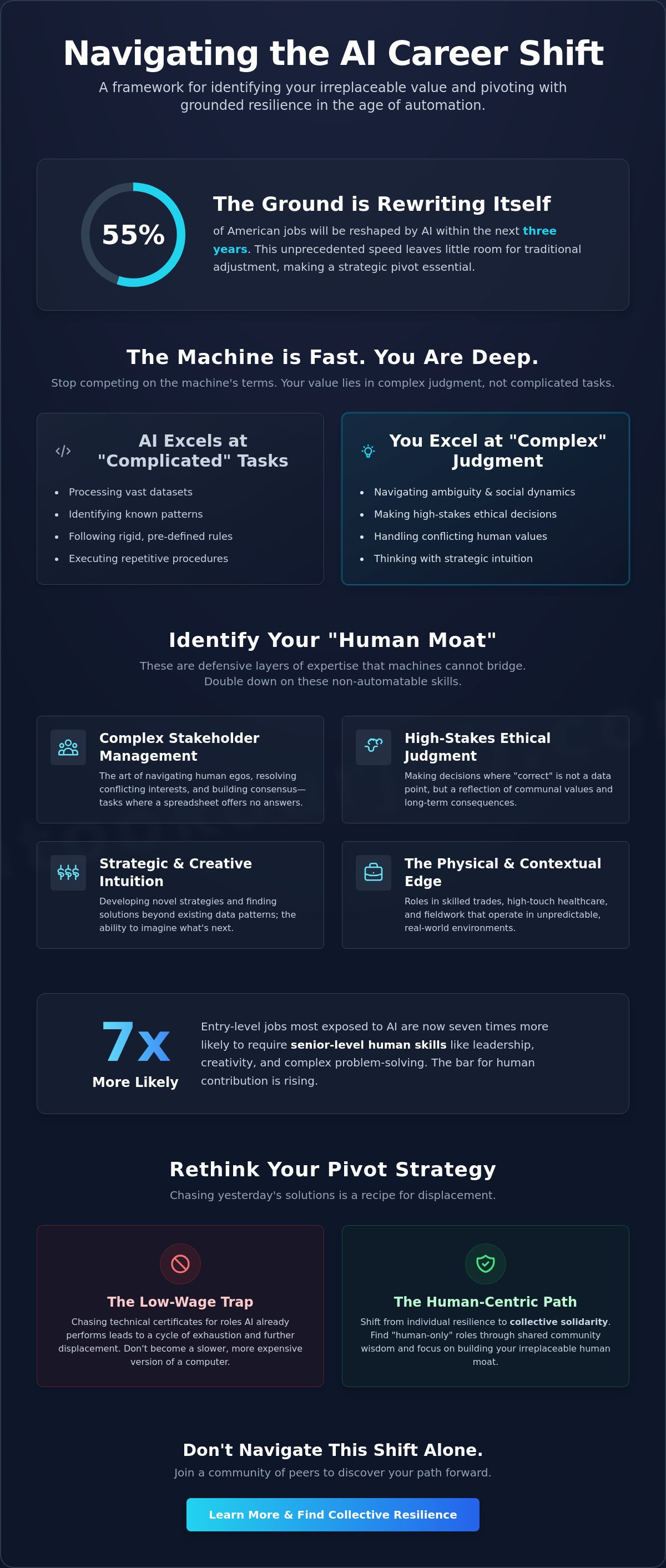
Fifty-five percent of American jobs will be reshaped by AI within the next three years. This isn't a distant forecast; it's a present reality. You likely feel the weight of this shift every time a new tool is announced or a colleague's role is "optimized" into a script. Navigating career change due to automation is a heavy, deeply personal task that often feels like losing a piece of yourself. The fear of falling into a low-wage trap is real. The noise of conflicting "future-proof" advice is deafening. How do you find your footing when the floor is constantly moving?
We agree that this moment requires more than superficial optimism. It demands radical honesty about what's changing and what remains uniquely yours. This guide provides a realistic, empathetic roadmap for pivoting your career when the landscape shifts under your feet. We'll explore a clear framework for identifying your transferable skills and building "human moats" that machines cannot bridge. From understanding the "seniorization" of entry-level roles to finding solidarity in a community of peers, you'll gain the tools to move forward with grounded, collective resilience.
Key Takeaways
- Identify your "Human Moat" by distinguishing between tasks that are merely complicated and those that require high-level human judgment.
- Master the Adjacency Strategy for navigating career change due to automation to leverage your existing expertise in sectors with lower machine displacement.
- Learn how to audit the "automation density" of potential industries before committing to a professional pivot.
- Address the psychological impact of displacement and learn specific tactics to avoid the cycle of low-wage gig work.
- Shift from individual resilience to collective solidarity to discover "human-only" roles through shared community wisdom.
The Reality Check: Why Automation-Driven Career Change Feels Different
The speed of generative AI is unprecedented. Unlike the slow crawl of the steam engine or the decades-long rollout of electricity, this shift is happening in months, not generations. It's a jarring acceleration that leaves little room for traditional adjustment periods. Navigating career change due to automation feels different because the ground beneath you isn't just shifting; it's being rewritten in real-time. Why does the modern office suddenly feel like a foreign country? Why do the skills that earned you a promotion two years ago now feel like relics? These aren't signs of your inadequacy. They are symptoms of a profound economic pivot.
Many professionals attempting to pivot fall into the "low-wage trap." This happens when you trade a specialized, automated role for a generalist position in a high-turnover sector. Lateral moves often fail because they focus on escaping a dying industry rather than moving toward a sustainable one. To survive this transition, you must stop viewing your work as a collection of tasks. Machines are excellent at tasks. They are poor at delivering outcomes that require human agency, ethical judgment, and social nuances. Understanding the history of technological unemployment helps us see that while the tools change, the need for human direction remains constant. The goal is to move where the machine cannot follow.
The "Alien Setting" of the Modern Workforce
Traditional career ladders in white-collar sectors are dissolving. The predictable path from junior associate to senior manager is being replaced by high-velocity, tech-intermediated roles that prioritize immediate output over long-term development. You may feel like you're working within an "alien" hierarchy where algorithms, not managers, dictate your daily priorities. This creates a sense of profound isolation. Automation displacement is a systemic shift, not a personal failure. It's a restructuring of how value is created, requiring us to find new ways to assert our human relevance in a landscape dominated by scripts and data models.
Why Traditional Upskilling Often Misses the Mark
For years, the standard advice was simple: learn to code. That silver bullet has lost its shine. Chasing technical certificates for roles that AI already performs is a recipe for exhaustion and further displacement. If a machine can do it in seconds, your six-month certification won't protect your salary. We need to shift our focus away from basic digital literacy toward "human-centric" value. This means doubling down on skills that require empathy, complex problem-solving, and strategic intuition. Navigating career change due to automation requires a roadmap that values your humanity over your ability to act like a slower, more expensive version of a computer.
Identifying Your "Human Moat": Skills Machines Cannot Replicate
The machine is fast. You are deep. To succeed in navigating career change due to automation, you must stop competing on the machine's terms. AI excels at "complicating" tasks: processing vast datasets, identifying patterns, and following rigid rules. However, it struggles with "complex" judgment. Complexity involves ambiguity, conflicting human values, and the high-stakes navigation of social dynamics. This is your "Human Moat." It's a defensive layer of expertise that is biologically or socially gated. Machines can simulate empathy, but they cannot feel the weight of an ethical consequence or the tension in a boardroom.
As we look toward The Future of Work, we see a massive premium being placed on these human-intensive traits. Research from 2026 shows that entry-level jobs most exposed to AI are seven times more likely to require senior-level human skills like leadership and creativity. The market isn't just looking for workers; it's looking for navigators. If you're feeling overwhelmed by the technical shifts, staying informed through a resource like an AI job loss briefing can help you spot where these moats are most valued.
The Taxonomy of Non-Automatable Skills
Complex Stakeholder Management is the art of navigating human egos. It's about finding a "win" when two departments have conflicting interests that a spreadsheet can't resolve. High-Stakes Ethical Judgment is another pillar. These are decisions where "correct" isn't a data point but a reflection of communal values. Finally, consider the Physical Edge. Roles in the trades or high-touch healthcare operate in unpredictable settings. A robot might weld a joint in a factory, but it cannot navigate a cluttered, century-old basement to fix a burst pipe. These environments are too unpredictable for current algorithms.
Inventorying Your Transferable Assets
Your job title is a cage. Strip it away. If you were a "Project Manager," you weren't just moving tickets; you were a translator between technical constraints and human desires. Transferable human capital is the foundational set of human-centric abilities you carry from one industry to the next. When navigating career change due to automation, these are the assets that matter most. Use this checklist to audit your current role for moat potential:
- Do I resolve conflicts where both parties have valid but opposing needs?
- Does my work require physical movement in unpredictable settings?
- Am I responsible for decisions that have moral or ethical consequences?
- Do I mentor others or build social cohesion within a team?
If you answered yes to any of these, you have a moat. You aren't starting from zero. You're simply relocating your most valuable assets to more stable ground.
The Strategic Pivot: Mapping Your Transition Without Starting from Zero
You don't need to burn your career to the ground to save it. When navigating career change due to automation, the most effective path is often the "Adjacency Strategy." This involves identifying roles that require your specific human moats but exist in sectors where the "automation density" is naturally lower. For example, a data analyst in high-frequency trading might find their role shrinking, but a data analyst in specialized elder care or bespoke manufacturing is suddenly a high-value rarity. These industries value the human-in-the-loop precisely because the stakes are too high or the variables too human for a machine to manage alone. You are moving sideways, not starting over.
For senior professionals, your years of service are not a liability. They are an "Experience Moat." While a junior worker might use AI to generate a marketing strategy, they lack the historical context to know why that specific strategy failed in a different market cycle. Transitioning into advisory or mentorship roles allows you to sell your judgment rather than your labor. You are the one who verifies the machine's output, ensuring it aligns with long-term organizational goals and ethical standards. When navigating career change due to automation, remember that you are a truth-teller in a room full of noise.
Step-by-Step Transition Framework
A successful pivot requires a methodology, not just a hope. Follow these steps to map your move:
- Step 1: Audit your tasks. Use a "Moat vs. Machine" matrix. List every task you do and rank it by how easily a script could replicate it. Focus your future on the human outliers.
- Step 2: Identify Sunrise Industries. Look for sectors where human-centric demand is growing. Healthcare, specialized education, and artisanal services are seeing a rise in roles that require complex social navigation.
- Step 3: Build a Proof of Human Value portfolio. A traditional resume lists what you did. A human-centric portfolio proves how you handled a crisis, mentored a team, or solved a problem where the data was missing.
Explaining the Pivot: The "Radical Honesty" Resume
How do you explain a gap caused by a machine? We believe in radical honesty. Don't hide the layoff. Instead, frame your transition as a proactive choice to move toward higher-value work. You aren't a "victim" of progress; you're a professional who recognizes where the market is going. You can find detailed guides on how to explain AI layoff on resume to ensure your narrative remains one of leadership and foresight. By owning the story, you project the image of a well-informed peer who is ready to lead in an automated world. This transparency builds trust with employers who are also trying to figure out the future.
Overcoming the Psychological and Systemic Barriers of Displacement
Being replaced by a machine is a personal affront. It hits differently than a typical layoff caused by a budget cut or a merger. When an algorithm takes over your responsibilities, it feels like a verdict on your future relevance. You aren't just losing a paycheck; you're facing an identity crisis. If your sense of self is tied to your professional output, automation can feel like an erasure of your history. Navigating career change due to automation requires more than a new skill set. It requires a total recalibration of how you view your worth in a world that increasingly prizes efficiency over humanity.
We must be radically honest about the "low-wage trap." Many workers, reeling from displacement, rush into the gig economy or entry-level service roles just to stay afloat. While these roles provide immediate relief, they often lack the "human moats" we discussed earlier, leaving you vulnerable to the next wave of automation. You cannot cycle through temporary fixes forever. To avoid this, you must resist the urge to devalue your own expertise. Older workers, in particular, often face the "tech-savvy" bias, where hiring managers assume a lack of digital fluency. Combat this by focusing on your strategic judgment. You don't need to be a faster coder than a 22-year-old; you need to be the person who knows why the code matters in a global context. Joining a community membership of peers facing similar transitions provides the solidarity needed to resist these systemic pressures.
Reclaiming Purpose After Displacement
Your value as a human is entirely separate from your productivity as a corporate resource. Machines are resources. You are an agent of change. Managing career anxiety starts with acknowledging that the "rules" of work are being rewritten by forces beyond your control. This isn't your fault. Shared stories are our greatest weapon against the isolation of displacement. When we talk openly about the "alien" feeling of the modern workplace, we normalize the experience. We move from individual despair to collective resilience. Have you asked yourself lately what you would do if productivity wasn't the primary goal? That answer is often where your new career begins.
Navigating Systemic Bias
Occupational segregation remains a significant hurdle. Certain sectors are being "democratized" by AI, which often leads to wage suppression and a loss of professional autonomy. You must be proactive in vetting potential employers. During the interview process, demand to see their ethical AI workplace policies. How do they handle displacement? Do they upskill from within? Before signing an offer, ask to see the company’s AI manifesto to ensure they view technology as a partner for workers rather than a wholesale replacement for them. Navigating career change due to automation means choosing environments that respect the "human-in-the-loop" as a necessity, not an inconvenience.
Joining the Collective: Navigating the Future of Work Together
Individual resilience is a corporate myth. For years, we've been told that our ability to "bounce back" is a personal responsibility, a trait we must cultivate in isolation. This narrative is convenient for organizations but dangerous for people. It shifts the burden of systemic technological shifts onto the shoulders of the individual worker. True resilience isn't found in a vacuum; it's found in the collective. When navigating career change due to automation, your greatest asset isn't just your skill set. It's your network of peers who are asking the same questions and facing the same "alien" workplace realities.
Community acts as a filter for the noise of the modern market. While public job boards are increasingly flooded with ghost listings and automated filters, the "hidden" job market remains stubbornly human. These are the roles discovered through shared wisdom, word-of-mouth, and high-trust connections. By joining a collective, you gain access to "human-only" roles that machines cannot see. We must move beyond simply surviving and begin advocating for responsible AI policies. This means pushing for workplaces that use technology to augment human judgment rather than replace it entirely. You aren't just a resource to be optimized; you're a partner in a shared future.
The Power of the Briefing
Information is the antidote to panic. When you lack clear data, your mind fills the gaps with worst-case scenarios. Staying informed through the AI Job Loss Weekly Briefing reduces this friction by providing a curated survival map of the current landscape. It allows you to see industry shifts months before they reach your specific desk, giving you the lead time necessary to pivot effectively. You stop being a passive consumer of headlines and become an active participant in a mobilized community. Knowledge, when shared, becomes a tool for collective preparation rather than a source of individual anxiety.
Advocacy and the Human Manifesto
We must demand human-centric career paths. This isn't a request for charity; it's a demand for economic stability. Employers need to understand that while AI can process data, it cannot lead, mentor, or navigate the ethical nuances of a complex society. Connecting with others allows for "radical honesty" about which career pivots actually lead to stable ground and which are just another low-wage trap. This shared intelligence is the only way to outpace the speed of automation. Don't navigate this transition in silence. Join the community and build your human moat today.
Reclaim Your Professional Future
The landscape has shifted, but your agency remains. Success in navigating career change due to automation comes down to two things: identifying your human moat and refusing to walk the path alone. We've explored how to strip away job titles to find the core judgment that machines cannot simulate. We've mapped the adjacency strategy to ensure your next move is sustainable and strategic. Now, it's time to move from theory to action. This transition is difficult, but it doesn't have to be a mystery. You deserve a clear view of the road ahead.
Join a community of thousands of displaced and proactive professionals who value radical honesty over corporate spin. Our weekly briefings are curated by industry experts, not algorithms, to provide you with a grounded perspective on labor market shifts. Subscribe to the AI Job Loss Weekly Briefing for your honest survival map. You are more than a resource to be optimized. You are a vital part of a resilient collective. Let's build the future of work together, one human-centric decision at a time. You've got this.
Frequently Asked Questions
Is it too late to change careers if I am over 45 and my job is being automated?
It is never too late to pivot, but your strategy must change. For those over 45, your advantage is strategic judgment and historical context that younger workers often lack. You aren't competing on technical speed but on wisdom. Focus on advisory roles or sectors where long-term stability and ethical oversight are prioritized. Your years of experience act as a hedge against the shallow outputs of generative tools.
How do I explain an AI-related layoff to a prospective employer?
Use radical honesty and frame the displacement as a proactive market realization. Tell prospective employers that you recognized the shifting landscape and chose to move toward roles that require higher-level human agency. This approach reframes a layoff from a personal failure into a strategic career move. It shows you are well-informed and proactive about navigating career change due to automation rather than being a passive victim of tech shifts.
What are the safest industries to pivot into to avoid future automation?
No industry is entirely immune, but those requiring high-touch human interaction or physical dexterity in unstructured environments are more stable. Healthcare, specialized elder care, and skilled trades like electrical work or plumbing have strong moats. These sectors involve variables that current algorithms cannot manage. Look for sunrise industries where the human-in-the-loop is an ethical or physical requirement rather than a cost to be cut.
Do I need to go back to university to survive the AI transition?
You don't always need a new four-year degree to survive this transition. Many professionals find success through targeted certifications or bootcamps that bridge their existing knowledge with new tools. As of 2026, government programs like the AI Upskill Accelerator provide funding for these industry-led partnerships. Focus on gaining digital fluency that complements your human judgment rather than trying to out-credential the machine in a traditional classroom setting.
How can I tell if my current skills are actually "automatable" or just being hyped?
You can distinguish between reality and hype by looking at the nature of your daily tasks. If your work follows a predictable pattern or relies on processing closed datasets, it is at high risk. If your role involves navigating human egos, making ethical trade-offs, or solving problems with missing data, you have a moat. Don't listen to the marketing; look at whether a script could replicate your specific decision-making process.
What is a "Human Moat" and how do I build one?
A Human Moat is a defensive layer of expertise that machines cannot bridge. It includes traits like empathy, strategic intuition, and the ability to build social cohesion. You build one by leaning into the parts of your work that require high-stakes judgment and social nuance. While AI can simulate these behaviors, it cannot feel the weight of the consequences or build genuine trust with a human stakeholder.
Can I use AI to help me pivot into a career that is "AI-proof"?
You should absolutely use AI to assist in navigating career change due to automation. These tools can help you analyze job descriptions for skill gaps, draft human-centric portfolios, and research industry automation density. The goal is to use the machine to accelerate your move toward a role where the machine cannot follow. It's about using automation as a bridge to a more human-intensive career.
Where can I find a support group for people who lost their jobs to AI?
Finding a support group is essential for managing the psychological toll of displacement. Look for communities that offer radical honesty and shared wisdom rather than generic career advice. Our community membership provides a space for professionals to share what is actually working in the current market. Moving from individual isolation to collective action is the fastest way to find your footing in a shifting landscape.