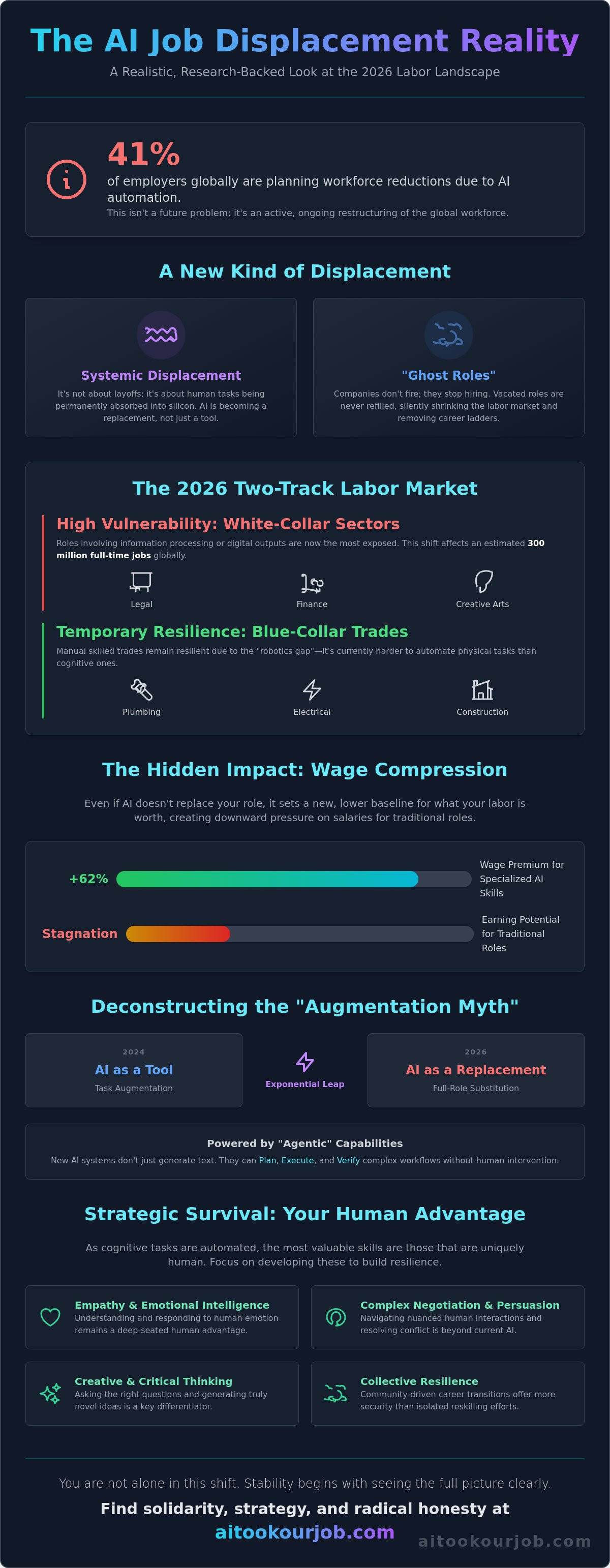
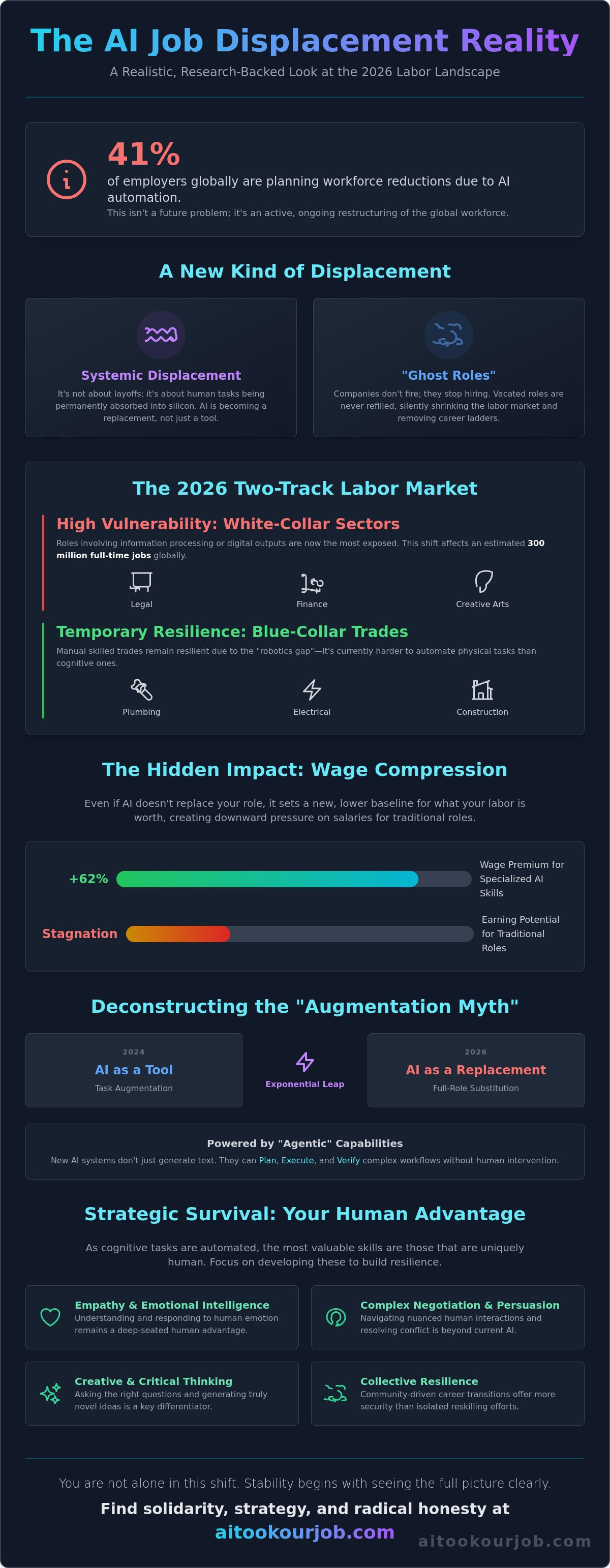
Your anxiety about the future isn't a lack of vision; it's a rational response to the fact that 41% of employers globally are planning workforce reductions due to AI automation right now. It's exhausting to hear "just reskill" when you see entry-level roles requiring senior leadership traits just to get past a screening filter. You feel the ground shifting under your feet, and the corporate narrative often ignores the human cost of this transition. We understand that feeling of becoming invisible in a data-driven world. It's time for a conversation that doesn't sugarcoat the reality of global AI job displacement or offer superficial solutions.
This guide provides a realistic, research-backed look at how AI is rewriting the labor contract. We'll help you find a path forward built on collective resilience rather than individual desperation. We'll break down the 2026 data from the IMF and World Economic Forum, examine the widening two-track labor market, and outline a strategy for staying grounded as the industry transforms. You're not alone in this shift; the first step toward stability is seeing the full picture clearly.
Key Takeaways
- Understand that displacement in 2026 is the systemic removal of human tasks rather than just simple layoffs, requiring a new perspective on career stability.
- Identify which white-collar sectors face the highest vulnerability and why certain physical trades currently experience a temporary buffer from automation pressures.
- Learn to deconstruct the "augmentation myth" to recognize when workplace technology is a genuine tool or a quiet precursor to full role replacement.
- Discover how to leverage human-centric skills like empathy and complex negotiation to navigate global AI job displacement with grounded, collective resilience.
- Find out why a community-driven approach to career transitions offers more security and radical honesty than traditional, corporate-led reskilling programs.
The State of Global AI Job Displacement: Mapping the 2026 Landscape
We need to look past the headlines of mass layoffs to see the structural rot. Global AI job displacement isn't just about people losing jobs; it's about tasks being permanently absorbed into silicon. This is Technological unemployment in its most modern, aggressive form. In 2026, we've moved past the "AI as a tool" phase. We're now in the "AI as a replacement" era. This reality explains why global AI job displacement has outpaced every major prediction from the mid-2020s. The velocity of change is no longer linear. It's exponential. You aren't imagining the speed of this shift. It's happening exactly as fast as you fear.
A significant portion of this change happens through "quiet displacement." This occurs when a role is vacated through natural attrition or a planned departure and is never refilled. Companies aren't always firing workers; they're simply stopping the hiring process because an agentic system now handles the workload. This creates a "ghost role" phenomenon where the career ladder simply disappears beneath the next generation of workers. It's a silent erosion of professional opportunity that doesn't show up in standard layoff trackers but fundamentally shrinks the labor market.
The Velocity of Automation in the 2020s
The 2026 models have achieved "agentic" capabilities that the 2024 versions lacked. They don't just generate text; they plan, execute, and verify complex workflows without human intervention. This has pushed many sectors from task-augmentation into full-role substitution. We've moved beyond simple chatbots to systems that manage entire procurement cycles or legal discovery processes. Cognitive Automation is the autonomous execution of complex, non-routine mental tasks that previously required human judgment and reasoning. This specific type of automation is the primary engine driving the current wave of displacement.
Geographic Vulnerability: A Global Heatmap
The impact isn't distributed evenly. Business Process Outsourcing (BPO) hubs in the Philippines and India are facing the first wave of mass displacement. These regions, which once thrived on service exports, are seeing their primary value proposition-cost-effective human labor-undercut by near-zero marginal cost AI agents. While Western "knowledge economies" are beginning to feel the squeeze in legal and financial sectors, the Global South is seeing its economic engine stall in real-time. National AI sovereignty is becoming a survival strategy. Some nations are already implementing local labor protections to ensure their workforce isn't entirely sidelined by foreign-owned AI infrastructure. The divide between those who own the models and those who are replaced by them has never been wider.
The Two-Track Labor Market: Identifying Vulnerable Sectors
The labor market has split in two. This isn't a tide that lifts all boats; it's a fundamental restructuring of how value is assigned to human effort. Global AI job displacement is hitting white-collar sectors with a precision that few predicted just two years ago. High-skill roles in law, finance, and the creative arts, once thought to be the safe harbor of human intellect, are now the most exposed. If your work involves processing information or generating digital outputs, you're in the crosshairs. We're seeing 300 million full-time jobs globally affected by this shift, and the impact is no longer limited to routine data entry.
We must talk about wage compression. It's the "hidden" impact of automation. Even if AI doesn't take your job entirely, it sets a new baseline for what that job is worth. When an AI agent can perform 80% of a paralegal's research or a junior analyst's modeling for pennies, the human salary ceiling drops. This isn't speculation. While workers with specialized AI skills enjoy a 62% wage premium, those in traditional roles are seeing their earning potential stagnate. You're working harder to prove your value against a machine that never sleeps, and that pressure creates a ripple effect of global AI job displacement that extends far beyond the tech sector.
White-Collar vs. Blue-Collar: The 2026 Divide
The 2026 divide is stark. Manual skilled trades like plumbing and electrical work remain resilient because the "robotics gap" is harder to close than the "intelligence gap." However, these trades face indirect pressure as displaced professionals attempt to pivot into physical labor, potentially flooding those markets. We're seeing a deep shift in AI and the future of work where "high-skill" no longer guarantees security. In many remaining human roles, Algorithmic Management now dictates the pace of work, turning professional careers into high-pressure, metrics-driven environments that feel more like a factory floor than a corner office.
The Entry-Level Crisis
The first rung of the career ladder is being severed. Companies now use AI to handle the research and drafting once reserved for junior staff. According to recent data, entry-level roles that are highly exposed to AI are now seven times more likely to require senior-level skills like leadership and creativity. How can you lead if you've never been allowed to follow? This creates a massive gap in professional mentorship. If the "junior" roles don't exist, the pipeline for future experts disappears. To stay informed about which roles are quietly being subsumed, consider checking our Weekly Briefing to see the latest sector-specific shifts.
Reshaping vs. Replacing: Deconstructing the 'Augmentation' Myth
The word "augmentation" has become a corporate shield. It's a soft term used to mask a hard reality. In many boardrooms, augmenting a role is simply the first step toward deleting it. This process begins with "task-stripping," where an AI system takes over the high-value, cognitive aspects of a job. The human worker is then left to manage the remaining administrative fragments. This isn't a partnership. It's a slow-motion handoff. When a company claims they are "reshaping" your department, they are often preparing for a future where fewer people do more work for less relative pay.
This trend is part of a larger pattern of global AI job displacement that hides in plain sight. Corporate strategies frequently disguise job loss as "organizational restructuring" or "efficiency optimization." By the time the layoffs arrive, the role has already been hollowed out. We're seeing cross-country evidence on AI and employment that suggests while technology can boost output in high-computer-use fields, it doesn't always translate to job security. The psychological toll of this "role erosion" is heavy. Staying in a position that feels increasingly hollow creates a sense of professional vertigo. You're still there, but your expertise is no longer the engine of the work.
When Reshaping Feels Like Replacement
Let's be honest about the numbers. In industries like digital marketing and technical support, "augmentation" initiatives have frequently led to 40% staff reductions within 18 months. The software doesn't just help the team; it makes half the team redundant. You can spot the signs of impending erosion by watching for a sudden focus on "standardizing workflows" or "capturing institutional knowledge." These are often precursors to full automation. Managing your anxiety during this phase requires radical honesty. Acknowledge that the role is changing, and start looking for the gaps where human judgment remains indispensable.
The Wage Ceiling Effect
The productivity paradox is real. Workers are producing more than ever thanks to AI, but these efficiency gains are rarely reflected in their paychecks. Instead, the surplus value is captured by shareholders and leadership teams. This creates a "wage ceiling" where salary stagnation becomes the norm in AI-augmented fields. In 2026, the historical link between a worker's productivity and their employment status has been effectively broken. You are more efficient, but you are not more essential. This decoupling is a core driver of the current industry transition, making collective action and shared wisdom more vital than ever.
Strategic Survival: Navigating Your Career Transition
Survival requires a shift in perspective. You aren't just a worker; you're a context specialist. Global AI job displacement is a structural shift that cannot be solved by working longer hours or hiding from the data. Professional services are rapidly fragmenting into project-based work, a trend often called "gig-ification." This feels unstable because it is. However, clarity is your best defense against the erosion of traditional roles. You must identify where the machine lacks the nuance of human experience and plant your flag there.
The 7 Skills AI Cannot Replicate
Algorithms excel at patterns but fail at context. To remain relevant, you must lean into high-context communication and emotional intelligence. These are the traits that allow you to navigate the "human-in-the-loop" oversight required for high-stakes decisions. When an algorithm can draft a contract but cannot understand the subtle tension in a boardroom, your value lies in that tension. Focus on these seven pillars: empathy, complex negotiation, ethical judgment, strategic leadership, creative problem-solving, cultural nuance, and high-stakes accountability. For a deeper dive into how these skills are being valued right now, see our AI Job Market Weekly Briefing: Your Survival Map for 2026. These aren't just "soft skills." They're your economic armor.
Community and Collective Action
Isolation is a trap. When you face professional transition alone, it's easy to internalize systemic failure as a personal one. Joining a community focused on global AI job displacement is a tactical career move, not just a support group. It allows you to share intelligence on which firms are quietly automating and which are investing in human talent. Collective resilience means moving from a victim of tech trends to an advocate for labor policy. We need to push for transparent automation disclosures and better protections for displaced workers.
Practical steps matter too. If you're explaining an AI-related layoff on a 2026 resume, don't be defensive. Position it as a "structural sector transition." Highlight how you managed the integration of new tools while maintaining the human oversight that the technology lacked. This shows you understand the landscape. You aren't fighting the future; you're directing it. To connect with others navigating these same challenges, join our community membership and start building your collective resilience today.
Solidarity in the AI Age: The AI Took Our Job Approach
We didn't build this platform to celebrate corporate productivity gains. We built it because the narrative surrounding automation is often hollow and one-sided. While leadership teams discuss "streamlining" and "optimization," you're left to process the reality of a desk that is no longer yours. Global AI job displacement is a shared burden. It demands a shared response. Truth-telling is our first act of defiance against a corporate culture that treats human talent as a line item to be deleted. We refuse to sugarcoat a transition that feels like an erasure. Instead, we choose to build a hub where your experience is seen and your professional anxiety is validated.
Isolation is the greatest threat to your resilience. When you're the only one in your circle facing a "restructuring," it's easy to internalize systemic shifts as personal failures. We're here to break that cycle. By sharing stories of role erosion and displacement, we create a collective map of the shifting landscape. This isn't about wallowing in despair. It's about grounding ourselves in reality so we can move forward with clarity. You aren't a casualty of progress; you're a participant in a massive industrial shift that requires a new kind of solidarity.
The Weekly Briefing: Your Market Intelligence
Intelligence shouldn't be a corporate secret. We track the velocity of automation across 15+ global sectors to see where the next wave of "quiet displacement" is likely to strike. Many companies hide their automation roadmaps until the layoffs are already signed. Our Weekly Briefing curates the data they try to obscure. We analyze legislative gaps and labor rights across different regions to give you a clearer picture of your standing. We look for the patterns in attrition and the hiring freezes that signal a permanent role shift. Staying informed is the difference between being blindsided and being prepared. It's about reclaiming the data for the people who actually do the work.
Reclaiming Identity After Automation
Who are you when the machine does your work? It's a heavy question that many are forced to answer too soon. We've been taught to tie our identity to a job title, but global AI job displacement is severing that link for millions. Reclaiming your sense of self outside of traditional employment is vital for your mental health. Peer-to-peer support isn't just about networking; it's about survival. When you share your story, you realize the failure isn't yours. It's a systemic change that we're all navigating together. We invite you to join a community that understands this shift. Join the AI Took Our Job community today and find your place in the collective.
Directing Your Path Through the AI Transition
The velocity of 2026 has made one truth undeniable: the old labor contract is gone. We've seen how global AI job displacement is a systemic rewriting of professional value rather than a temporary economic dip. You now know that "augmentation" is often a quiet prelude to replacement and that entry-level rungs are being severed in real-time. But knowledge without action is just more noise. You don't have to navigate this transition in isolation. It's time to move from feeling invisible to becoming an active participant in your own future.
We've built a space for those who refuse to be ignored in the corporate AI narrative. By joining 50,000+ displaced professionals, you gain access to real stories from the front lines and a movement that advocates for responsible AI labor laws. We provide the market intelligence that leadership teams often keep behind closed doors. It's time to reclaim your agency. Stay ahead of the shift-Subscribe to the Weekly Briefing and find your place in the collective.
You possess the context, empathy, and judgment that no algorithm can simulate. Ground yourself in that truth. We're here to help you turn professional anxiety into collective resilience. You aren't alone in this shift; together, we can direct what comes next.
Frequently Asked Questions
Is AI job displacement happening faster than expected in 2026?
Yes, the velocity of change has exceeded 2024 predictions because AI models now possess agentic capabilities. These systems don't just suggest tasks; they execute them autonomously. This shift has accelerated global AI job displacement beyond the linear expectations of previous years. You aren't falling behind; the world is moving at a speed that traditional labor structures weren't designed to handle. It's a structural acceleration that requires immediate, grounded preparation.
What are the most 'AI-proof' careers in the current global market?
Careers requiring high-context human judgment and physical dexterity remain the most resilient. Skilled trades like plumbing and electrical work are protected by the robotics gap, while roles centered on complex negotiation and empathy are difficult for algorithms to simulate. High-skill no longer means AI-proof. If your value is tied solely to data processing, you're more vulnerable than a professional who manages human crises or physical infrastructure.
How do I explain an AI-related layoff to a prospective employer?
Frame the layoff as a structural sector transition rather than a personal performance issue. Prospective employers in 2026 understand that entire departments are being reshaped by technology. Highlight your ability to manage AI tools while providing the human oversight that machines lack. You're an expert who survived a systemic shift, not a casualty of it. This approach demonstrates professional maturity and a clear-eyed understanding of the current economy.
Will Universal Basic Income (UBI) actually happen as a result of AI displacement?
Universal Basic Income remains a theoretical policy rather than a global reality in 2026. While some regions are testing pilot programs, most governments haven't yet implemented the legislative frameworks needed to support displaced workers at scale. Relying on a future safety net is risky. This is why collective resilience and community-driven intelligence are your most reliable tools for navigating the immediate challenges of global AI job displacement.
Which industries are currently facing the highest rates of AI job loss?
Business Process Outsourcing (BPO), legal services, and financial analysis are currently facing the highest displacement rates. These sectors rely heavily on the type of cognitive automation that 2026 AI models have mastered. Creative fields like graphic design and technical writing are also seeing significant role erosion. If your industry involves high-volume digital output, the pressure to automate is likely already reshaping your daily workflow and job security.
Can AI really replace entry-level roles entirely?
AI can replace the functional tasks of entry-level roles, effectively severing the first rung of the career ladder. Companies now use autonomous agents for the research, drafting, and data synthesis traditionally handled by junior staff. This creates a mentorship crisis. If you're starting out, you must focus on senior-level traits like strategic leadership and creative problem-solving immediately, as the learning roles are being automated out of existence.
What is 'quiet displacement' and how can I spot it in my company?
Quiet displacement occurs when roles disappear through natural attrition or hiring freezes instead of public layoffs. You can spot this in your company when vacated positions aren't refilled or when leadership suddenly prioritizes standardizing workflows and capturing institutional knowledge. These are often precursors to full automation. If the team is shrinking but the output stays the same, the machine is likely absorbing the human workload in silence.
How does AI impact salaries in industries where it hasn't replaced workers yet?
AI creates a wage ceiling effect where salaries stagnate even if your job isn't replaced. When a machine can do 80% of your tasks for near-zero cost, your bargaining power as a human worker diminishes. Efficiency gains are often captured by shareholders rather than laborers. You might produce more than ever, but your pay won't necessarily reflect that productivity because the technology has lowered the market value of your specific outputs.