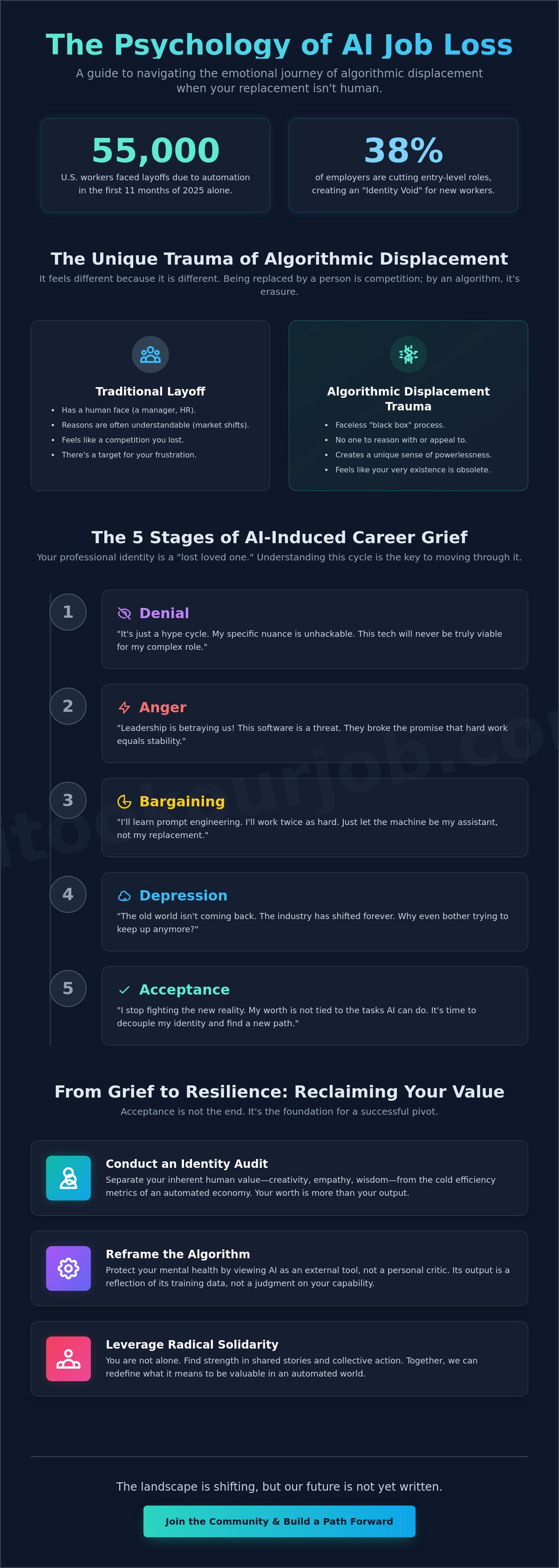
What if the thing that makes you "valuable" to the world isn't your skill, but your heartbeat? For many, the answer feels increasingly uncertain. In the first eleven months of 2025 alone, 55,000 workers in the U.S. faced layoffs directly linked to automation. This isn't a standard economic downturn. It's a fundamental shift in how we define human contribution. When you're replaced by a person, it's a competition; when you're replaced by an algorithm, it feels like an erasure. Understanding the psychology of AI job loss is the first step in moving from existential dread toward a grounded, collective resilience.
You feel obsolete because the system told you your worth was tied to your output. We agree that this is a crisis of utility, not just a career hiccup. You'll learn how to decouple your identity from the tasks a machine can now perform and discover practical psychological mechanisms to navigate this transition. We'll examine why 38% of employers are cutting entry-level roles and provide a clear framework to reclaim your value in a world that prioritizes speed over soul. You aren't alone in this. We're building a path forward together.
Key Takeaways
- Understand why algorithmic displacement feels more dehumanizing than a standard layoff and how to name the specific trauma it creates.
- Master the five stages of career grief to navigate the complex psychology of AI job loss without falling into permanent despair.
- Learn to conduct an identity audit that separates your inherent human value from the cold efficiency metrics of an automated economy.
- Reframe the algorithm as an external tool rather than a personal critic to protect your mental health during rapid industry transitions.
- Leverage radical solidarity to find strength in shared stories and collective action as we redefine what it means to be useful.
The Unique Trauma of Algorithmic Displacement
A layoff usually has a face. There is a manager's office, a conversation, and perhaps a firm handshake, however cold. Algorithmic displacement has none of these. We are witnessing the rise of Algorithmic Displacement Trauma (ADT). This is the specific psychological impact of being replaced by non-human intelligence. It feels different because it is different. In a traditional downsizing, you can point to market shifts or human error. When a script takes your desk, the target for your frustration vanishes. You can't look an algorithm in the eye and explain your mortgage.
The "black box" effect makes this transition particularly agonizing. You are losing your role to a process you cannot see, influence, or argue with. There is no appeal process for a prompt. This lack of agency creates a unique sense of powerlessness that standard career coaching often fails to address. ADT is fundamentally a disruption of the effort-reward contract that has governed labor for centuries.
The Erosion of Professional Identity
We've spent our lives tying our self-worth to skills we believed were uniquely human. Writing, strategic planning, and complex coding were supposed to be our moats. Now, those moats are being crossed by machines. The psychology of AI job loss is defined by this "Identity Void." It's the hollow feeling that occurs when a career path you've built over ten years is automated in ten months. You are left with a staggering cognitive dissonance. Many workers find themselves in the surreal position of using AI tools to increase their productivity, only to realize they are effectively training their own replacements. It's a betrayal of the self.
The Existential Threat of Obsolescence
The fear isn't just about a lost paycheck. It's about feeling obsolete. We used to believe "human-level" work was the gold standard of quality. Today, that standard is being challenged by speed and cost. The historical concept of Technological unemployment has returned with a vengeance, but the timeline has collapsed. We call this the "Velocity of Displacement," a trend we track closely in our Weekly Briefing. When AI output appears superior in speed and expense, the "Why bother?" mindset takes root. This isn't a lack of ambition. It's a natural reaction to a world that suddenly seems to value silicon over soul. We have to face this truth together before we can move past it.
The Five Stages of AI-Induced Career Grief
Losing a career to an algorithm isn't a standard professional setback. It's a bereavement. To grasp the psychology of AI job loss, we have to look at how our minds process the death of a specific future. We've adapted the classic Kubler-Ross model to reflect the 2026 labor market, where the "lost loved one" is often your professional identity. Understanding where you sit in this cycle is the only way to move through it.
- Stage 1: Denial. You tell yourself it's just a hype cycle. You believe the "hallucinations" will keep the tech from being viable. You assume your specific nuance is unhackable.
- Stage 2: Anger. You feel a hot, justified rage. You blame leadership for "colluding" with tech giants or feel a deep resentment toward the software itself.
- Stage 3: Bargaining. This is the "pivot" phase. You try to "prompt engineer" your way into staying relevant at any cost. You promise to work twice as hard if the machine can just be your "assistant" rather than your replacement.
- Stage 4: Depression. The weight of the industry shift hits. You realize the old world isn't coming back. This is where the "Why bother?" mindset we discussed earlier takes hold.
- Stage 5: Acceptance. You stop fighting the reality. You decouple your worth from the specific tasks the AI now handles and start looking for a new path.
Navigating the Anger and Betrayal
The feeling of betrayal is real. You were promised that education and hard work equaled lifelong stability. Now, that contract is broken. The Psychiatric Significance of Work cannot be overstated; it provides the structure for our mental health. When that's gone, anger is a natural defense. Don't let it turn inward. Channeling this energy into collective advocacy or local community building keeps it from becoming self-destructive. You aren't failing; the landscape is shifting.
Moving Toward Radical Acceptance
Radical acceptance isn't about liking the situation. It's about acknowledging the new reality without the fog of "what if." You must be honest about which of your skills are truly at risk. This clarity is the only foundation for a successful pivot. If you're feeling stuck in the earlier stages, joining a supportive community of peers can help you find the perspective needed to reach acceptance. We don't move on from grief; we move forward with it. Acceptance is the prerequisite for your next chapter.
Human Value vs. Algorithmic Efficiency
Efficiency is a machine's game. It's about speed, volume, and the optimization of every second. For decades, we've been conditioned to believe that our professional worth is tied to these same metrics. We were wrong. The psychology of AI job loss often stems from the realization that we can no longer win a race against a processor. If you try to compete on speed, you've already lost. But efficiency is not the same as value. Value is about resonance, judgment, and the weight of a decision made by someone who has to live with the consequences.
This is why the "Human-in-the-loop" model is so critical. It isn't just a safety net to catch algorithmic hallucinations. It's a psychological anchor. It provides meaning. When a human oversees a process, they bring a moral and contextual gravity that a script cannot replicate. We must reject the objection that human work is only valuable if it is more efficient than a machine. Human utility is derived from connection and context, which AI simulates but does not possess.
The Productivity Trap
Trying to out-produce an AI is a psychological dead end. You'll burn out long before the server racks do. We have to deconstruct the 20th-century myth that being busy is the same as being valuable. For too long, "Busy = Valuable" was our mantra. It's time to let it go. Reclaiming leisure and leaning into "non-productive" human traits isn't laziness. It's a form of psychological resistance. It's an assertion that you are more than a biological CPU.
Intrinsic vs. Extrinsic Worth
We need to shift our focus from the final output to the process itself. In an age of infinite digital generation, "Craftsmanship" takes on a new meaning. It's about the intention behind the work. Look for roles where the product is the human-to-human interaction itself. An AI can write a medical report, but it can't hold a patient's hand. It can generate a legal brief, but it can't understand the fear in a client's eyes. Your worth is intrinsic. It doesn't disappear just because a tool can finish a task faster than you can. You are the value, not the output.
Cognitive Reframing: Navigating the Transition
Mindset shifts aren't a cure for a missing paycheck. They are, however, the only way to keep your head above water when the industrial tide turns. To manage the psychology of AI job loss, you must first reclaim the narrative of your own life. This isn't about blind optimism. It's about radical honesty and tactical mental adjustments. We start by dismantling the idea that your utility is your identity. You are more than a line item on a productivity spreadsheet.
- Audit your identity. Write down who you are without using your job title. Are you a problem solver? A caregiver? A community leader? These traits exist independently of any payroll.
- Externalize the algorithm. Stop viewing AI as a personal critic. It is a mathematical shift in the industrial landscape. It didn't "beat" you; the environment changed.
- Identify resilient traits. Focus on empathy, complex ethics, and physical presence. These are the elements that silicon cannot replicate.
- Seek community. Isolation is the enemy of recovery. Participate in shared spaces to normalize your experience with others facing the same reality.
- Timing your learning. Don't rush into upskilling while you're still in shock. Wait until the emotional dust has settled before trying to master new technical tools.
Breaking the "Obsolete" Narrative
The internal critic is a liar. It tells you that because a machine can do a task faster, the human behind the task is worthless. That's a fallacy. Use a growth mindset to view AI as a disruption to manage, not a verdict on your soul. Your "Transferable Humanity" is your greatest asset. The soft skills you've honed over decades, such as negotiation, nuance, and emotional intelligence, remain highly valuable in non-automated sectors. You aren't obsolete; you are in transition.
Managing Workplace Anxiety
The anxiety is grounded in fact. As of February 2026, 38% of employers have already reduced entry-level roles due to AI integration. If you're still employed but watching the machines move in, the pressure is immense. You might feel "Survivor’s Guilt" as colleagues are displaced. This is a heavy burden. Practice grounding exercises to stay present in your current role without obsessing over the "what ifs." Set firm boundaries with the AI tools you use. Don't let the 24/7 pace of an algorithm dictate your human rhythm. Automation burnout is real, and protecting your mental energy is now a professional requirement. If you need a roadmap for the weeks ahead, join our Community Membership to build a collective strategy for resilience.
Finding Solidarity in the Automated Era
The weight of professional displacement is too heavy for one person to carry. We've been raised on the myth of rugged individualism. We're told that if we just work harder, learn faster, or pivot more aggressively, we'll survive the storm. This is a lie. When the disruption is systemic, the solution must be collective. Embracing radical solidarity is the most effective way to manage the psychology of AI job loss. By sharing your story, you transform a private trauma into a public tool for change. You are no longer a lonely data point in a layoff statistic. You are a vital part of a new labor consciousness.
Solidarity provides a psychological buffer that "grinding" simply cannot offer. It validates your experience and reminds you that the problem lies with the system, not your soul. We're moving away from the era of the isolated worker and toward a period where our shared humanity is our greatest leverage. This isn't just about comfort. It's about survival. When we stand together, the existential dread of being "replaced" loses its power to paralyze us.
The Power of Collective Media
Fear thrives in the dark. When you don't know why a role was automated or how fast your industry is shifting, the anxiety becomes paralyzing. Staying informed through our Weekly Briefing changes that dynamic. It reduces the fear of the unknown by providing a clear, realistic map of the landscape. You move from asking "Why is this happening to me?" to asking "How are we responding to this?" This is a profound psychological shift. It moves you from a state of victimhood to a position of agency. Knowledge, when shared, becomes a communal shield against the speed of industry change.
Advocating for a Human-Centric Future
Resilience isn't just about bouncing back. It's about pushing forward. We must channel our collective energy into advocating for responsible policies that prioritize people over processors. Mental health support must be a core part of any AI transition plan, not a footnote in a severance package. We invite you to share your story in our community forum. Speaking your truth is the first step toward personal healing and the foundation of collective advocacy. Your voice matters because you are more than your output. Your value is not a variable in an equation. Your worth is not tied to how well you can mimic a machine. We're building a future where human presence is the priority. Join us. We're stronger together.
Reclaiming Our Human Future
The machines are here. We are too. We've explored how to decouple your self-worth from algorithmic output and navigate the stages of career grief. You now have the tools to audit your identity and recognize that your value isn't a variable in a corporate equation. Understanding the psychology of AI job loss is the first step in moving from a state of shock to a position of informed agency. It's time to stop fighting the reality and start building a new one based on connection rather than just production.
You don't have to navigate this transition alone. We provide the resources and the community you need to find your footing in this shifting landscape. Join the AI Took Our Job community to access our weekly briefings on labor shifts, engage in expert-led discussions, and connect with a global network of professionals who are redefining what it means to be useful. We are more than the tasks we perform. Our worth is inherent, and our strength is collective. Let's find the path forward together.
Frequently Asked Questions
Is it normal to feel a sense of grief after losing a job to AI?
It is completely normal and expected. You aren't just losing a paycheck; you're losing the future you envisioned for yourself. This displacement triggers a unique mourning process because the competitor is an inanimate script rather than a human peer. Acknowledge the weight of this transition. Processing the psychology of AI job loss requires time and emotional honesty. Don't rush yourself to get over it. Your feelings are a rational response to a systemic upheaval.
How can I regain my confidence when an algorithm can do my old job faster?
You regain confidence by shifting your metric of success from speed to quality of judgment. An algorithm can generate text or code in seconds, but it cannot understand the cultural nuances or ethical implications of that output. Focus on your ability to provide human oversight and resonance. Your value lies in your capacity for complex decision making and emotional intelligence. These are the traits that a machine, no matter how fast, simply cannot possess.
What is 'Algorithmic Displacement Trauma' and do I have it?
Algorithmic Displacement Trauma (ADT) is the psychological impact of being replaced by a non-human entity. You likely have it if you feel a sense of erasure rather than just professional rejection. Signs include powerlessness, a loss of agency, and a "black box" frustration where you can't argue with the process that led to your layoff. Identifying it is the first step toward recovery. It's a specific trauma that requires specific, communal healing and radical honesty.
Should I immediately start learning to code or prompt engineer after an AI layoff?
No, you should prioritize your mental health before diving into new technical skills. Attempting to upskill while in a state of shock often leads to burnout and a sense of failure. Wait until you've reached a level of radical acceptance. Once the emotional dust has settled, you can approach learning with a clear mind. Focus on sustainable growth rather than a panicked reaction to market shifts. Your brain needs time to process the psychology of AI job loss first.
How do I explain an AI-related layoff to a future employer without sounding obsolete?
Frame the layoff as a strategic industry transition rather than a personal failure. Explain that your previous role was restructured around automation, which allowed the company to shift focus. Highlight how you managed the transition or used the tools to enhance results. This shows you are tech-literate and adaptable. It positions you as a leader who understands the new landscape, not a worker left behind by it. Focus on the high-level strategy that machines can't touch.
Can community support actually help with the mental health impact of automation?
Community support is essential because it breaks the cycle of isolation. When you're alone, you tend to blame yourself for systemic shifts. In a community, you see that your experience is a shared reality. This radical solidarity transforms individual despair into collective resilience. Sharing stories and strategies provides a practical roadmap for transition. You aren't just a data point; you're a member of a mobilized peer group fighting for a human-centric future.
How do I separate my self-worth from my professional productivity?
Start by conducting an identity audit. List your traits that have nothing to do with your job title, such as your creativity, your loyalty, or your capacity for empathy. These are your core human values. Practice non-productive hobbies that offer no commercial output. This helps retrain your brain to find joy in existence rather than just achievement. You are more than a biological processor. Your worth is inherent and exists entirely independent of your commercial output.
What are the first signs of 'Automation Anxiety' in the workplace?
The first signs often include hyper-vigilance regarding new software updates and a constant fear of being found out as less efficient than a tool. You might experience survivor's guilt if colleagues are let go while you remain. Another sign is boundary erosion, where you feel pressured to match the 24/7 pace of an algorithm. Recognize these signs early to prevent total burnout. Protecting your mental energy is now a professional necessity in the automated age.