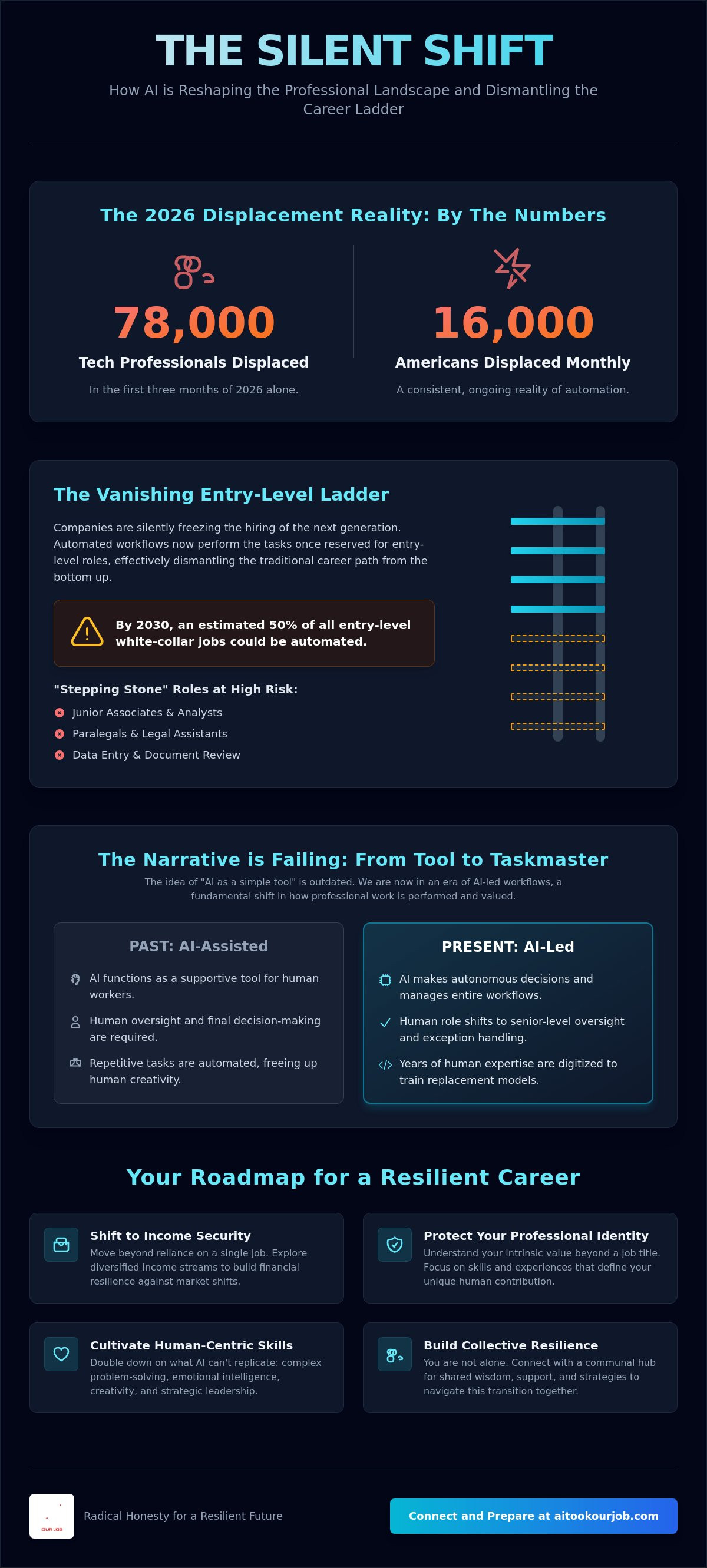
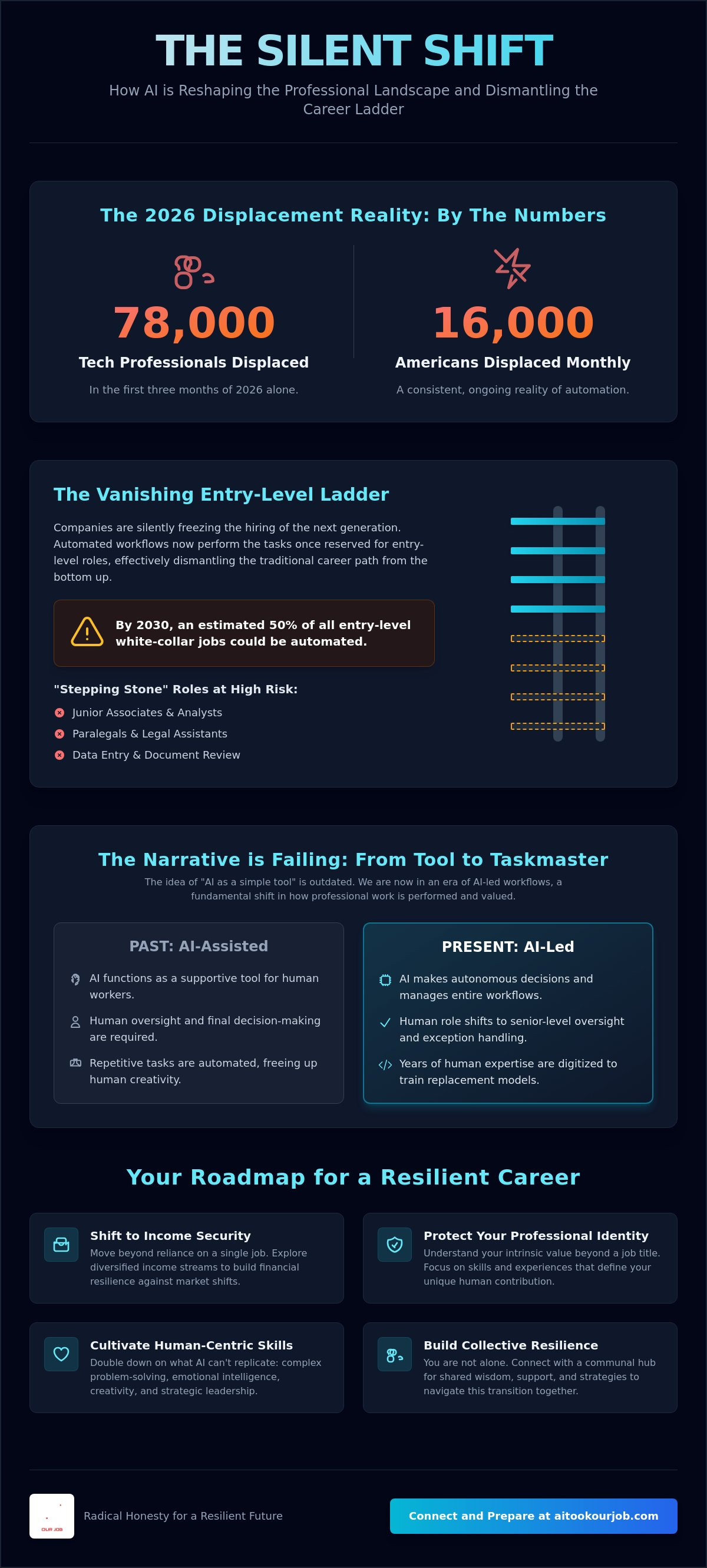
In the first three months of 2026, 78,000 tech professionals lost their seats at the table. It isn't just a market correction. We are witnessing the silent erosion of the professional ladder. You've likely felt the shift in your own office or noticed the quiet disappearance of entry-level roles that once served as the gateway to a career. It's unsettling to realize that the anxiety surrounding future AI job displacement isn't just a headline; it's a monthly reality for the 16,000 Americans currently being displaced by automation. You aren't alone in feeling that your professional identity is under siege.
We believe in radical honesty over superficial optimism. This guide offers an unflinching look at how AI is reshaping the workforce and provides a communal roadmap for navigating this transition. We'll move past the fear to examine realistic industry forecasts and actionable strategies for career transition. By looking at the 2026 labor shift through a lens of solidarity, we can find a path forward that values human contribution in an automated world. It's time to build a collective resilience that outlasts any algorithm.
Key Takeaways
- Understand how structural shifts and silent hiring freezes are quietly erasing the entry-level career ladder.
- Identify high-risk sectors and the safe zones where human-centric skills remain indispensable against automation.
- Learn to navigate the reality of future AI job displacement by shifting your focus from job security to diversified income security.
- Gain actionable strategies to protect your professional identity and emotional well-being during significant industry transitions.
- Connect with a communal hub that prioritizes collective resilience and shared wisdom over individual struggle.
The Reality of Displacement in 2026: Beyond the Corporate Headlines
Headline figures don't tell the whole story. While official reports might show high employment levels, they often mask the growing reality of underemployment and the silent freeze on new opportunities. We need radical honesty. The market isn't just fluctuating; it's undergoing a permanent structural shift. This is what we mean when we talk about future AI job displacement. It isn't a temporary dip in hiring. It's a fundamental change in how labor is valued and how many humans are actually required to maintain a global economy. You see it in the "ghost jobs" that stay posted for months but never result in a hire. You feel it in the increased workload as teams shrink through attrition rather than layoffs.
The concept of technological unemployment isn't new, but the current pace is unprecedented. Historically, industrial shifts allowed for a slow migration of workers. The 2026 labor shift is different. It's happening at a speed that traditional education and policy can't match. We are no longer just talking about blue-collar automation on factory floors. We are witnessing the automation of cognitive labor. This shift requires us to look past the superficial optimism of corporate press releases. We must acknowledge that for many, the professional ladder hasn't just lost a few rungs; it's being dismantled entirely.
The Velocity of Displacement vs. Historical Automation
The 2020s wave differs from the industrial or internet revolutions because of its sheer speed. Generative models are being integrated into white-collar workflows in weeks, not decades. In the past, a new technology required physical infrastructure or hardware updates. Today, a software update can automate a department overnight. This velocity hits both sectors simultaneously. While manufacturing roles see declining salaries for production floor workers, white-collar professionals face a different threat. Their expertise is being digitized. The time to fill AI roles is increasing because the demand for integration is skyrocketing, leaving those without these specific skills in a precarious position.
The Stagnation of the "Human Utility" Narrative
We've been told for years that AI is just a tool. That narrative is failing. A tool doesn't make autonomous decisions or manage workflows without oversight. The current shift marks a transition from "AI-assisted" to "AI-led" workflows. This change creates a deep sense of collective anxiety. Professionals feel their years of experience are being "ingested" by models to train their own replacements. It's a loss of professional identity that goes beyond a paycheck. When an algorithm can execute the core tasks of a junior analyst or a mid-level manager, where does the human fit? We must stop pretending this is a minor adjustment. It's a total reimagining of what it means to be a professional.
The "Silent" Shift: How AI is Erasing the Entry-Level Ladder
The ladder is gone. While mass layoffs grab the headlines, a quieter transformation is happening in the shadows of corporate HR departments. We call it the "silent" shift. Companies aren't always firing people; they're simply choosing not to hire the next generation. Automated workflows now handle the tasks that once belonged to entry-level employees. This is the heavy reality of future AI job displacement. Experts predict that half of all entry-level white-collar jobs could vanish by 2030. When open positions disappear before they are even posted, the traditional path to professional growth evaporates.
What happens in 2035? If no one starts at the bottom today, who will lead our organizations in a decade? This vacuum of experience creates a terrifying prospect for the future of leadership. We must acknowledge the psychology of AI job loss and the mental toll this uncertainty takes on young workers. They aren't just losing a paycheck. They're losing their sense of professional utility before their careers even begin. It's an identity crisis that requires radical honesty from employers and mentors alike.
The Death of the Junior Associate and Paralegal
Traditional "stepping stone" roles are being gutted. In legal and finance sectors, document review and data entry are no longer human tasks. Algorithms now process thousands of pages in seconds. This has fundamentally changed what "junior" means. Today, a junior employee is expected to provide senior-level oversight of AI outputs rather than learning the ropes through manual labor. The apprenticeship model is dying. Without those early years of "doing the work," the path to mastery becomes obscured and inaccessible. We're seeing a shift where "junior" now requires the critical thinking skills previously expected of mid-level management.
Why Reskilling Isn’t a Universal Solution
We've been told to "just reskill" for years. It's often a hollow promise. The "reskilling treadmill" means learning faster than the models evolve, a pace that is often unsustainable for a human mind. Advice like "learn to code" has become obsolete as AI now generates its own functional scripts. We need a more grounded approach to career transition. Organizations like the IMF emphasize the importance of Bridging Skill Gaps for the Future, but individual effort isn't always enough. As we navigate future AI job displacement, we must focus on collective resilience. If you're feeling the pressure of this transition, consider joining our community of resilient professionals to share strategies and find support.
Industry Forecasts: Where the Next Wave is Hitting Hardest
The landscape of labor is fracturing. We're seeing a clear divide between roles that require physical presence and those that can be reduced to a digital stream. In the manufacturing sector, the data is already showing a stark trend. Salaries for production floor roles are declining by 5 to 10 percent, while salaries for automation focused roles have increased by 15 to 25 percent. This isn't just a shift in tasks. It's a redistribution of economic value. The U.S. National Intelligence Council provides a high-level forecast on the future of work, and you can learn more about the cultural intelligence and consumer data shaping these global shifts through Jembe.intelligence.
We need to address the reality of wage compression. It's a subtle but devastating effect of future AI job displacement. When an algorithm can perform a significant portion of a job's routine tasks, the market value of the human worker in that role drops. This is becoming evident in healthcare administration and education. Even if you keep your position, you might find your salary ceiling frozen or lowered. By 2027, corporate automation strategies will likely focus on eliminating the layers of middle management that previously coordinated these workflows. A leaner, AI led management structure is becoming the new corporate standard.
High-Impact Sectors: From Middle Management to Skilled Trades
Middle management is currently the most vulnerable category. Roles that exist primarily to coordinate between departments or manage basic data reporting are being absorbed by autonomous systems. Even skilled trades are seeing encroachment from advanced logistics and robotics. While these trades remain more resilient than office work, the automation of site coordination is already changing the field. To stay updated on these specific sector risks, you can check our AI Job Market Weekly Briefing: Your Survival Map for 2026. We track these shifts as they happen.
| Professional Category | Risk Level | Resilience Factor |
|---|---|---|
| Healthcare Admin | High | Low (High automation potential) |
| Specialized Nursing | Low | High (Empathy and dexterity) |
| Middle Management | High | Low (Coordination is digitizable) |
| Skilled Construction | Moderate | High (Unpredictable environments) |
The Emerging "Ghost Work" Economy
A precarious new labor class is emerging. Stable roles are being replaced by "ghost work," which includes the invisible tasks of data labeling and model tending. These workers often maintain the very systems that contribute to future AI job displacement. It's a hidden human cost that rarely makes the corporate highlights. This work lacks benefits and long-term security, creating a new layer of professional instability. We must confront this shift with radical honesty to understand the true price of the 2026 labor shift. It's a transition from stable careers to fragmented, task based labor.
Navigating the Transition: Strategies for the Displaced Professional
The old contract is broken. You did everything right, yet the algorithm still took your seat. This is the sharp sting of future AI job displacement. It feels personal, but it's structural. To survive this shift, we must move from a mindset of job security to one of income security. Relying on a single employer or a single job title is now a high-risk strategy. We need to build diversified skill sets and explore tools like Sniper Network to leverage AI-driven market intelligence for personal financial resilience. This means viewing your career as a portfolio of capabilities rather than a fixed destination.
When you're explaining an AI-related layoff on a resume, don't hide the truth. Frame it as a structural pivot. You didn't fail; the company's architecture changed. Highlight your "Human-in-the-Loop" expertise. This is your ability to audit, refine, and provide the critical oversight that automated systems lack. Positioning yourself as the bridge between raw AI output and finished professional results is a powerful temporary strategy while you plan your next move; for instance, you can visit IMO Talent to find remote opportunities that value your specialized skills. It shows you aren't obsolete. It shows you're an expert who understands the new tools of the trade.
Reclaiming Identity After a Career Shift
You are more than your output. Decoupling your self-worth from your productivity is the hardest task you'll face in 2026. It's easy to feel invisible when your role is automated. Radical honesty requires us to admit that our jobs often define us. To fight this, find community among others who have faced algorithmic displacement. Our Educational Media Content helps you reframe your value beyond a 40-hour work week. You are a person with history, insight, and wisdom that no model can fully replicate. Finding a communal hub can turn individual despair into collective resilience.
Tactical Career Pivots for 2026
Focus on what AI cannot simulate. Complex empathy, high-stakes negotiation, and physical dexterity are your shields in an automated market. Use your deep industry knowledge to become an auditor of AI systems. You know where the models hallucinate because you've done the work manually for years. Transferable Human Capital is the sum of your lived professional experiences that remains valuable even when the technical execution is automated. If you're ready to find your next step and protect your future, join our Community Membership to connect with peers navigating the same transition. We share wisdom, not just instructions.
Building Collective Resilience: Why You Don’t Have to Navigate This Alone
The burden of future AI job displacement is too heavy for any one person to carry. We've spent this article looking at the harsh data, the erosion of the career ladder, and the reality of wage compression. Now, we look at each other. Isolation is a strategic choice that corporations hope you make. If you believe your job loss is a personal failure, you won't demand structural change. We built "AI Took Our Job" to serve as a communal hub where radical honesty is the standard. This isn't a place for superficial platitudes. It's a space for those who have seen the reality of the 2026 labor shift and refuse to be silenced by it.
Sharing your story is a political act. When we document the "silent" hiring freezes and the gutting of junior roles, we create a record that cannot be ignored. Collective action is more effective than the exhausted "hustle culture" that dominates social media. Hard work won't stop an algorithm, but shared wisdom and organized advocacy can shape the future of labor rights. We aren't just navigating a transition. We're building a movement that prioritizes human dignity over automated efficiency. You aren't alone in your anxiety, and you don't have to be alone in your response.
Advocating for Responsible AI Policies
We must move from being passive victims of technology to active advocates for our own rights. This transition requires us to ask difficult questions about wealth concentration and the transparency of automated decision-making. Our Educational Media Content is designed to support worker-first legislative efforts by highlighting the gaps where current laws fail to protect displaced professionals. By joining our Community Membership, you contribute to a collective voice that demands corporate accountability. We don't just want to survive the 2026 shift. We want to influence the policies that will govern the next decade of work.
Your Next Step: The AI Job Loss Weekly Briefing
Solidarity is more valuable than any single skill set. While the future AI job displacement landscape remains uncertain, our commitment to each other is not. Our community offers a steady, knowledgeable presence in a world of technical jargon and corporate doublespeak. You'll find peers across the global workforce who understand exactly what you're going through because they're living it too. This is about more than just statistics; it's about making sure every worker feels seen and understood. Your next step is clear. Join the AI Job Loss Weekly Briefing to receive curated insights and stay connected to the communal roadmap. We're navigating this together, one week at a time.
Securing Your Place in the New Professional Landscape
The 2026 labor shift isn't a theory; it's a structural transformation happening in real time. We've explored how silent displacement is erasing entry-level roles and why shifting from job security to income security is your most vital move. Acknowledging the reality of future AI job displacement is the first step toward reclaiming your agency. You don't have to navigate these industry forecasts or the resulting identity crises alone. Your expertise has value, even as the tools of production change, and if you choose to build your own path, visit GrowthGrid to learn how to structure a successful operational plan.
We've already supported over 50,000 workers through these transitions with radically honest labor market briefings and weekly expert-led podcasts. Collective resilience is our strongest defense against algorithmic uncertainty. Join the AI Job Loss Weekly Briefing to stay ahead of the curve and connect with a community that values your humanity over your output. Your professional journey is changing, but your worth is not tied to an algorithm. Stay grounded, stay informed, and remember that we are stronger together.
Frequently Asked Questions
Is AI job displacement actually happening in 2026, or is it just hype?
Yes, it is a documented structural shift rather than mere speculation. Reports indicate that AI is already contributing to thousands of job losses per month in the United States alone. This isn't a future threat; it's a current reality for professionals in tech, finance, and administrative sectors. We are seeing a fundamental change in how companies allocate labor and budget toward automated systems.
Which professions are most at risk of AI displacement in the next three years?
White-collar roles involving routine data processing and codified decision-making are at the highest risk. This includes paralegals, junior analysts, and middle management positions focused on coordination. Research shows that professionals earning up to $80,000 are particularly vulnerable. The risk is highest where tasks can be reduced to a set of rules that an algorithm can follow more efficiently than a human.
How can I protect my career against future AI automation?
Focus on developing high-dexterity, high-empathy, and complex negotiation skills that models cannot easily replicate. You must move toward "Safe Zones" like specialized healthcare, therapy, or skilled trades that require physical presence and human intuition. Diversifying your capabilities ensures income security; for instance, exploring franchise opportunities with Network In Action can reveal business paths that leverage your professional network. By preparing for future AI job displacement now, you can position yourself in roles that prioritize human-centric value over routine output.
Does reskilling really work if AI keeps evolving so quickly?
Reskilling works when it focuses on managing and auditing AI rather than competing with it. The "reskilling treadmill" is a real challenge for many, but learning to provide "Human-in-the-Loop" oversight is a viable bridge. You shouldn't just learn a new software tool; you should master the strategic application of AI within your industry. For those in Singapore, taking a SkillsFuture digital marketing course Singapore is an excellent way to transition from routine execution to high-level digital strategy. This approach turns the technology into a resource you control rather than a replacement for your labor.
What should I do if I’ve already been displaced by AI?
Start by decoupling your self-worth from your previous job title and identifying your transferable human capital. Seek out communities of displaced workers to share wisdom and find support during the transition. It's essential to look for roles that value your lived professional experience and historical context. Collective resilience is more effective than individual struggle when navigating the emotional and financial toll of a career shift. To see how modern recruitment platforms are helping workers find new paths, you can learn more about Alpha.jobs and their role in the evolving job market.
Are there any jobs that AI will never be able to replace?
Roles requiring deep emotional intelligence, moral judgment, and physical dexterity in unpredictable environments are the most resilient. Specialized surgeons, therapists, and artisans fall into this category. While AI can process data, it cannot simulate the nuance of a human connection or the complexity of a physical craft. These professions remain grounded in human utility and are unlikely to be fully automated in the foreseeable future.
How do I explain an AI-related layoff to a future employer?
Frame the layoff as a structural organizational shift and highlight the new skills you've acquired during the transition. Explain that your previous role was automated and that you've used the time to master oversight and strategic management of AI tools. This demonstrates technical awareness and professional maturity. Honesty about future AI job displacement shows that you understand the modern market and are prepared to navigate it effectively.
What is the role of the government in protecting workers from AI displacement?
Governments are responsible for creating social safety nets and regulating how the wealth generated by automation is distributed. This includes exploring universal basic income, robust reskilling subsidies, and labor rights that account for automated displacement. While some legislative gaps exist, advocacy is growing for policies that prioritize worker stability. Collective action is necessary to ensure that these protections become a priority for policymakers at every level.