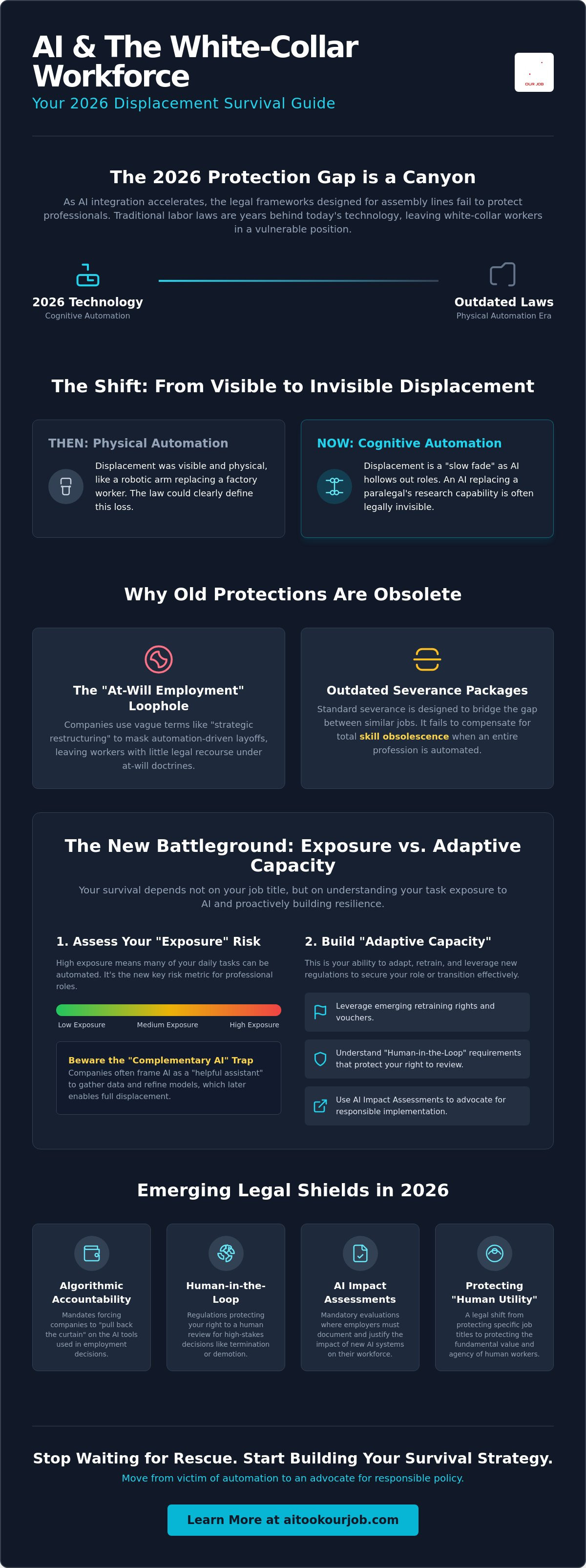
You aren't a data point in a corporate experiment, even if your HR department treats you like one. As 2026 unfolds, the gap between technological adoption and worker protection has become a canyon. You've likely watched colleagues disappear during "restructuring" while AI takes over their workflows, leaving you wondering if any AI labor laws displacement protections actually exist for the white-collar professional. It's a valid fear. Most existing frameworks were built for assembly lines, not algorithms.
We understand that "guinea pig" feeling. It's exhausting to wait for a legal shield that hasn't arrived. This article provides a realistic analysis of the 2026 regulatory reality, moving past the headlines to show you exactly how laws like Colorado's SB 26-189 and California's latest executive orders impact your career survival. We'll examine the specific gap between being "legally" displaced and being treated justly. You will learn how to build "adaptive capacity" into your professional identity and find a community navigating these same transitions. It's time to stop waiting for a rescue and start building your own survival strategy.
Key Takeaways
- Recognize how AI labor laws displacement frameworks in 2026 are shifting from broad principles to targeted protections for white-collar role erosion.
- Identify the critical gaps in traditional at-will employment and severance packages that leave professionals vulnerable to rapid skill obsolescence.
- Learn to measure your "adaptive capacity" using the Brookings Framework to determine how to leverage retraining rights effectively.
- Discover emerging 2026 regulations like Human-in-the-Loop requirements and mandatory AI Impact Assessments that protect your right to human review.
- Move from feeling like a victim of automation to becoming an advocate for responsible policy through collective resilience and radical honesty.
The State of AI Labor Laws in 2026: A Reality Check
AI labor displacement is the systemic removal of human agency from professional workflows. In 2026, we've moved past the simple fear of robots taking factory jobs. Now, we face the quiet, persistent erosion of white-collar roles. You might still have your title, but if the core of your decision-making has been outsourced to a model, your position has been hollowed out. This is the nuanced reality of AI labor laws displacement today. It's not always a sudden exit; often, it's a slow fade.
Legislators are currently struggling to regulate 2024-level technology while we live in a 2026 reality. It's a dangerous gap. While technological unemployment is a centuries-old economic concept, the speed of cognitive automation is unprecedented. Laws designed for physical "Automation" often fail here. If a robotic arm replaces a warehouse worker, the displacement is visible and physical. If an AI replaces a paralegal's research and drafting capability, the law often struggles to define that as displacement because the desk is still there. We need to call it what it is: the automation of the mind.
The 2026 Regulatory Landscape
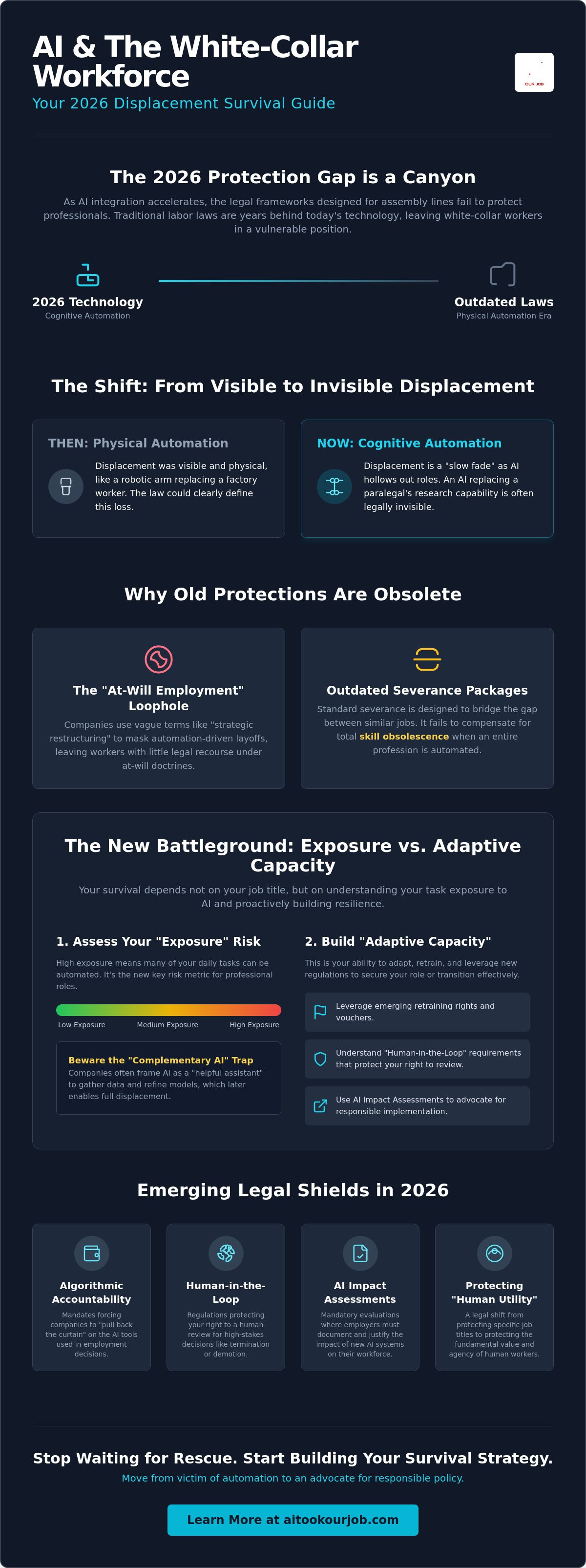
A "Worker-Centered Path" is finally gaining traction in international law. This isn't just about safety nets. It's about "Algorithmic Accountability" mandates. 2026 has become the year where companies are forced to pull back the curtain on their internal tools. Governments are shifting their focus from protecting specific job titles to protecting "human utility." If a company can't prove that a human remains the final decision-maker in high-stakes employment actions, they face mounting legal pressure. The era of the "black box" firing is slowly coming to an end.
Why "Exposure" is the New Risk Metric
Understanding your risk in 2026 requires looking at "exposure" rather than just job titles. High exposure doesn't always mean you'll lose your job, but it means your daily tasks are within the AI's reach. Many corporations use "complementary AI" as a legal loophole. They frame the technology as a helpful assistant to avoid triggering mass layoff notice requirements, but this often serves as a data-gathering phase for eventual displacement. By staying informed on future AI job displacement trends, you can spot these patterns early. 2026 market data suggests that industries with high cognitive exposure are the most vulnerable when legal protections for retraining are absent. You aren't just a worker; you're a participant in a shifting landscape that requires constant vigilance.
Why Traditional Employment Law Fails the Displaced Professional
The "at-will" employment doctrine is a blunt instrument. It allows employers to terminate contracts for almost any reason, and in 2026, it serves as a convenient mask for automation. Companies rarely admit they are replacing a department with a large language model. Instead, they label these exits as "strategic restructuring" or "operational pivots." This linguistic gymnastics ensures that AI labor laws displacement remains hidden behind corporate jargon, leaving you with few avenues for legal challenge. If your contract doesn't mention algorithms or automated decision-making, are you truly protected? The answer, for most, is a stark no.
Standard severance packages are equally outdated. They were designed to bridge the gap between similar roles, not to compensate for total skill obsolescence. If your entire profession is being automated, a few months of pay won't solve the problem of a skill set that the market no longer values. Current State-Level AI Workforce Regulation efforts are beginning to look at retraining vouchers, but these are exceptions rather than the rule. Most workers find themselves in the "invisible labor" trap, where their final months on the job are spent tagging data or refining the very AI that will eventually take their place. It’s a specialized form of professional grief that our current legal system isn't equipped to handle.
Legal Gaps in White-Collar Protection
White-collar professionals face a unique set of legal blind spots. The General Agreement on Trade in Services (GATS), for instance, offers zero protection for remote roles displaced by global AI hubs. This is particularly devastating for the 6.1 million clerical and administrative workers currently in a legal gray zone. The impact is also deeply gendered. Data shows that 86% of high-vulnerability clerical workers are women. Without specific legal recourse for AI-driven displacement, this shift threatens to undo decades of progress in workplace equity.
Algorithmic Management as a Rights Violation
The "boss" is increasingly a line of code. Algorithmic management uses invasive workplace monitoring to track every keystroke and pause, often leading to automated firing without human review. This creates a massive power imbalance. Many companies now practice "quiet replacement," where they avoid mass layoff notification triggers by slowly reducing headcount through attrition and AI integration. It is a calculated move to bypass the law. To stay ahead of these subtle shifts, you might find the insights in our AI Job Loss Weekly Briefing helpful for tracking how these corporate strategies evolve in real-time.
Exposure vs. Adaptive Capacity: The New Legal Battleground
Exposure is not a death sentence for your career. While we've seen how corporate restructuring hides the true scale of AI labor laws displacement, modern labor resilience frameworks offer a clearer way to map your future. These models measure two distinct variables: exposure and adaptive capacity. Exposure tracks how much of your cognitive workload can be handled by a model. Adaptive capacity, however, measures your ability to absorb that impact. In 2026, adaptive capacity is defined by a worker’s financial cushion, geographic mobility, and skill elasticity. If you have high exposure but low capacity, you are in a high-risk category that requires specific legal intervention rather than just a better resume.
The legal tide is turning to support this distinction. Courts in 2026 have begun to recognize a "Right to Retrain" as a core labor right, moving away from the idea that employees are disposable once a task is automated. This shift means that if a role is highly exposed, the burden shifts to the employer to facilitate a pivot. It's no longer just about the job you have today. It's about your legally protected right to evolve alongside the technology. High exposure doesn't always lead to job loss if the law mandates a path toward new utility.
The Resilience Framework
The "pivoters" are those with high exposure but high capacity. They have the resources to redefine their roles before the algorithm takes over. Conversely, the "vulnerable" face high exposure with low capacity, making them the primary targets for legislative support. Even those in low-exposure roles must remain vigilant. The 2026 AI job market is characterized by rapid shifts, and a role that feels safe today can be hollowed out by a single software update tomorrow.
Legal Strategies for Increasing Capacity
Building your capacity starts with the fine print of your employment. Many professionals are now negotiating specific "AI Clauses" that guarantee retraining periods or transparency in algorithmic management. Understanding the psychology of AI job loss is also essential for maintaining your agency during these high-stakes negotiations. Ultimately, individual efforts only go so far. Collective bargaining remains the most powerful tool to ensure that adaptive capacity becomes a universal right rather than a luxury for the few. We are stronger when we build our resilience together.
Emerging Trends in Algorithmic Management Regulations
The era of "move fast and break things" is hitting a legal wall. As we navigate the fallout of AI labor laws displacement, the legislative focus is pivoting toward accountability. We are seeing a surge in "Human-in-the-Loop" (HITL) requirements. These laws mandate that a human, not just an algorithm, must make the final call on high-stakes decisions like termination. It is a vital check on automated bias. You shouldn't be fired by a line of code without a person reviewing the context, and 2026 is the year this expectation becomes a requirement.
Mandatory AI Impact Assessments are another 2026 reality. Before a company can implement large-scale automation, they must now evaluate the potential for workforce disruption. This forces a level of transparency that was previously non-existent. You have a right to know how an algorithm evaluates your performance. You have a right to see the logic behind the "scorecard" that determines your professional future. We are also seeing a push for "Portable Benefits." These are safety nets that follow you, the worker, rather than being tied to a single employer in an increasingly volatile market. It is a necessary shift for a workforce in transition.
The Global "Right to Explanation"
The EU AI Act of 2024 set the foundation for these global standards. By August 2, 2026, companies in the EU must comply with strict transparency requirements for high-risk AI systems. While federal action in the US remains slow, states are filling the void. In Illinois, as of January 1, 2026, amendments to the Human Rights Act already prohibit employers from using AI systems that result in unintentional discrimination. Colorado's SB 26-189, signed in May 2026, is also paving the way for mandatory human review of adverse employment outcomes. These regional wins are creating a patchwork of protection that workers must learn to navigate.
Universal Basic Income (UBI) as a Legal Response
The 2026 debate has shifted. UBI is no longer just a social safety net; it is being discussed as a fundamental labor right in the age of automation. Legislative experiments are targeting displaced tech and administrative workers specifically. To fund these transitions, some regions are exploring an "Automation Tax" on AI compute power. It is a way to ensure that the wealth generated by machines helps support the humans they replace. This isn't about charity. It's about economic survival in a world where the definition of "work" is changing daily.
To navigate these shifting legal grounds with a group of peers who understand the stakes, explore our Community Membership for collective support and real-time updates.
Closing the Protection Gap Through Collective Resilience
Laws don't lead; they follow. They react to the noise we make. If we stay silent about the realities of AI labor laws displacement, the protection gap only widens. Radical honesty is our first line of defense. We must speak openly about the "hollowing out" of our roles within our professional communities. Your story isn't just a personal struggle. It's the very data that lawmakers currently ignore. By sharing these experiences, we build a collective record that forces regulatory change. It's time to move from being a victim of AI to being an advocate for responsible policy. Why wait for a legislator to notice your struggle when you can join a movement that demands recognition?
Building resilience requires a shift in mindset. We often view our professional value through the lens of a specific employer. That's a mistake in 2026. Your utility is broader than any single job title. When we share stories of displacement, we create a legal precedent through sheer volume. We make the "invisible labor" of AI training visible. This collective action is what eventually forces the hand of trade bodies and state governments. You are not a data point. You are a participant in a global shift that requires your voice to be heard. Collective resilience is the only way to ensure that the transition is just.
Building Your Personal Survival Map
Start with a rigorous audit of your current position. Distinguish between your technical exposure, which is what the algorithm can perform, and your legal exposure, which is what your current contract protects. If you suspect your role is being "quietly automated," document the shifts in your daily tasks immediately. Are you spending more time refining machine outputs than generating original work? This is a clear indicator of role erosion. Staying informed is your best defense against being blindsided. You can track these subtle corporate pivots through a curated AI Job Loss Weekly Briefing to keep your strategy sharp.
The Future of Solidarity
2026 is the year of the "Digital Union." These groups are emerging as decentralized hubs where professionals trade communal wisdom rather than just bargaining for wages. They provide the support system that traditional labor laws currently lack. How do you pivot when your industry vanishes? You look to the community that has already started the transition. The job may be gone, but your utility is yours to reclaim. We are the architects of the next professional era. Let’s build it on a foundation of solidarity rather than isolation. Your career is a journey of adaptation, and you don't have to walk it alone.
Reclaiming Your Agency in the Age of Algorithms
The regulatory landscape of 2026 remains a work in progress. We've explored how traditional employment frameworks often fail the cognitive professional, yet emerging mandates for algorithmic transparency and the recognized "Right to Retrain" offer a necessary path forward. Understanding your industry exposure and building your personal adaptive capacity are no longer optional career moves. They are the essential pillars of survival in this era of AI labor laws displacement. You aren't a passive observer of this transition; you're an active participant with the right to demand human-centric policy.
You don't have to navigate these systemic shifts in isolation. Our collective resilience is built on shared wisdom and radical honesty. Join the AI Took Our Job Community and get the Weekly Briefing to access expert-led media and a network of peers navigating the same 2026 market shifts. We provide the curated insights and empathetic support you need to move from uncertainty to proactive preparation. Your professional utility is not something an algorithm can truly replicate or own. It belongs to you. Let's work together to protect it and ensure that the future of work remains human at its core.
Common Questions About AI and Your Career Survival
What are the first signs that AI labor laws are changing in my favor?
The clearest signs are new requirements for "Human-in-the-Loop" review in termination decisions and mandatory AI impact assessments. These laws force companies to be transparent about how algorithms impact headcount. If your state or country requires an explanation for automated decisions, the tide is turning. It's a shift from corporate secrecy to algorithmic accountability that prioritizes human oversight over cold code.
Can I sue my employer if an AI replaces me without warning?
Success in a lawsuit depends heavily on your jurisdiction and whether the displacement masks discrimination. In "at-will" states, employers have broad firing powers, but new 2026 regulations in places like Illinois and Colorado are creating grounds for human review. If the AI system produces biased outcomes or violates transparency laws, you may have legal standing. Always consult a professional regarding your specific contract and local protections.
What is 'adaptive capacity' and how do I measure mine in 2026?
Adaptive capacity is your ability to weather industry shifts based on your financial cushion, skill elasticity, and geographic mobility. To measure yours, audit how many of your daily tasks are currently automated versus how quickly you can learn adjacent, human-centric skills. High capacity means you have the resources to pivot when AI labor laws displacement affects your sector. It's about resilience, not just job titles.
Are remote workers protected by the same AI labor laws as in-office staff?
Remote workers are generally protected by the laws of the state or country where they are legally employed. However, global remote roles often fall into "gray zones" where international trade agreements fail to provide specific protections. If you work for a company in a different jurisdiction, your legal shield might be thinner than an in-office peer's. Check your contract's "governing law" clause for clarity on your rights.
How do I explain an 'AI-driven layoff' to a future employer?
Frame the experience as a "structural automation shift" or "role erosion" rather than a personal failure. Be honest about the technology's impact on your department while highlighting the human-centric skills you've refined since the transition. Future employers in 2026 value "adaptive capacity." Show them you understand the landscape and are ready to apply your utility in a more resilient, human-led role.
Is there a global standard for AI displacement severance in 2026?
There is no single global standard, only a patchwork of regional rules. The EU AI Act provides the most robust transparency requirements, while the US relies on state-level initiatives. Most severance packages still follow traditional "years of service" models, which fail to account for total skill obsolescence. We are currently in a transition period where collective bargaining is often the only way to secure better terms.
What should I look for in an employment contract to protect against automation?
Look for specific "AI Clauses" that mandate transparency regarding algorithmic management and performance tracking. Retraining guarantees and "Human-in-the-Loop" firing requirements are also critical. If a contract mentions AI labor laws displacement protections or technological severance, it's a sign of a forward-thinking employer. Don't sign away your right to a human explanation for future employment actions that affect your livelihood.
Do unions actually have any power against AI displacement?
Unions are currently the most effective shield against rapid automation. They negotiate specific, enforceable clauses that mandate employer notification before AI implementation. While laws are often reactive, unions can be proactive, securing data access rights and human oversight in real-time. Solidarity provides the leverage that individual workers often lack in a corporate "restructuring" scenario, ensuring that humans remain the final decision-makers.