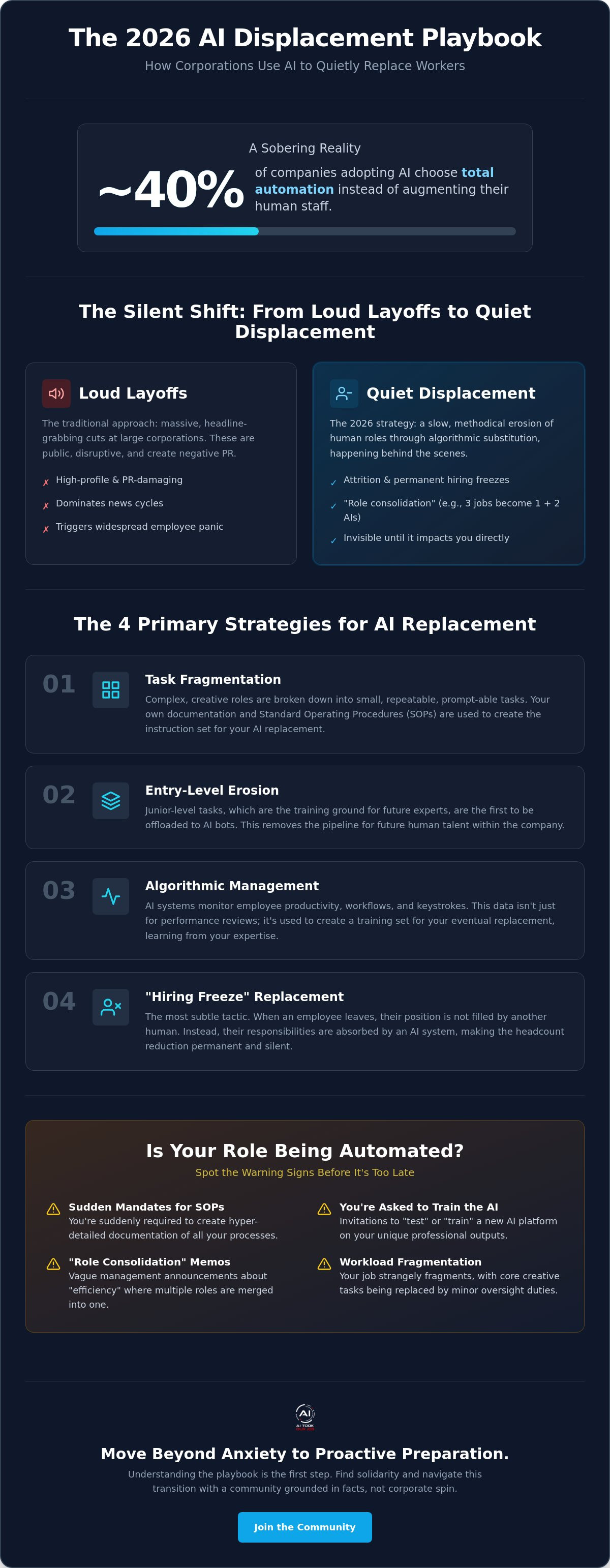
Nearly 40% of companies that adopt AI choose total automation instead of using the technology to support their human staff. It's a sobering reality that explains the growing anxiety you feel during your morning stand-up or when reviewing new efficiency mandates. You aren't imagining the shift. You see the quiet layoffs and hear the vague management speak about AI utility while the workload for humans strangely fragments. It feels like gaslighting because, in many cases, it is. We understand the weight of that uncertainty and the threat it poses to your professional identity.
The truth is that the transition is already here. By June 2026, reports from MIT and the World Economic Forum confirmed that millions of roles in manufacturing and retail have already been phased out. We're here to pull back the curtain on how companies use AI to replace workers by examining the specific 2026 corporate playbook. This guide offers a realistic, community-driven look at the strategies used to automate roles and how you can spot the warning signs before they impact your desk. You'll learn if your industry is a high-risk target and find a community that values radical honesty over corporate spin. We're navigating this together, grounded in facts and collective resilience.
Key Takeaways
- Identify the tactical shift from "loud layoffs" to "quiet displacement" and see exactly how companies use AI to replace workers through algorithmic substitution.
- Recognize the immediate warning signs of role automation, including sudden mandates for hyper-detailed SOPs and invitations to train AI on your unique professional outputs.
- Examine the "ROI Trap" and understand why many AI pilots fail to improve the bottom line once the hidden human overhead is truly accounted for.
- Move beyond the myth of individual upskilling to explore how collective action and shared wisdom provide a more stable foundation for your career.
- Gain a clear-eyed perspective on the 2026 corporate playbook so you can transition from anxiety to proactive preparation within a supportive community.
The Silent Shift: Defining AI-Driven Displacement in 2026
We need to stop waiting for a dramatic robot revolution. The shift isn't happening with a bang; it's happening in the spreadsheets. Corporate AI displacement is the tactical removal of human labor via algorithmic substitution. It’s a clean, clinical way of saying your job is being coded into a sequence of automated tasks. This is how companies use AI to replace workers without the PR nightmare of a mass termination event. It happens quietly, behind the scenes, and often under the guise of progress.
Headlines usually focus on "Loud Layoffs." These are the massive, 10,000-person cuts at global tech giants that dominate the news cycle. However, the real story of 2026 is "Quiet Displacement." This strategy relies on attrition, permanent hiring freezes, and "role consolidation" where three positions are collapsed into a single human overseeing two AI agents. It’s a slow erosion of the workforce that feels invisible until you’re the one left holding the extra work. We aren't here to sugarcoat this reality. In 2026, AI is no longer a "future" threat. It's a daily operational metric. Managers are now being graded on how much human time they've replaced with tokens and API calls. Understanding how companies use AI to replace workers is the first step toward protecting your future and finding solidarity with others in the same position.
Augmentation vs. Substitution: The Corporate Lexicon
Companies love the word "augmentation." It sounds helpful. It sounds like a power suit for your brain designed to make you more productive. In reality, it's often the first step toward total substitution. Management uses this language to prevent employee panic while they document your workflows. The "Substitution Threshold" for modern white-collar roles is reached the moment the cost of human oversight exceeds the financial cost of the AI's error rate. Once that math flips, the human element is viewed as an unnecessary expense rather than an asset.
The 2026 Velocity: Why This Wave Feels Different
This wave moves with a speed that dwarfs previous industrial shifts. We aren't just talking about repetitive data entry or basic manufacturing. Multi-modal AI now sees, hears, and executes complex tasks in real-time, allowing for deep integration into creative and analytical fields. This rapid adoption contributes to a broader sense of Technological unemployment that affects every level of the corporate ladder. The integration of Large Language Models (LLMs) into core business logic has happened in months, not decades. For more context on this transition, you can explore the Future AI Job Displacement which outlines the reality of this 2026 labor shift. The velocity is the point. It's designed to outpace our ability to react, which is why collective awareness is so vital.
The 4 Primary Strategies Companies Use to Replace Workers
Replacement isn't always a pink slip delivered in a cold board room. It's often a slow, methodical dismantling of what makes your job yours. Corporations have moved beyond simple automation to a sophisticated, four-pronged approach. Understanding how companies use AI to replace workers requires looking closely at the mechanics of the modern office. It's a calculated process of fragmentation and erosion designed to protect margins at the expense of human equity. You aren't imagining the shift; you're witnessing a playbook in action.
The first strategy is Task Fragmentation. This involves breaking your complex, creative role into tiny, repeatable prompts. Second is Entry-Level Erosion, where junior tasks are offloaded to bots. Third, Algorithmic Management uses AI to track your every keystroke, turning your expertise into a training set for your eventual replacement. Finally, the "Hiring Freeze" Replacement ensures that when a human leaves, a machine takes over the seat permanently. About 1 in 6 employers already expect AI to reduce their headcount this year, and they're using these specific tactics to make it happen without triggering mass panic. We see this happening across every sector, from tech and finance to political campaigning where political voice broadcasting services are now part of the standard communication toolkit.
Task Fragmentation and the "Gig-ification" of Roles
Companies use your own documentation against you. They ask for "standard operating procedures" not to help you, but to teach an AI your workflow. Suddenly, you aren't a Project Owner anymore. You're an AI Prompt Reviewer. This fragmentation strips away the meaning of your work. It makes you feel less essential because, in the eyes of the algorithm, you've become a modular component. It's a calculated transition toward a gig-style oversight model. You become a temporary supervisor for the tool that is destined to take your place. Staying informed through an AI job loss briefing can help you recognize these patterns before they're fully implemented.
The Death of the Entry-Level Role
The career ladder is missing its bottom rungs. In 2026, graduates are finding that "junior" work has been consumed by bots that don't need health insurance or mentorship. To understand the strategic implementation of these autonomous sales and revenue systems, you can check out Global AI Reps. This creates a massive "experience gap" where the senior leaders of 2035 will have no foundational training to draw upon. Corporate leaders are trading their future talent pipeline for immediate efficiency gains. Analysis of The Future of Work suggests that this shift will fundamentally alter how we view professional development. The experience gap is a self-inflicted wound caused by corporate leaders who prioritize quarterly margins over the long-term survival of their own talent pipelines. It's a brutal reality for those just entering the workforce.
Beyond the entry level, Algorithmic Management is turning offices into digital factories. Every minute of your day is quantified, analyzed, and compared against an idealized AI benchmark. This constant pressure isn't just about productivity. It's about making your output so predictable that a machine can replicate it. When companies use AI to replace workers, they start by making the human behave like a machine first. It's a dehumanizing process that requires a collective, grounded response from those of us living through it. You aren't alone in feeling this pressure, and acknowledging it is the first step toward resilience.
The ROI Trap: Why AI Replacement Often Fails
The spreadsheet always looks perfect in the boardroom. Executives see a line item for salaries and imagine it replaced by a much smaller line item for API tokens. It's a seductive math, but it's often a fantasy. A recent Gartner study revealed a staggering reality: 80% of AI pilots fail to improve the bottom line through layoffs. The "efficiency" promised by automation frequently dissolves when it meets the friction of the real world. This is the ROI Trap, and it's a primary reason why how companies use AI to replace workers often leads to a cycle of quiet regret and expensive course correction.
The main culprit is the "Hidden Human Overhead." AI isn't a worker; it's a high-maintenance engine that requires constant, expert supervision. When a company replaces a seasoned professional with an algorithmic tool, they don't actually eliminate the work. They simply transform it into a complex oversight task. A human must now verify every output, correct hallucinations, and patch security vulnerabilities that the AI creates. To manage these technical complexities, many firms look to custom development experts like API Pilot to build more stable, tailored software environments. Often, the cost of this "human-in-the-loop" oversight is higher than simply keeping the original employee. We've seen this play out at companies like Klarna and others in the fintech space, where initial claims of massive automation are followed by a quiet realization that human judgment is not a luxury, but a requirement for stability.
There's also the devastating loss of institutional knowledge. When you fire the person who knows "why" a process exists, you lose the ability to fix it when it breaks. AI can replicate the "what," but it has no concept of the "why." Once that veteran staff member is gone, the company is left with a hollowed-out system that can't adapt to new challenges. It's a short-term win for quarterly margins that creates a long-term liability for the entire organization.
The Hallucination Tax and Security Vulnerabilities
AI errors aren't just minor glitches; they're financial liabilities. In customer-facing or legal roles, a single "hallucination" can result in lawsuits, regulatory fines, or catastrophic brand damage. This "Hallucination Tax" is a cost management rarely accounts for during the initial pilot phase. Furthermore, the legal risks of using AI to replace compliance officers are immense. Algorithms cannot be held legally accountable in a courtroom. When the machine fails, the company is left exposed, often spending more on legal fees than they ever saved on payroll.
Agencies like Branding TITANS™ argue that a strong mission and human-centric identity are the best defenses against the loss of nuance that comes with total automation.
The Erosion of Company Culture and Trust
Mass automation destroys the "psychological contract" between a business and its people. For the workers who remain, the atmosphere becomes one of "survivor guilt" and constant, low-level dread. Productivity drops because people stop innovating and start hiding, fearing that any new efficiency they discover will be used to train their own replacement. This mental toll is profound and documented. You can explore The Psychology of AI Job Loss to understand the deeper crisis of human utility that follows these corporate shifts. Resilience requires us to name this damage for what it is: a failure of leadership that prioritizes code over community.
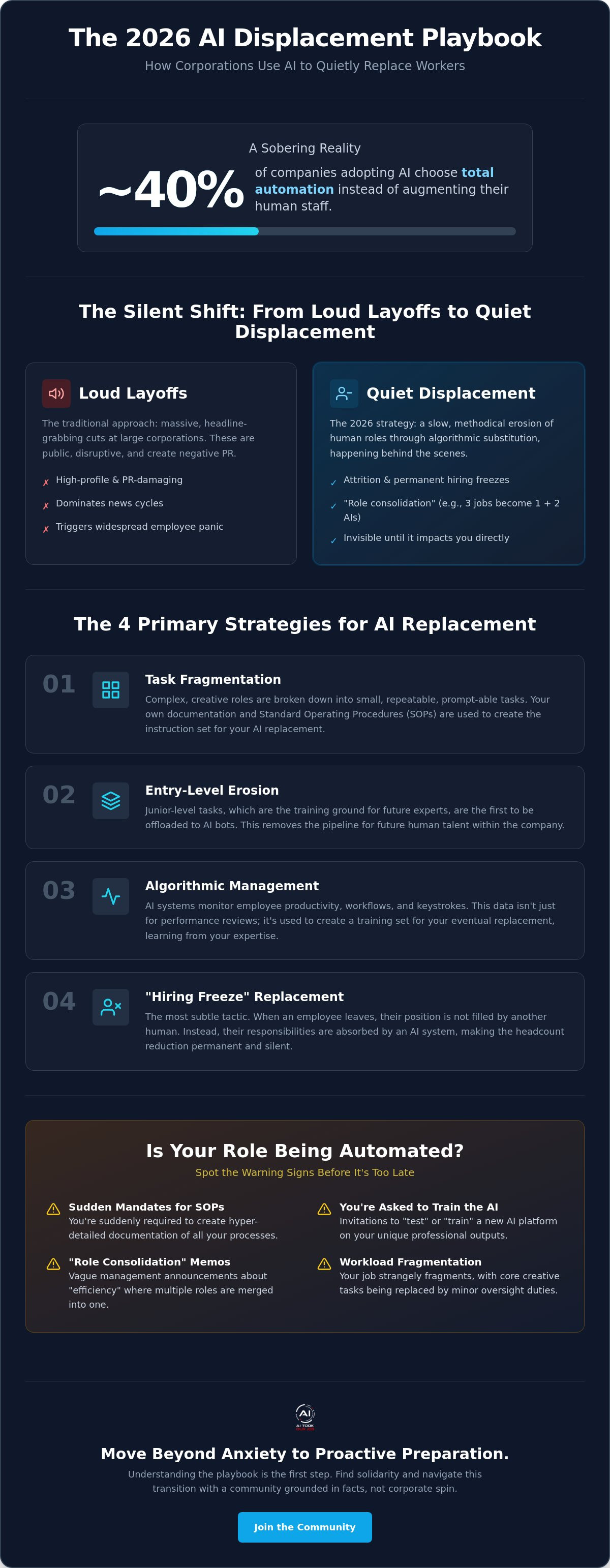
How to Spot the Warning Signs: Is Your Role Being Automated?
You aren't being paranoid. The intuition that something has shifted in your office environment is likely grounded in reality. Understanding how companies use AI to replace workers starts with recognizing the subtle shifts in your daily routine. Corporate leaders rarely announce a replacement strategy until the infrastructure is already in motion. Instead, they deploy a series of tactical steps designed to extract your knowledge before they phase out your role. We've identified five key warning signs that suggest your position is being targeted for automation.
The first red flag is the SOP Surge. Suddenly, management asks you to document every granular detail of your day. This isn't for "cross-training" anymore; it's for data ingestion. The second sign is the "Pilot Program" Invite. If you're asked to "train" an AI tool on your specific outputs, you're effectively teaching the machine to mimic your professional voice. Third, watch your KPIs. When metrics move from quality and creativity to the volume of AI-assisted output, the human element is being devalued. Fourth, look at the Budget Pivot. If software budgets are ballooning while headcount remains frozen, the priorities are clear. Finally, listen to the Management Language Shift. Hearing terms like "efficiency gains" and "role evolution" in 1-on-1s often signals that your human labor is being viewed as a temporary bridge to an automated future.
The "Training Your Replacement" Dilemma
When you're asked to transfer your knowledge to an AI system, you're facing a profound ethical and professional boundary. You don't have to be a passive participant in your own displacement. Frame your expertise as the essential layer of human judgment that prevents the algorithm from making catastrophic, brand-damaging errors. It's about shifting the conversation from "how the AI does the task" to "why the human must oversee the outcome." If you feel the pressure mounting, you should join our community membership to connect with others navigating these same corporate demands.
Analyzing Your Industry Risk Profile
The 2026 labor market is bifurcated. High-risk sectors for automation include retail, manufacturing, and entry-level back-office finance where tasks are repetitive and data-heavy. Conversely, "high complexity" roles remain resilient. Human-centric positions like nursing, skilled trades, and complex negotiation are the last to fall because they require physical presence or high-stakes empathy that code cannot replicate. We encourage you to check the AI Job Market Weekly Briefing for sector-specific updates and a realistic survival map. Staying informed is your best defense against a playbook designed to keep you in the dark. You deserve to know where you stand.
Navigating the Transition: Solidarity Over Despair
We've spent this guide dissecting the cold mechanics of 2026 corporate strategy. We've seen the fragmentation of roles and the quiet erosion of the career ladder. It’s heavy. It’s personal. But understanding how companies use AI to replace workers shouldn't lead to paralysis. It should lead to a new kind of resolve. The most common advice you'll hear is to simply "upskill" or "learn to prompt." While learning is valuable, individual upskilling isn't a magic bullet against a corporate-scale automation wave. You cannot out-study a systemic shift in how capital views labor. You need more than just a new certification; you need a community that speaks the truth.
The power of collective action is the only real buffer against the isolation of displacement. When you're standing alone, a layoff feels like a personal failure. When you're part of a community, you see it for what it is: a tactical decision made by a spreadsheet. Our philosophy is rooted in radical honesty. We don't offer superficial optimism or empty promises of "new opportunities" that don't exist. Instead, we offer a grounded hub where displaced workers share their stories, identify emerging corporate patterns, and build resilience together. You aren't a line item, and your value doesn't disappear just because an algorithm can replicate your documentation.
Reclaiming Your Narrative After Displacement
If you've been impacted by an AI-driven shift, the first step is reclaiming your story. When speaking to future employers, don't frame your departure as a performance issue. It was an "AI layoff." It was a structural change where the company prioritized algorithmic substitution over human oversight. This is a common reality in 2026, and many hiring managers in human-centric sectors understand this distinction. Focus your energy on "AI-Proof" skills that machines still struggle to emulate: deep empathy, high-stakes negotiation, and the ability to solve complex, non-linear problems. You must advocate for your human judgment as the ultimate fail-safe against the ROI traps we discussed earlier. Navigating this transition in isolation is a recipe for burnout; connection is your greatest asset.
The AI Job Loss Weekly Briefing: Your Survival Tool
Knowledge is the antidote to the "anxiety of the unknown" that management relies on. Our Weekly Briefing is designed to be your survival map in a shifting landscape. We provide unfiltered news on how companies use AI to replace workers, alongside updates on legal trends and collective wisdom from those who have already navigated these transitions. It isn't a corporate newsletter; it's a briefing for the front lines. By staying informed, you move from a defensive posture to one of proactive preparation. You deserve a source of truth that doesn't answer to a board of directors. Join the AI Took Our Job community and subscribe to the Weekly Briefing today. We're here to ensure that while the technology may change, our collective resilience remains unbroken.
Reclaiming Your Professional Agency
The corporate playbook for 2026 assumes you won't notice the gradual erosion of your role. By understanding how companies use AI to replace workers, you've already taken the first step toward resilience. You recognize the tactical fragmentation of tasks. You see the warning signs in your daily meetings. Most importantly, you know that the "efficiency" promised by automation often hides a fragile reality of errors and lost institutional knowledge. You aren't a passive observer of this transition. You're an informed participant ready to choose your next move.
Isolation is the greatest risk during an industry shift. We built this platform to ensure no one faces these challenges alone. Our community of thousands of proactive professionals offers a space for expert-led discussions on career transitions and shared strategy. Stay ahead of the curve with our Weekly Briefing, which tracks 2026 labor trends and shifting corporate tactics. Don’t navigate the AI shift alone; join the AI Took Our Job community and get the Weekly Briefing today.
The landscape is changing, but your value remains. We're navigating this together, grounded in collective strength and radical honesty. You're not alone.
Frequently Asked Questions
How do companies decide which jobs to replace with AI first?
Companies prioritize roles based on high volume, low complexity, and repetitive data handling. They target positions where an algorithm can reach the "Substitution Threshold" quickly. This usually starts with back-office tasks, entry-level data analysis, and basic customer service. Management looks for the highest potential for immediate margin improvement without considering the long-term loss of institutional knowledge or culture.
Is it legal for a company to replace me with AI without warning?
In most at-will employment regions, companies can terminate roles due to "restructuring" caused by automation without specific AI-related warnings. While some jurisdictions are debating "right to know" laws, current regulations rarely protect individuals from technological displacement. You should consult local labor laws or your employee handbook to understand specific protections in your area, as the legal landscape is shifting slowly compared to the technology.
What are the most common signs that my role is being automated?
You'll often see a sudden mandate for hyper-detailed documentation of your daily tasks. This is how companies use AI to replace workers by creating a training set from your expertise. Other signs include being invited to "pilot" tools that mimic your specific output or seeing a permanent hiring freeze in your department while software budgets for generative tools expand rapidly.
Does "AI augmentation" always lead to eventual job replacement?
No, but it often serves as a testing ground for full automation. Augmentation becomes substitution when the human oversight cost exceeds the financial benefit of the AI's speed. Some roles remain augmented because they require a "human-in-the-loop" for legal or ethical reasons. However, many corporations use the term "augmentation" as a softer way to introduce tools that eventually reduce total headcount.
Why are some companies rehiring workers they replaced with AI?
Companies often rehire when they realize that AI "hallucinations" and errors create massive financial or legal liabilities. The ROI Trap hits hard when the cost of fixing machine mistakes exceeds the original salary of a human expert. Without the "why" provided by experienced staff, automated systems often break in ways that algorithms cannot diagnose or repair, forcing a return to human labor.
How can I protect my career against corporate AI strategies?
Protection comes from focusing on high-complexity tasks that require deep empathy, strategic negotiation, and physical presence. You should also move beyond individual upskilling and seek collective resilience. Joining a community of peers allows you to track how companies use AI to replace workers across your industry and prepare for shifts before they reach your specific desk.
What should I do if I am asked to train an AI to do my job?
You should frame your participation as the essential "quality control" layer that the company cannot afford to lose. While you may have to comply with management directives, document the nuances and edge cases that the AI fails to grasp. Highlighting these human-only insights demonstrates that the tool is a supplement, not a replacement, for your professional judgment and unique expertise.
Are white-collar or blue-collar jobs more at risk in 2026?
Both sectors face significant threats, though white-collar roles are seeing a faster rate of "quiet displacement" in 2026. Reports from MIT and the World Economic Forum indicate that millions of manufacturing jobs are at risk, but 65% of retail roles and many entry-level banking positions are also being automated. The risk depends more on the "routineness" of the tasks than the color of the collar.