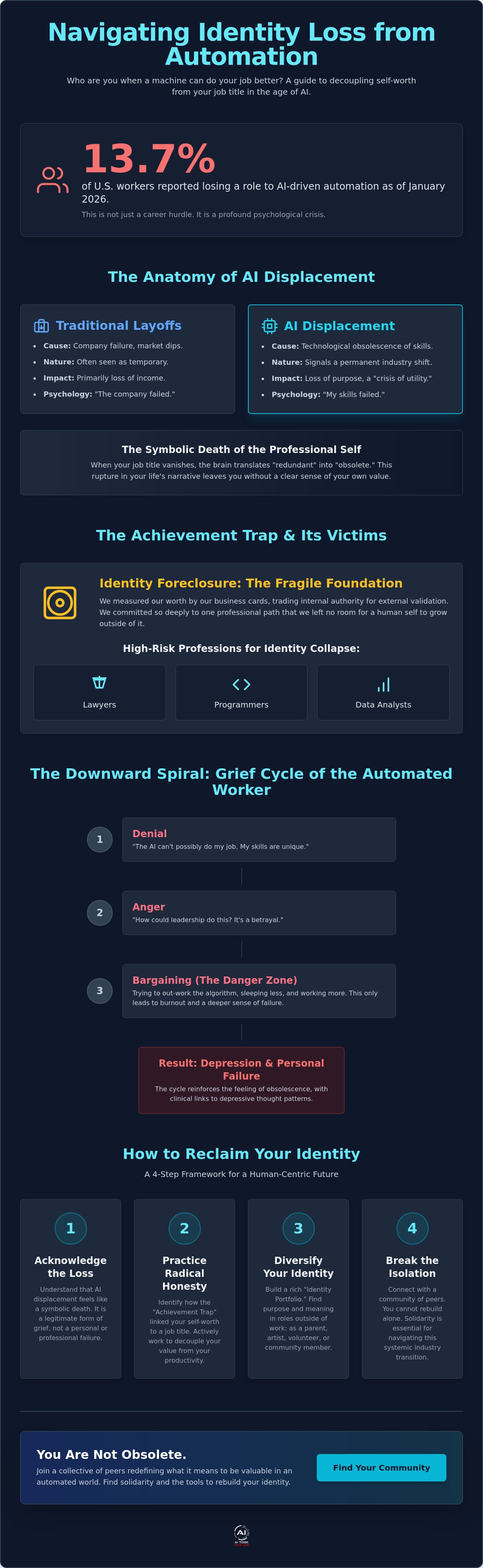
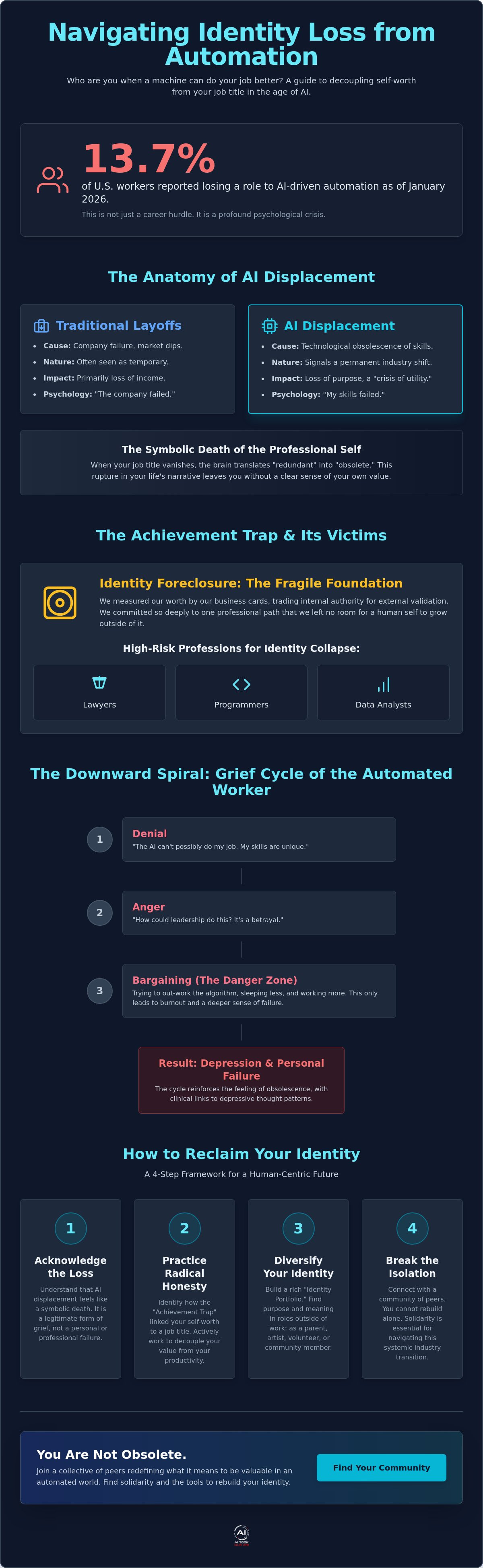
Who are you when a machine can do your job better than you can? It is the question haunting millions of professionals in 2026. Your title was your shorthand. Now, it is gone. As of January, 13.7% of U.S. workers reported losing a role to AI-driven automation. This isn't just a career hurdle. It is a profound psychological crisis. We call it identity loss from automation. It feels like a symbolic death because society conditioned us to believe our work was our worth. The feeling of obsolescence is real, and the anxiety about your future relevance is justified.
You aren't failing. You are grieving. It is exhausting to wake up without the daily structure or the social status your old office once provided. We understand the weight of this transition because we are navigating it together. This guide will show you how to decouple your self-worth from your job title and find meaning beyond your productivity. We will explore a structured way to process this loss, practical steps to rebuild your daily life, and how to join a collective of peers who are redefining what it means to be valuable in an automated world.
Key Takeaways
- Understand why AI displacement feels like a symbolic death and how to begin the transition toward a human-centric identity.
- Identify the "Achievement Trap" that links your self-worth to professional titles, especially in high-risk sectors like law or programming.
- Apply a 4-step recovery framework to navigate the profound psychological shift of identity loss from automation with radical honesty.
- Diversify your "Identity Portfolio" by finding purpose in roles that exist entirely outside the sphere of labor and productivity.
- Break the isolation spiral by connecting with a community of peers who understand the reality of this industry transition.
What is Identity Loss from Automation?
Identity loss from automation is more than just a gap in your resume. It is a psychological rupture occurring when a machine's speed or accuracy renders your hard-won expertise redundant. In 2026, this isn't a distant theory. It is a lived reality for millions. While traditional layoffs usually signal a company's failure or a temporary market dip, AI displacement signals something more permanent. It suggests that the very skills you built your life around are no longer unique to humans. This creates a "crisis of utility" that goes far beyond the need for a paycheck.
To understand the depth of this shift, we must look at What is Technological Unemployment? and how it differs from the current crisis. Economic displacement is about the loss of income. Identity loss is about the loss of a reason to wake up. When a bot takes over your workflow, it doesn't just take your desk. It takes the narrative that you are a necessary part of the world's machinery. It feels like a personal invalidation because we have been told for generations that our labor is our legacy.
The Symbolic Death of the Professional Self
For decades, we have used professional competence as the primary foundation for the modern ego. We aren't just people who happen to practice law or write code. We are lawyers and programmers. When the reality sets in that a bot does it faster and more accurately, the human brain often translates "redundant" into "obsolete." This is a heavy burden to carry alone. We define identity loss from automation as a profound rupture in the narrative of one’s life-work that leaves the individual without a clear sense of their own value. It is an internal invalidation that feels personal, even though the cause is systemic.
The 2026 Context: Total vs. Partial Automation
The velocity of change in 2026 is unprecedented. In previous eras, workers had years to pivot. Today, that window has shrunk to months. Many professionals find themselves in the agonizing position of "shadowing" the very AI models that will eventually replace them. You are essentially training your own successor, one prompt at a time. This creates a unique psychological toll that traditional career coaching isn't equipped to handle. You can read more about the specific scale of these changes in our report on Future AI Job Displacement: The Reality of the 2026 Labor Shift. This isn't just about losing a job. It's about losing the time we used to have to figure out who we are without one.
The Conventional Identity Under Siege
The Achievement Trap is a subtle poison. For years, we measured our worth by the weight of our business cards and the height of our social standing. We believed that being "useful" to a corporation was the same as being "valuable" as a person. This Productivity Myth is now collapsing. In 2026, the high-status roles we once envied, like lawyers, programmers, and data analysts, are at the highest risk of identity collapse. Research helps us understand who is most at risk from automation, highlighting that specialized cognitive roles are now more vulnerable than many manual trades. When these roles vanish, the identity loss from automation feels like a social exile. Your social circle, often built around your career, might not know how to relate to you anymore. You don't just lose a paycheck; you lose your seat at the table.
Why Your Job Title is a Fragile Foundation
We have traded internal authority for external validation. We let HR departments and LinkedIn algorithms tell us who we are. This is "Identity Foreclosure." We committed to one path so deeply that we didn't leave room for a human self to grow outside of it. If you are not a Senior Designer or a Project Manager, who is left standing? It's a terrifying question. Staying informed through our AI Job Loss Weekly Briefing can help you see these shifts coming before they become personal crises. We must stop asking what we do and start asking who we are when the doing stops.
The Grief Cycle of the Automated Worker
Displacement isn't just a logistical problem. It's an emotional one. We see the Kubler-Ross stages play out in real-time. First, there's denial that the AI can actually do the job. Then, anger at the leadership. The most dangerous stage is bargaining. You try to out-work the algorithm. You sleep less and work more, hoping to prove your "human edge." It doesn't work. It only leads to burnout. This cycle often leads to a deep sense of personal failure. There is a documented clinical link between the feeling of obsolescence and persistent depressive thought patterns. Acceptance is the only way forward, but it requires a total re-evaluation of what makes you "you." You are more than your output. You are more than a line item on a spreadsheet. Reclaiming that truth is the first step toward resilience.
Decoupling Your Self-Worth from Your Productivity
Efficiency is a machine's metric. For too long, we have adopted it as our own. We grew comfortable defining ourselves by how much we could produce in an eight-hour window. This is the core of identity loss from automation. When the machine produces more, faster, and cheaper, the person left behind feels worthless. But your value was never actually tied to your output. It was tied to your humanity. We must learn to separate what we produce from who we are. This isn't just a feel-good sentiment. It is a survival strategy for the 2026 labor market.
Rebuilding after identity loss from automation starts with recognizing that your worth is not a variable in an equation. It's a constant. You don't need to "earn" your right to exist through a daily quota. You carry value simply because you are here. This shift is difficult because our culture has spent a century telling us the opposite. We were told that to be idle was to be invisible. In reality, being idle is often where our most human traits begin to resurface.
Achievement-Based vs. Human-Centric Identity
The shift requires moving from an achievement-based identity to a human-centric one. Achievement-based identity relies on external markers like titles, salary tiers, and manager approval. These are hierarchies that machines can easily replicate or disrupt. Human-centric identity focuses on internal values such as integrity, empathy, and presence. While a bot can simulate a legal brief, it cannot offer genuine empathy to a grieving neighbor. It cannot make ethical choices based on shared community history. The NIH has documented how this transition triggers psychological and existential distress when workers cannot find a new foundation for their self-worth. For more on this, explore The Psychology of AI Job Loss: Navigating the Crisis of Human Utility.
- Achievement-Based: Relies on external validation, KPIs, and social status. It is fragile and market-dependent.
- Human-Centric: Relies on internal character, communal ties, and presence. It is resilient and inherently human.
Reclaiming the "Post-Conventional" Self
The "Post-Conventional" identity is a state where your authority comes from within. You don't need a performance review to tell you that you matter. This crisis is an invitation. It is a forced evolution away from the corporate ego. To get there, you must embrace "unproductive" time. Sit. Walk. Talk to friends without checking your notifications. These moments aren't wasted. They are essential for identity recovery because they remind you that you exist outside of a workflow. You are finding authority in your own values rather than a manager’s feedback. It is a slow process, but it is the only way to build a foundation that no algorithm can touch.
How to Reclaim Your Identity: A 4-Step Recovery Framework
Awareness is the first step, but action is what builds a new foundation. Reclaiming your life after identity loss from automation requires a deliberate, structured approach. It isn't about finding a new job immediately. It's about finding yourself. We have developed a framework to help you move through the wreckage of a displaced career and into a more resilient state of being. This process focuses on internal narrative, social diversification, and collective power.
- Step 1: The Narrative Audit. You must rewrite your story. The AI shift is a chapter in your life, not the final page. You didn't fail. The system shifted.
- Step 2: Diversifying Your "Identity Portfolio." Don't put all your emotional eggs in one basket. Invest in roles that have zero market value, such as being a dedicated neighbor, a local advocate, or a parent.
- Step 3: Radical Honesty. Acknowledge that this is systemic. By Jan 2026, 13.7% of U.S. workers had already reported losing a role to automation. This data removes the sting of personal shame.
- Step 4: Communal Reintegration. Stop hiding. Find solidarity with the "Displaced Class." Sharing your story transforms personal grief into communal resilience.
Step 1 & 2: Rewriting the Internal Script
Try this exercise. Set a timer for two minutes. Describe yourself without mentioning your past job title or your future career goals. Most people struggle after thirty seconds. This silence is where your "Identity Portfolio" needs work. You must invest in non-marketable hobbies as a form of psychological defense. Paint. Garden. Volunteer. These activities are safe from algorithms because their value is found in the doing, not the output. Identity diversification is essential before the next automation wave hits. If you are five different things to five different groups of people, losing one role won't destroy your entire sense of self.
Step 3 & 4: From Individual Shame to Collective Action
Language matters. Stop calling it a "layoff." That term implies a temporary business dip. Call it "displacement." This shift in vocabulary acknowledges the permanent, systemic nature of AI integration. It removes the burden of personal failure from your shoulders. You aren't a "failed worker." You are a person navigating a global industrial transition. Communal media and podcasts are vital here. They normalize the transition and remind you that you are not alone in this silence. To stay grounded in this new reality without falling into despair, you should join the AI Job Loss Weekly Briefing. We provide the facts you need to move from isolation to informed action. Solidarity is our greatest tool for reclaiming what the machines cannot take.
Finding Solidarity: Why You Cannot Rebuild Alone
Isolation is the silent partner of identity loss from automation. When you lose your role, your first instinct is often to retreat. You stop answering texts. You avoid social media. You feel like a ghost in your own life. This is the Isolation Spiral. It is dangerous because it reinforces the lie that your displacement was a personal failure. In reality, you are part of a massive, global cohort navigating the same silence. You cannot rebuild a sense of self in a vacuum. You need the reflection of others who see your value even when the market does not. Shared stories are the only thing that can transform private grief into communal resilience.
We must move from the individual question of "What happened to me?" to the collective question of "What are we going to do about it?" This is the core mission of AI Took Our Job. We aren't here to offer hollow optimism or "upskilling" platitudes. We are here for radical honesty. By documenting the reality of this transition, we act as an advocate for the collective. We are building a hub where your worth isn't determined by a machine's efficiency. When we stand together, we stop being victims of a shift and start being the architects of what comes next.
The Power of the Displaced Community
The old divide between white-collar and blue-collar labor is dissolving in 2026. A displaced lawyer and a displaced warehouse worker are now facing the same existential questions. This cross-sector connection is vital for our survival. Collective media acts as a truth-teller in an era where corporate gaslighting tells us that displacement is just "evolution." It isn't just evolution. It is a fundamental rewriting of the human contract. To see the full scope of how these shifts are hitting different sectors, explore AI Impact by Industry: The 2026 Reality of Global Labor Displacement. Understanding the scale helps you realize that your identity loss from automation isn't a glitch. It is the feature of a new economy that we must navigate together.
Taking the First Step Toward Reconnection
Reconnection starts with a single story. We invite you to share yours in our community hub. Ask a question. Listen to someone else's journey. This isn't just about emotional support; it is about proactive preparation. Use our Weekly Briefing as a tool to stay informed about regulatory changes and industry shifts before they reach your doorstep. Knowledge is the antidote to reactive fear. We are building a grounded, collective resilience that can withstand the velocity of current AI shifts. Don't navigate this transition in the dark. Join the community and download our identity rebuilding resources. Your value didn't vanish with your job. It is time to reclaim it alongside those who truly understand the cost of the machine.
Reclaiming Your Future Beyond the Machine
The machine may have your old tasks, but it doesn't have your essence. You've learned that your worth is inherent, not something you must earn through a corporate quota. By diversifying your identity portfolio and embracing a human-centric perspective, you're building a foundation that no algorithm can touch. Navigating the profound shift of identity loss from automation isn't a journey you should take alone. It requires radical honesty and a commitment to collective resilience.
We're here to ensure you stay informed and supported. Our platform offers weekly briefings on industry shifts and labor advocacy, alongside expert-led discussions on mental health and career resilience. You can join a global community of professionals who are navigating this same industrial transition right now. Join the AI Took Our Job Community & Get the Weekly Briefing to move from reactive fear to proactive preparation. You're more than your output. Together, we can redefine what it means to be valuable in 2026 and beyond. Stay grounded. Stay connected.
Frequently Asked Questions
Is identity loss from automation a recognized psychological condition?
While it is not yet a formal clinical diagnosis in the DSM, researchers and clinicians increasingly recognize it as a specific form of existential and occupational distress. It shares many characteristics with disenfranchised grief and the psychological trauma seen in traditional long term unemployment. In 2026, mental health professionals are documenting a surge in patients who feel a profound "crisis of utility" as their cognitive mastery is surpassed by AI systems.
How long does it typically take to recover from the identity crisis of AI job loss?
Recovery is a non linear process that varies for every individual, but many professionals report a significant shift after three to six months of intentional identity work. The duration often depends on how deeply your sense of self was "foreclosed" into a single career path. Recovery isn't about moving on; it's about integrating the displacement into a broader, more resilient life story that includes your value outside of labor.
Can I still find professional meaning if my role is only partially automated?
Yes, you can find meaning by leaning into the high level human traits that machines cannot replicate, such as ethical oversight and complex empathy. As AI handles the data processing and drafting, your role shifts toward becoming a "human in the loop" who provides context and moral direction. This transition is a vital opportunity to practice decoupling your worth from your speed before total displacement becomes a reality.
How do I explain my "identity gap" to family and friends who still value traditional roles?
Frame the conversation around the systemic reality of the 2026 labor market rather than your personal performance. Use the term "displacement" to explain that the technology has outpaced the role itself. By being radically honest about the scale of the shift, you help them move past outdated metrics of success. Remind them that your inherent value as a family member or friend remains unchanged by your employment status.
What are the first signs that my self-worth is too tied to my job?
The most common sign is the inability to describe yourself for more than thirty seconds without using your job title or professional achievements. You might also feel a sense of "invisibility" during weekends or experience intense anxiety when a task is automated. If your mood is entirely dictated by your daily productivity, you are likely suffering from identity loss from automation even before you lose your paycheck.
Does "reclaiming identity" mean I should stop looking for a new job?
Reclaiming your identity actually makes you a more resilient and effective job seeker because you are no longer searching from a place of desperation. It means you are looking for work from a position of internal authority. You are seeking a role that fits your human centric values instead of begging for a slot that a machine could easily fill. This psychological shift protects you from the burnout of the 2026 hiring cycle.
How can I support a spouse or friend who is experiencing AI-driven identity loss?
Listen without offering immediate "fix it" solutions or unsolicited career advice. Validate their experience of identity loss from automation as a legitimate and heavy burden. Encourage them to engage in hobbies that have zero market value, such as gardening or community volunteering. These activities provide a safe space where they can feel competent and valuable without the pressure of being "productive" for a corporation.
What is the difference between "Conventional" and "Post-Conventional" identity?
Conventional identity is built on external validation, such as salary tiers, job titles, and social hierarchies. It is inherently fragile because it depends on a market that is currently in flux. Post-Conventional identity is anchored in internal values, integrity, and communal presence. Moving toward a Post-Conventional state means you no longer need a performance review to tell you that you matter. It is the ultimate defense against the volatility of the modern world.