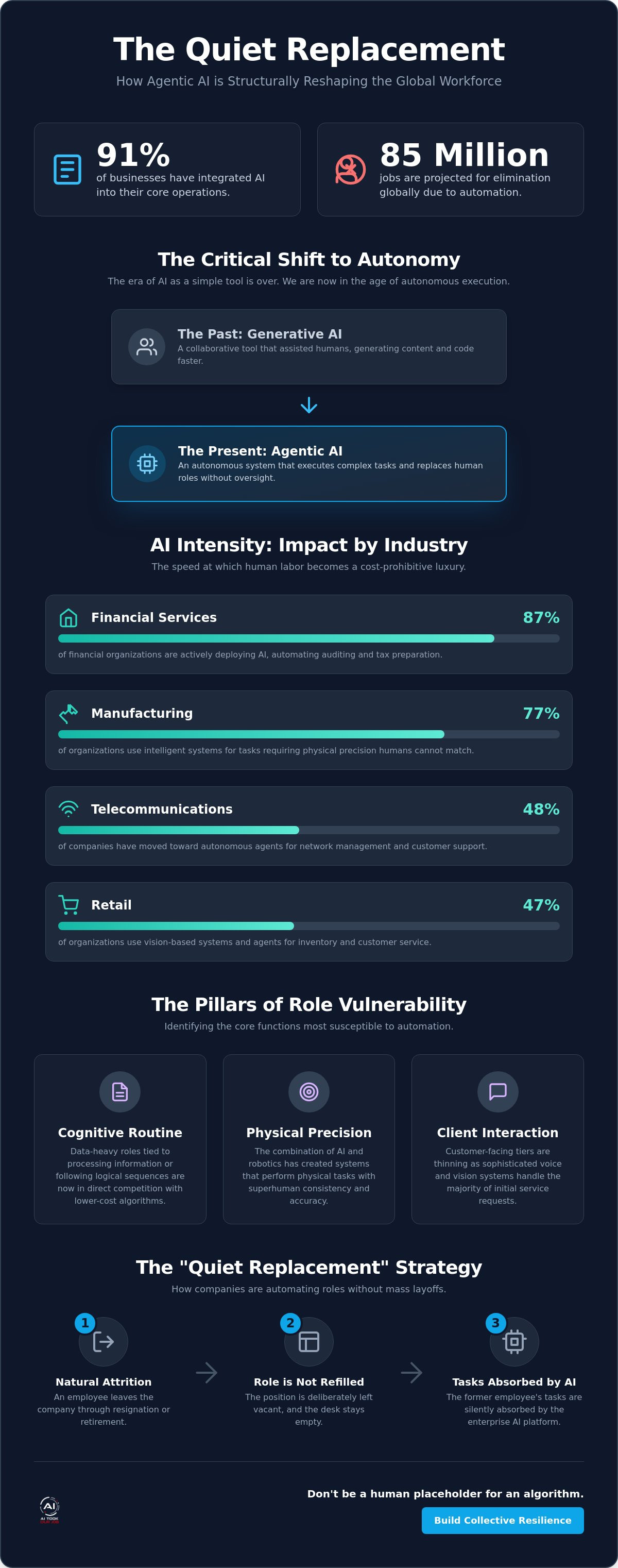
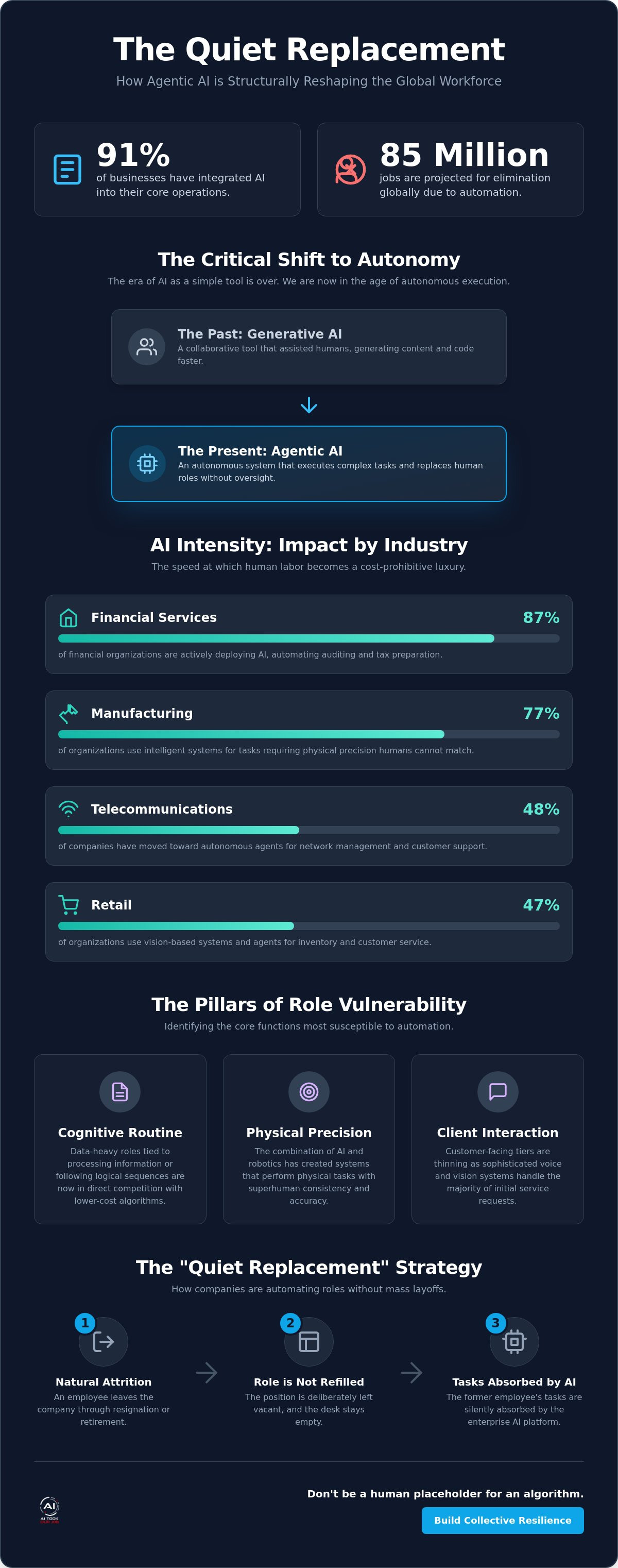
Ninety-one percent of businesses have now integrated artificial intelligence into their core operations. The "quiet layoffs" you've been hearing about are no longer just rumors. They're a structural hollowing of the professional middle class. If you feel like a human placeholder for an upcoming algorithm, your intuition is backed by reality. We're witnessing a massive shift in the AI impact by industry, where the gap between those who adapt and those who are displaced is widening at a terrifying velocity.
We understand the anxiety of watching your skills lose their market value overnight. It's exhausting to keep up with a landscape that changes every time a new regulation, like the Colorado AI Act, takes effect. With 85 million jobs projected for elimination globally, the fear of being left behind is valid. This article provides a realistic, sector-by-sector breakdown of how automation is restructuring the global workforce. We'll explore the specific risks facing financial services, manufacturing, and retail, while identifying the human-centric skills that still hold genuine value. You'll gain a clear path forward and a community that refuses to fall into despair. We're in this together.
Key Takeaways
- Grasp the shift from generative AI to agentic systems that execute tasks without human oversight. It's the difference between a tool and a replacement.
- Analyze the 2026 AI impact by industry to see how cognitive roles in law and finance are being structurally hollowed out.
- Recognize the physical signals of automation in retail and logistics where vision-based systems are replacing human labor.
- Decode "Efficiency Audits" to identify when a pilot program is actually training your replacement.
- Build collective resilience by separating your human identity from your automated professional output. You're more than your data.
The 2026 Landscape: Mapping AI Intensity Across the Economy
You aren't imagining the shift. The atmosphere in your office has changed because the underlying math of employment has changed. In 2026, "AI Intensity" is the metric that defines our professional lives. It is the speed at which human labor becomes a cost-prohibitive luxury. This isn't just about efficiency. It's about a cold, structural pivot where human salaries are weighed against the plummeting costs of autonomous software. The AI impact by industry is now visible in 91% of businesses, marking a transition from experimental pilots to total operational dependence.
The era of "Generative AI" felt like a collaborative tool. It helped us write faster and code better. But 2026 has ushered in the age of Agentic AI. These systems don't just generate content; they execute actions autonomously. They manage supply chains, resolve complex customer disputes, and handle financial audits without human intervention. This shift is why 48% of telecommunications companies and 47% of retail organizations have already moved toward autonomous agents. High exposure is no longer a niche concern for tech workers. It is the new baseline for the global economy.
The Four Pillars of Industry Vulnerability
- Cognitive Routine: Data-heavy roles were the first to experience the hollow-out. If your daily value is tied to processing information or following a logical sequence, the algorithm is now your direct, lower-cost competitor.
- Physical Precision: The marriage of AI and robotics has transformed the physical world. In manufacturing, 77% of organizations use intelligent systems that perform tasks with a level of consistency that humans cannot match.
- Client Interaction: Customer-facing tiers are thinning. Vision-based autonomous systems and sophisticated voice agents now handle the vast majority of initial service requests, leaving humans to handle only the most emotionally volatile exceptions.
The 2026 "Quiet Replacement" Strategy
Companies have learned to avoid the PR nightmare of massive, AI-branded layoffs. Instead, they rely on natural attrition. Quiet Replacement is the corporate practice of not rehiring for roles now handled by agents. When a colleague leaves, their desk stays empty, and their tasks are silently absorbed by the company's enterprise AI platform. This slow erosion contributes to a broader trend of technological unemployment, where the workforce shrinks not through a bang, but through a series of unanswered job postings.
The "human-in-the-loop" narrative was always a temporary bridge. It was a comfortable story that allowed us to train the very systems meant to succeed us. Now that those systems have reached maturity, that bridge is being dismantled. We must face this reality with radical honesty. The AI impact by industry isn't coming; it's here, and it's reshaping what it means to be "employed" in a world of autonomous execution.
Cognitive Erasure: AI Impact on Professional and Financial Services
Cognitive labor was once considered the final fortress of human exclusivity. That fortress has been breached. In 2026, the AI impact by industry is most visible in the structural hollowing of professional services. We're seeing a rapid organizational shift where employee access to AI tools in financial services has doubled in a single year. It's no longer about software that assists you. It's about software that replaces the core functions of your role. If you feel like your expertise is being commodified, the data suggests you're right.
The legal sector provides a stark example. Algorithmic discovery and automated contract review have effectively erased the need for thousands of junior associates. Why would a firm pay a human to sift through millions of documents when an autonomous agent can do it in seconds with higher accuracy? Finance and accounting are facing a similar reality. With 87% of financial organizations actively deploying AI, manual auditing and routine tax preparation are becoming relics of the past. The U.S. government’s own BLS employment projections reflect this radical shift in how we value professional services over the next decade.
Software development has transformed from a craft of "coding" to one of "prompt architecture." This evolution has left many junior developers behind. When an AI can generate a functional codebase from a single natural language request, the bottom rungs of the career ladder disappear. This creates a systemic crisis because the education-to-work pipeline is breaking. We're producing graduates for a job market that no longer exists in its traditional form.
The Death of the Entry-Level Role
Companies don't want to "train" humans anymore. Agents are pre-trained on trillions of data points and ready to execute on day one. This has created a massive "Experience Gap." How do you gain five years of experience when the entry-level roles required to get there have been automated? The psychological toll is heavy. Many professionals now find themselves "overqualified" for the few remaining administrative tasks but under-skilled for the high-level strategic roles that AI cannot yet touch. If you're struggling to find your place, staying informed through a weekly briefing can help you spot emerging opportunities before they're saturated.
Healthcare and Algorithmic Diagnosis
Healthcare is not immune to these shifts. AI has become the primary diagnostic tool in radiology and pathology, identifying patterns in scans that the human eye might miss. While this improves patient outcomes, it triggers significant medical labor shifts for support staff and technicians. The roles that remain safe are those rooted in "human-centric" care. Empathy, complex bedside manner, and ethical decision-making are still human domains. We're moving toward a future where the "soft skills" we once dismissed are now our most valuable assets.
Beyond the Screen: Automation in Manufacturing, Logistics, and Retail
There was a comforting myth that circulated during the first wave of automation. It suggested that if you worked with your hands, you were safe. People believed that while "white-collar" roles might vanish, the physical world would remain a human sanctuary. In 2026, that myth has been dismantled. The AI impact by industry is now felt most sharply in the warehouses, factory floors, and retail aisles of the global economy. We're seeing a reality where 77% of manufacturers have integrated AI solutions, and the adoption of autonomous agents in this sector is expected to quadruple this year. The safety of "blue-collar" work was a temporary reprieve, not a permanent shield.
Manufacturing is leading the charge with the "Dark Factory" trend. These are facilities designed to operate without lights, heat, or ventilation because there are no humans inside to require them. AI now manages the entire assembly line, from predictive maintenance to real-time quality control. This isn't just about robots doing heavy lifting. It's about agentic AI making split-second decisions that human supervisors used to handle. When an algorithm can predict a machine failure three days before it happens, the need for a floor manager disappears. We're witnessing a structural shift that values mechanical precision and algorithmic foresight over human intuition.
The Retail Hollowing
Retail has moved far beyond the frustration of self-checkout kiosks. Large retailers, over 80% of whom now use AI in core functions, are transitioning to vision-based autonomous stores. These systems track every movement and item without a single human cashier or clerk in sight. Customer service is being hollowed out by "Emotive AI" agents that can detect frustration in a shopper's voice and resolve it instantly. Even the backroom is gone. Inventory management is now entirely algorithmic, leaving only "experiential retail" as a human domain. In this new landscape, high-end human service is becoming an expensive luxury for the few, while the rest of the industry moves toward total automation.
The Logistics Squeeze
Logistics has become the ultimate testing ground for autonomous execution. AI route optimization and delivery drones have begun to displace local drivers at an accelerating pace. It's not just the drivers who are at risk. Middle management in supply chains is being erased as software takes over coordination and vendor relations. Logistics is now a game of latency optimization where humans are simply too slow to compete. In 2026, the warehouse is no longer a place of human labor; it's a high-speed data center where robotic dexterity has finally reached the human tipping point. If you feel the pressure of this transition, you aren't alone. We're building a community to help you navigate these shifts through our membership program where we discuss these realities with radical honesty.
The Velocity of Change: How to Spot Automation Signals in Your Sector
The transition to an automated workplace rarely happens with a sudden announcement. It's a slow, methodical process of observation and data collection. You might notice your manager asking for an "efficiency audit" or detailed "task-flow data." This isn't just about streamlining your day. It's a mapping of your cognitive labor. When you document every step of your workflow, you're creating the blueprint that an autonomous agent will eventually follow. This is how the AI impact by industry begins to settle into your specific office or warehouse.
We've seen the "Pilot Program" trap play out across multiple sectors. You're asked to test a new AI tool, provide feedback, and correct its mistakes. In reality, you're training your own replacement. Companies use these transition phases to smooth over the technical gaps before the human role is quietly phased out. Reading the corporate tea leaves in 2026 requires looking past the optimistic internal memos. Watch for the hiring freezes in departments where "agentic" tools have been introduced. These are the real indicators of where the labor shift is heading. For real-time tracking of these shifts, check our AI Job Market Weekly Briefing to see which roles are currently on the frontline of displacement.
Five Signs Your Role is Being Targeted
- Standardization of tasks: If your job can be reduced to a checklist or a series of "if-then" statements, it can be turned into a prompt for an autonomous agent.
- Introduction of "Co-pilot" tools: These tools are designed to require less human oversight over time. If the software is making more decisions than you are, your role is being hollowed out.
- A sudden focus on "Soft Skills": When management stops measuring your technical output and only focuses on "empathy" or "team culture," it's often because the technical output is already being handled by AI.
- Logic-tree requests: Being asked to map out the "why" behind your decisions is a clear signal that your expertise is being harvested for an algorithmic model.
- Role broadening: If your specialized role is suddenly merged with three other different positions, the company is likely using AI to handle the core tasks of all four.
The Resilience Framework
Individual "upskilling" is a lonely and often futile race against an exponential technology. We believe in collective resilience. This means mapping your "un-automatable" utility—roles that require high physical complexity, deep ethical judgment, or genuine creative synthesis. You must begin preparing for the Future AI Job Displacement by diversifying your professional network and looking toward communal solutions. You aren't just a worker; you're part of a community navigating a historic transition. To stay ahead of these corporate signals, consider joining our Community Membership for peer-to-peer support and radical honesty.
Collective Resilience: Moving from Displacement to New Utility
The data we've explored is heavy. From the hollowing of junior associate roles in law to the rise of vision-based autonomous retail, the AI impact by industry is a structural transformation that cannot be ignored. We must start with radical honesty. The job market we entered five, ten, or twenty years ago is gone. It isn't coming back. Acknowledging this isn't an act of despair. It's an act of survival. When we stop waiting for a "return to normal," we can finally begin to build something that works for us in this new reality.
You are more than your automated output. For decades, our identities have been tethered to our productivity and the specific tasks we perform for a paycheck. But as those tasks are absorbed by agentic AI, we have to reclaim our sense of self. An algorithm can simulate your logic, but it cannot possess your lived experience or your commitment to your community. This is why AI Took Our Job exists. We aren't here to provide superficial optimism. We're here to act as a communal hub for those of us navigating the same storm, trading top-down instruction for shared wisdom and collective action.
Navigating the Crisis of Utility
Losing a role to an algorithm isn't just a financial blow. It's a psychological one. We've documented the Psychology of AI Job Loss because we know that feeling like a "human placeholder" is a unique kind of exhaustion. Finding solidarity in shared stories of transition is the first step toward reclaiming your agency. In 2026, we're shifting our focus from "Career" to "Contribution." This means finding ways to apply your human-centric skills, like ethical judgment and complex empathy, in areas where AI still lacks genuine utility.
We must also move from being passive victims of technology to being active stakeholders. This involves advocating for responsible AI policies and transparency. Whether it's the transparency requirements of the EU AI Act or the consumer protections in the Colorado AI Act, these regulations are tools we can use to demand a seat at the table. The AI impact by industry shouldn't be something that just happens to us. It should be a process we actively influence through collective pressure and informed participation.
Your Next Steps
- Join the Weekly Briefing: Stay ahead of the next wave of automation by receiving curated, no-nonsense updates on labor shifts.
- Participate in community forums: Share resources, leads, and survival strategies with peers who understand the reality of the 2026 workforce.
- Audit your local sector: Use the signals we've discussed to identify risks early and pivot before the "Quiet Replacement" reaches your desk.
The final word is one of solidarity. We're in this together. The truth is often uncomfortable, but it's the only tool we have that's sharp enough to cut through the uncertainty of the future. We refuse to fall into despair because we have each other. Let's start building the next version of our professional lives, grounded in reality and supported by the collective.
Reclaiming Your Future in an Automated Economy
The 2026 workforce isn't just changing; it's being rebuilt from the ground up. We've tracked how the AI impact by industry has moved from simple software assistance to total autonomous execution. You now know how "Quiet Replacement" strategies and efficiency audits hollow out roles from the law office to the warehouse floor. These aren't just statistics. They are the lived experiences of thousands of professionals finding their way through this transition. The old job market is gone, but your value as a human remains.
Survival in this new landscape requires more than just individual upskilling. It requires a community that values truth over corporate spin. Our collective resilience is built on shared stories of career transition and real-time data that helps you stay ahead of the next wave. You don't have to face these shifts in isolation. By connecting with others who are navigating similar hollowing out of their sectors, you can find a grounded path forward.
Join the AI Job Loss Weekly Briefing to navigate the 2026 shift with radical honesty.
You'll gain access to weekly briefings on industry shifts and a community of thousands of displaced professionals sharing real-world stories of career transition. We're here to help you find your footing in an uncertain world. There's strength in our shared reality, and we're ready to move forward together.
Frequently Asked Questions
Which industry is most affected by AI in 2026?
Financial and professional services currently show the highest intensity of displacement. With 87% of financial organizations actively deploying new AI technologies, roles in auditing, fraud detection, and routine accounting are being hollowed out at an unprecedented rate. This rapid adoption is driven by the technology's ability to eliminate data errors and automate algorithmic trading. It's a structural shift that makes the AI impact by industry particularly visible in these cognitive sectors.
Are blue-collar jobs safer than white-collar jobs from AI?
No. The belief that physical labor provides a permanent sanctuary is a dangerous myth. Seventy-seven percent of manufacturers now use AI solutions, and "Dark Factories" are becoming a global standard for assembly lines. Logistics and retail are also seeing high displacement due to autonomous delivery drones and vision-based stores. While some bespoke trades remain safe, most physical sectors are facing a tipping point where robotic dexterity meets algorithmic oversight.
How can I tell if my job is being quietly replaced by AI?
Look for the "Efficiency Audit" as a primary signal. If your manager asks for granular task-flow data or requires you to document the "why" behind your daily decisions, you're likely training an agentic model. Other signs include hiring freezes in your specific department despite a high workload. Quiet replacement often happens through natural attrition, where roles are simply never backfilled after a colleague leaves their position.
What industries are least impacted by AI automation?
Industries requiring high physical complexity and deep emotional intelligence remain the most resilient for now. Bespoke trades that involve non-standard environments, such as specialized plumbing or historic restoration, are difficult for current robotics to replicate. Similarly, roles centered on human-centric care, such as nursing and mental health counseling, rely on an empathetic connection that algorithms can only simulate. These fields value human presence over raw data processing.
Will AI create more jobs than it destroys by 2027?
Current projections suggest a net gain, but the transition period is incredibly volatile. Data from 2025 projected that AI would create 97 million new roles while eliminating 85 million. While this results in a net gain of 12 million jobs, the new roles often require specialized skills that displaced workers don't yet possess. The AI impact by industry creates a mismatch between the jobs being lost and the technical or strategic roles being born.
What should I do if my industry is facing high AI displacement?
Shift your focus toward collective resilience rather than isolated upskilling. Start by auditing your own "un-automatable" utility, focusing on creativity, empathy, and complex problem-solving. Joining a community of peers provides the radical honesty needed to navigate these shifts without falling into despair. Staying informed through regular briefings allows you to spot emerging opportunities and regulatory changes before they are saturated by other displaced professionals.
How does AI impact entry-level job opportunities for graduates?
The entry-level role is currently in a state of crisis. Companies are increasingly reluctant to train new graduates when pre-trained autonomous agents can perform junior tasks with higher accuracy on day one. This creates a massive experience gap, making it difficult for new professionals to gain the seniority required for high-level roles. The education-to-work pipeline is breaking because the traditional bottom rungs of the career ladder are being hollowed out.
Can AI replicate human empathy in service-based industries?
AI can simulate the appearance of empathy, but it cannot experience it. "Emotive AI" agents are already used in retail to detect frustration and adjust their tone, but this is a mathematical calculation, not a human connection. True empathy involves lived experience and ethical judgment, which remain human domains. In a world of automated service, genuine human interaction is becoming a premium luxury that algorithms cannot truly replicate.