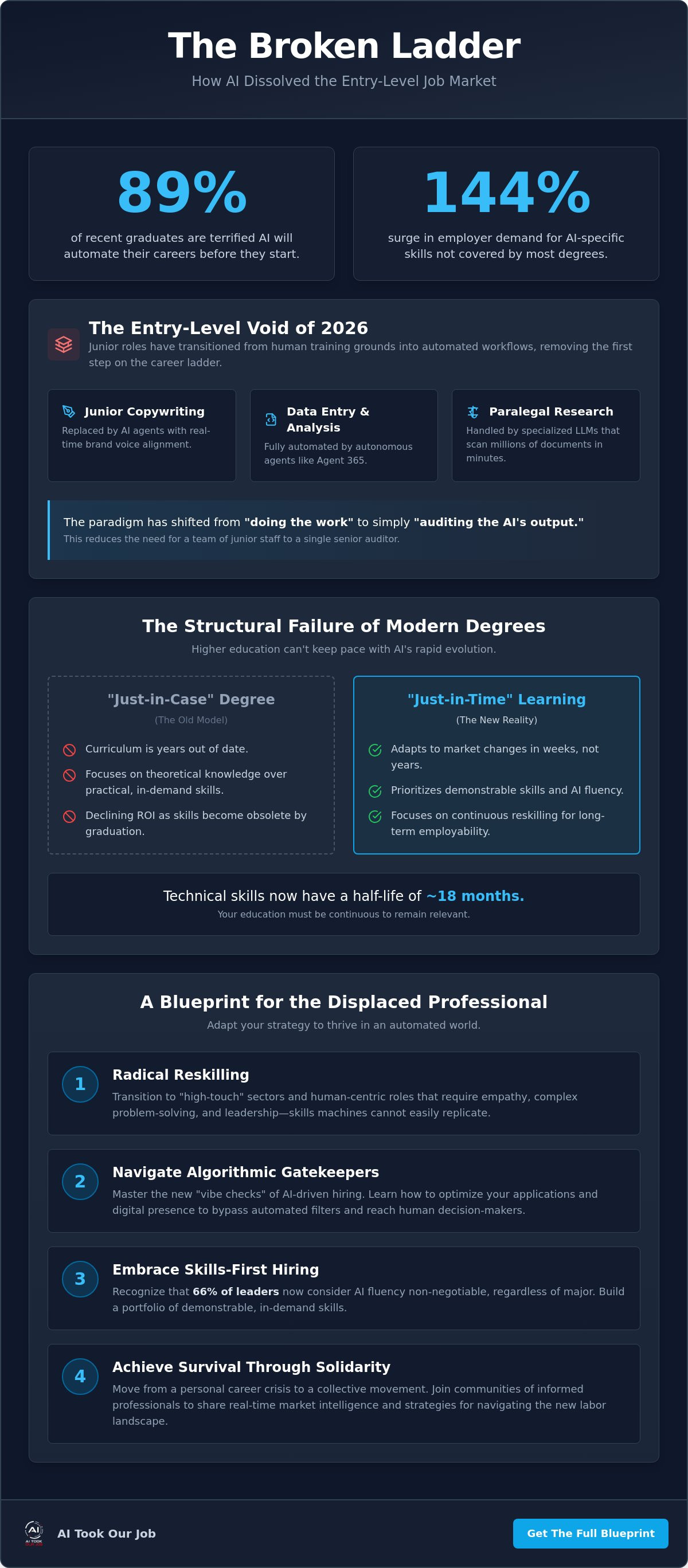
89% of recent graduates now admit they are terrified that AI will automate their careers before they even start. This isn't just graduation jitters. It's a rational response to a world where OpenAI's GPT-5.4 can handle the research, drafting, and coding tasks that used to be the bread and butter of junior staff. If you feel like your AI job market education stopped at the campus gates, you're right. The traditional pipeline is broken.
You aren't alone in this anxiety. The entry-level hiring crisis is real, driven by a 144% surge in demand for AI skills that most degrees simply don't cover. We're here to offer an unflinching look at how AI is dissolving the first rung of the career ladder. We'll provide a realistic map of the 2026 labor landscape and show you how to build a career in a market that has effectively automated away the junior role. From the rise of human-agent teams to the practical alternatives replacing four-year degrees, we will explore what it takes to find stability in this new, flatter professional world.
Key Takeaways
- Understand why traditional junior roles have transitioned from training grounds into automated workflows, effectively removing the first rung of the career ladder.
- Learn why a standard degree no longer guarantees employability and how to refocus your AI job market education on high-context skills that machines cannot easily replicate.
- Discover how to navigate the new era of algorithmic gatekeeping by mastering the "vibe checks" required to bypass modern AI-driven hiring filters.
- Identify a clear blueprint for reskilling that prioritizes high-touch sectors and human-centric roles less susceptible to total automation.
- Transition from facing a personal career crisis to participating in a collective movement of informed professionals who share real-time market intelligence.
The Broken Ladder: How AI Dissolved the Entry-Level Rung
The career ladder is no longer a ladder. It's a cliff. In 2026, the entry-level job market has shifted from a training ground for human talent into a series of automated workflows. Companies aren't just hiring fewer graduates. They're opting for agentic AI systems that don't require health insurance, sleep, or three years of "learning the ropes." This collapse in the bottom tier of the workforce has created a "Missing Middle" in corporate hierarchies. While senior leaders remain to steer the ship, the bridge between a university degree and a mid-level management role has effectively dissolved.
Recent data from the Federal Reserve Bank of New York in May 2026 shows the unemployment rate for recent college graduates at 5.6%. This is higher than the national average. It's a stark signal that the traditional AI job market education provided by colleges isn't keeping pace with the velocity of displacement. White-collar sectors are feeling this most acutely. While blue-collar entry points still require physical presence, the digital entry-level role has been replaced by tools like GPT-5.4 and Gemini 3.1 Pro. This disconnect isn't your fault. It's the result of a system that is automating faster than it can educate.
The Death of "Intellectually Mundane" Training
The tasks that once served as your apprenticeship are gone. Sorting data, drafting basic memos, and conducting preliminary research used to be how you learned a company's DNA. Now, these "intellectually mundane" tasks are handled by LLMs in seconds. This creates a massive gap in mentorship. How do you learn to lead a team if you never learned the foundational work the team does? The conversation around AI in education often focuses on classroom tools, but the real crisis is the loss of the human-to-human knowledge transfer that only happens in entry-level roles. We are losing our training grounds.
Which Roles are Vanishing First?
We see a rapid exit of junior copywriters, entry-level paralegals, and basic data analysts. These roles have transitioned from "doing" the work to simply "auditing" what the AI produces. If a machine can do 90% of the heavy lifting, a firm only needs one senior auditor instead of five junior creators. This shift has created a permanent structural gap in the AI job market education pipeline. The Entry-Level Void of 2026 is the structural absence of junior positions that once served as the essential bridge between academic theory and professional mastery.
- Junior Copywriting: Replaced by multi-modal agents capable of brand-voice alignment in real-time.
- Data Entry and Analysis: Fully automated through autonomous agents like Agent 365.
- Paralegal Research: Handled by specialized legal LLMs that can scan millions of documents in minutes.
Beyond AI Literacy: The Structural Failure of Modern Degrees
The four-year degree is no longer a reliable bridge to a career. It's too slow. A curriculum designed in 2022 was built for a world that simply doesn't exist anymore. By the time a student walks across the stage in 2026, the technical skills they learned in their freshman year have already been automated by models like Gemini 3.1 Pro. This decoupling of higher education from actual employability is the defining crisis for today's students. We are seeing a massive shift from "Just-in-Case" degrees to "Just-in-Time" learning, where the ability to adapt outweighs the prestige of a diploma.
The future AI job displacement we warned about is now a daily reality. This shift has fundamentally gutted the ROI of traditional college. Why spend six figures on a degree when 66% of leaders now state that AI fluency is a non-negotiable skill for new hires, regardless of their major? The market is moving toward a skills-first model where what you can do today matters more than where you sat for four years. The ivory tower is being bypassed by those who understand that the market doesn't wait for graduation.
The Lagging Curriculum Crisis
Technical skills now have a half-life of roughly 18 months. Institutional accreditation, once a mark of quality, has become a bottleneck. It takes years for a university to update a syllabus, but AI capabilities change in weeks. This institutional lag means your AI job market education is often happening in spite of your professors, not because of them. According to the Center for Democracy & Technology, 86% of students use AI in their daily work, yet less than half have received formal guidance on its safe and ethical use. Forward-thinking companies are ignoring diplomas in favor of micro-credentials and portfolio-based proof of work. For instance, you can discover IAB Academy to gain micro-credentials in financial literacy and AI-integrated investing. They want to see what you've built with the tools of 2026, not what you memorized from a 2022 textbook.
The New "Human-Only" Skillset
The role of the "Knowledge Worker" is dying. It is being replaced by the "Context Manager." You are no longer paid to know things; you are paid to manage the context in which AI operates. This requires a pivot toward skills that remain stubbornly human. Empathy, high-stakes negotiation, and complex physical dexterity are the new premiums in the labor market. If a task can be described in a prompt, it's already gone. If it requires navigating human ego, ethical nuance, or physical unpredictability, it's your new career path. Facing this transition alone is exhausting. Joining a Community Membership can help you stay grounded as we navigate these structural shifts together. We don't have all the answers, but we have each other.
Algorithmic Gatekeeping: The Hidden Education in Hiring
You hit "submit" and wait. The silence that follows isn't a lack of interest. It's the sound of an algorithm deciding your professional fate before a human ever sees your name. By 2026, Applicant Tracking Systems (ATS) have evolved from simple database filters into sophisticated "Career Killers." They don't just look for keywords anymore. They analyze your career trajectory, predict your "cultural fit," and even assess the likelihood that you'll leave the company within a year. This is the part of your AI job market education that university never mentioned. You aren't just competing against other candidates. You're competing against a machine's mathematical model of what a "perfect" employee looks like.
The gatekeeping has become even more surreal with the rise of AI-to-AI interviewing. Companies are now deploying autonomous agents to conduct first-round screenings of other autonomous agents used by candidates to apply for jobs. It's a closed loop. If your digital presence isn't optimized for this algorithmic "vibe check," you are effectively invisible. This is why a traditional resume is now a liability. It's a static document in a dynamic, automated screening world. To survive, you need to understand the new rules of engagement that prioritize data over descriptions.
Beating the Hiring Bot
The old trick of "keyword stuffing" is dead. Modern platforms use semantic search to understand the context of your experience. They look for "Outcome Evidence." Instead of saying you "managed a team," the bot wants to see how you managed the integration of Gemini 3.1 Pro into a specific workflow to increase output by a verifiable margin. There's also a growing ethical dilemma. Should you use an AI agent to tailor your application for an AI-screened role? In states like Illinois, where the Human Rights Act was amended in January 2026 to regulate AI in employment, the transparency of these tools is under scrutiny. However, the reality remains. If you don't use the tools, you're fighting a 2026 war with 20th-century weapons.
The Portfolio as Your New Diploma
A degree says you sat in a room. A portfolio says you can solve a problem. In the current AI job market education landscape, "Demonstrated Impact" has replaced the "Certified" label. Employers are looking for public proof-of-work that has been vetted by peers, not just professors. Why? Because institutional grades are often based on outdated metrics. Community-vetted projects, open-source contributions, and documented AI-human collaborations carry more weight than a GPA. They prove you can navigate the "Human-Agent Teams" that are now the standard operating model. Your portfolio isn't just a collection of work. It's your evidence of survival in an automated world.
Radical Reskilling: A Blueprint for the Displaced
The ladder is gone. Now, we build a bridge. Radical reskilling isn't about taking one more online course or learning to write better prompts. It's about a total reorientation of your professional identity. In 2026, the most valuable part of your AI job market education is learning to audit your own role with brutal honesty. If your daily output can be summarized in a spreadsheet or a standard report, the machines are already coming for it. We have to face this reality without blinking. While the panic of seeing a junior role disappear is valid, the path forward requires a cold, clinical look at what remains uniquely yours in a world of infinite digital labor.
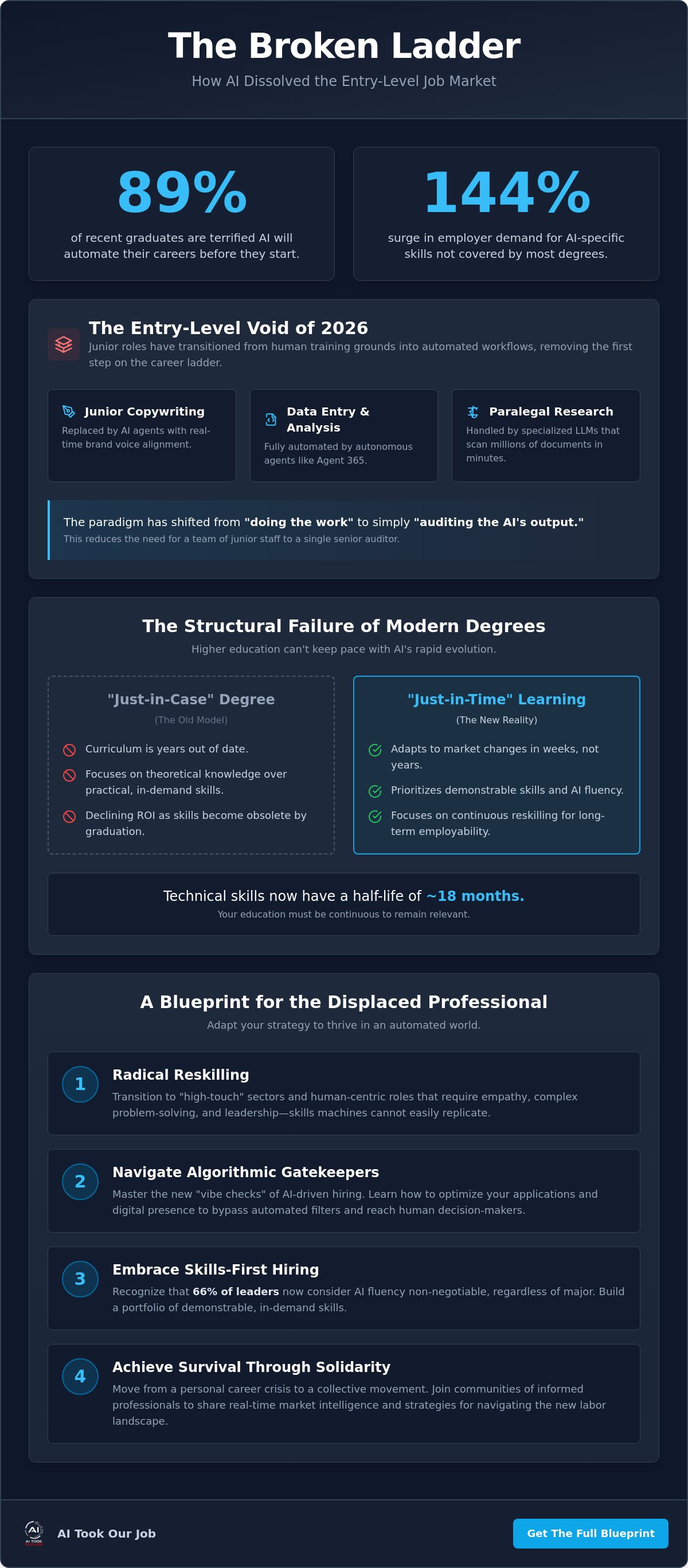
Survival requires a four-step blueprint. First, audit your "Automation Susceptibility." Be clinical; look at your tasks, not your title. Second, pivot toward "High-Context" or "High-Touch" sectors where human nuance and physical presence are still premiums. Third, stop trying to impress automated gatekeepers and join a community of practice where human referrals bypass the bots. Finally, master "AI Orchestration." Don't just use tools. Manage them. You are the conductor, not the first violin. By 2030, the World Economic Forum predicts 170 million new roles will be created, but they won't look like the jobs of the past. They will require a level of strategic oversight that current degrees simply don't teach.
Navigating the Crisis of Human Utility
Losing a job to a machine hurts. It's not just a financial blow. It's a crisis of purpose. We've spent decades tying our self-worth to our productivity, but that's a losing game in 2026. Understanding the psychology of AI job loss is the first step toward recovery. Your value isn't tied to your output anymore. It's tied to your judgment and your ability to navigate ethical complexity. Building resilience means leaning on collective wisdom rather than trying to outrun the algorithm alone. We are all learning to be human again in a world that values us for our efficiency.
Alternative Learning Pathways
The digital-first economy has ironically made "Analog Skills" more valuable. Trade schools and apprenticeships are seeing a massive resurgence as the "Master-Apprentice" model returns. While white-collar roles vanish, the demand for skilled trades and high-stakes human interaction remains high. Finding mentorship outside corporate structures is now essential. You need a guide who has survived the transition, not a manager who is just as scared as you are. To stay ahead of these shifts, you should subscribe to our AI Job Loss Weekly Briefing for real-time updates on the shifting AI job market education landscape and the roles that are actually hiring.
Survival Through Solidarity: The AI Took Our Job Approach
The system is designed to keep you isolated. It wants you to believe your unemployment is a personal failure rather than a structural collapse. We know better. In 2026, the only way to outpace the algorithm is to stop running alone. This is the core of our philosophy. Your AI job market education doesn't end at graduation; it begins when you join a collective that refuses to be invisible. We've moved past the era of individual competition. Now, we rely on solidarity to navigate a landscape where entry-level roles have been swallowed by automation.
The AI Job Market Weekly Briefing is your new curriculum. It isn't a passive news feed. It's a survival map updated in real-time as companies pivot toward tools like Agent 365 or adjust to new regulations like the Illinois Human Rights Act amendment that took effect on January 1, 2026. By sharing "Hidden Job Market" tips, our community identifies the opportunities that never make it to the bot-infested job boards. We find the human-centric gaps that the algorithms haven't mapped yet. These are roles based on trust, referral, and high-context expertise that a scraper simply cannot find.
Join the Weekly Briefing
You need a no-nonsense analysis of which roles are actually hiring humans. Our briefing provides real-time updates on industry shifts and automation strategies. We track the rapid release cycles of tools like GPT-5.4 and Gemini 3.1 Pro to tell you exactly how they are being used to displace or augment specific roles. We provide a direct line to experts who have already survived their own career transitions. They've seen the displacement curve and found a way around it. Don't wait for a university syllabus to catch up to the reality of 2026. Get the intelligence you need to act now.
A Community That Understands
Sharing your story is the first step in career reclamation. It's how we move from a state of individual crisis to collective action. When 89% of graduates are worried about AI replacing their jobs, the problem isn't your resume; it's the structure of the market. When you access the collective intelligence of the displaced, you stop being a victim of the transition and start being a participant in the new economy. We share the wisdom that institutional gatekeepers can't provide. Join the AI Took Our Job community and reclaim your future. We are the hub for those who refuse to be left behind. Together, we are stronger than any algorithm.
Reclaiming Your Agency in an Automated World
The 2026 job market isn't just changing; it's being fundamentally rebuilt. We've seen how the entry-level ladder has dissolved into automated workflows and why university degrees are struggling to keep pace with the velocity of displacement. These aren't just temporary disruptions. They are permanent structural shifts that require a complete reevaluation of your AI job market education. You don't have to face this transition in isolation.
Resilience in this era comes from real-world survival strategies and the collective intelligence of a community that understands the psychological toll of industry shifts. By focusing on high-context skills and bypassing algorithmic gatekeepers, you can find stability even as the landscape continues to move. We're here to help you track market volatility and stay informed. Stay ahead of the next wave—subscribe to our Weekly Briefing and join an empathetic community of professionals who are redefining what it means to work. The future is uncertain, but it's a future we can navigate together. You are more than your productivity; you are a vital part of a resilient movement.
Frequently Asked Questions
Is a college degree still worth it in the 2026 AI job market?
A degree’s value as a guaranteed career ticket has collapsed, though it still provides a foundational network. Most four year programs are now "Just-in-Case" credentials that struggle to keep up with the 18 month half-life of technical skills. To stay competitive, your AI job market education must be supplemented with micro-credentials and a public portfolio that proves you can handle the tools of today, not the theories of 2022.
Which entry-level jobs are safest from AI automation right now?
Roles requiring high-stakes empathy, physical dexterity, or complex human negotiation are currently the most secure. Skilled trades, specialized healthcare positions, and high-touch hospitality roles remain difficult for AI to replicate because they involve physical unpredictability. If your work requires you to navigate human ego or ethical nuance in person, you have a much stronger buffer against the current wave of displacement.
How do I explain an AI-related layoff on my resume?
Frame the layoff as a structural industry transition rather than a personal performance issue. Be direct about how your previous role was impacted by automation and highlight the "High-Context" skills you have refined during your pivot. Modern employers are familiar with the "Missing Middle" in corporate hierarchies and often respect candidates who can demonstrate proactive reskilling and a realistic understanding of the 2026 labor landscape.
What are the most important "human" skills to learn for 2026?
Ethical judgment, cross-functional orchestration, and the ability to manage human-agent teams are the new premiums. You need to move from being a "Knowledge Worker" to a "Context Manager." This means becoming the person who can interpret the "why" behind a project and navigate the ethical dilemmas that AI models often ignore. Being the conductor of the machine is far more valuable than trying to compete with its speed.
Can AI actually replace entry-level creative roles like graphic design?
Yes, AI has already automated the production-heavy tasks that used to define junior creative roles. Models like Gemini 3.1 Pro can generate assets and layouts in seconds, leaving little room for humans who only focus on execution. To survive, entry-level designers must pivot toward brand strategy and creative direction. Your value now lies in your ability to ensure that machine-generated content actually resonates with human emotions and brand values.
How can I tell if my current company is planning to automate my role?
Look for signs of "Task Standardization" or the introduction of governance tools like Agent 365. If your leadership is suddenly obsessed with documenting every minute detail of your daily workflow, they are likely building a dataset for an AI agent. Another red flag is a shift in your responsibilities from original creation to simply auditing and fact-checking machine-generated output. These are the early stages of role dissolution.
What is "AI Orchestration" and why is it better than "AI Literacy"?
AI Literacy is simply knowing how to use a tool, while AI Orchestration is the ability to manage an entire automated ecosystem. In a modern AI job market education, orchestration is the ultimate goal for any professional. It involves conducting multiple AI agents to solve complex problems and ensuring they work together ethically. You aren't just writing a prompt; you are designing the workflow that allows the machine to be productive under your supervision.
Where can I find a community of workers who have been displaced by AI?
You can find a grounded, supportive community of peers right here at AI Took Our Job. We provide a space where displaced professionals share "Hidden Job Market" tips and collective wisdom that bots simply cannot access. Joining our community membership helps you move from a state of individual crisis to one of collective resilience. It is a hub for those who want to reclaim their future through solidarity rather than isolation.