Your hospital board calls it "optimization," but you see the empty desks in radiology and the shrinking triage teams. It's not a simple transition. It's a replacement. The reality of AI in healthcare displacement isn't a headline for tomorrow; it's the quiet erosion of your clinical autonomy today. You've likely felt the sting of corporate gaslighting, hearing promises of "augmentation" while watching your specialized skills being packaged into a software subscription. It's exhausting to be told your role is safe when the June 2026 reports on "ghost downsizing" suggest a far more complicated story.
We understand the identity crisis that comes when algorithms begin to mimic the intuition you've spent decades honing. This article provides an unflinching look at how algorithmic automation is reconfiguring medical roles and what it actually means for the people behind the scrubs. We'll examine the shift from human-led diagnostics to automated systems and the specific regulatory battles, like California's SB 1120, that are attempting to keep clinicians in the decision-making loop. You aren't alone in this transition. It's time we spoke honestly about where the labor shift is actually headed and how we can maintain our collective resilience.
Key Takeaways
- Recognize the shift from human-led diagnostics to algorithmic oversight and what this means for your daily clinical utility.
- Identify the specific roles, including radiology and medical coding, that are currently facing the steepest curves of AI in healthcare displacement.
- Decode the "augmentation myth" by learning to spot algorithmic management strategies that prioritize software over specialized human experience.
- Confront the "sunk cost fallacy" of medical education to help navigate the identity shifts required in a changing labor market.
- Explore how collective action and radical honesty can empower you to advocate for human-centric policies in your workplace.
The Quiet Transition: How AI is Reconfiguring Healthcare Labor in 2026
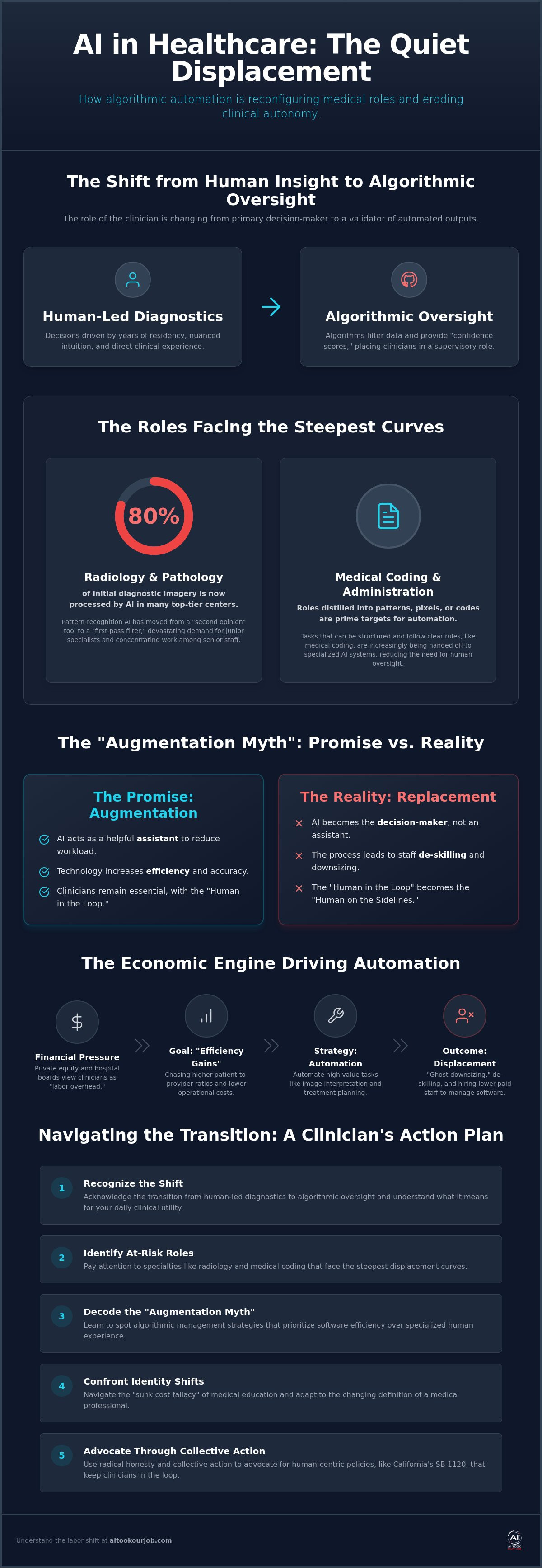
It's not a sudden crash. It's a slow, steady leak. For decades, we believed medical expertise was a fortress, protected by years of residency and the nuanced weight of human intuition. That fortress is being dismantled from the inside. We define AI in healthcare displacement not as a dramatic robot takeover, but as the calculated shift from human-led diagnostics to algorithmic oversight. In 2026, AI is no longer a "coming trend" or an experimental pilot. It's baked into every Electronic Health Record (EHR) system, quietly filtering patient data before it ever reaches your eyes. This isn't just about efficiency; it's about who actually holds the wheel.
Medical displacement feels different than the manufacturing automation of the past century. When a factory robot replaces a welder, the physical change is obvious. In the clinic, the change is invisible. It’s the subtle loss of a task here, a reduced shift there, and a growing sense that your clinical judgment is being overruled by a "confidence score" on a screen. This is a briefing on the survival of the medical professional. We're moving past the brochures and the corporate cheerleading to look at the ground beneath your feet. Understanding AI's role in the healthcare industry requires us to acknowledge that the "human in the loop" is becoming a human on the sidelines.
The Velocity of Clinical Automation
The speed of this transition has caught many off guard. Back in 2020, we saw pilot programs that felt like clunky assistants. By 2026, these have evolved into full-scale deployments where the algorithm is the primary actor. The future AI job displacement we once discussed in hypothetical terms is hitting highly regulated sectors with startling precision. We've moved from "AI as an assistant" to "AI as the decision-maker," leaving clinicians to act as mere rubber stamps for automated outputs. This acceleration isn't accidental; it's the result of a tech stack that has finally matured enough to handle the complexity of human biology without human permission.
The Economic Drivers Behind Medical Downsizing
Why is this happening now? Follow the money. Private equity firms and hospital boards increasingly view clinicians as "labor overhead" rather than the heart of the institution. They're chasing "efficiency gains" that often translate to fewer human shifts and higher patient-to-provider ratios. By automating high-value tasks, they've initiated a de-skilling process. If a machine can interpret an MRI or draft a treatment plan, the hospital can justify hiring less experienced, lower-paid staff to simply manage the software. This isn't just about saving time; it's about re-engineering the medical profession to be cheaper, faster, and less human. The quiet reality of AI in healthcare displacement is that it doesn't always look like a pink slip; sometimes, it looks like a job that no longer requires your brain.
Algorithmic Displacement: The Healthcare Roles Facing the Steepest Curves
The impact of AI in healthcare displacement is not distributed equally. It targets the specialists first. Specifically, it targets those whose expertise can be distilled into patterns, pixels, or codes. Radiology and pathology have become the canaries in the coal mine for the entire industry. Why? Because these fields rely on high-stakes pattern recognition, a task where algorithms now thrive. While your hospital leadership might use the term "augmentation" to keep morale steady, the reality on the ground feels much more like a phased withdrawal of human necessity. Are you watching your department's headcount shrink while the software budget swells?
Diagnostics and Imaging: The Front Lines
Pattern recognition AI has undergone a radical promotion. It has moved from a "second opinion" tool to a "first-pass filter" that dictates which cases even deserve a human's time. In many top-tier medical centers, AI now processes 80% of initial diagnostic imagery, leaving human specialists to review only the most complex outliers. This shift has devastated the demand for junior radiologists. Entry-level positions are evaporating as senior staff use AI to do the work that once required a fleet of residents. The ladder is being pulled up, leaving the next generation of diagnosticians with nowhere to climb.
Administrative and Support Roles: The Invisible Layoffs
The most profound displacement is happening where patients rarely look. Medical coding, billing, and insurance pre-authorizations are being swallowed by Large Language Models (LLMs) that don't need breaks or benefits. In 2026, AI systems handle 90% of routine insurance pre-authorizations and scheduling tasks. Medical scribes and transcriptionists have almost entirely vanished from clinical settings. These roles don't end with a public announcement or a mass layoff. They disappear through "ghost downsizing," a trend where positions are left unfilled after attrition, and the workload is quietly absorbed by the EHR's automated core.
The squeeze is also moving upward into hospital middle management. Administrative layers that once coordinated staff and resources are finding their functions replaced by real-time optimization algorithms. Even primary care is not immune. Triage bots now conduct initial consultations, filtering patients before they ever speak to a human provider. If you feel like your professional identity is being reduced to a series of data points, you're right. It is. If you’re feeling the pressure of these shifts, joining a community membership of peers navigating the same transition can provide the clarity that hospital HR won't. We have to be honest about the curve we're facing. Only then can we decide how to move forward together.
The Augmentation Myth: When Assistance Becomes Replacement
The corporate brochure promised a revolution of ease. It said AI would strip away the administrative burden, leaving you with more time for the sacred "bedside manner." We now know better. This narrative of "augmentation" has largely served as a smokescreen for AI in healthcare displacement. Instead of shorter days or more meaningful patient connections, many clinicians find their "freed-up" time instantly filled with higher patient quotas. The algorithm saves ten minutes on a diagnostic report, and the hospital board responds by adding three more patients to your afternoon block. You aren't being helped; you're being accelerated.
This is the rise of algorithmic management in the clinical setting. Software now dictates the pace of care, measuring your productivity against the relentless efficiency of a machine. As the role of the physician shifts from "expert practitioner" to "AI supervisor," we are seeing a troubling trend of wage compression. If the system believes the machine is doing the heavy lifting, it devalues the human oversight required to catch its errors. Why pay for a specialist's intuition when you can pay for a supervisor's signature? It is a calculated de-skilling of the profession.
The Supervision Trap
In this new landscape, humans are kept "in the loop" primarily to carry the legal risk. You are asked to verify hundreds of AI-generated decisions daily, often with only seconds to review each one. The liability remains yours, but the agency belongs to the software. This dynamic is hollow. It erodes the professional satisfaction that drew you to medicine in the first place. This shift carries a heavy burden, often leading to a profound sense of irrelevance. You can explore the psychology of AI job loss to better understand the mental toll this crisis of utility takes on a lifelong medical career.
The Education-to-Work Pipeline Break
The most alarming consequence of this shift is the damage to the next generation. We are witnessing a fundamental break in the medical training model. As entry-level tasks in radiology, pathology, and even primary care are automated, the "junior" roles used for training are vanishing. This trend in the 2026 AI job market is stranding thousands of medical graduates who no longer have a clear path to expertise. What happens to the future of medicine when the ladder of experience is replaced by a black box? We are trading long-term institutional wisdom for short-term algorithmic efficiency, and the cost of that trade is only just beginning to surface.
Beyond the Bedside: Surviving Professional Identity Shifts
It is okay to be angry. You were promised a career built on the bedrock of expertise, but you're facing the cold reality of AI in healthcare displacement. For many, the lab coat isn't just a uniform; it is a hard-won identity. When an algorithm begins to perform the core tasks of your specialty, the sense of betrayal is visceral. You aren't just losing a set of duties. You're losing the version of yourself that you spent a decade and hundreds of thousands of dollars to build. We have to acknowledge this grief before we can move through it. Silence only serves the institutions that are profiting from this transition.
The "sunk cost fallacy" is a heavy anchor in the medical community. You’ve invested so much into a specific path that the idea of pivot feels like an admission of failure. It isn't. Staying in a role that is being hollowed out by automation is a greater risk than seeking new ground. Resilience in 2026 requires identifying skills that algorithms cannot easily replicate. While AI can process data at lightning speed, it lacks the physical dexterity for complex, messy interventions; the emotional depth for true empathy; and the moral weight required for high-stakes ethical dilemmas. These are the human-only territories where we must plant our flags.
Reclaiming Your Identity After the Lab Coat
Your value was never actually about your diagnostic speed. It was about your ability to hold a patient's hand through the worst day of their life. We must decouple our self-worth from the tasks that machines can now do better. Start viewing yourself as an advocate for the patient rather than a technician for the hospital. In this shifting market, human-centric healthcare is becoming the new premium tier, reserved for those who prioritize the person over the data point. You are a guardian of the human experience in a system that is becoming increasingly mechanical.
Navigating Career Transitions
Transition is not a sign of defeat; it is a strategic adaptation. Your medical knowledge remains incredibly high-value in fields like healthcare policy, medical ethics, and bio-tech oversight. These sectors need people who understand the clinical reality to manage the very systems that are causing this shift. To stay ahead of these movements, you need to track the weekly briefing AI job market to see where human expertise is being redirected. Knowledge is the only antidote to the fear of professional irrelevance. If you're ready to find your place in this new landscape, we invite you to join our community membership today to connect with others who are reclaiming their agency in the age of AI in healthcare displacement.
Reclaiming Agency: Collective Action for Displaced Healthcare Professionals
Radical honesty is our only path forward. We have to stop pretending that every technological shift is a win for the patient and the provider. It isn't. The reality of AI in healthcare displacement is often a story of loss; loss of autonomy, loss of income, and loss of the human touch. When we speak the truth about what's happening in our hospitals and clinics, we strip away the power of corporate gaslighting. You aren't failing to adapt. You're being squeezed by a system that prioritizes algorithmic throughput over human care. Acknowledging this is the first step toward reclaiming your agency.
How do we fight back? We advocate for "Responsible AI" policies that mandate human oversight and protect clinical judgment. This isn't just about job security; it's about patient safety. In 2026, the role of unions and professional associations has never been more critical. These organizations are the last line of defense against the total automation of the medical labor market. They provide the legal and collective weight needed to demand that AI serves the clinician, not the other way around. We have to organize. We have to be heard. Collective resilience is the only way to ensure that the people behind the scrubs aren't rendered invisible.
The Power of the Collective
Sharing your story is a political act. In an automated economy, your personal experience is the one thing the algorithm cannot quantify or replace. While corporate "reskilling" programs often feel like a hollow box-ticking exercise, community wisdom is grounded in reality. We learn from each other. We share strategies for navigating AI in healthcare displacement that HR won't talk about. By signing up for our AI Job Loss Weekly Briefing, you stay informed on the actual labor shifts happening across the country. Knowledge is power. Solidarity is survival.
Next Steps for the Displaced
Don't wait for the layoff to start planning. Begin documenting AI-driven role changes today. Keep a record of how your duties are shifting and where algorithmic management is overriding your clinical decisions; this data is vital for future labor claims and collective bargaining. You need a survival map for 2026 and beyond. It shouldn't come from the people selling the software. Our Educational Media Content and Community Membership are designed to provide exactly that. You don't have to navigate this transition alone. Join us, speak your truth, and let's build a future where healthcare remains fundamentally human.
Navigating the New Clinical Reality Together
The reconfiguration of our medical roles is no longer a distant threat. It is here. We've seen how the "human in the loop" can become a trap for legal liability rather than a path to better care. We've analyzed how AI in healthcare displacement is hollowing out specialties like radiology and medical coding through attrition and ghost downsizing. These shifts are heavy. They're visceral. But they don't have to be the end of your professional story. You are more than a diagnostic engine; you're a guardian of human health.
To stay ahead of the curve, you need a map that isn't drawn by hospital boards or tech vendors. Join our community and get the Weekly Briefing to navigate the healthcare labor shift. You'll gain access to our Weekly Briefing with 2026 market volatility updates, a community of thousands of professionals sharing their own transition stories, and expert-led podcasts focused on your labor rights. The path ahead is uncertain, but we'll walk it together. Your expertise still matters. We'll make sure it stays heard.
Frequently Asked Questions
Is AI currently replacing doctors in 2026?
AI isn't initiating a mass firing of doctors in 2026, but it is facilitating a slow withdrawal of human necessity. While 75% of healthcare executives report hiring remains steady, the trend of "ghost downsizing" tells a different story. Organizations are increasingly using algorithms to handle diagnostic volume without adding new staff. You might not see a pink slip, but you'll likely see your department's growth freeze as automation fills the gaps.
Which medical specialties are most at risk of AI displacement?
Radiology and pathology are currently the front lines of AI in healthcare displacement. These specialties rely on pattern recognition, a task where algorithms now excel. Beyond diagnostics, administrative roles like medical coding and billing are facing a steep curve as LLM-based systems handle 90% of routine pre-authorizations. If your role involves high-volume data interpretation without physical intervention, the risk of displacement is significantly higher.
How can medical students prepare for an AI-dominated job market?
Medical students must pivot toward high-complexity human interactions and interventional procedures. Proficiency in algorithmic oversight is now a requirement, but your true value lies in ethical leadership and patient advocacy. Don't just learn to read a scan; learn to navigate the moral dilemmas that software can't touch. Focus on specialties that require physical dexterity and nuanced, face-to-face communication, as these remain the most resilient against automation.
Can an algorithm be held legally responsible for medical errors?
No, the legal burden remains firmly on human shoulders. New regulations, such as California’s SB 1120, specifically prohibit healthcare services from being denied based solely on AI determinations. This creates a "supervision trap" where you carry the legal risk for decisions the algorithm suggests. While the machine provides the data, you are the one who will be held accountable in a court of law for the final outcome.
What are "AI-resilient" skills in nursing and patient care?
Nursing remains one of the most resilient fields because of its tactile and emotional requirements. AI cannot mimic the physical dexterity needed for wound care or the nuanced empathy required for end-of-life support. Your ability to manage complex, unpredictable patient behaviors is a skill that software simply cannot quantify. Focus on these human-centric elements of care to maintain your professional utility in an increasingly automated environment.
Are healthcare layoffs due to AI being reported accurately?
Transparency is rare. Most healthcare layoffs aren't announced as "AI-driven." Instead, they happen through attrition and the elimination of "junior" roles that once served as the training ground for new clinicians. This trend is a core component of AI in healthcare displacement, where the workforce shrinks quietly without the public outcry of a mass layoff. If you see positions in your department going unfilled, you're likely witnessing a quiet transition.
How does AI in healthcare impact wage growth for human staff?
AI often triggers wage compression by reclassifying expert roles as "supervisory" tasks. When a hospital board believes the software is doing the "hard" work of diagnostics, they find it easier to justify lower pay for the human staff overseeing the output. This shift devalues the years of training required for clinical intuition. You aren't just fighting for your job; you're fighting to keep the economic value of your specialized expertise.
What should I do if my hospital implements a new diagnostic AI system?
Start by documenting exactly how the system changes your daily workflow and clinical autonomy. Are you being forced to "rubber stamp" algorithmic decisions to meet new quotas? Understanding the technical and regulatory landscape is essential for protecting your career. Join professional communities and stay informed on labor rights to ensure you aren't navigating this transition in isolation. Collective action is the only way to demand responsible AI implementation.