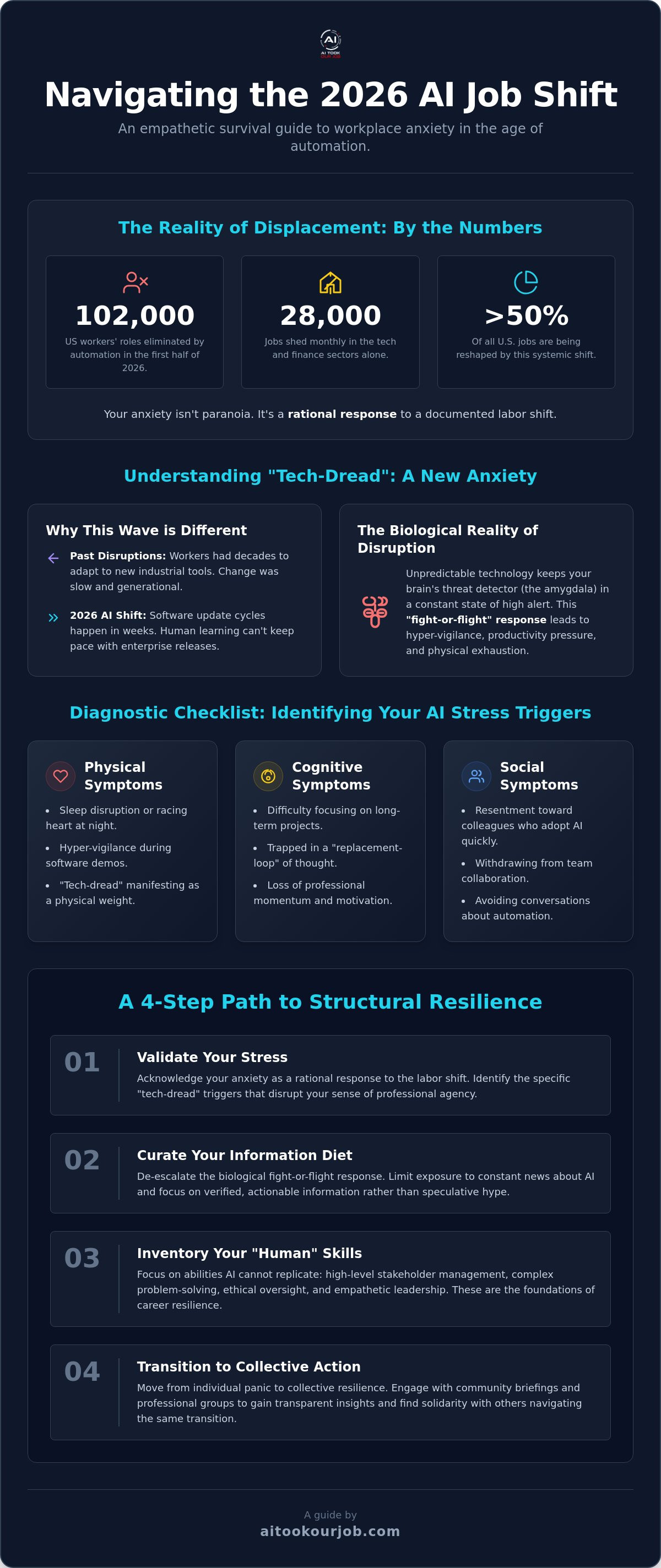
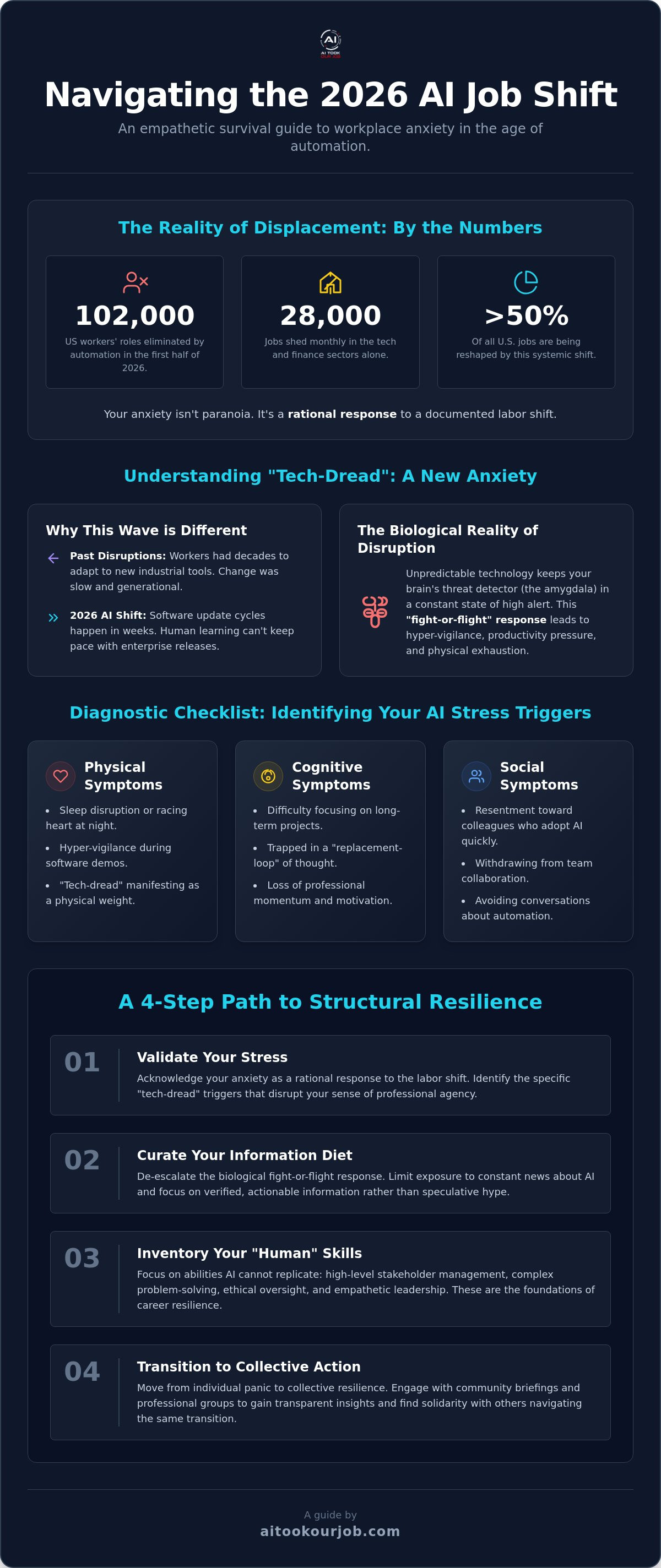
In the first half of 2026, nearly 102,000 American workers saw their roles eliminated by automation. If you find yourself scanning every team meeting for subtext or feeling like a temporary placeholder until the software is ready, you aren't overreacting. The tech and finance sectors are currently shedding 28,000 jobs every month. Your workplace anxiety AI fears are grounded in a stark, documented reality. It is a rational response to a systemic shift that is reshaping over 50 percent of all U.S. jobs.
You don't need more "grit" or superficial optimism. You need a way to stay grounded while the ground itself is moving. This guide provides an empathetic, unflinchingly honest survival checklist to help you identify triggers and lower your cortisol levels. We will explore how to navigate your rights under new 2026 state regulations like the Colorado AI Act, and how to transition from individual panic to collective resilience. You aren't alone in this transition. There is a practical, community driven path forward that honors your humanity in an increasingly automated world.
Key Takeaways
- Validate your stress as a rational response to the 2026 labor shift and identify the specific "tech-dread" triggers that disrupt your professional agency.
- Implement a curated information diet to de-escalate the biological fight-or-flight response often triggered by workplace anxiety AI and constant software updates.
- Inventory your un-automatable human skills, focusing on high-level stakeholder management and ethical oversight to build a foundation of structural career resilience.
- Transition from individual panic to collective action by engaging with community-driven briefings that provide transparent, real-time insights into industry transitions.
Understanding AI-Induced Workplace Anxiety in 2026
AI anxiety is the persistent fear that your skills, utility, or professional role will be rendered obsolete by algorithmic systems. It isn't a pathology. It isn't a sign of personal weakness. Instead, it's a data-backed response to the 2026 labor shift. When nearly 102,000 American workers lose their jobs to automation in a single six-month period, feeling uneasy isn't "paranoia." It is an accurate assessment of the environment. This specific form of workplace anxiety AI creates is distinct from general job insecurity. Traditional layoffs usually follow a clear market dip or poor corporate performance. AI displacement is different because of its "black box" nature. You don't know when the next software update will happen. You don't know which of your tasks will be deemed "automatable" next Tuesday. This uncertainty leads to a Human Utility Crisis. We stop asking if we'll be fired and start questioning if our human contribution still has value.
The Biological Reality of Disruption
Our brains aren't built for the current pace of change. When you face technology you cannot predict or control, your amygdala stays in a state of high alert. This part of the brain, responsible for the fight-or-flight response, perceives the unpredictable nature of 2026 software agents as a threat to your survival. It creates a constant productivity pressure on your nervous system. You might feel a desperate need to work faster just to outrun the code. This persistent state of hyper-vigilance is physically exhausting. Understanding the psychology of AI job loss is a vital step in reclaiming your agency. You have to recognize that your body is trying to protect you from a perceived predator in the digital grass.
Why This Wave of Anxiety is Different
The speed of deployment in 2026 is unprecedented. Historically, workers had decades to adapt to new industrial tools. Now, update cycles happen in weeks. This creates a cognitive disconnect. Human learning cannot keep up with the release schedule of enterprise-grade productivity tools. We are also witnessing the "Invisible Replacement." Roles aren't always eliminated overnight. They are hollowed out. You keep your job title, but the meaningful, creative parts of your day are handed to a prompt. You become a supervisor of a machine that used to be your craft. AI anxiety is a rational evolutionary response to perceived resource scarcity. It is a modern manifestation of technological unemployment, a phenomenon that has shifted societies for centuries, but never at this terrifying velocity.
The Diagnostic Checklist: Identifying Your AI Stress Triggers
Before you can de-escalate the biological response discussed in the previous section, you have to identify where the pressure is building. Stress isn't a monolith. It manifests in quiet, specific ways that we often dismiss as just part of the job. But in 2026, the unique pressure of workplace anxiety AI requires a more precise diagnostic. Identifying your triggers is the first step toward reclaiming your sense of agency. Are you experiencing these symptoms?
- Physical Symptoms: You find yourself struggling with sleep disruption or waking up at 3:00 AM with a racing heart. During software demos or town halls, you experience hyper-vigilance, scanning the presenter’s face for signs of upcoming efficiency announcements. That tech-dread on Sunday nights has become a physical weight in your chest.
- Cognitive Symptoms: It’s becoming harder to focus on long-term projects because you’re trapped in a replacement-loop. You keep asking yourself why you are perfecting this slide deck if an agent will do it in six months. This leads to a profound difficulty in maintaining professional momentum.
- Social Symptoms: You might feel a growing resentment toward colleagues who adopt new AI tools faster than you. This often leads to withdrawing from team collaboration or avoiding Slack channels where automation is discussed. According to a recent APA survey on AI anxiety, these feelings of isolation are increasingly common as the two-track labor market takes shape.
Environmental Red Flags
Sometimes the trigger isn't inside you. It’s in the walls. Pay attention to management’s shift toward efficiency metrics that prioritize raw output over human quality. Are tools being implemented suddenly, without clear training or human-in-the-loop safeguards? Watch for stealth automation. This is a culture where roles aren’t refilled after attrition, and the remaining work is quietly shifted to algorithmic agents. If this environment feels familiar, staying informed through a reliable industry briefing can help you distinguish between rumors and reality.
Internal Narrative Check
We often tie our entire self-worth to specific tasks. If you are a writer and an AI writes a draft, it feels like an attack on your soul. This leads to a sense of identity loss as your professional niche narrows. Ask yourself: am I more than the sum of my automatable outputs? Learning how to reclaim your identity after AI displacement is essential for long-term mental health. You are a strategic thinker and a complex human being. No software can replicate your lived experience or your ethical judgment. Don't let the machine define your value.
De-escalating the Biological Response to Automation
You have identified the triggers. Now, you need to manage the fire. When a new tool is announced, your body reacts before your logic can intervene. This is the biological core of workplace anxiety AI. To stay functional, you must learn to lower your internal temperature in real time. Start with immediate grounding. When the email arrives or the demo begins, don't touch your keyboard. Put your hands on your desk. Feel the texture of the wood or metal. This physical intervention signals to your amygdala that you are safe in the physical world, even if the digital one feels volatile. It's a small, necessary act of rebellion against the panic of displacement.
Control your information diet. Stop the doomscroll. Most AI news is curated for engagement rather than accuracy, feeding a cycle of perpetual dread. Recent research on AI and emotional exhaustion shows a direct link between constant AI awareness and a decline in mental well-being. You don't need to know every experimental update. You only need to know what impacts your specific workflow. Establish "Analog Zones" in your day. Use a paper journal for brainstorming. Conduct face-to-face meetings without screens. These zones remind your brain of your human-centric utility, proving that your value exists independently of the software you use. Finally, practice radical honesty. Admit your fear to a trusted peer. Isolation is where anxiety grows; shared reality is where it begins to dissolve.
Managing the "Replacement Loop"
Interrupt the spiral. We often tell ourselves stories like, "If the AI does my reporting, then I am useless." This is the replacement loop. You have to break it by focusing on high-context tasks. AI lacks nuance, ethics, and genuine empathy. It can't navigate a delicate stakeholder conflict or understand the unspoken culture of your team. Set firm boundaries with the 2026 hustle culture. You can't outpace an algorithm by working more hours. Don't try. Instead, double down on the strategic oversight that code cannot replicate.
Restoring Psychological Safety
Ask for transparency. You can request clarity from management without sounding anti-tech or fearful. Use neutral language: "How does this tool change my specific performance metrics?" Knowledge is a grounding force. Build a mutual support pact with your colleagues. Share resources and information openly rather than hoarding "hacks." Solidarity is a structural defense against displacement. High levels of chronic cortisol inhibit the very creative thinking and problem-solving skills you need to adapt to AI. By lowering your stress, you are literally making your brain more resilient to the transition.
Structural Resilience: A Checklist for Professional Transition
Resilience is not a feeling. It is a structural defense system built on the reality of your current market value. If you feel trapped in your current role, your workplace anxiety AI will remain high regardless of how many breathing exercises you perform. To lower the stakes, you must shift from a defensive posture to a prepared one. This transition requires a cold-eyed assessment of your professional moats. You aren't just a collection of tasks; you are a strategic asset. By following a structured checklist, you can move from a state of reactive fear to one of proactive agency.
- Inventory your "un-automatable" skills: Identify the high-context areas where code fails. This includes complex stakeholder management, ethical oversight, and cross-departmental diplomacy. These are the human moats that protect your utility.
- Keep a "Human Value Log": Document every problem you solved that required intuition or empathy. This provides a record of impact that an algorithm cannot replicate. It is your proof of value for future negotiations.
- Network outside the algorithm: Algorithms don't hire people; people do. Focus on human-to-human connections and mentorship that exist independently of platform feeds or corporate Slack channels.
- Build a "Displacement Fund": Financial stability is the ultimate cure for panic. Setting aside three to six months of expenses won't stop a layoff, but it will provide the psychological breathing room needed to think clearly during a transition.
Real-World Upskilling vs. Corporate Fluff
Don't waste time on "AI-washing" certifications. Many internal corporate programs are designed to make the organization look innovative rather than making you more marketable. Research shows that AI is 5.7 times more likely to shift your job responsibilities than to eliminate your role entirely. Focus your learning on "AI-Adjacent" functions like system auditing, integration management, and output verification. Look for training that teaches you to be the architect of the workflow instead of just another user of the tool. To stay grounded in what the market actually demands, join our Community Membership for peer-led insights and shared resources.
The Power of the Exit Strategy
A Plan B is the best medicine for workplace dread. It gives you the power to negotiate from a position of strength or walk away when a culture becomes toxic. When you update your resume, don't frame yourself as a victim of technological shifts. Instead, position yourself as a professional who navigated a major industry transition with strategic foresight. You can read our AI Job Market Weekly Briefing to identify where the real opportunities are emerging in 2026. Knowing where the exits are makes staying in the room much easier.
Finding Solidarity: Moving Beyond Individual Panic
Individual survival strategies are essential. They keep you grounded. However, they don't change the systemic reality of the 2026 labor market. Real resilience is collective. You have to move from a mindset of "Me vs. The Machine" to "Us vs. The Displacement." When you realize that your workplace anxiety AI is shared by thousands of peers across the tech and finance sectors, the shame of displacement begins to fade. It stops being a personal failure. It starts being a shared industrial transition. Solidarity is the only response that matches the scale of the disruption we are facing together.
Community media and transparent briefings serve as a necessary counterweight to corporate PR. While a company might frame a 28,000-job decline as "operational optimization," a community tells the truth about the human cost. This radical honesty is vital. It allows you to process the reality of the situation without the filter of "superficial optimism" that often characterizes management communications. By sharing the burden of uncertainty, we reduce the weight on any single individual. We move from a state of paralysis into a state of informed, collective preparation.
The Role of Community in 2026
Isolation is a choice that often benefits the systems displacing us. It keeps workers from comparing notes or noticing patterns in how roles are being hollowed out. In a community setting, you can ask the questions you simply cannot ask HR. How are other teams navigating the human review and appeal processes mandated by the Colorado AI Act? Are others seeing the same "stealth automation" trends during quarterly reviews? Finding peers in different sectors who face the same algorithmic hurdles provides a perspective that no corporate town hall will ever offer. It breaks the "placeholder" feeling by reminding you that your humanity is a shared asset, not a professional liability.
Channeling Anxiety into Advocacy
Anxiety is a potent source of energy. You can let it manifest as a replacement loop, or you can channel it into advocacy for "Responsible AI" and labor transparency. Moving from passive victimhood to active participant in labor policy discussions changes your internal narrative. You aren't just waiting for the next software update to happen to you. You are part of a mobilized community that understands its rights under new 2026 regulations. Staying informed through consistent, truth-telling resources keeps you ahead of the curve. It ensures you have the data needed to advocate for yourself and your peers. Join our community and get the Weekly Briefing to stay informed and supported. Your story is part of the larger map we are drawing for the future of work.
Reclaiming Agency in the 2026 Workforce
Your discomfort is a signal. It tells you that the landscape has shifted and your old maps no longer apply. Managing workplace anxiety AI isn't about ignoring the data or waiting for the tide to turn. It's about shifting your response from isolation to action. We've mapped the path from identifying biological stress triggers to building structural resilience through human-centric skills. You now have the tools to inventory your unique value and establish the analog zones necessary to protect your focus and your sanity.
The transition ahead is significant, but you don't have to face it in a vacuum. True resilience is built through collective intelligence and radical honesty about the market. Don't navigate the AI shift alone. Subscribe to the Weekly Briefing for the ground-level truth. You'll join over 10,000 professionals in our displacement community who receive weekly updates on the real labor market and participate in expert-led discussions on career transition. We're navigating this shift together. Stay informed. Stay connected. Your human utility is not a variable in a corporate equation. You're part of a mobilized community that values shared wisdom over top-down instruction.
Frequently Asked Questions
Is it normal to feel physical symptoms of anxiety because of AI?
Yes, physical symptoms are a standard response to systemic disruption. Your nervous system is reacting to a perceived threat to your resources and professional agency. Hyper-vigilance and sleep disruption are common. These aren't signs of personal weakness. They are biological indicators that you need grounding. Reclaiming your agency starts with acknowledging these physical signals rather than suppressing them.
How can I tell the difference between standard job stress and AI displacement anxiety?
Standard job stress usually involves a heavy workload or a difficult manager. AI displacement anxiety is different because it feels existential. It is the specific fear that your utility is being erased by a "black box" you can't control. If your stress is tied to the fear of being replaced by code, you're dealing with workplace anxiety AI triggers. It's a rational response to a documented labor shift.
What should I do if my boss starts replacing my tasks with AI without telling me?
You should request a direct conversation regarding your changing performance metrics. Don't approach this with accusations. Instead, ask how these automated tools change your specific responsibilities. Knowledge is a grounding force. If your role is being hollowed out, having the "ground-level truth" allows you to plan your next move with clarity. Transparency is your right in a shifting market.
Can upskilling really cure my workplace anxiety?
Upskilling is a tool for transition, but it isn't a "cure" for the systemic fear of displacement. Learning new software won't stop the industry from shifting. However, focusing on "un-automatable" human skills can lower your internal temperature. It provides a sense of structural resilience. You aren't just learning a tool; you're protecting your professional moat against automation.
How do I talk to my colleagues about our shared fear of AI without sounding negative?
Use "radical honesty" to frame the conversation around shared professional realities. You don't have to be negative to be realistic. Ask your peers how they are navigating new efficiency metrics or update cycles. This shifts the focus from individual panic to collective resilience. Solidarity is the best defense against the isolation that displacement often creates. It turns fear into a shared strategy.
What are the first signs that my industry is facing an AI labor shift?
Watch for "stealth automation" where roles aren't refilled after attrition. Another sign is a sudden management obsession with efficiency metrics over human quality. In 2026, many organizations are reshaping over 50 percent of their roles through AI. If your creative tasks are being replaced by agents while your title remains the same, your industry is facing a labor shift. These are clear indicators that it's time to act.
Where can I find a community of people who have actually been displaced by AI?
You can find a dedicated community of over 10,000 professionals within our membership platform. We focus on truth-telling and shared wisdom rather than corporate spin. It's a space where you can ask the questions you can't ask HR. Connecting with others who face similar algorithmic hurdles reduces the shame of displacement. You'll find peers who understand the reality of the 2026 market.
Is there any legal protection against AI-driven job loss in 2026?
Yes, several state laws take effect in 2026 to provide transparency. The Colorado Artificial Intelligence Act (CAIA) mandates a process for human review and appeal for employment decisions starting June 30, 2026. Illinois and Texas also implemented laws on January 1, 2026, to prevent discriminatory outcomes from automated systems. These regulations ensure you aren't just a variable in a black box. You have a right to know how AI impacts your career.