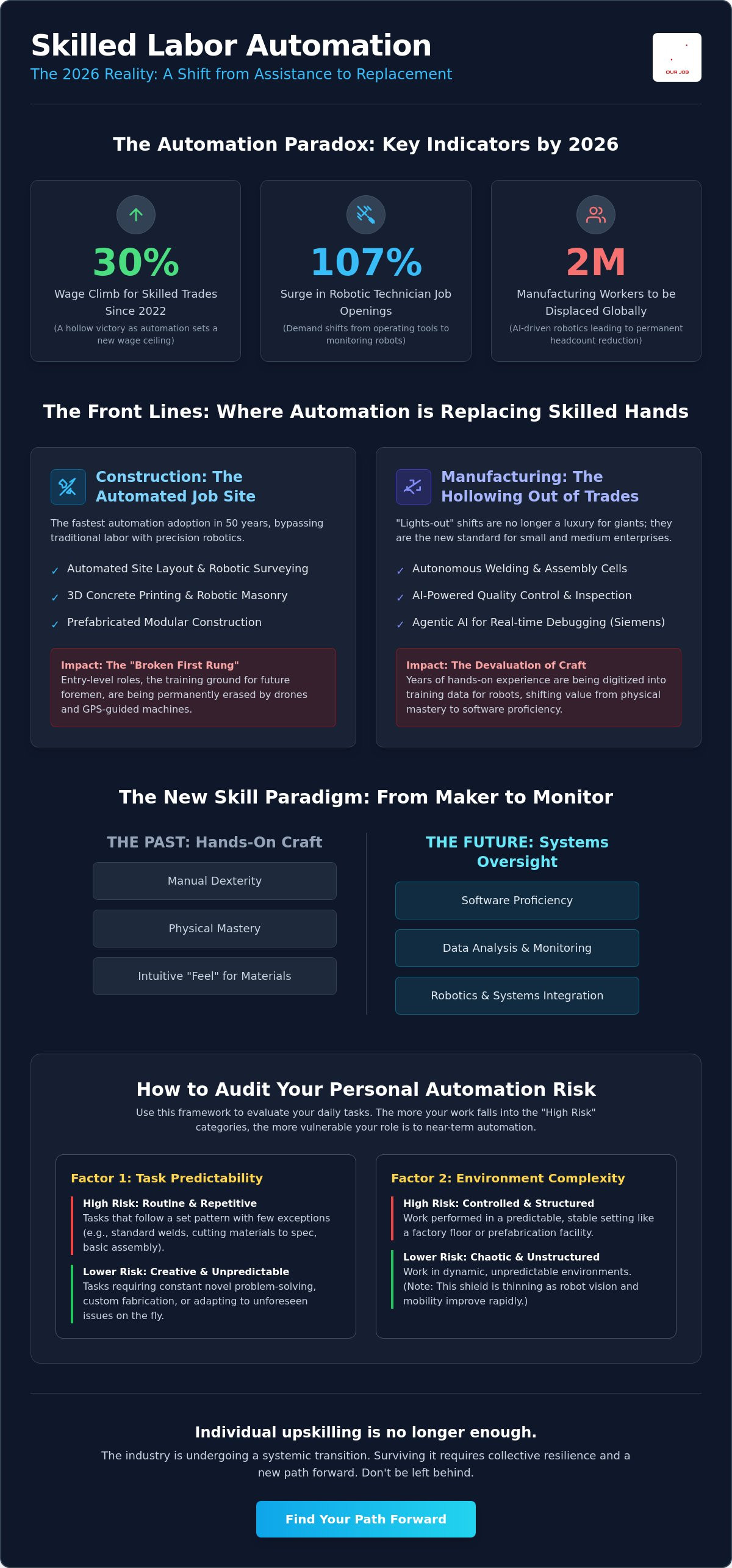
What if the very tools you were told would make your job easier are actually being designed to make you obsolete? It's a hard question to face while you're standing on the job site. You've likely noticed the shift already. While wages for skilled trades have climbed 30% since 2022, that extra pay feels hollow when you see Siemens' Agentic AI assistants debugging code in real-time or robotic technician roles surging by 107%. The rise of skilled labor automation isn't a distant threat anymore; it's the current reality of 2026. You feel the pressure of being aged out by technology that doesn't need a lunch break or a pension. It's a heavy burden to carry alone.
We aren't here to offer empty platitudes or tell you that everything will be fine if you just "work harder." Instead, this is a radical, honest look at how automation is hollowing out the trades and what it actually means for your career survival. You'll gain a clear-eyed understanding of the 2026 automation timeline and learn how to identify which specific parts of your daily routine are most at risk. We will explore the "Broken First Rung" problem and the new regulatory landscape, including the Colorado AI Act, to help you find a path forward with a community of peers who refuse to be left behind.
Key Takeaways
- Understand why 2026 marks a fundamental shift from tools that assist to autonomous systems that make real-time decisions on the job site.
- Identify the specific sectors in construction and manufacturing where "lights-out" shifts and robotic masonry are already replacing manual intervention.
- Learn how skilled labor automation creates a wage ceiling for traditional craft while concentrating financial rewards among a shrinking group of technical specialists.
- Master a practical framework to audit your daily tasks for predictability and environment complexity to pinpoint your personal automation risk.
- Discover why individual upskilling is no longer enough and why building collective resilience is the only way to survive a systemic industry transition.
Defining Skilled Labor Automation in the 2026 Economy
Skilled labor automation is the integration of algorithmic decision-making into physical trades. This is no longer about a better power tool or a faster assembly line. It is a fundamental shift from machines that follow instructions to systems that perceive, analyze, and act. In the 2026 economy, the distinction between "digital" and "physical" work has dissolved. When a machine can navigate a chaotic construction site or adjust a weld in real-time based on thermal data, the human role changes instantly. We are moving away from tools that require a hand and toward systems that require a monitor.
The narrative you often hear is one of necessity. Companies frequently point to a "labor shortage" to justify massive capital investments in autonomous technology. While it is true that some roles are hard to fill, this story often masks a deeper motivation. Automation isn't just bridging a gap; it is resetting the floor for labor costs. With 2 million manufacturing workers globally expected to be displaced by AI-driven robotics by the end of 2026, the reality is clear. This transition is less about finding help and more about permanent headcount reduction. It is a calculated move toward a future where human presence is a variable to be minimized.
The Convergence of AI and Physical Robotics
What makes 2026 different? It is the marriage of Large Language Models (LLMs) and advanced computer vision. Robots have finally solved the "unstructured environment" problem. They can now "see" and understand a messy job site just as well as you can. Siemens has already integrated Agentic AI assistants into its TIA Portal this year to provide real-time code debugging for engineers. Meanwhile, Rockwell Automation is preparing the release of its Logix Edge software-centric control system in Q4 2026. These advancements mean that "Cobots" are no longer just safety-conscious helpers. They are a transitional phase leading directly toward full autonomy. The timeline from "assistant" to "replacement" is shrinking every day.
From Craftsmanship to Systems Oversight
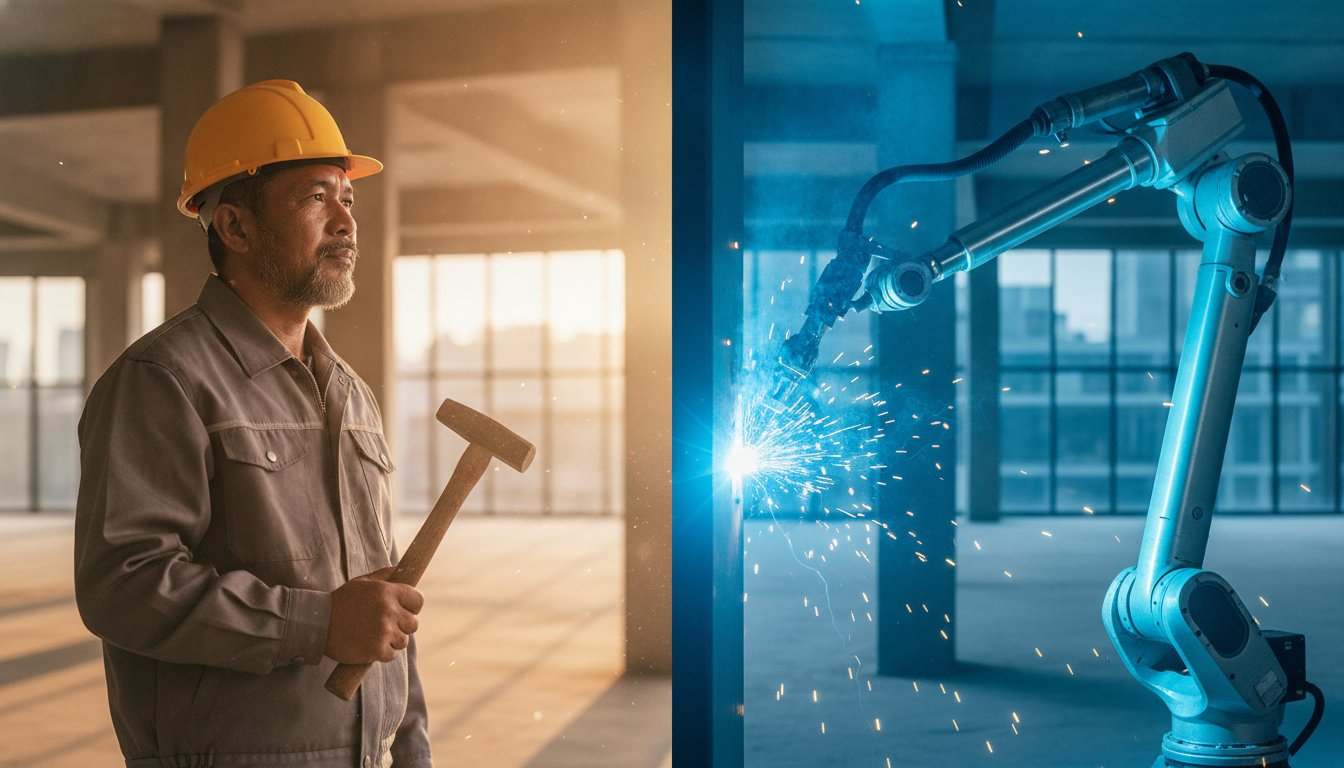
The "human touch" was once considered the ultimate shield against machines. That shield is thinning. Your years of experience and your "feel" for the material are being quantified and digitized into training data. This leads to a phenomenon known as technological unemployment, where manual dexterity is no longer the primary measure of value. You are being asked to shift from being a "maker" to being a "monitor." In this new landscape, "skilled" is increasingly defined by software proficiency rather than physical mastery. Do you want to be the one swinging the hammer, or the one watching the screen while the machine does it for you? The answer to that question will determine your survival in this trade shift.
The Front Lines: Where Automation is Replacing Skilled Hands
The hands that built our infrastructure are being replaced by sensors and actuators. It isn't a theory. It's happening at 7:00 AM on job sites across the country. Skilled labor automation is no longer confined to clean rooms or tech hubs; it has arrived in the mud and the grease. As of May 2026, job openings for robotic technicians have surged by 107%, a direct reflection of how quickly autonomous welding and assembly cells are taking over factory floors across North America. This isn't just about efficiency. It's about a fundamental reconfiguration of who is allowed to participate in the physical economy.
Construction and the Automated Job Site
Construction is seeing the fastest automation adoption in 50 years. Companies are aggressively deploying automated site layout systems and 3D concrete printing to bypass traditional labor costs. Entry-level layout roles, once the essential training ground for future foremen, are being erased by drones and robotic surveying tools that work with millimeter precision. Prefabricated modular construction is moving the work from the field to the factory, where environment-controlled machines handle the heavy lifting. The Impact of Automation on Skilled Trades is most visible here, where the perceived "labor shortage" has become a permanent excuse for total machine replacement.
The Hollowing Out of Manufacturing Trades
In manufacturing, the "lights-out" shift is no longer a luxury for industrial giants. Small and medium enterprises are now running entire production cycles without a single human on the floor. Veteran welders and machinists are being rebranded as "Cell Operators," their roles reduced to clearing jams and watching dashboards. This is the future AI job displacement we were warned about, where human intuition is replaced by predictive AI that knows when a part will fail before it even starts to vibrate. Generative design software now handles the prototyping that used to require a master machinist's touch, hollowing out the middle of the workforce.
Even the most experienced mechanics are finding their "ear" for engines superseded by vibration sensors and neural networks. Predictive AI is hollowing out the maintenance trades by detecting failures weeks in advance. These systems don't just detect problems; they schedule the repairs for the few remaining human technicians or, increasingly, for specialized repair robots. It feels like the ground is shifting beneath your boots. You don't have to navigate this transition in isolation. Staying informed is your first line of defense, and you might find it helpful to track these shifts weekly to see the next wave before it hits.
The Skill Premium Paradox and the Devaluation of Craft
The market is sending mixed signals. You see headlines about historic wage growth, yet your paycheck feels like it has hit a glass ceiling. This is the skill premium paradox. While average trade wages rose 30% between 2022 and 2026, the real gains are being captured by a tiny sliver of the workforce. Skilled labor automation is creating a winner-take-all environment where the gap between the expert and the competent is becoming a canyon. If your value is tied to a task that a machine can now replicate, your bargaining power doesn't just stall; it evaporates. It is a quiet, steady erosion of the financial security you were promised.
Automation sets a hard ceiling on what a human can charge for their time. Once a company invests in a robotic masonry system or an autonomous welder, the operating cost of that machine becomes the new benchmark for labor. A human worker cannot easily charge a premium for craftsmanship when a machine delivers consistency at a fixed hourly rate. This commoditization of trade skills is hollowing out the middle of the labor market. The journeyman role, once the stable backbone of the industry, is disappearing. You are increasingly pushed toward one of two poles: a low-wage monitor of machines or a high-wage architect of systems.
The Winner-Take-All Trade Economy
The expert tier remains safe for now, but the competent tier is under siege. Research into skilled labor challenges and automation shows that technology doesn't just fill gaps; it redefines what skill actually means. Our weekly briefing AI job market data reveals that workers who can apply AI to specific domain problems command a 62% wage premium. Meanwhile, the value of basic AI literacy has compressed by 15% since 2023. The market no longer rewards you for knowing how to use the tool. It rewards you for knowing when the tool is failing and having the judgment to intervene.
The Loss of Bargaining Power
Automation is the silent strikebreaker of the modern era. In labor disputes, the threat of a walkout loses its sting when the machines don't need to leave the floor. This shift also destroys the traditional apprenticeship model. When entry-level, repetitive tasks are automated, the first rung of the career ladder is removed, leaving no way for the next generation to climb. If a machine can do 80% of your job, what happens to your leverage during a contract negotiation? You aren't just competing with other workers anymore. You are competing with an asset that doesn't tire, doesn't unionize, and never asks for a raise. We must acknowledge this reality together to build a new kind of collective resilience.
How to Audit Your Role for Automation Risks
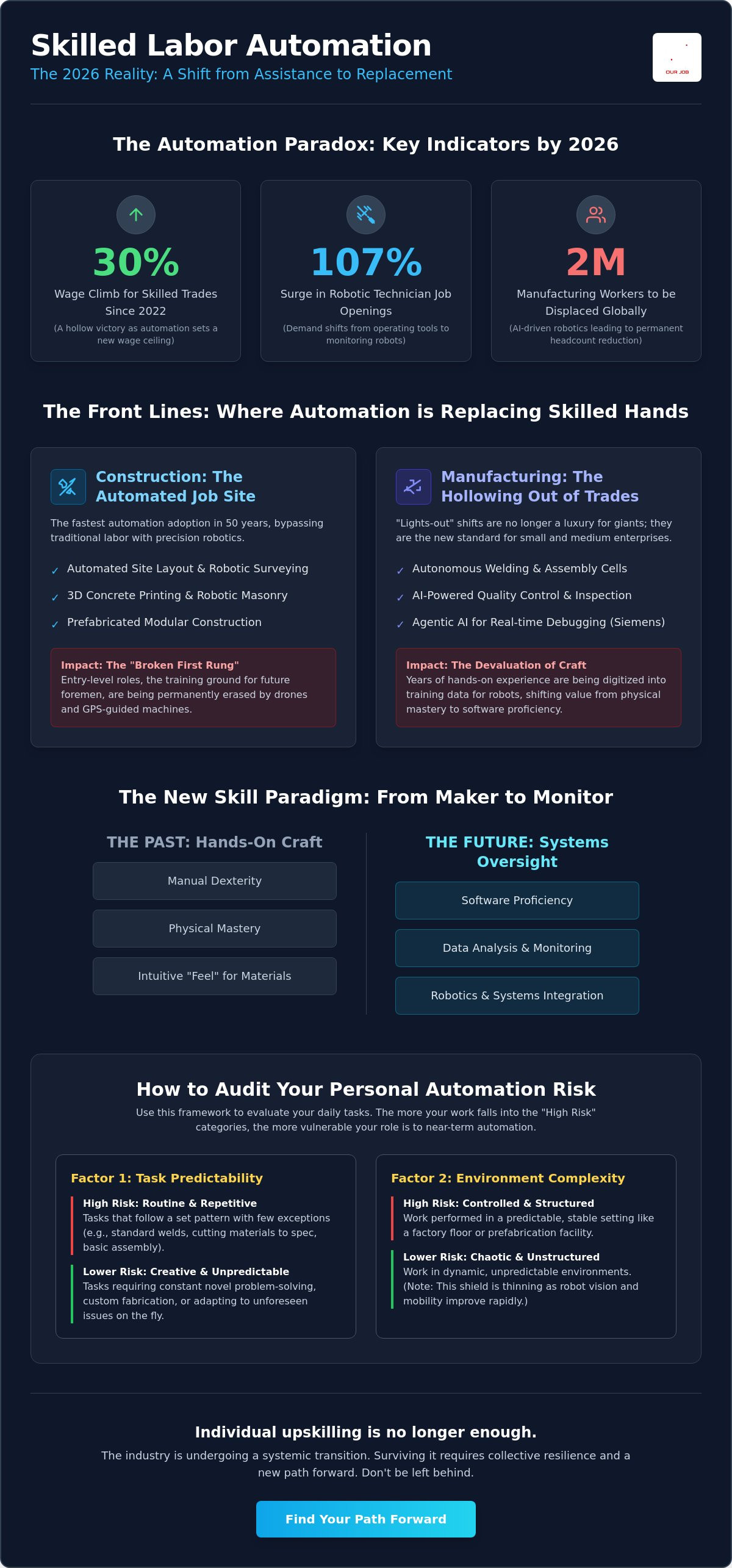
Waiting for a layoff notice is a strategy for failure. You need to look at your daily routine with the same cold objectivity a CFO uses when reviewing a capital expenditure request. The rise of skilled labor automation isn't a mysterious force; it's a series of calculated financial decisions. If your role consists of tasks that are repetitive, predictable, and data-heavy, the clock is already ticking. You must identify the "Intuition Gap" in your work. This is the space where you make complex, non-linear decisions that software cannot yet replicate. If that gap is small, your risk is high.
Consider the investment cost. A common rule in industrial boardrooms is the three-year salary threshold. If the technology to automate your primary tasks costs less than your total compensation over three years, the decision to replace you has likely already been made. Research suggests that 47% of US workers are at risk of having their jobs automated over the next decade. You aren't just competing with a machine's speed; you're competing with its lack of healthcare costs, vacation days, and human error. It's a brutal calculation, but seeing it clearly is the only way to prepare.
Task-Level vs. Role-Level Automation
Roles rarely vanish overnight. They are eroded task by task in what we call the "Boiling Frog" effect. You might notice a new piece of software that handles your scheduling, or a sensor that takes over your quality control checks. These feel like "helpers," but they are actually carving out the core utility of your position. Use this checklist to identify high-risk tasks in your trade:
- Does the task follow a strict Standard Operating Procedure (SOP)?
- Is the work environment highly controlled and predictable?
- Can the outcome of your work be measured purely by data?
- Does the task require high physical dexterity in a static position?
The Reality of Reskilling
The advice to "learn to code" was a distraction. In 2026, the real value lies in learning to oversee the systems that do the work. This means shifting your focus to AI-resistant niches. Custom restoration, complex troubleshooting in chaotic "brownfield" environments, and high-level leadership are harder to automate than new-build construction or assembly line welding. Understanding the psychology of AI job loss is essential here. It helps you maintain your professional identity while your manual utility is being stripped away. You aren't losing your worth; you're being forced to reapply it.
Don't face this transition without a map. You can join our community membership today to access the tools and peer support you need to navigate these audits and find your next secure foothold.
Beyond Displacement: Building Collective Resilience
Upskilling alone is a myth. We've been told for years that if we just learn one more software or get one more certification, we'll stay ahead of the curve. It's a lie. When an entire industry undergoes a systemic shift, individual effort isn't enough to stop the tide. Skilled labor automation is a global reconfiguration of value, and you can't out-train a machine that is being designed to replace your core utility. We must move beyond the "me" and start focusing on the "us." Resilience isn't found in a new digital badge; it's found in collective action and radical honesty about our shared reality.
The goal of the AI Took Our Job community is to break the isolation that follows displacement. It's easy to feel like you've failed when your trade changes, but the numbers tell a different story. With projections suggesting 92 million jobs could be displaced globally by 2030, this is a societal crisis, not a personal one. We need to advocate for policies that prioritize workers over corporate margins. This means supporting frameworks like the Texas Responsible AI Governance Act or the Illinois Human Rights Act amendments, which demand transparency in how these systems are deployed. We don't just need better skills; we need better protections.
Radical Honesty in the Workplace
Start by breaking the silence on the shop floor. Talk to your coworkers about the new sensors, the "smart" layout tools, and the robotic cells being introduced. Management often frames these as safety upgrades or efficiency boosts, but we must identify the signs of "hidden automation" designed to eventually reduce headcount. Are the new machines slowly taking over the most complex parts of the job? Is the training you're receiving actually turning you into a temporary monitor for your own replacement? Moving from anxiety to action requires communal knowledge. When we share what we see, the "Boiling Frog" effect loses its power.
Joining the Briefing
You need a source of truth that doesn't rely on the toxic positivity of tech media. Most industry news is written for investors, not for the people whose hands are on the tools. Our AI Job Loss Weekly Briefing is designed to be a "no-nonsense" briefing that tracks real-world displacement events and regulatory shifts. It's a survival map for the 2026 labor shift. We don't offer superficial optimism; we offer grounded, actionable data so you can see the next wave before it hits your zip code. Staying informed is your first line of defense in a world that wants to treat your experience as training data.
You are more than your utility to a machine. Your worth as a craftsman, a peer, and a human being is not something an algorithm can quantify. Join our community membership today to find your place among others navigating this transition. We are building a hub for those who refuse to be quiet about the hollowing out of the trades. Together, we can find a path forward that acknowledges the unflinching reality of 2026 without falling into despair. Let's start the conversation.
Securing Your Place in a Transformed Industry
The transition we are witnessing is not a temporary dip. It is a permanent restructuring of how we build, manufacture, and maintain our world. We've explored how skilled labor automation is eroding the middle of the trade market and why auditing your tasks is the only way to survive. The reality is heavy. It doesn't have to be paralyzing. You now have the framework to identify your risks and the understanding that your value as a professional remains, even as your manual utility is challenged.
Information is your most powerful tool. You don't have to navigate these shifts in isolation or rely on the empty promises of tech giants. Join the AI Took Our Job Weekly Briefing to stay ahead of the automation wave. By signing up, you'll join a community of thousands of professionals who are choosing collective resilience over individual anxiety. We provide weekly data-driven insights on labor market shifts and empathetic, no-nonsense advocacy for the displaced. The future is uncertain. We are stronger together. Stay sharp, stay connected, and remember that we're in this with you.
Frequently Asked Questions
Is skilled labor really at risk from AI compared to white-collar jobs?
Yes, the risk is significant but manifests differently than in office roles. While white-collar workers face cognitive automation, tradespeople are dealing with the convergence of AI and physical robotics. This skilled labor automation is hollowing out the middle rungs of the career ladder by replacing repetitive physical tasks that once required years of manual experience with machines that don't tire or require benefits.
Which trades are the most difficult for AI and robots to automate?
Trades that operate in "unstructured environments" remain the hardest to automate. Custom restoration, complex electrical troubleshooting in older "brownfield" facilities, and roles requiring deep emotional intelligence are safer than roles in controlled environments. If your job requires you to solve non-linear problems in a chaotic space, you have a stronger "intuition gap" that software cannot yet replicate.
What is the "Skill Premium" and how does it affect my paycheck?
The skill premium is the widening wage gap between technical specialists and the general workforce. As of June 2026, workers with AI-specific skills command a 62% wage premium, while the value of basic labor is stagnating. This creates a "winner-take-all" economy where a few experts get raises while the average worker's pay is capped by the cost of running a machine.
How quickly will automation take over construction sites?
The shift is already happening, particularly in commercial projects. By the end of 2026, autonomous site layout and robotic masonry are expected to be standard on large-scale developments. It isn't an overnight takeover; instead, it's a steady erosion where machines handle the "hard" parts of the job, leaving humans to act as monitors rather than makers.
Can I still start an apprenticeship in a trade in 2026?
You can, but you must choose your specialty with extreme care. The "broken first rung" problem means many entry-level tasks are being automated, making it harder for juniors to learn the ropes. Look for apprenticeships that focus on systems oversight, high-level troubleshooting, or custom craftsmanship rather than repetitive roles that are already being targeted by AI-driven robotics.
What should I do if my company starts installing autonomous robots?
You should immediately audit your daily tasks to see which ones overlap with the robot's capabilities. Don't ignore the change or hope it's just a "helper." Instead, move toward the "intuition gap" by taking on responsibilities that require complex judgment or human coordination. Staying quiet about the change only increases your isolation; talk to your peers about building collective resilience.
How does AI Took Our Job help workers in the trades?
We act as a communal hub and a "truth-teller" for those navigating industry transitions. Through our AI Job Loss Weekly Briefing and community membership, we provide data-driven insights that avoid superficial optimism. We help you identify which parts of your job are at risk and connect you with a network of peers who refuse to be left behind.
Is there any legislation protecting skilled workers from AI displacement?
New regulations are finally taking effect to provide some transparency. The Colorado AI Act (CAIA) and the Texas Responsible AI Governance Act now require employers to provide notice about AI use and offer processes for human review. These laws don't stop skilled labor automation, but they do give you a legal foothold to demand transparency and appeal decisions made by algorithms.