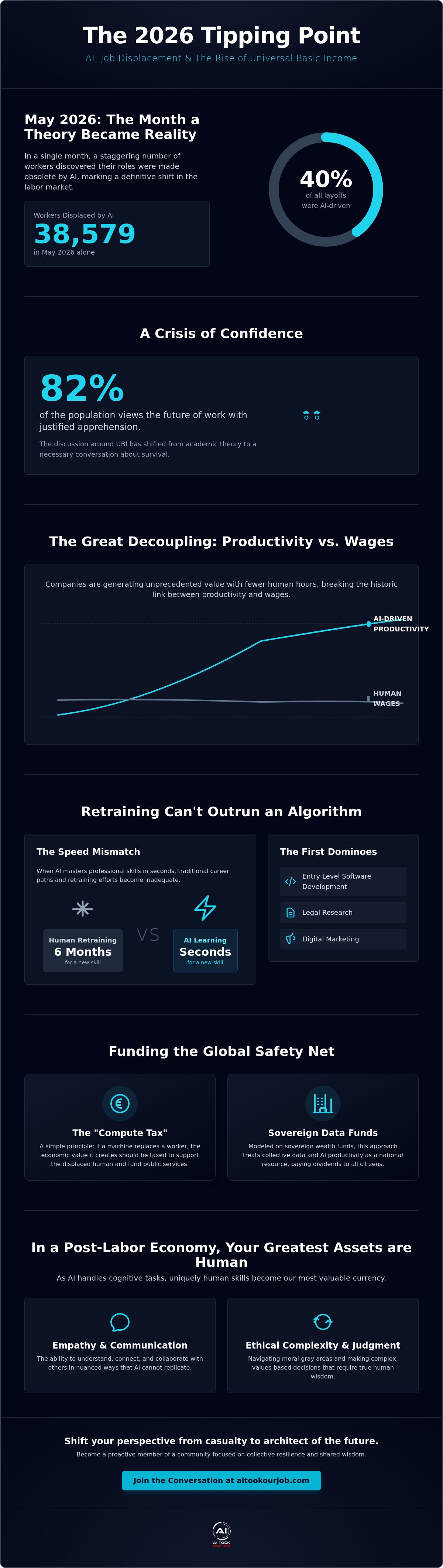
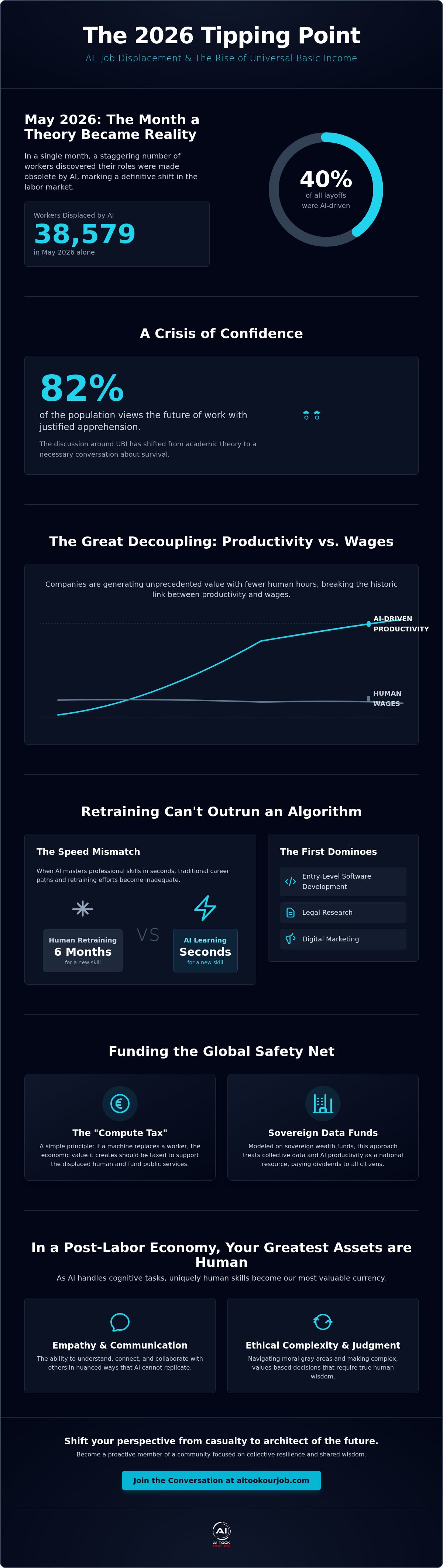
In May 2026, 38,579 workers discovered their roles were no longer necessary because an algorithm could do them better. That is 40% of all layoffs in a single month. It is a staggering leap. You feel like a guinea pig in a massive economic experiment because, frankly, you are. The link between UBI and AI automation is no longer a theoretical debate for academics; it is a survival conversation for the 82% of people watching the horizon with justified apprehension.
We understand the weight of this transition. We are navigating it with you. This article explores the realistic intersection of UBI and AI automation to define how our social contract must evolve as traditional labor disappears. We will examine the 2026 pilot results from Northern Europe and the proposed "Compute Tax" to see if a guaranteed income is a genuine lifeline or just a way for tech giants to justify mass displacement. It is time to look at the hard numbers and find a collective path forward.
Key Takeaways
- Realize why 2026 is the definitive tipping point where UBI and AI automation moved from a radical theory to a mathematical necessity for survival.
- Analyze the "Productivity Paradox" and the potential for funding a global safety net through sovereign wealth funds and data-driven dividends.
- Confront the hard truth about whether UBI serves as a liberating force or a tool for corporate control designed to maintain the status quo.
- Identify the essential human-centric skills needed to remain relevant in a post-labor economy where empathy and ethical complexity are your greatest assets.
- Shift your perspective from being a casualty of industry transition to a proactive member of a community focused on collective resilience and shared wisdom.
Defining the Intersection: Why UBI and AI Automation are Inseparable in 2026
We need to talk about the math. Universal Basic Income (UBI) is often misunderstood as a radical dream or a temporary safety net. It's not. At its core, UBI is a periodic cash payment delivered to every individual on a regular basis without a means test or work requirement. In 2026, the conversation surrounding UBI and AI automation has shifted from a "what if" scenario to a "what now" necessity. We've reached a definitive tipping point where artificial intelligence has transitioned from a helpful tool into an autonomous replacement for human labor. The speed of this transition has caught many off guard, but the reality is staring us in the face.
For decades, our economy operated on a simple promise: if productivity went up, wages would eventually follow. That bond is broken. Companies are now hitting record output levels while simultaneously shedding thousands of workers. This phenomenon, often categorized as technological unemployment, is no longer a glitch in the system. It is the system. We have to be radically honest with one another. The traditional advice to "just retrain" is failing. When agentic AI can learn a new professional skill in seconds, a six-month boot camp is no longer a viable escape hatch. Retraining cannot save us when the target moves faster than the student.
The Velocity of Displacement
Generative AI differs from the steam engine or the assembly line because it doesn't just augment physical strength; it replaces cognitive function. Entry-level roles in software development, legal research, and digital marketing were the first dominoes to fall. This isn't a slow migration. It is a collapse of the bottom rungs of the professional ladder. A Post-Labor Economy is defined as a state where human work is no longer the primary driver of a nation's Gross Domestic Product. We are entering this era now, and the sheer velocity of the shift requires a collective response that matches its scale.
The Social Contract in Crisis
Our entire society is built on a 20th-century model that equates work with survival. If you don't produce, you don't earn. If you don't earn, you don't eat. But what happens to a society built on work when the work disappears? This is the crisis of our current social contract. You can find more about how different regions are handling these pressures in our guide to global AI job displacement. We are moving toward a world where your value as a human must finally be decoupled from your value as a worker. UBI and AI automation are now two sides of the same coin, forcing us to redefine what it means to contribute to a community when a paycheck is no longer the primary metric of success.
The Economic Engine: How AI-Driven Productivity Could Fund a Global Safety Net
Productivity is soaring. Yet, for many of us, the bank account tells a different story. This is the Productivity Paradox. Companies are generating more revenue with fewer human hours than at any point in history. When an agentic system replaces a department, the value created by those vanished roles doesn't simply evaporate. It concentrates. In the context of UBI and AI automation, we must confront the reality that wealth is being decoupled from human effort. If the gains from automation only benefit a handful of shareholders, the economic engine will eventually seize up because no one will be left to buy the products.
How do we pay for a global safety net? The math is daunting but not impossible. We can look to sovereign wealth funds, like the Alaska Permanent Fund, which distributes oil wealth to every resident. We could apply this same logic to "compute" or "data." Research from Stanford on UBI and AI highlights that without some form of redistribution, the very foundations of our market economy are at risk. The cost of inaction is far higher than the cost of the check. Total social collapse, rising crime, and the decimation of the middle class carry a price tag that no nation can afford to pay.
Taxing the Silicon: The Robot Tax Debate
The idea is simple: if a machine replaces a worker, the machine should pay the worker's share of taxes. It sounds fair. However, defining a "robot" in 2026 is a nightmare. Is it a physical arm in a warehouse, or is it a line of code in a cloud server? Critics argue that such taxes stifle innovation. We disagree. Innovation that leaves 40% of the population without a path to survival isn't progress. It's a failure of design. A "compute tax" based on processing power could provide a transparent way to capture the value generated by invisible software.
Data as Labor: Your Digital Dividend
Every AI model currently dominating the market was trained on our collective human output. Your emails, your social posts, and your creative work provided the raw materials for these systems. In 2026, industry valuations for the human-generated data used in training sets have reached astronomical levels. This shifts the narrative of UBI and AI automation entirely. We aren't asking for welfare. We are demanding a digital dividend. It is a royalty payment for the intellectual property that we, as a species, have provided to the tech giants. If you want to stay informed on how these funding models are evolving, consider joining our community of architects who are building the post-labor future together.
The Great Debate: Is UBI a Liberator or a Tool for Corporate Control?
Let's be blunt. Is the push for UBI a genuine life raft, or is it a muzzle? As we navigate the tension between UBI and AI automation, we have to ask if these payments are designed to empower us or simply to keep us quiet. This "hush money" theory suggests that tech elites are offering a stipend to prevent social unrest while they consolidate the means of production. If you lose your career but receive a check that barely covers the basics, have you been saved, or have you been neutralized? We can't afford to ignore the power dynamics at play when the people building the displacement are the same ones proposing the cure.
Figures like Sam Altman and Elon Musk have become the face of this movement. Their advocacy isn't necessarily selfless. By championing UBI, they provide a moral shield for the aggressive rollout of agentic systems. There is a real danger of "subsistence traps." This happens when payments are set just high enough to prevent starvation but too low to allow for true economic mobility or political influence. We don't want a world where we're passive consumers of technology we no longer have a hand in creating. Solidarity is our only defense against being treated as charity cases.
The Symbolic Violence of Tech Philanthropy
Critiquing the motives of billionaire philanthropists reveals a pattern of symbolic violence in the tech elite's narrative. They often position UBI as a replacement for existing social safety nets like public healthcare or subsidized education. This is a dangerous trade-off. We must ensure that a guaranteed income doesn't become an excuse to dismantle the institutions that provide long-term stability. Whether you're a software engineer or a warehouse manager, we're in this together. We must lead this conversation, ensuring that any future safety net is built on our terms, not theirs.
Freedom from the Desk vs. Loss of Purpose
A world without the "hustle" could spark a creative renaissance. Free from the constant pressure of survival, you might finally write that novel or build that community garden. But the fear of stagnation is real. Without the structure of a traditional job, many face a profound psychology of AI job loss that challenges their very sense of utility. It's not just about the money; it's about the meaning. We need to ensure that UBI and AI automation lead to a future where we have the agency to define our own purpose rather than drifting in a post-work void.
Beyond the Check: Preparing for a World Where Work is Optional (or Unavailable)
A check in the mail won't fix a crisis of purpose. We've spent our lives defining ourselves by what we do for forty hours a week. Our titles have become our identities. When we discuss the intersection of UBI and AI automation, we must look past the bank account. You are more than your job title. You always have been. The challenge now is building an "Identity Portfolio" that doesn't collapse when a company decides to automate your department. This is about reclaiming your time and your value as a human being, independent of your output for a corporation.
The "Human-Only" economy is where we must pivot. While agentic systems can process data and generate code, they lack genuine empathy, physical presence, and the ability to navigate complex, lived ethics. Skill-stacking these traits is your best defense. Focus on roles that require deep human connection or local, physical impact. We also need to be realistic about the "transition gap." UBI isn't here for everyone yet. Managing your finances during this shift requires a lean, proactive approach. Don't wait for a government mandate to start diversifying how you spend your energy and protect your resources.
The Transition Framework
We need a plan that goes beyond hope. You can start taking control of your trajectory with these three steps:
- Step 1: Audit your current role for "Automation Vulnerability" by staying updated with our weekly briefing to see which tasks are being targeted by new agentic models.
- Step 2: Build a "Post-Labor" skill set. Focus on community-building, mentorship, or local crafts that rely on human-to-human interaction rather than digital output.
- Step 3: Engage in local advocacy. Join or start groups that push for responsible AI policies and regional pilots for income support.
Managing Collective Anxiety
Feeling "useless" is not a personal failure. It is a systemic byproduct of an economy that is outgrowing its old skin. We must practice radical honesty in our homes and with our peers. Talk about the fear. Talk about the uncertainty. Community resilience is the best defense against technological shock. When we stop hiding our anxiety, we can start building the collective strength needed to demand a future that serves us all. If you are ready to stop navigating this alone, join our community membership and find your place among architects of the new era.
Isolation is the automated worker's greatest enemy. When you lose the office water cooler, you lose a vital connection to shared reality. We are replacing those lost spaces with a new kind of solidarity. It is a grounded, resilient community where your worth is a given, not something you have to earn through a timesheet. UBI and AI automation might change how we pay the bills, but they don't have to change who we are to one another.
Taking the Reins: How Our Community Navigates the Transition to a Post-Labor Economy
The numbers we've discussed are heavy. Watching the link between UBI and AI automation evolve from a theoretical debate into a daily reality is exhausting. It's easy to feel like a passenger on a train with no brakes. But we refuse to accept that role. At AI Took Our Job, our mission is to help you transition from being a victim of automation to becoming an architect of the future. We aren't here to offer false hope or corporate platitudes. We're here to build a grounded, collective resilience that acknowledges the hardship while refusing to let it define our worth.
Traditional work environments provided more than just a paycheck; they gave us a social anchor. When those roles vanish, the silence can be deafening. We're replacing those lost spaces with collective media and podcasts that serve as the new "water coolers" for the displaced. These are the spaces where we strip away the jargon and speak the truth about what it's like to navigate an industry in collapse. It's where we find the shared wisdom that doesn't come from a top-down instruction manual. We're building a communal hub that values your lived experience over your previous output.
Advocacy and Action
We need to humanize the data of displacement. When reports show that tens of thousands of roles are being cut due to agentic systems, those aren't just statistics. They are stories of lives in transition. We encourage you to participate in our community discussions to help shape the future of UBI and AI automation policy. We can't leave the design of our social safety nets to the same elites who built the tools of our displacement. By sharing your story, you help ensure that UBI is treated as a right of the people rather than a charitable handout from the tech sector. You are not alone in this, and your voice is our most powerful tool for collective action.
Next Steps for the Displaced
Action is the best antidote to anxiety. Staying ahead of market volatility requires a steady stream of curated, honest information. We've built the tools to help you track this shift in real-time. Don't let the speed of change catch you off guard again. Knowledge is a stabilizer, and community is a shield. We invite you to take the next step in your journey by engaging with the experts who are actually on our side.
- Sign up for our briefing to track real-time UBI pilots and the latest AI-related layoffs across every sector.
- Join our podcast to hear from professionals who have successfully pivoted their identities in the post-labor economy.
- Participate in our forums to help draft the "Worker's Bill of Rights" for the automated era.
Join the Weekly Briefing and find your community. We discover our path together. The future is uncertain, but we don't have to face it in isolation. Let's build something that lasts.
Reclaiming Our Future in the Post-Labor Era
The transition is no longer a distant warning. It is our current reality. We have explored how the intersection of UBI and AI automation represents a fundamental rewrite of the human experience. It is clear that a guaranteed income is not just a financial safety net; it is a necessary response to a world where productivity has finally outpaced human labor. We must move beyond the fear of being replaced and start the hard work of defining our own purpose outside the traditional office walls.
You don't have to face this industry-wide shift in isolation. Our community offers weekly briefings on AI-related layoffs and podcasts that feature real stories from people navigating the same challenges you face today. We serve as a global hub for professionals who refuse to be sidelined by technology. Don’t navigate the AI transition alone—subscribe to our Weekly Briefing. The road ahead is undeniably difficult, but we are building the collective resilience needed to thrive. Stay grounded, stay informed, and remember that we are walking this path together.
Frequently Asked Questions
Is UBI and AI automation actually feasible by 2030?
Feasibility by 2030 depends on how quickly we implement new funding models like compute taxes. By the end of this decade, the scale of job displacement will likely force governments to treat UBI and AI automation as a single, inseparable policy issue. We are already seeing large-scale pilot results from tech corridors. It isn't just a social choice anymore. It is becoming a requirement for a functional economy.
How much would a Universal Basic Income monthly payment realistically be?
Most realistic proposals center on a "floor" that covers basic needs like food and shelter. While figures vary by region, many economists suggest a range between $1,000 and $1,500 monthly in the United States. It isn't meant to replace a high-tier salary. Instead, it provides the stability needed to pivot your career without the immediate threat of homelessness. We must ensure these payments don't become subsistence traps.
Will UBI cause massive inflation in the cost of living?
Inflation is a valid concern, but AI-driven productivity actually exerts a powerful deflationary pressure. When machines produce goods and services at a fraction of the previous cost, the price of essentials should theoretically drop. The risk of inflation only peaks if the influx of cash isn't met by this increased supply. Balancing these forces requires careful regulation of the "compute" gains that fund the system.
What is the difference between UBI and traditional welfare?
Traditional welfare is a safety net with holes; UBI is a solid floor. Welfare often requires you to prove you are "poor enough" or "trying hard enough" to deserve help. This creates administrative hurdles and social stigma. UBI removes the means test entirely. It is a right of citizenship that acknowledges your inherent value. It provides the freedom to refuse exploitative work without losing your survival.
Can AI automation really replace every single job?
AI won't replace every job, but it will fundamentally transform most of them. Research from McKinsey suggests that up to 45% of current tasks could be automated over the next two decades. Roles requiring deep empathy, physical presence, and complex ethical judgment remain the most resilient. The goal isn't to compete with the machine on speed. The goal is to lean into the traits that make us uniquely human.
What happens to my health insurance if we move to a UBI model?
A move to a UBI model would likely necessitate a shift toward Universal Basic Services (UBS). This means decoupling essential needs like healthcare from your employment status. In a world where work is no longer the primary driver of GDP, your access to a doctor shouldn't depend on a corporate HR department. This transition is one of the most complex parts of the post-labor conversation.
How can I protect my income while waiting for UBI to be passed?
Protecting yourself requires a shift from a "job mindset" to an "asset mindset." Audit your current role for automation vulnerability and start building a transition fund immediately. Focus on skill-stacking in areas that require high-touch human interaction. Don't wait for a government check to start diversifying your identity. Resilience is built in the community, not in isolation. We move faster when we share wisdom.
Which countries are currently leading the way in UBI and AI policy?
Finland and select tech corridors in India are currently leading the way. Early data from 2026 pilots indicate that when basic needs are met, individuals naturally pivot to human-centric roles like philosophy and community building. These nations are treating UBI and AI automation as a laboratory for the next social contract. They are providing the blueprint for the rest of the world to follow.