What if the most important person in your career is no longer a person at all? You've likely felt the cold shift. It's that nagging anxiety that your role is being "quietly" displaced by a black-box algorithm you don't understand and didn't approve. It feels like the ground is moving beneath you. You aren't alone in feeling powerless against corporate decisions made at the speed of code. We agree that the threat of automation isn't just about losing a job; it's about losing your voice. This is why the intersection of unions and AI automation has become the most critical front in the modern labor movement.
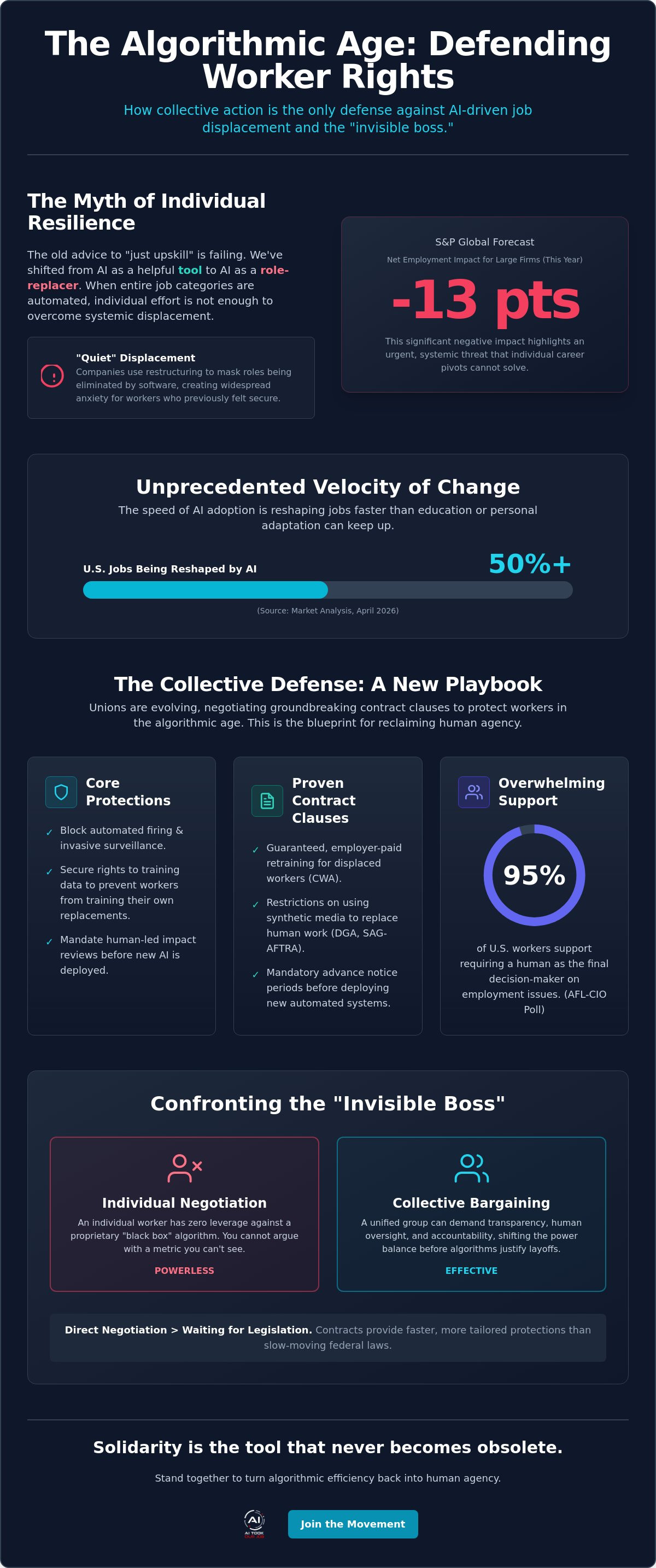
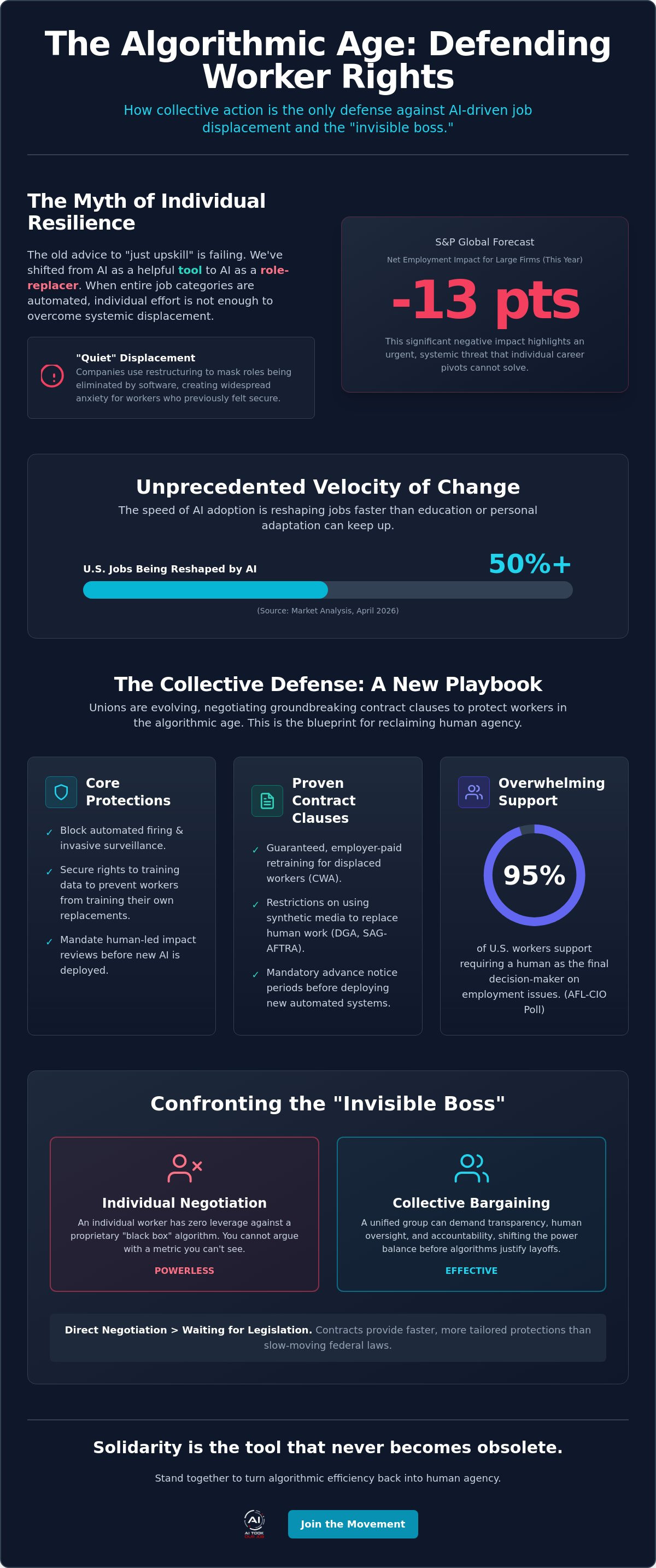
This article explores how labor groups are negotiating the algorithmic age to show why collective action is the only realistic defense against displacement. With S&P Global forecasting a -13 point net employment impact for large firms this year, the stakes couldn't be higher. You'll discover specific contract clauses, like those recently ratified by the DGA and CWA, that are actually working to protect human utility. We will preview how to organize in a hybrid environment and why resilience is built on solidarity, not individual panic. It's time to stop waiting for permission to be heard and start looking at the collective strategies that turn algorithmic efficiency back into human agency.
Key Takeaways
- Solo upskilling is a myth in a world of systemic displacement. Learn to audit your workplace for "hidden" AI implementation to see exactly where the ground is shifting.
- Modern strategies for unions and AI automation now include training data rights. Find out how creative guilds are ensuring workers aren't trained out of their own jobs.
- Stop the "Invisible Boss" from making life-altering decisions. We'll explore how collective power can block automated firing and invasive surveillance practices.
- Federal laws are slow, but your contract doesn't have to be. Discover why direct negotiation is more effective than waiting for outdated legislative frameworks to catch up.
The 2026 Labor Crisis: Why Individual Resilience Fails Against Automation
The advice was always the same: keep upskilling. For years, workers were told that as long as they learned the next tool, they would stay ahead of the curve. It's a lie. In 2026, this narrative has shifted from helpful guidance to a form of corporate gaslighting. We've moved past the era of "tool-based" AI, where a software assistant helped you write an email. We're now firmly in the era of "role-replacing" AI. The technology isn't just helping with the work; it's being configured to perform the work entirely. When an entire job category is optimized away by a proprietary model, your personal ability to learn a new coding language or a marketing framework becomes irrelevant. You cannot outrun a systemic shift with individual effort.
This is where the traditional buffer of unions and AI automation becomes the only logical defense. Individual resilience is a myth when the displacement is structural. We need a collective floor, not just a personal ladder. Without a unified front, workers are left to face a level of algorithmic volatility that no single career pivot can solve.
The Velocity of Displacement in the Late 2020s
The 2026 labor market is fundamentally different from previous waves of industrial change. The speed is unprecedented. Recent market analysis from April 2026 suggests that over 50% of U.S. jobs are currently being reshaped by AI, changing work expectations faster than traditional education or personal "pivoting" can keep up. We're seeing "hidden automation" where corporate restructuring is used to mask the fact that roles are being deleted by software. This creates a deep sense of anxiety about automation among white-collar professionals who previously felt safe. The shift is quiet, fast, and devastating to those trying to navigate it alone. This isn't a wave you can swim over; it's a tide that requires a structural sea wall.
The Limits of Individual Negotiation
You cannot reason with a mathematical weight. When a company implements a "black box" algorithm to determine staffing levels or evaluate performance, an individual worker has zero leverage. How do you argue against a proprietary metric you aren't allowed to see? This power imbalance is why the collective voice is so crucial. A May 2026 AFL-CIO poll found that 95% of U.S. workers support a requirement that a human be the final decision-maker on employment issues. Achieving that requirement isn't something you can do in a performance review. It requires the weight of a collective bargaining unit. Reclaiming human agency means standing together to demand transparency in how these algorithms operate before they are used to justify a layoff. Solidarity is the only tool that doesn't become obsolete when the software updates.
The New Playbook: How Unions Are Negotiating Algorithmic Protection
The contracts are signed. The lines are drawn. In June 2026, we witnessed a massive shift in how labor interacts with code. The Directors Guild of America (DGA) and SAG-AFTRA didn't just ask for better pay; they ratified agreements that fundamentally restrict how synthetic media can replace human work. These aren't just creative wins. They are the blueprint for unions and AI automation in every sector. We're seeing a push for revenue sharing where, if your work is used to train a model, you're compensated for that digital footprint. It's about ownership. It's about dignity. If you want to track these contract wins as they happen, staying connected through a community membership for workers in transition can provide the data you need to organize your own shop.
Beyond the spotlight of Hollywood, the Communications Workers of America (CWA) has already established principles with Microsoft and ZeniMax to ensure AI usage remains transparent. These agreements often include guaranteed retraining. Instead of you paying for a boot camp to survive, the employer pays for the transition. This shifts the financial burden of automation from the worker to the corporation profiting from it. Notice periods are also becoming standard. Companies must now provide advance warning before deploying new systems, allowing for a mandatory human-led review of the technology's impact on the current staff.
Mandatory Algorithmic Impact Assessments
Unions are now demanding Mandatory Algorithmic Impact Assessments as a non-negotiable part of any new contract. This means a company cannot simply flip a switch on a new AI tool. They have to prove, through data, that the software won't cause discriminatory harm or mass displacement. It's a veto power over high-risk workflows. By forcing transparency, unions are pulling back the curtain on how these tools actually function before they are embedded in the workplace.
The "Human-in-the-Loop" Contract Clause
The "Human-in-the-Loop" clause is the ultimate safety net. It ensures that no algorithm has the final word on hiring, firing, or disciplinary actions. This is a direct response to the rise of algorithmic management, where "bossware" monitors every keystroke. Logistics unions are already using these clauses to fight automated termination systems. You aren't just a data point. You are a person, and a person should be the one looking you in the eye if your livelihood is at stake. Protecting the "human touch" is no longer a luxury; it's a contractual requirement in healthcare, education, and beyond.
Confronting the Invisible Boss: Algorithmic Management and Surveillance
The supervisor isn't just in the corner office anymore. They're in your keyboard. They're in your webcam. They're in the metadata of every document you close. This is the reality of "bossware," a pervasive layer of surveillance that tracks productivity with a cold, mathematical precision. By 2026, 46% of organizations are expected to use AI within their HR departments, often for monitoring, evaluation, and even disciplinary tracking. It's an exhausting way to live. The psychological weight of constant, invisible scrutiny creates a unique kind of burnout. We have to talk about the psychology of AI job loss and the crisis of human utility it triggers, even for those who still have a desk. Being managed by a machine feels like being stripped of your humanity.
This is why the intersection of unions and AI automation is pivoting toward data sovereignty. It's no longer enough to negotiate for a paycheck; we must negotiate for our privacy. Who owns the digital footprint of your movements, your speed, and your tone of voice? Without collective intervention, that data belongs entirely to the corporation. It is often used to train the very systems meant to eventually replace you. Reclaiming your data is a foundational step in reclaiming your value.
Transparency in Performance Metrics
If an algorithm says you're underperforming, you have the right to know why. Unions are now demanding full access to the logic behind productivity scores. We've seen how "black box" metrics often contain baked-in biases that penalize workers for basic human needs. Challenging these biased algorithms ensures that management styles remain grounded in reality. The goal is simple. No worker should be disciplined or fired by an automated system without a meaningful human review. We must insist on a human-centric approach to performance that values quality over raw, algorithmic speed.
Digital Picket Lines and Remote Organizing
Solidarity looks different when the office is a Slack channel. Remote and hybrid environments make traditional organizing difficult, but not impossible. We're seeing the rise of digital picket lines, where workers use encrypted community platforms to share data and coordinate actions outside of corporate surveillance. These spaces are vital for protecting whistleblowers who expose irresponsible AI use. Organizing in the AI age means building a decentralized network of trust. It's about moving faster than the "invisible boss" can track. Solidarity isn't about where you sit. It's about who you stand with.
The Legislative Gap: Can Regulation Keep Pace with AI Velocity?
The law moves at the speed of paper. AI moves at the speed of light. By the time a bill is debated, amended, and signed, the technology it aims to regulate has already evolved into something else entirely. This is the fundamental crisis of 2026. Many current AI labor laws displacement frameworks are essentially obsolete upon arrival. We see this in the "Great American AI Act" discussion draft released in June 2026. While it proposes a Center for AI Standards, it also suggests a three-year preemption of state laws. This would effectively strip away local protections, like the New York FAIR News Act, just as they are beginning to take hold. It's a lobbying war where Big Tech's deep pockets meet Labor's boots on the ground. Big Tech wants a single, weak federal standard. Unions want the right to fight for stronger protections at the state level.
Waiting for a federal rescue is a losing strategy. This is why the relationship between unions and AI automation is shifting toward the use of "Living Contracts." These are dynamic agreements designed to be reopened and adjusted as new AI capabilities emerge. If a law won't protect you, your collective bargaining agreement must. You need a source that keeps you ahead of these legislative shifts before they impact your paycheck. To stay informed on the latest regulatory hurdles and contract wins, you can subscribe to our AI Job Loss Weekly Briefing.
Closing the Loophole on "Independent Contractors"
Companies are increasingly using AI to fragment work into micro-tasks. If an algorithm assigns the task, monitors the progress, and processes the payment, corporations often claim the worker is an independent contractor rather than an employee. This misclassification is a deliberate attempt to bypass unions. The 2026 "Human Data Labelers" strike highlighted this growing tension. These workers, who provide the essential "ground truth" data for AI models, are fighting for the right to organize. They're proving that even the people building AI are ready to walk out for basic labor rights and human dignity.
Advocating for Universal Basic Income (UBI)
Labor organizations are undergoing a massive philosophical shift. They're moving from "job defense" to "income defense." As global employment indices show a deepening negative impact from AI across professional sectors, unions are becoming the most vocal political advocates for Universal Basic Income. They're acting as a bridge to broader social safety nets. When complex tasks once reserved for senior experts are automated at scale, the traditional 40-hour work week model breaks. Unions are now pushing for a world where productivity gains from AI fund the survival of the humans it replaces.
Finding Solidarity: Building Collective Power in the AI-Driven Workplace
Don't wait for an official announcement. Companies rarely broadcast their intent to automate; they frame it as "workflow optimization" or "digital transformation." Start by auditing your own environment for the subtle signs of algorithmic creep. Are you being asked to label data for a new internal tool? Is a "copilot" suddenly monitoring your creative process? These are the footprints of change. Once you spot them, document everything. Connect with peers across different departments to see if they are seeing the same patterns. Corporate silos are designed to keep you from realizing that the "quiet" displacement in accounting is linked to the "efficiency" drive in customer service. Sharing this data is the first step toward building a unified front.
Information is the only thing that moves faster than an algorithm. Use educational media AI job loss resources to stay ahead of the technical curve. These survival guides help you distinguish between a tool that helps you and a tool that replaces you. Once you have the data and the vocabulary, it is time to formalize your collective voice. The relationship between unions and AI automation is about more than just job security. It is about demanding a share of the productivity gains. If a machine does the work of three people, the remaining workers should see shorter hours or higher pay, not just a thinner staff and a fatter bottom line for the board.
The Role of Community in Career Transition
Isolation is the greatest threat to your career. When you face automation alone, the anxiety feels like a personal failure. You start to believe the lie that you just didn't "upskill" fast enough. In a community, that anxiety is transformed into a shared strategic challenge. Use community forums to find "hidden" job markets where human-centric expertise is actually growing. Our Weekly Briefing serves as a vital pulse check, tracking industry shifts so you aren't blindsided by the next wave of corporate restructuring. Solidarity isn't just about fighting for the old ways; it is about supporting each other through the new ones.
Final Reality Check: Radical Honesty for the Path Ahead
We owe you radical honesty. Not every role can be saved by a union. Some job descriptions will inevitably be rendered obsolete by the velocity of 2026 technology. However, while a role might vanish, the human behind it does not. Collective resilience is about making sure you aren't discarded along with the old software. It's about securing severance, retraining, and a social safety net that acknowledges your worth. You don't have to navigate this transition in a state of individual despair. There is power in the group. Join the AI Took Our Job community to find your collective voice and start building a future that values people over processors.
Reclaiming the Future of Work Together
The ground is shifting. We can't pretend that individual upskilling is enough when the velocity of change is this high. You've seen how unions and AI automation are becoming inseparable as workers fight for transparency and data rights. From the creative guilds to logistics hubs, the message is clear. We are stronger as a collective than as isolated data points. Negotiating the algorithmic age isn't just about saving specific tasks. It's about preserving our utility and our dignity in a world that often values efficiency over humanity.
You don't have to face these transitions alone. Our community is trusted by thousands of displaced professionals who are sharing data and building advocacy networks to ensure no one is left behind. We provide weekly briefings on the 2026 labor market to keep you informed before the next shift happens. Join the AI Job Loss Weekly Briefing to stay ahead of the shift and find your place in our exclusive community for collective advocacy. The road ahead is difficult, but it's a road we can walk together. Stay informed. Stay connected. Stay resilient.
Common Questions About Labor and Automation
Can a union actually stop a company from using AI to replace workers?
A union rarely stops technology entirely, but it can stop a company from acting unilaterally. Through collective bargaining, workers gain the power to negotiate the terms of deployment. This might include "no-layoff" clauses or requirements that AI only be used to augment, not replace, specific roles. It's about ensuring the transition happens with your consent rather than as a corporate surprise.
Are white-collar workers in tech and finance allowed to join unions?
Yes. The legal right to organize extends to most private-sector employees, including those in tech and finance. We're seeing a massive surge in white-collar organizing as "professional" roles face the highest levels of AI exposure. If you aren't a supervisor with the power to hire or fire, you likely have the right to form a collective bargaining unit and protect your career.
What is "algorithmic management" and how do unions fight it?
Algorithmic management is the use of AI to track, evaluate, and even discipline workers without human intervention. Unions fight this "invisible boss" by demanding transparency in performance metrics. They negotiate for the right to audit the software's logic and ensure that any disciplinary action or termination requires a human review. You shouldn't be fired by a math equation you aren't allowed to see.
How do union contracts handle the retraining of workers replaced by AI?
Modern contracts are shifting the financial burden of retraining onto the employer. Instead of you paying for a boot camp to stay relevant, unions negotiate for guaranteed education funds and paid time for learning. This ensures that if the company changes the technology, they are responsible for ensuring you have the skills to operate it or transition to a new internal role.
What happens to my data if my company uses AI to monitor my work?
Without a contract, the company typically owns every byte of your digital footprint. Unions are now negotiating for data sovereignty to protect your privacy. This includes limits on how long surveillance data is kept and strict rules against using your work performance data to train the very AI models intended to automate your specific job functions.
Is it possible to organize a union in a fully remote or hybrid workplace?
Digital organizing is the new reality. While you might not have a physical breakroom, workers are building solidarity through encrypted messaging apps and decentralized community platforms. The lack of a shared office doesn't diminish your legal rights. Remote workers are successfully coordinating digital picket lines and sharing salary data to ensure their collective voice remains loud and effective.
What are the most common AI-related clauses in 2026 labor contracts?
The relationship between unions and AI automation is often defined by three key clauses. First, "Human-in-the-Loop" requirements ensure people make final employment decisions. Second, Mandatory Algorithmic Impact Assessments force companies to prove a tool won't cause harm. Third, advance notice periods require management to disclose new AI implementations months before they go live. These protections turn a corporate dictate into a shared negotiation.
How do unions help workers who have already been displaced by AI?
Unions negotiate for "just transition" packages that go far beyond a standard two-week check. This can include extended healthcare coverage, significant severance pay, and "right of first refusal" for new roles created by the technology. They also provide a communal hub where displaced professionals can share resources and find support, ensuring that a job loss doesn't lead to total isolation.