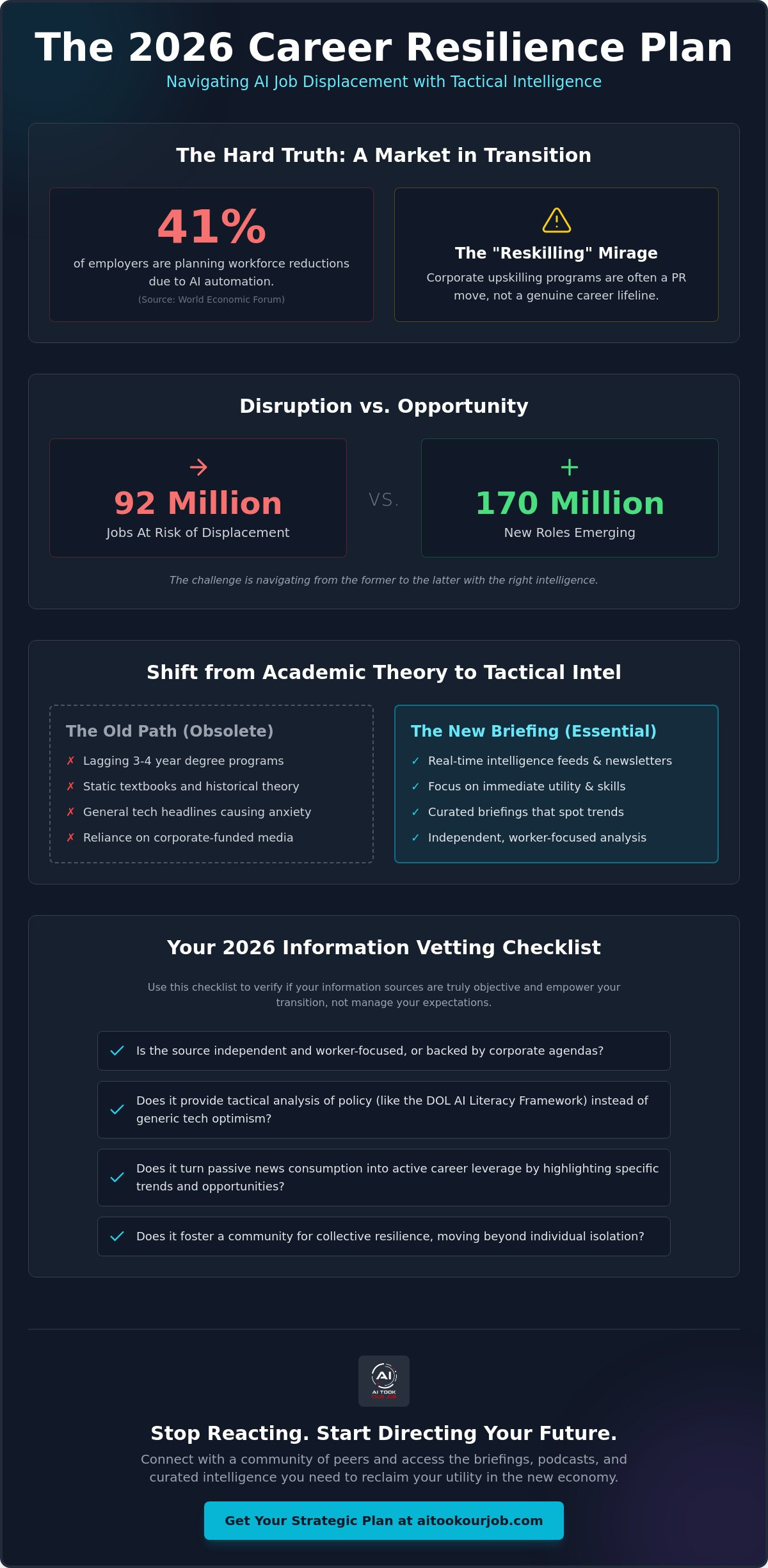
Your company's promise to "reskill" you is often just a polite way of saying they're waiting for the software to catch up to your salary. It's a hard truth to hear, but 41% of employers are already planning workforce reductions due to automation. If you've felt the sting of educational media AI job loss, you know that generic tech headlines and corporate webinars don't offer real solutions. They offer noise. You feel isolated, overwhelmed, and rightfully skeptical of upskilling programs that seem more like a PR move than a career lifeline.
We're here to change that narrative. You deserve a source of truth that acknowledges the 92 million jobs at risk while focusing on the 170 million new roles emerging in this transition. This guide provides a strategic plan for career resilience, connecting you with a curated ecosystem of educational media designed for the 2026 landscape. We'll explore the White House’s National Policy Framework, the Department of Labor’s new literacy standards, and the specific communities where workers are reclaiming their utility. Let's stop reacting to the shift and start directing it together.
Key Takeaways
- Learn to distinguish between corporate upskilling propaganda and educational media that offers a realistic analysis of the 2026 labor market.
- Identify the high-velocity resources and specialized newsletters you need to navigate educational media AI job loss with precision and clarity.
- Transition from passive news consumption to active career leverage. Use industry-specific media to anticipate the next wave of automation.
- Use our 2026 evaluation checklist to verify if your information sources are truly objective. Don't trust corporate-backed agendas.
- Connect with a community of peers. Use our briefings and podcasts to prioritize collective resilience over individual isolation.
Redefining Educational Media for the AI Displacement Era
The definition of "educational media" has fundamentally broken. If you search for this term today, you will likely find coloring pages for toddlers or interactive math games for middle schoolers. That is a luxury we can no longer afford to prioritize. In 2026, educational media has transitioned from a classroom supplement to a survival briefing for the displaced professional. It's the difference between a static textbook and a live map of a minefield. The old path is gone. It's not coming back.
The reality is stark. According to the World Economic Forum, 41% of employers are planning workforce reductions due to AI automation. When you face an educational media AI job loss, you don't need a three-year degree program. You need a real-time intelligence feed. You need to know which sectors are holding firm and which ones are dissolving. Your job might be gone, but your utility remains. The challenge is finding media that speaks to your value rather than your replacement cost. Finding a reliable source of truth regarding educational media AI job loss is the first step toward building a strategic plan for career resilience.
The Shift from Academic to Tactical Learning
Traditional degrees are lagging. They move at the speed of bureaucracy, while AI displacement moves at the speed of light. We are seeing the rise of real-time briefing media designed for professionals who need to pivot now, not in four years. This "Survival Curriculum" focuses on immediate utility. It prioritizes understanding the new U.S. Department of Labor AI Literacy Framework over memorizing historical theory. You need media that functions like a daily briefing. It must be efficient, curated, and deeply informative to be useful in a crisis.
Identifying Bias in Tech-Driven Media
Don't let the "upskilling" promises fool you. Much of the media currently labeled as educational is funded by the very corporations accelerating Technological unemployment. Their goal is often to manage your expectations rather than empower your transition. They use "optimism" as a sedative to keep you from asking difficult questions about labor rights and corporate accountability.
Independent, worker-focused media is your only shield against this corporate-backed narrative. You have to learn to spot the bias. Is the content telling you that "AI is a partner" while your department is being halved? Or is it showing you how to protect your rights under the 2026 National Policy Framework? Solidarity starts with shared, honest information. You are more than a productivity metric; you are a participant in a shifting society. Reclaiming your narrative begins with choosing media that values your humanity over a company's bottom line.
The 2026 Media Landscape: Essential Resources for Displaced Workers
The information age has morphed into the intelligence age, and the speed of information has left traditional academic resources in the dust. If you rely on quarterly journals or peer-reviewed studies to navigate your career transition, you're already behind. When facing educational media AI job loss, you need high-velocity, high-accuracy media that reflects the reality of 2026. This isn't about general interest. It's about tactical survival. Speed matters because your bills don't wait for a semester to end.
Newsletters and Real-Time Briefings
Daily news cycles are designed to trigger anxiety, not action. They offer a relentless stream of "what" without ever explaining the "how" or "why" for your specific situation. A weekly briefing is superior because it provides the distance necessary to spot trends rather than just reacting to headlines. You need a curated feed that tracks how 134 state-level bills are actually impacting hiring practices in real time. For instance, understanding the AI Labor Laws and Displacement: The 2026 Regulatory Reality Check is more valuable than a thousand generic tech updates.
These briefings should act as your scout. They should identify which sectors are seeing the 170 million new jobs created by AI and which are among the 92 million being phased out. To build a foundation, you can start with free resources like the U.S. Department of Labor's AI Ready program, which offers a direct path to literacy. However, legislative shifts move fast. Staying informed means choosing media that prioritizes your utility over corporate stock prices.
The Power of Communal Audio and Video
Facts are necessary, but they aren't enough. The emotional toll of displacement is often the biggest barrier to a successful pivot. This is where podcasts and communal video hubs become essential. They offer a space to hear unfiltered peer stories, proving that your experience isn't a personal failure but a systemic shift. Listening to others navigate the psychology of AI job loss helps dismantle the isolation that corporate "upskilling" promises often ignore.
Communal webinars should focus on collective action. They shouldn't just tell you to "hustle harder" or learn to code in a vacuum. Instead, they should foster connections between displaced workers who are pooling their resources and insights. Isolation kills momentum. You aren't alone. When you hear a colleague describe how they used a specific AI design tool to secure a new role, the path forward becomes visible. If you're looking for a place to start, consider joining a Community Membership where the data is shared and the support is real.
Turning Media Consumption into Career Leverage
Passive consumption is a trap. In the wake of an educational media AI job loss, simply reading the news can feel like productive work. It isn't. To survive 2026, you must convert these insights into career leverage. This means moving beyond the role of a spectator and becoming a participant in the labor discourse. When you walk into an interview, you shouldn't just list the tools you know. You should use the data from your weekly briefings to explain how you'll manage the automation shifts already impacting their industry. This level of AI fluency shows strategic thinking that a generic resume cannot convey.
Understanding the future of AI job displacement allows you to anticipate where the next cuts will happen. It gives you the lead time to pivot before the pink slip arrives. Knowledge is only power if you use it to move. You aren't a victim of technology; you are an informed professional navigating a temporary storm. By treating media as a tactical map, you can identify "hidden" roles in sectors that are still prioritizing human oversight and complex problem solving.
From Information to Advocacy
Media resources are your blueprint for defense. If you're facing a layoff, use educational content to understand your rights under the newest state regulations. Don't let corporate HR define the terms of your departure. By sharing these resources with colleagues, you help build a collective voice. This shared knowledge is the foundation for unionization efforts and worker-led AI policies. In 2026, with 134 bills introduced across 31 states regarding AI in education and labor, staying silent is a risk you can't afford. Solidarity isn't just a feeling; it's an informed strategy that protects your future utility.
Strategic Networking within Media Hubs
The 2026 job market has largely moved underground. Traditional job boards are flooded with AI-generated resumes, making them nearly useless for humans. Real opportunities are found in the hubs where the media is discussed. You can find mentors in the comment sections of industry briefings or through a Community Membership. These spaces allow you to connect with experts who are navigating the same shifts. Stop applying to cold listings. Start connecting with people who value shared wisdom over automated screening. The shift from "applying" to "connecting" is the hallmark of a resilient career. It turns a solitary struggle into a communal advantage.
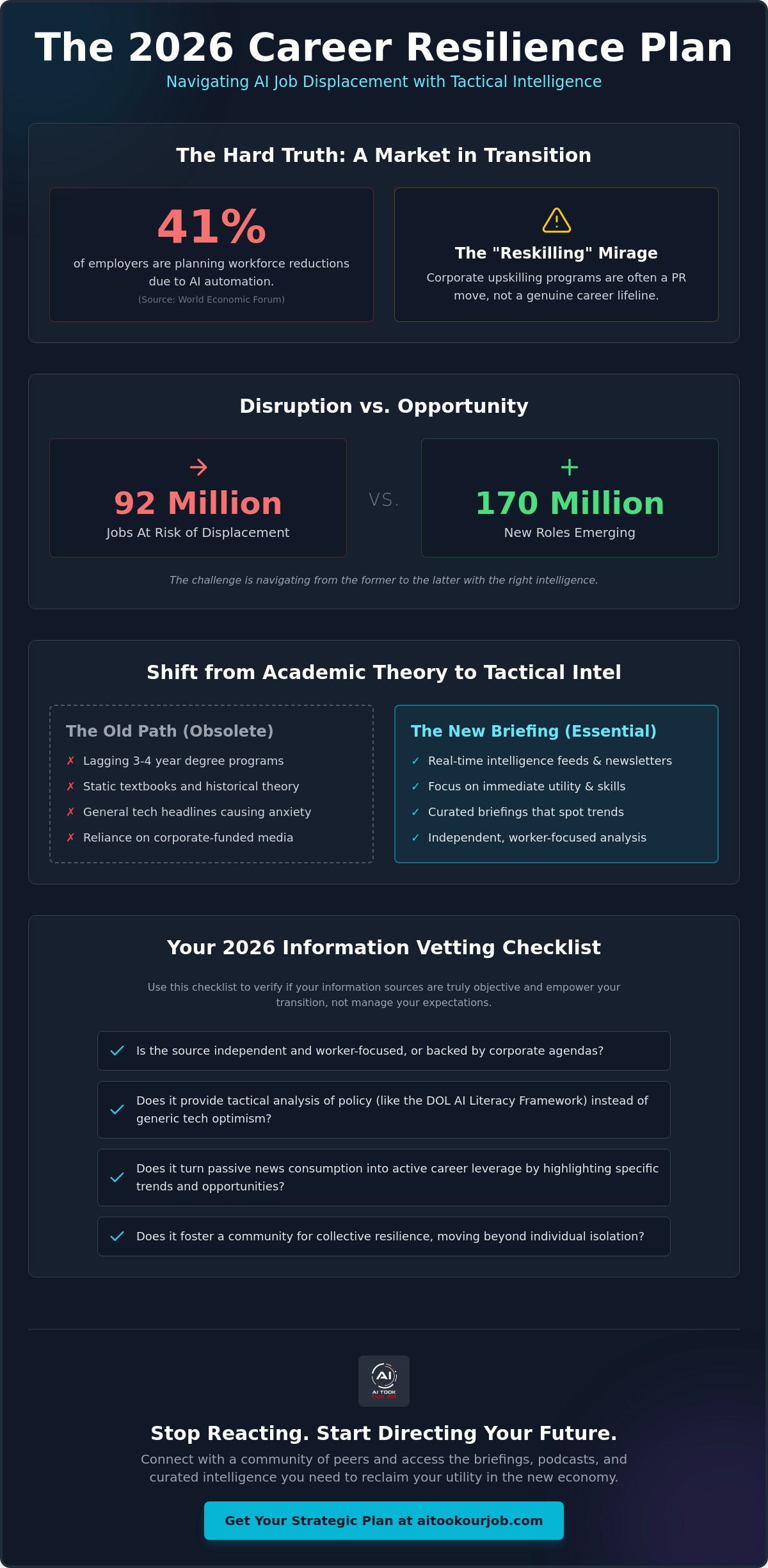
A Checklist for Evaluating Educational Media in 2026
The market is flooded with noise. Choosing the wrong source doesn't just waste your time; it misleads your strategy. When you're dealing with educational media AI job loss, you need a filter that actually works. Not every briefing has your best interests at heart. Many are designed to manage your reaction rather than empower your pivot. Use this five-step checklist to vet every resource you consume.
- Step 1: Check the funding source. Is this media objective or corporate-backed? If a platform is funded by the same tech giants accelerating automation, their "educational" content will always favor a narrative of inevitable replacement.
- Step 2: Evaluate the velocity. Is the information updated weekly? AI shifts happen in days. If the data is older than a month, it's a history lesson, not a survival guide.
- Step 3: Look for empathy. Does the content acknowledge the human cost? If the media treats the displacement of 92 million workers as a mere "efficiency gain," it isn't for you.
- Step 4: Assess the community. Does this media connect you to others? Reliable resources should act as a hub for collective resilience, not just a broadcast of top-down instructions.
- Step 5: Verify the actionability. Does it offer a clear path forward? You need a strategic plan, not more anxiety. If it doesn't provide a next step, it's just noise.
Need a source that passes every step of this test? Subscribe to our AI Job Loss Weekly Briefing for unfiltered, high-velocity intelligence.
Avoiding the 'Upskilling' Trap
Be wary of "educational media" that serves as a marketing funnel for software. The 2026 reality is that "learning to code" is no longer the default answer to displacement. AI now handles routine technical tasks with higher efficiency than most entry-level humans. Your focus should shift to human-centric skills that AI cannot easily replicate. This includes ethical oversight, complex emotional intelligence, and high-level strategic coordination. Don't spend your limited time learning a skill that an algorithm will commoditize by next quarter.
The Value of Radical Honesty
Truth is a survival tool. You should seek out media that is brave enough to admit when the future is uncertain. The danger of "toxic positivity" in professional development is that it sets you up for failure by ignoring the gravity of the shift. Building resilience requires grounded, realistic expectations. It's okay to acknowledge that this transition is difficult. In fact, it's necessary. Radical honesty allows us to move from a state of shock into a state of mobilization. We don't need superficial optimism. We need a steady, knowledgeable presence that values shared wisdom over corporate talking points.
The AI Took Our Job Ecosystem: Your Communal Advantage
You aren't just looking for another newsletter. You're looking for a way out of the fog. We built this ecosystem because we saw the void left by traditional outlets that prioritize tech hype over human survival. When you face educational media AI job loss, the last thing you need is a sanitized corporate blog or a generic "how-to" guide. You need a hub that treats your displacement with the gravity it deserves. Our resources don't just explain the shift; they provide the tools to navigate it without losing your dignity or your direction.
This ecosystem is designed to be your steady, knowledgeable presence in an era of unprecedented uncertainty. We believe that collective resilience is the only way forward. By combining high-velocity data with a supportive undertone, we help you move from a state of reactive shock to proactive preparation. You are part of a mobilized community that values shared wisdom over top-down instruction. We don't have all the answers, but we are committed to finding them together.
The Weekly Briefing: Your Strategic Advantage
Our Weekly Briefing serves as your survival map for 2026. It isn't a news recap. It's a tactical intelligence report. In every issue, we strip away the filler to focus on what is essential and actionable. We track market volatility, identify sudden hiring freezes, and analyze the specific sectors where automation is accelerating. You will learn to use this data to stay ahead of the AI job market trends that are currently reshaping the professional landscape.
We maintain a commitment to radical honesty. If a specific career path is dissolving, we'll tell you. If a new regulation offers a shield for your rights, we'll show you how to use it. This briefing is your early warning system, providing the lead time you need to pivot before the next wave of displacement hits. It's about reclaiming your utility in a world that no longer guarantees your role.
Why Our Media Matters for Your Future
Educational media should do more than just teach a skill. It should help you reclaim your identity. In our podcasts and community hubs, we share the unfiltered truth of the labor shift. We move beyond the desk and focus on the human experience of transition. Hearing peer stories helps combat the isolation that often follows a layoff. It proves that your situation isn't a personal failure but a systemic event. This is the power of collective wisdom. It turns a solitary struggle into a shared movement for responsible AI and worker rights.
You aren't a productivity metric. You are a participant in a shifting society. By joining us, you gain access to a network that prioritizes solidarity over individual "hustle." We invite you to step out of the isolation and into a community that sees you and understands your value. The transition is difficult, but you don't have to navigate it alone.
Join the AI Took Our Job community and subscribe to the Weekly Briefing today.
Reclaiming Your Narrative in the AI Era
The old career maps have been shredded. You can't rely on the same institutions that prioritize automation over people. To survive, you must transform your media consumption into a tactical advantage. We focused on filtering for radical honesty, prioritizing high-velocity briefings, and finding utility within a group of peers. Navigating educational media AI job loss isn't just about finding a new role. It's about finding your voice in a landscape that often tries to silence the worker.
You deserve a source of truth that doesn't sugarcoat the 2026 labor shift. Our ecosystem provides no-nonsense, worker-first analysis and connects you with a global community of professionals in transition. Stop waiting for the corporate narrative to change. Start building your own strategy for resilience. It's time to move from a state of uncertainty to a state of collective action.
Subscribe to the AI Job Loss Weekly Briefing and join our community
You aren't alone in this transition. Together, we can turn this period of displacement into a foundation for collective strength.
Frequently Asked Questions
What is the best type of educational media for someone recently laid off by AI?
Tactical briefings and real-time intelligence feeds are your most effective tools for immediate pivots. Unlike traditional academic courses that take months to complete, these resources provide the specific data you need to understand current hiring freezes or emerging roles. You need information that moves at the speed of the 2026 labor market to make informed decisions about your next move.
Can educational media really help me find a job in an automated market?
Yes, but only if you use it to develop AI fluency and strategic foresight. By consuming media that analyzes industry-specific automation, you can anticipate shifts before they happen. This knowledge allows you to position yourself in roles that require human oversight, such as ethical coordination or complex problem-solving. These human-centric roles remain essential even as routine tasks are automated.
How do I know if a newsletter or podcast is biased toward AI companies?
Check the funding source and the language used to describe displacement. If a resource is backed by major tech firms, it will often frame job loss as an inevitable "efficiency gain" or focus solely on individual upskilling. Biased media avoids discussing worker rights or the human cost of automation. Seek out independent, worker-focused outlets that prioritize radical honesty over corporate PR.
Is it worth paying for a premium membership for AI job loss resources?
It's worth it if the membership offers access to unlisted opportunities and a community of peers. In a market where 41% of employers are reducing staff, having a support network is a survival necessity. Premium resources often provide the depth of analysis and direct networking that free, generic tech news simply cannot match. You are paying for the quality of the filter and the connection to others.
What are the signs that my industry is about to be automated?
Look for a sudden shift toward high AI adoption rates within your sector's leading firms. If your daily tasks are being broken down into standardized, repetitive prompts, the risk is high. Another sign is when educational media AI job loss becomes a frequent topic in your industry's trade publications. This usually signals that a significant labor shift is already underway and companies are preparing for reductions.
How can I use educational media to advocate for better labor laws?
Use the data from briefings to educate your colleagues and build a collective voice. Knowledge of the 134 AI-related bills introduced in 2026 gives you the leverage to demand transparent policies. Sharing independent media helps dismantle the corporate narrative. This makes it easier to organize for unionization or specific worker protections in your workplace. Information is the first step toward mobilization.
What is the difference between upskilling and survival media?
Upskilling media focuses on learning new software or technical skills, often under the promise of future employability. Survival media is about navigating the current crisis. It prioritizes understanding your rights, tracking market volatility, and finding communal support. While upskilling prepares you for a tool, survival media prepares you for the reality of a broken labor market. One is a lesson; the other is a briefing.
How does the AI Took Our Job Weekly Briefing differ from standard tech news?
Standard tech news celebrates "innovation" from a shareholder perspective. Our AI Job Loss Weekly Briefing is written exclusively for the worker. We don't care about a company's stock price; we care about your utility and your future. Every issue is a curated survival map. It's designed to help you navigate the 2026 labor shift with clarity, radical honesty, and collective resilience.