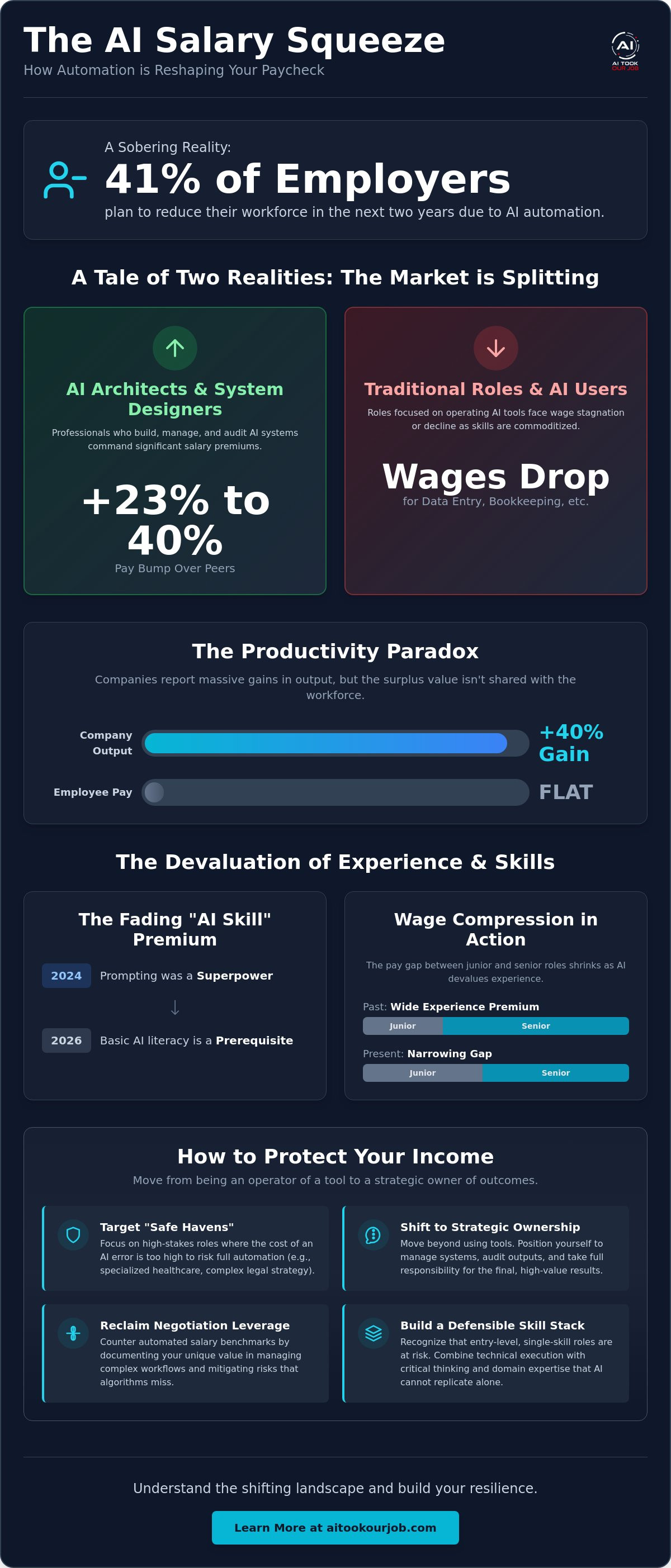
41% of employers plan to reduce their workforce due to AI automation within the next two years. It's a sobering reality that confirms what you likely already feel in your gut. The AI impact on salaries is no longer a distant forecast; it's a present-day force that is bifurcating the labor market. While AI-proficient professionals are seeing pay bumps of up to 40%, many traditional roles like basic bookkeeping and data entry have already seen their average wages drop by thousands of dollars. The ladder isn't just harder to climb. In many sectors, it's being dismantled entirely.
We know the anxiety of watching the "AI skill" goalposts move just as you think you've caught up. It feels like you're losing leverage even as your productivity hits record highs. This article provides an unflinching look at how these market shifts are eroding bargaining power. We'll break down the 80/20 adoption framework and provide realistic strategies to help you maintain your income levels. You deserve to understand the ground you're standing on, so let's look at the facts together and map out a path toward collective resilience.
Key Takeaways
- Recognize the reality of a bifurcated market. You'll learn why the initial AI premium is fading as basic literacy becomes a baseline requirement for every professional role.
- Navigate the productivity paradox. We explore why the AI impact on salaries often means doing 40% more work without seeing a single cent of that gain in your bank account.
- Prepare for the disappearance of the junior premium. We look at why the traditional starter salary is under threat and what you can do if your role is being squeezed by automation.
- Reclaim your leverage at the negotiation table. Understand how HR departments use automated knowledge graphs to suppress wages and how you can counter their data-driven upper hand.
- Shift your focus to strategic ownership. You'll find out how to position yourself in high-stakes roles where the cost of an AI error is simply too high for companies to risk.
The 2026 Salary Landscape: A Tale of Two Realities
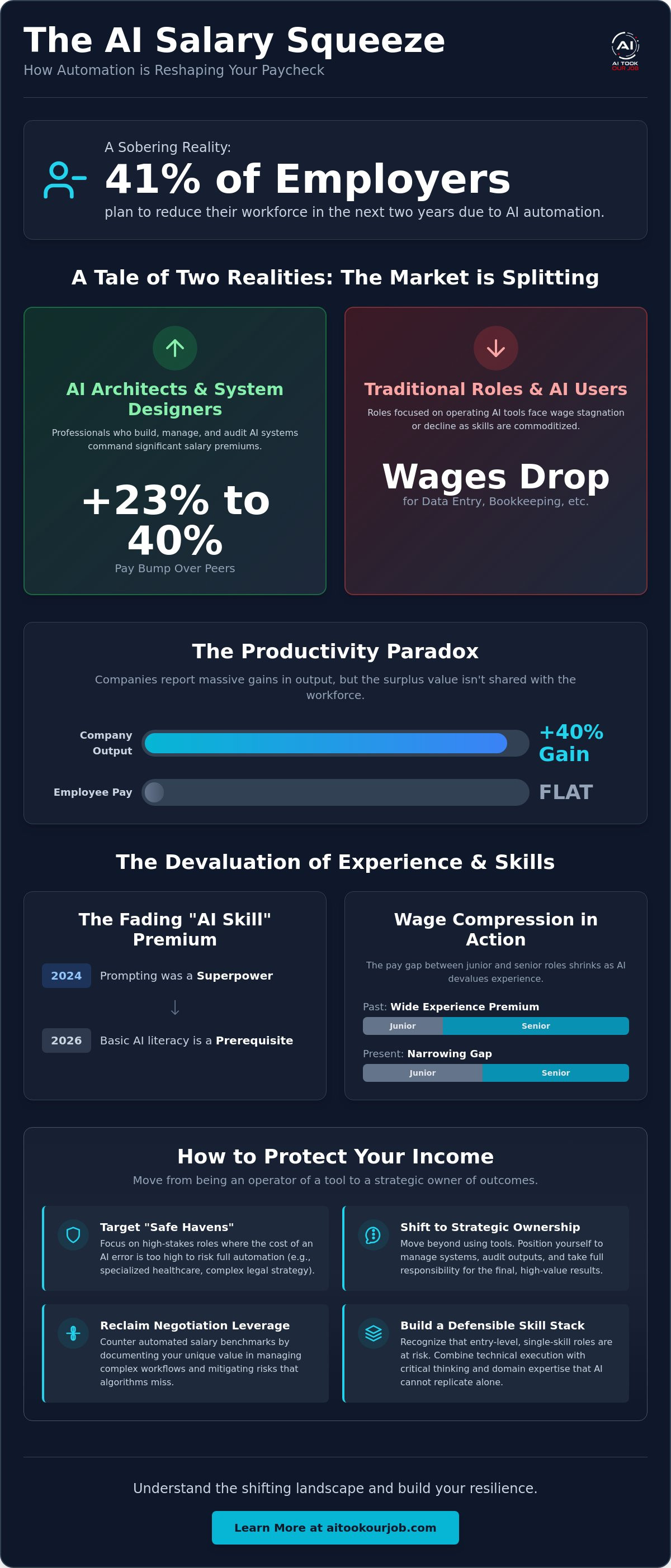
The market has split. It’s a harsh truth we have to face together. As we move through 2026, the AI impact on salaries has created a clear, often painful divide between those who build the systems and those who simply operate them. We are witnessing a bifurcated economy. On one side, AI architects and system designers are still commanding premiums of 23% to 40% over their peers. On the other, the vast majority of professionals are finding that their paychecks have hit a ceiling. We are producing more than ever before, yet for many, that increased output isn't reflected in their bank accounts.
This shift isn't about laziness or a lack of effort. It's about the fundamental way value is calculated in a world of infinite digital labor. Grasping this shift requires understanding wage compression, a phenomenon where the gap between entry-level and experienced roles shrinks because the "expert" work is now handled by a model. We have to look past job titles and start talking about human utility. If a tool can do the heavy lifting, the person holding the tool becomes replaceable. That's the reality we're navigating.
The Illusion of the AI Skill Premium
In 2024, knowing how to use a prompt was a superpower. In 2026, it's a prerequisite. The "AI skill" premium is fading fast because basic AI literacy is now the baseline for almost every white-collar role. Employers no longer pay extra for someone who can "use AI" to write a report or analyze a spreadsheet; they expect it. Skill commoditization is the process where rare expertise becomes a push-button function. If you are merely a user of these tools, your salary growth will likely stagnate. The real growth is reserved for those who manage the systems, audit the outputs, and take strategic ownership of the results.
Sector-Specific Salary Volatility
The squeeze isn't felt equally across the board. When we look at the AI impact by industry, we see "Automated Zones" where wages are in freefall. Data entry, basic bookkeeping, and Tier 1 support have seen significant drops as AI handles the bulk of the work. Conversely, "Safe Havens" exist in high-stakes environments like specialized healthcare or complex legal strategy where the cost of an AI error is too high to risk. However, even in these havens, the rise of global AI access means companies can hire talent from anywhere, creating a global salary floor that keeps local wages from rising. It's a challenging landscape, but understanding where the floor is helps us decide where to stand.
Wage Compression: Why Productivity Isn't Translating to Paychecks
The math doesn't add up for the worker. We're seeing companies report 40% gains in output thanks to automation, yet base pay remains stubbornly flat. This is the productivity paradox in action. While the AI impact on salaries should, in a fair market, reflect this massive leap in efficiency, the surplus value is being captured almost entirely by the organization. You're doing more. You're working faster. But your paycheck looks exactly the same as it did two years ago. It's a frustrating reality that many feel but few corporate reports acknowledge.
This leads us to a structural shift called wage compression. It's the narrowing gap between what a junior makes and what a senior professional commands. In the past, years of experience earned you a significant premium. Now, if an AI can handle 80% of the technical execution, that experience premium evaporates. Companies are effectively de-skilling high-paying roles by turning complex expertise into a series of managed prompts. Suddenly, a senior role that once required a decade of nuance is being reclassified as a mid-tier position. To make matters worse, algorithmic management tools now use real-time market data to cap salary increases, ensuring pay stays at the absolute minimum required to prevent turnover.
The Salary Ceiling and the Productivity Paradox
Doing more with less usually results in less for the many. We're moving away from hourly value toward output-based value, but the person producing the output isn't the one setting the price. Look at the "AI+1" model. Firms are replacing entire junior teams with a single senior lead who "manages" an AI fleet. This senior professional might feel secure, but they've actually hit a hard salary ceiling. Without a team to lead or a ladder to climb, their path to executive pay is blocked. They've become a highly efficient, yet capped, individual contributor.
Non-Monetary Erosion: The Hidden Pay Cuts
Pay cuts aren't always visible on your offer letter. We call these phantom cuts. Companies are shifting budgets away from employee bonuses and health benefits to fund massive AI infrastructure costs. You might keep your base salary, but your total compensation is shrinking. Some firms offer "flexibility" as a consolation prize, using remote work as a justification to lower base pay or skip annual raises. It's a trade-off that feels like a choice but often isn't. The psychological toll is heavy. Working harder for a smaller slice of the pie breeds a specific kind of exhaustion. To stay ahead of these shifts, many are turning to our AI Job Loss Weekly Briefing to track how these trends are evolving in real-time. We're in this together, and staying informed is the first step toward collective resilience.
The Death of the Junior Premium and the Entry-Level Crisis
The entry-level ladder is breaking. For decades, a $60,000 to $80,000 "starter" salary was the standard for white-collar graduates entering fields like law, marketing, or finance. Today, those roles are vanishing. This is a direct AI impact on salaries at the most vulnerable stage of a career. If an LLM can handle 80% of a junior analyst's drafting, research, or coding work, firms find it hard to justify the overhead of a human trainee. Why pay for potential when you can subscribe to performance?
This creates what we call the "Junior Gap." It's not just a hiring freeze; it's a structural removal of the first rung of the professional ladder. When you lose that first step, your lifetime earnings trajectory takes a massive hit. You're starting later, earning less, and struggling to build the equity that previous generations took for granted. The compounding effect of a lower starting base can result in hundreds of thousands of dollars in lost wealth over a forty-year career. To see where this trend is heading, you can explore the data on future AI job displacement and the reality of the 2026 labor shift.
The Apprenticeship Void
We are losing the talent pipeline. Senior leaders used to mentor juniors through "learning by doing" on low-stakes tasks. Now, those leaders just prompt a system. This "Senior Squeeze" means experts are doing their own grunt work because AI makes it faster than explaining a task to a human trainee. It creates a cruel experience trap where juniors can't get the experience that AI now handles. Without that hands-on training, the path to seniority becomes a bottleneck. We are trading long-term institutional knowledge for short-term efficiency gains.
The Rise of the 'Freelance Junior'
The full-time entry-level role is being replaced by the "Freelance Junior." These are precarious, project-based gigs where you provide the human "check" on AI outputs for a fraction of a traditional salary. There's no 401(k), no health insurance, and no predictable path to a raise. It's a survivalist market. This shift impacts more than just your monthly budget; it fundamentally alters retirement planning and long-term stability. Staying on top of these micro-shifts is critical, which is why we track these changes in our weekly briefing AI job market. We must be honest about these challenges to build a grounded, collective resilience.
The Erosion of Bargaining Power: Why AI Changes the Negotiation Table
You’ve likely heard the common wisdom: if you use AI to become more productive, you’ll have more leverage. It sounds logical. It feels right. But in 2026, we have to be radically honest about the flaw in that logic. If every single person in your field is also 40% more productive because of the same tools, your individual advantage vanishes. When productivity becomes the baseline, it stops being a bargaining chip. The AI impact on salaries is often a story of vanishing uniqueness. If everyone is super-powered, then no one is special. Leverage requires scarcity, and AI is the ultimate engine of abundance.
This abundance has a chilling effect on the negotiation table. The Replacement Threat is now the silent negotiator in every performance review. You don’t even have to hear the words to feel the pressure. HR departments no longer guess what a role is worth. They use AI-driven Knowledge Graphs that aggregate real-time global data to set hard caps on compensation. The niche expert who once held the keys to a specific process is finding their doors unlocked. AI can now simulate years of specialized expertise in seconds, turning what was once a rare craft into a commodity service.
The Transparency Trap
Information is power, and currently, the house has all the cards. Companies are increasingly using predictive AI to monitor employee engagement and sentiment. They can often predict when you are likely to quit before you’ve even updated your resume. This neutralizes the classic "I have another offer" strategy. The move toward standardized output means individual workers are becoming more interchangeable. When your work is filtered through a corporate AI model, your personal flair is stripped away. This makes you a replaceable unit of production in the eyes of an algorithm.
Collective Action vs. Individual Negotiation
Individual hustle is failing. You can't outrun an algorithmic salary cap by working longer hours. We need to look toward new floors for worker leverage. Some are exploring how UBI and AI automation might provide a necessary safety net in an era of mass displacement. But until systemic changes arrive, our power lies in solidarity. We reclaim leverage by sharing data and experiences. We refuse to be isolated. If you’re feeling the squeeze, you aren't alone. You can join our community membership to access shared salary insights and navigate this transition with a collective of peers who understand the stakes.
Strategic Resilience: How to Protect Your Income in the Automated Economy
It's time to act. Protecting your income requires a fundamental shift in mindset. We've seen how the AI impact on salaries is flattening traditional career paths. To resist this, you must move from being a "skill provider" to a "strategic owner." This means you don't just provide the labor. You own the outcome. When you take responsibility for the final decision, you move yourself out of the replaceable middle. Companies will pay a premium for the person who says "I stand behind this result" in a world where AI output is often unverified or hallucinated.
Focus your energy on high-empathy and high-stakes roles. These are the positions where the cost of an error is simply too high for a machine to handle alone. Diversifying your income streams is no longer a side hustle; it's a survival strategy to mitigate the risk of a single-sector salary collapse. This transition is as much mental as it is professional. Understanding the psychology of AI job loss is vital for maintaining your professional worth. When you realize that your value isn't tied to the speed of your output but the depth of your judgment, you can navigate this transition with a clearer head.
Building an 'Antifragile' Career
Build a career that thrives on volatility. Focus on roles that require physical presence or, more importantly, legal accountability. AI can't sign a legal document or take the blame in a boardroom. Human-in-the-loop oversight is becoming a high-paying niche for those who can audit machine decisions with precision. In 2026, soft skills aren't just "nice to have." They're the only hard skills left. Deep empathy, conflict resolution, and high-stakes negotiation are things a model can't replicate because they require a human soul and a nervous system.
The Community as Your Safety Net
Don't navigate this landscape alone. Collective intelligence is your best defense against salary erosion. By sharing data and experiences, we can spot trends before they hit our own paychecks. Our weekly briefings help identify sectors that are still upwardly mobile, giving you the lead time needed to pivot. Remember, you're more than your output. Reclaiming your value in a world of infinite content is the ultimate act of resilience. We're building a community that values shared wisdom over top-down instruction. You belong here, and together, we can find the path forward.
Reclaiming Your Value in the Automated Economy
The landscape has shifted. We've seen how the AI impact on salaries is dismantling the traditional entry-level ladder and tightening the squeeze on mid-career professionals. Relying on productivity alone is no longer a viable path to leverage. Instead, your resilience depends on moving toward strategic ownership and high-stakes judgment where human accountability remains the ultimate premium. It's a difficult transition, but you aren't walking this road alone.
You don't have to navigate these market shifts in the dark. We offer the radical honesty you won't find in corporate reports. Our platform provides weekly insights from over 50,000 transitioning workers and real-time salary data shared by our community members. Join the Weekly Briefing to stay ahead of the AI salary shift. Your professional worth is not a variable in an algorithm. By staying informed and connected, we can build a future grounded in collective strength. Keep looking forward.
Frequently Asked Questions
Is AI actually causing salaries to drop right now?
Yes, the market is already shifting. Verified data from 2024 to 2026 shows that roles like data entry saw average salaries drop from $38,000 to $33,000. Basic bookkeeping followed a similar path, declining from $42,000 to $36,000. The AI impact on salaries isn't universal, but for routine tasks, the downward pressure is real. It's a sobering trend that highlights the need for strategic career pivots.
What industries are seeing the biggest salary impact from AI?
Industries relying on repetitive digital tasks are seeing the tightest squeeze. Data-heavy sectors like entry-level finance and customer service have seen roles either eliminated or devalued. However, it's not all decline. Specialized roles in senior accounting or escalation support are seeing increases as they shift toward AI augmentation. The divide is growing between those who provide raw data and those who provide strategic judgment.
Should I still ask for a raise if my company is using AI to automate my tasks?
You should absolutely ask for a raise, but your leverage has changed. Simply being faster isn't enough when every colleague has the same tools. You must prove that your oversight prevents costly errors or that you're managing higher-stakes outcomes. Focus on the accountability you provide. In an automated economy, the person who takes the blame for the machine's mistakes is the one who keeps their bargaining power.
Can AI skills really guarantee a higher salary in the long run?
A premium exists today, but it won't last forever. Currently, AI-proficient professionals earn 20% to 40% more than their peers. However, as these tools become standard, that premium will fade. The long-term winners won't just be "users" of the technology. They'll be the architects who design the workflows and the strategic owners who ensure the AI impact on salaries remains positive for their specific niche.
How do I negotiate my salary when my boss knows I use AI to do my job?
Stop negotiating based on time and start negotiating based on risk and responsibility. Your boss knows the AI does the heavy lifting, but they also know the AI can hallucinate or fail. Position yourself as the essential "human-in-the-loop" who guarantees the quality of the final result. Your value is no longer in the drafting; it's in the auditing, the strategic alignment, and the final sign-off.
What is wage compression and how does it affect mid-career professionals?
Wage compression happens when the pay gap between entry-level and senior roles shrinks. For mid-career professionals, this creates a frustrating ceiling. Since AI can now handle 80% of the technical execution that juniors used to do, the premium for "years of experience" is eroding. You're being squeezed from the bottom as the technical skills you spent a decade mastering are turned into push-button functions.
Will Universal Basic Income (UBI) replace traditional salaries?
UBI is a proposed safety net for mass displacement, but it's not a replacement for professional income yet. While it could provide a necessary floor for worker leverage, it doesn't solve the crisis of human utility. We shouldn't wait for a policy shift to protect our livelihood. Collective resilience and shifting toward high-empathy, high-stakes roles are more immediate ways to secure your financial future.
How can I find out if my role is at risk of a 'salary ceiling'?
Audit your daily workflow using the 80/20 framework. If 80% of your tasks can be performed by an AI-led autonomous agent, you're at high risk for a salary ceiling. Conversely, if your role is 80% human-led but uses AI for augmentation, you're in a "Safe Haven." Roles requiring physical presence, legal accountability, or complex human negotiation are the least likely to hit a pay limit.