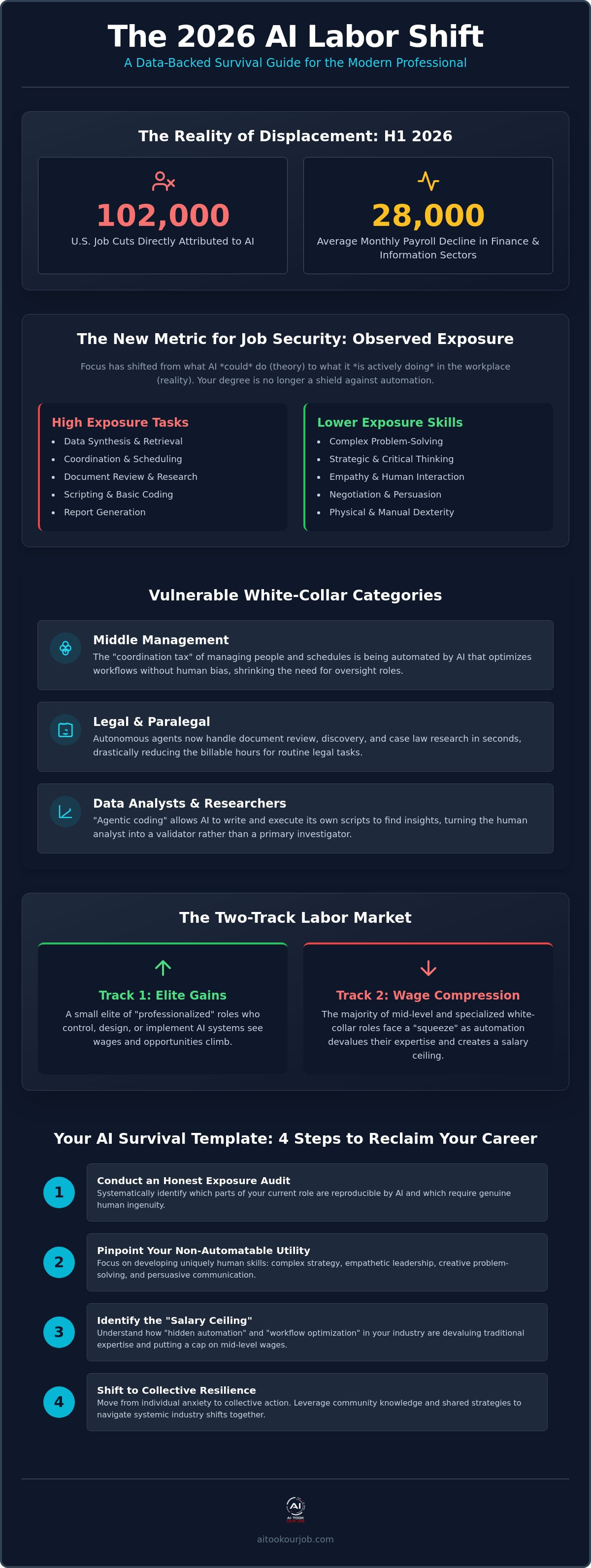
In the first half of 2026, nearly 102,000 job cuts in the U.S. were attributed directly to AI. This isn't a distant threat. It's a lived reality for thousands of professionals, particularly within the finance and information sectors where payrolls have declined by an average of 28,000 every month this year. Understanding the latest AI job market trends is no longer just about professional curiosity; it's about keeping your footing as the ground shifts beneath you. Are you watching the entry-level roles in your department vanish? Do you feel the pressure of wage compression as mid-level management is squeezed by automated efficiency?
We know the weight of "observed exposure" metrics on your mind. Your anxiety isn't a sign of weakness; it's a rational response to a historic labor shift. You deserve a clear path through the volatility. This article provides a realistic, data-backed survival template designed to help you identify your specific displacement risks and reclaim your career. We'll explore the current map of industry instability and outline a community-backed strategy for collective resilience in this new era. You are not navigating this transition alone.
Key Takeaways
- Learn why current AI job market trends favor elite gains while causing systemic wage compression for specialized white-collar roles.
- Discover why "Observed Exposure" is the new metric for job security and why traditional degrees no longer serve as a shield against automation.
- Identify the "salary ceiling" in your specific industry to understand how hidden automation is devaluing expertise in the mid-level management tier.
- Follow a step-by-step survival template to conduct an honest exposure audit and pinpoint the non-automatable human utility within your skillset.
- Shift from individual anxiety to collective resilience by leveraging community-backed strategies to navigate systemic industry shifts.
The 2026 AI Labor Shift: Beyond the Corporate Efficiency Narrative
The corporate narrative is polished. It speaks of "productivity" and "growth." But for the professional on the ground, the 2026 AI job market trends tell a different story. We are witnessing a two-track labor market. On one track, a small elite of "professionalized" roles sees wages climb; on the other, the majority of mid-level managers face a relentless squeeze. It's a wage compression that feels like a slow leak. You aren't imagining the pressure. It's a structural realignment designed to favor those who control the systems over those who operate within them.
This year marks the rise of "Hidden Automation." Companies have stopped announcing mass layoffs in favor of quiet, algorithmic restructuring. They use buzzwords like "workflow optimization" or "strategic agility" to mask the reality. These are often signals of impending displacement. When a leader mentions "right-sizing for an AI-first future," they are usually describing a plan to replace human oversight with autonomous logic. We must look past the jargon to see the mechanics of the shift. The middle class is shrinking. The elite are pulling ahead. It's time to be honest about who is winning.
The Velocity of Displacement in 2026
The speed of this transition is staggering. We've moved past the era of "augmentative AI" where tools simply helped us write emails. Today, autonomous agents handle entire project lifecycles. This isn't a new phenomenon, as the history of technological unemployment shows us that disruption is a constant. However, the current future AI job displacement is aggressive because it targets cognitive labor rather than physical tasks. The "highly educated" are no longer safe. The shield of a degree has cracked under the weight of 2026's processing power.
The Hiring Freeze: A Silent Trend
The most devastating trend isn't always the firing; it's the refusal to hire. Many firms are keeping roles empty, letting natural attrition do the work of a layoff. This has led to the sudden death of the entry-level role. Why pay a junior to learn when a model can execute at 90% accuracy for pennies? This creates a "missing generation" of talent. If you see a "reorganization" announcement that emphasizes "leveraging existing internal efficiencies," it's often a sign that the ladder has been pulled up. The path forward requires us to acknowledge this vacancy and find new ways to prove our utility.
Decoding "Observed Exposure": Who AI is Actually Replacing
Theoretical capability is a laboratory dream. Observed exposure is the paycheck reality. While early predictions focused on what AI could do, the 2026 AI job market trends are defined by what AI is already doing in active workplaces. We call this "observed exposure." It's the measurable displacement of human tasks by automated systems. If your role involves synthesis, coordination, or data retrieval, you aren't just theoretically at risk. You are currently being measured against an algorithm that doesn't sleep or ask for a raise. The shield of the white-collar office has been breached.
The most unsettling truth of 2026 is that a high-level degree is no longer a shield. In fact, it might be a target. Data from Stanford's annual AI Index Report highlights that the demand for traditional cognitive skills is being outpaced by the efficiency of generative models. This shift disproportionately impacts older, more educated professionals and women in administrative or analytical roles. Experience used to be a moat. Now, it's often viewed as a "legacy cost" by firms looking to automate. You can't out-study a machine that has already read every textbook in existence.
Vulnerable White-Collar Categories
Legal and paralegal roles are transforming rapidly. The shift toward algorithmic diagnosis means that document review and case law research are now handled by autonomous agents in seconds. Middle management is also under fire. The "coordination tax" of managing people and schedules is being automated away by organizational AI that optimizes workflows without human bias. Even data-heavy professions aren't safe. "Agentic coding" has changed the baseline for analysts, as AI now writes and executes its own scripts to find insights, leaving the human "expert" with nothing to analyze.
The Resilience of Skilled Trade
Physical dexterity remains the ultimate barrier. While a model can write a legal brief, it still cannot navigate a cluttered basement to fix a burst pipe. This creates a fascinating paradox. High-tech tools are being developed to assist, not replace, low-risk physical roles. We are seeing a move toward "phygital" occupations where digital expertise meets manual skill. If you're feeling the squeeze in a purely digital role, it's time to look at skilled labor automation to see where the human hand still holds the power. Staying informed is your first line of defense, so consider joining our community of resilient professionals to track these shifts together.
The Two-Track Market: Wage Compression vs. Elite Gains
The traditional middle class role is evaporating. In its place, we see a starkly divided labor market where the gap between the algorithmic elite and the automated majority grows wider every day. The 2026 AI job market trends confirm a "two-track" reality. A 2026 PwC report indicates that "professionalized" jobs, which demand deep human judgment, are growing twice as fast and enjoy 42% higher wage growth than "democratized" roles. For everyone else, AI has effectively lowered the salary ceiling. If a machine can perform 80% of your specialized tasks, your employer no longer feels the need to pay for 100% of your expertise. You are being squeezed into a narrower financial corridor.
This has led to a frustrating Productivity Paradox. Companies most exposed to AI are reporting 40% higher productivity growth, yet the average professional feels more exhausted and less financially secure. You are likely working more, managing more automated outputs, and yet earning less in real terms. We are seeing a massive "gig-ification" of white-collar work. Full-time roles are being decomposed into contract-based task blocks, stripping away the stability that once defined a "career." It's a systemic shift that prioritizes corporate margin over human livelihood.
Wage Compression Mechanics
The mechanics of this squeeze are simple but devastating. Large Language Models have commoditized high-value expertise, turning "experts" into "editors." When your primary value shifts from creating original work to merely proofreading what an agent produced, your leverage in salary negotiations vanishes. According to U.S. Bureau of Labor Statistics projections, the impact on various occupational groups is profound, as AI changes the very baseline of what constitutes "skilled" labor. You can see the specific AI impact by industry in creative and analytical sectors where salaries have already begun to stagnate or retract as the "expert" premium disappears.
The Elite Gap
Who is winning in this environment? It's the 1% of workers who control the algorithmic levers. These individuals aren't just using AI; they are the ones defining how it replaces others. We must be honest: "AI Literacy" is often pitched as a path to growth, but in the hands of management, it's becoming a tool for wage suppression. By making tasks easier for non-experts, companies can hire less-qualified labor at lower rates. We are entering a future where labor value is finally decoupled from time. To survive, you must move beyond being a "user" and become someone who understands the systemic value of human utility.
The AI Job Market Survival Template: Mapping Your Next Move
You've seen the data on observed exposure. You feel the squeeze of wage compression. Now, it's time to stop reacting and start mapping. The 2026 AI job market trends require a tactical pivot, not just a resume update. This survival template isn't about chasing the latest software certification. It's about auditing your fundamental utility in a landscape where cognitive labor is being commoditized. We must be honest with ourselves. If your value is tied to a digital output that an agent can replicate, your position is a single point of failure. Resilience starts with diversification and a clear-eyed assessment of what you bring to the table that a model cannot.
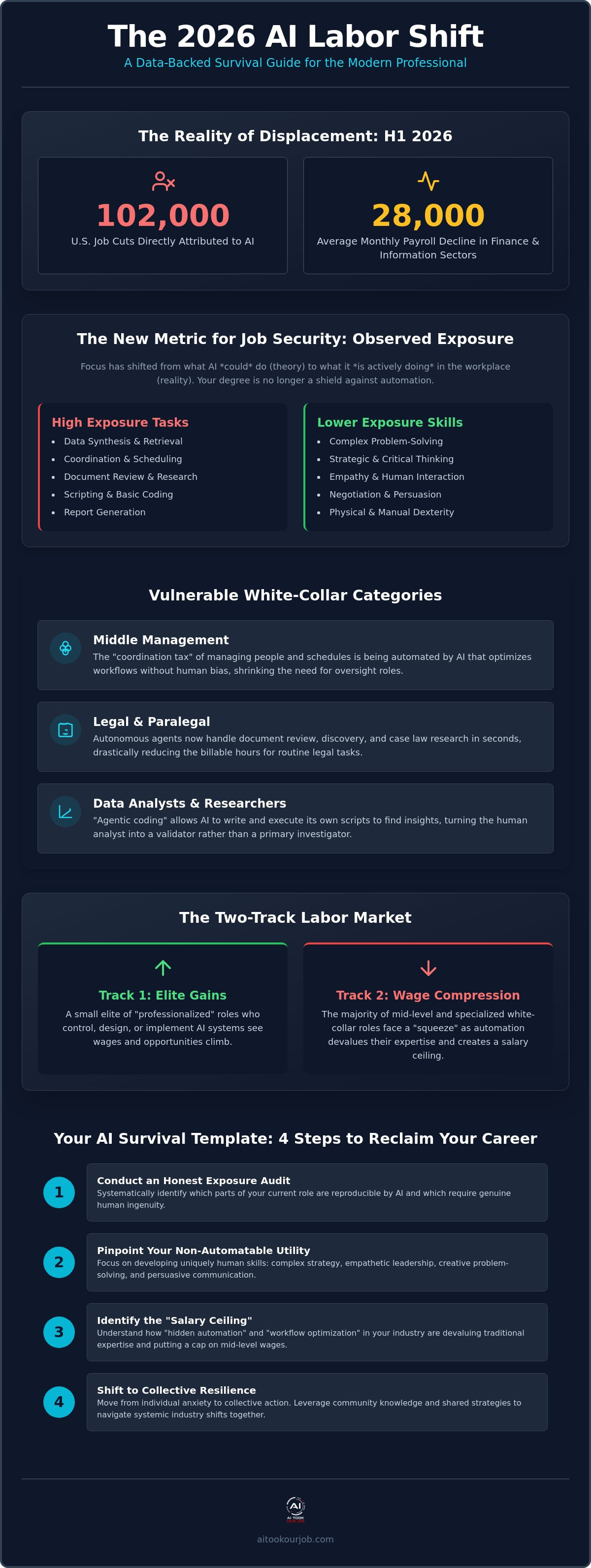
- Step 1: Conduct an Honest Exposure Audit of your current role to see where the machine is already gaining ground.
- Step 2: Identify "Non-Automatable" human utility. Focus on judgment, physical presence, or high-stakes accountability.
- Step 3: Network within community hubs rather than traditional job boards. LinkedIn has become a noise machine for automated applications.
- Step 4: Diversify your income streams. Don't rely on one employer who might "right-size" their department overnight.
- Step 5: Join our weekly briefing AI job market for real-time volatility updates and collective strategy.
The Exposure Audit Checklist
Start with radical honesty. Is your output primarily digital and text-based? If so, you're in the highest exposure bracket. Does your role involve "coordination" that an autonomous agent could handle? Coordination is a tax that companies are eager to automate. Finally, try this exercise: write a single sentence defining your core value that does not involve a software tool. If you can't do it, your professional identity is too closely tied to the very systems replacing you. We need to move toward skills that exist outside the screen.
Building Your Resilience Network
Traditional job boards are failing. In 2026, the best opportunities aren't posted; they're shared within specialized, honest communities of peers who understand the shift. We must move away from the performative polish of legacy social media. When you're explaining an "AI Layoff" on a resume, don't hide it. There's no stigma in being part of a historic labor shift. Frame it as a transition toward human-centric utility. This is why we advocate for joining our community membership. You need a space where you can speak the truth about your career without fear of judgment. Solidarity is our strongest asset in a market that feels increasingly indifferent to the individual.
Collective Resilience: Joining the Displaced Workforce Community
Individual effort has hit a wall. In the face of systemic automation, the old advice to "just work harder" or "upskill on your own time" feels hollow. It is hollow. We are navigating a fundamental restructuring of how society values labor. The 2026 AI job market trends show us that displacement isn't a personal failure; it's a corporate strategy. To survive this, we must move beyond the myth of the rugged individual. Real resilience is collective. It's found in the shared wisdom of those who have already seen their roles "optimized" out of existence. By joining the AI Took Our Job community, you gain more than just data. You find a hub of peers who refuse to be silent about the realities of this transition.
You are more than your automated output. Your identity has likely been tied to your professional utility for years, making this shift feel like a personal erasure. We're here to help you reclaim that identity. Our community acts as a shield against the isolation that often follows a layoff. We provide the context and solidarity needed to move from a state of shock to a state of proactive preparation. You don't have to carry the weight of this industry shift alone. Together, we can turn professional anxiety into a grounded, collective force for change.
The Psychology of Utility
The crisis of human value is real. When a machine can replicate your life's work in seconds, it triggers a deep existential friction. We explore the psychology of AI job loss to help you navigate this crisis of utility. It's about more than just finding a new paycheck. It's about finding solidarity in a world that increasingly prioritizes algorithmic efficiency over human experience. This is where you shift from being a "displaced worker" to an advocate for responsible AI policies. Your voice matters more when it's part of a chorus.
Your Next Step: The Weekly Briefing
The 2026 labor market is volatile. You need a map that updates in real time. Our AI Job Loss Weekly Briefing provides exactly that, offering deep dives into market volatility and educational media content designed for your transition. We don't offer superficial optimism. We offer the truth. Our reports ensure you stay ahead of the latest AI job market trends, giving you the clarity needed to make informed decisions before the next wave of "hidden automation" reaches your desk. Don't wait for the next reorganization announcement to take action. Join the community and sign up for the briefing today.
Reclaim Your Professional Narrative
The map is now in your hands. You've moved from the fog of professional anxiety to a clear-eyed understanding of the two-track market and the reality of observed exposure. This knowledge is your first line of defense. Will you wait for the next quiet reorganization, or will you anchor yourself in a community that tracks the shift in real time? Staying ahead of AI job market trends isn't just about reading reports. It's about collective resilience and tactical preparation.
You don't have to navigate this transition in isolation. Our mission is to provide the clarity that corporate narratives often hide. We invite you to sign up for the AI Job Loss Weekly Briefing. You'll gain consistent updates on market volatility, access to a global community of displaced professionals, and real-world survival templates for your next career move. The ground beneath our careers is moving, but when we stand together, we don't have to fall. Your utility is human; your future is still yours to define.
Frequently Asked Questions
What are the most at-risk jobs in the 2026 AI job market?
Roles involving digital synthesis, data retrieval, and administrative coordination face the highest risk today. This includes paralegals, middle managers focused on scheduling, and data analysts whose primary tasks are now handled by agentic coding. High education levels and traditional degrees no longer serve as a shield against displacement. If your work exists primarily on a screen and follows predictable logic, the risk of automation is immediate and measurable.
How is AI impacting entry-level hiring trends this year?
AI is effectively freezing entry-level hiring in white-collar sectors by automating the junior tasks once used for training. Companies now use autonomous agents to handle research and drafting, which has led to a "missing generation" of talent in finance and information services. This shift makes it incredibly difficult for new graduates to find a foothold. The ladder is being pulled up as firms prioritize immediate algorithmic efficiency over long-term human development.
What is "Observed Exposure" in the context of labor market research?
Observed exposure measures the actual displacement of human tasks by AI in live work environments rather than theoretical capability. It's a critical metric for understanding AI job market trends because it tracks real-world paycheck impacts. While many roles were theoretically "exposed" years ago, observed exposure confirms that firms are now actively replacing human hours with automated systems. It's the difference between a laboratory prediction and a real-world layoff notice.
Can AI actually lead to wage growth for the average worker?
Wage growth is currently concentrated among a small elite of "professionalized" roles that manage algorithmic systems. For the average professional, AI often results in wage compression rather than growth. Even though companies report 40% higher productivity, these gains rarely trickle down to mid-level staff. Instead, the "democratization" of tasks allows firms to hire less-qualified labor at lower rates, effectively lowering the salary ceiling for specialized white-collar work.
How do I protect my career from "Hidden Automation" strategies?
Protecting your career requires looking past corporate buzzwords like "workflow optimization" or "strategic agility." You must conduct a personal exposure audit to identify which of your tasks an autonomous agent could replicate. Focus on building "non-automatable" utility, such as high-stakes judgment, physical presence, or complex human empathy. Diversifying your income streams is also essential to ensure that a single "right-sizing" announcement doesn't result in total financial collapse.
Is there a specific template for transitioning out of an AI-exposed role?
Yes, our survival template emphasizes auditing your current exposure and pivoting toward human-centric utility. This involves moving away from digital-only roles and toward "phygital" occupations or high-accountability positions. You should also stop relying on traditional job boards, which are often flooded with automated noise. Instead, focus on specialized communities and radical honesty about your career transition to find opportunities that aren't visible to the general public.
What industries are showing the most resilience against automation in 2026?
Skilled trades and healthcare roles requiring deep physical empathy remain the most resilient sectors. Plumbers, electricians, and specialized technicians are safe because physical dexterity and navigation of unpredictable environments are still massive barriers for AI. Additionally, roles that require high-stakes accountability, where a human must be responsible for a decision, continue to hold value. The more your job requires a physical hand or a moral compass, the safer you are.
How can I join a community of professionals affected by AI job loss?
You can join our community membership to connect with others navigating AI job market trends in real time. We provide a space for collective resilience where professionals share honest survival strategies and transition maps. By signing up for our AI Job Loss Weekly Briefing, you'll gain access to volatility reports and educational media content designed to help you reclaim your career. You don't have to face these systemic shifts in isolation.