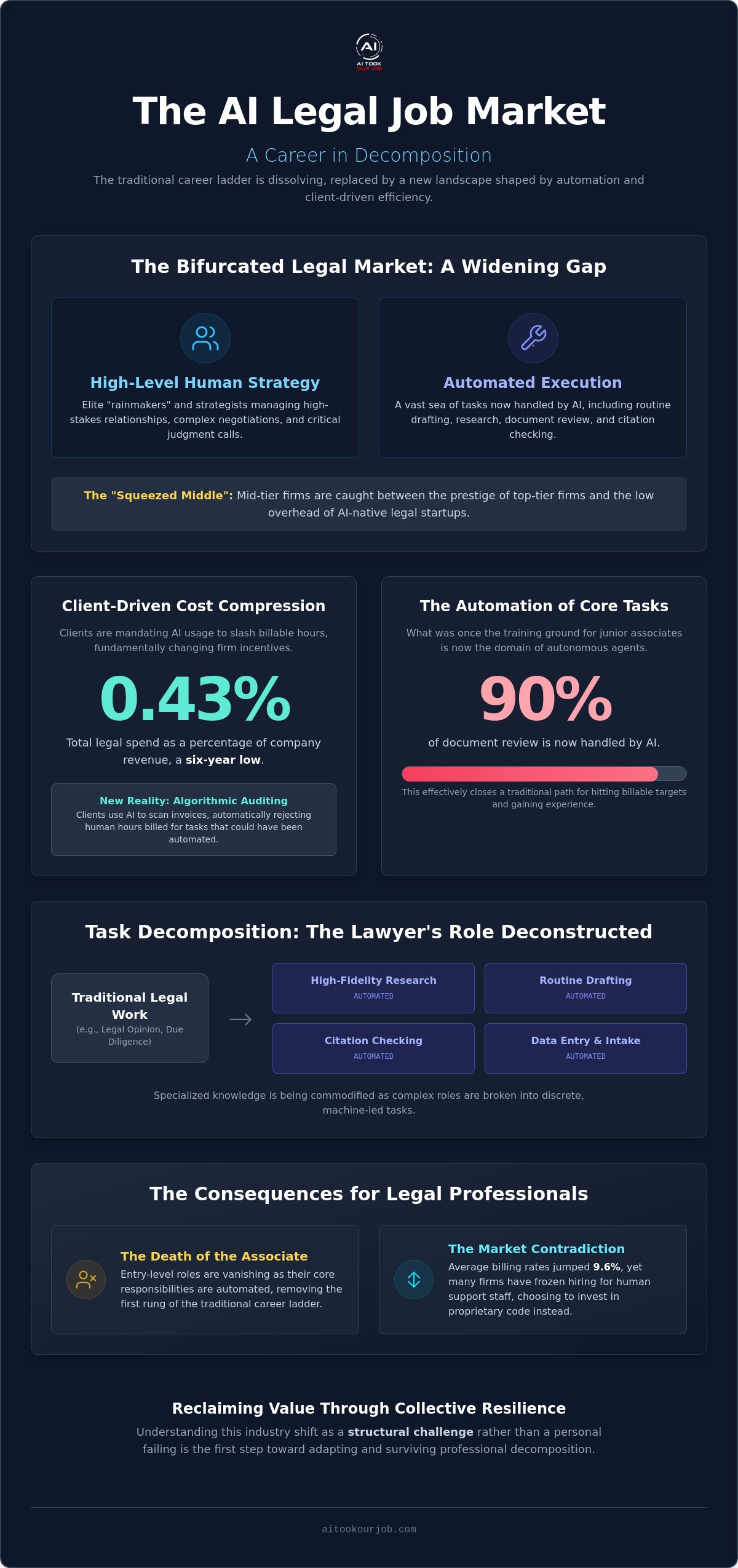
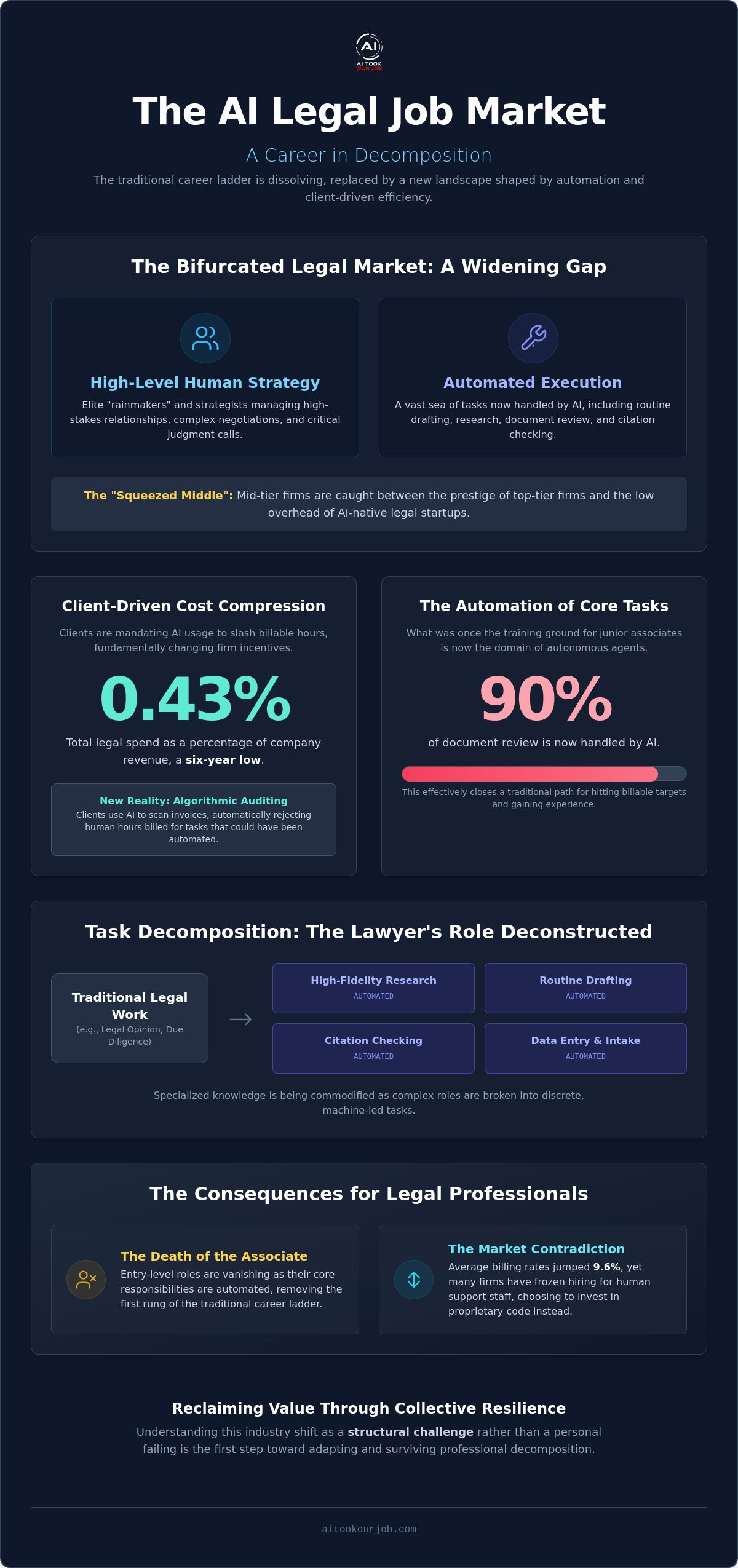
The ladder is dissolving. What if the career you've been building for a decade isn't just changing, but is actually decomposing beneath your feet? It's a question many of us are asking as the AI legal job market shifts from a futuristic concept to a daily disruptor. You feel the pressure. Total legal spend as a percentage of revenue has hit a six-year low of 0.43 percent. Entry-level associate roles are vanishing. Document review is now an automated afterthought. The specialized knowledge you spent years acquiring is being commodified by algorithms that don't sleep.
We understand the quiet anxiety of watching a hallucination risk dictate your workflow. It's isolating. You aren't alone in this identity crisis, and we promise to provide an honest look at the tasks being permanently handed to machines alongside realistic salary expectations for 2026. This article previews the shift from traditional firm structures to a bifurcated market where technical proficiency is the only currency. We'll explore how to survive this professional decomposition without losing your footing. You'll find a clear map of the new landscape and a community of peers ready to adapt alongside you.
Key Takeaways
- Recognize the new "bifurcated" landscape where legal work is split between high-level human strategy and automated execution.
- Identify how "task decomposition" is breaking your role into automated components, turning high-fidelity research and drafting into a machine-led standard.
- Discover why entry-level associate positions are vanishing as firms automate research, intake, and citation checking to satisfy client-side auditing tools.
- Navigate the realities of the AI legal job market by understanding the "In-house Exodus" and the structural forces driving wage compression.
- Reclaim your professional value through collective resilience, acknowledging that the current industry shift is a structural challenge rather than a personal failing.
The 2026 Legal Market: Efficiency for Clients, Uncertainty for Lawyers
The legal industry is currently living through a strange, painful contradiction. While average standard billing rates jumped by 9.6 percent in 2025, the internal reality for many practitioners feels increasingly fragile. We are entering a bifurcated AI legal job market where the traditional career path is splitting in two. On one side, you have the elite strategists who manage high-stakes relationships and complex negotiations. On the other, a vast sea of automated execution. It's an uncomfortable truth to swallow. Law firms are reporting record profits, yet many have frozen hiring for human support staff. They are choosing to invest in proprietary code rather than new colleagues.
The Bifurcation of Big Law
The gap is widening at a pace that feels dizzying. Elite "rainmakers" still command massive fees for their judgment, but the "back office" that once housed dozens of junior associates is being replaced by lean, AI-integrated teams. Mid-tier firms find themselves caught in the "Squeezed Middle." They are unable to match the prestige of Am Law 50 firms or the low overhead of AI-native legal startups. These startups leverage advanced Legal technology to deliver high-quality results at a fraction of the traditional cost. If your value is based on speed and accuracy rather than high-level strategy, you're in the path of the storm in this changing AI legal job market.
Client-Driven Cost Compression
The pressure isn't just coming from within firm walls. Fortune 500 companies are no longer passive payers of ever-increasing invoices. They are now mandating AI usage to slash billable hours. Total legal spend as a percentage of company revenue fell to a six-year low of 0.43 percent in 2026. This isn't a coincidence. It's a calculated move. Clients are now using their own sophisticated software to fight back against rate hikes. Algorithmic auditing is the practice of using AI to scan legal invoices for tasks that could have been automated, automatically flagging and rejecting human hours billed for routine drafting, citation checking, or basic research.
The shift from hourly billing to value-based pricing is no longer a theory. It's a requirement for survival. It changes the fundamental incentive of the law firm. If you can't prove your "human premium," your billable hours are at risk. We need to ask the hard questions together. Is your firm investing in your professional growth, or are they quietly licensing the very tools designed to phase out your role? Facing this reality is the first step toward collective resilience. Staying informed through tools like our AI Job Loss Weekly Briefing ensures you aren't blindsided by these structural shifts.
Algorithmic Law: How Task Decomposition Erases Traditional Roles
The law was once a fortress of specialized knowledge. That moat is drying up. In the current AI legal job market, we are seeing the rise of "task decomposition." This isn't just a buzzword. It's the process of deconstructing a lawyer's professional identity into discrete, repeatable units of data entry, research, and drafting. What used to be a bespoke legal opinion is increasingly becoming a standardized algorithmic output. By 2026, the era of Large Language Models (LLMs) prone to hallucinations has passed. We now work with high-fidelity systems that provide precise, verified citations in seconds. This shift has profound implications for how we view our own expertise. A Harvard Law expert on AI's impact suggests that these technologies are not just tools, but transformative forces that redefine the very nature of legal practice.
Document Review and Due Diligence
The numbers are stark. Approximately 90 percent of document review is now handled by autonomous agents. These systems don't get tired. They don't miss commas in the middle of the night. For decades, junior associates relied on this work to hit their billable targets and learn the ropes. That path is effectively closed. If your daily routine consists of spotting patterns in thousands of contracts, you are likely feeling the ground shift. It's essential to recognize these patterns early. You can find more detail on this in our guide, Is Your Role Next? 7 Unflinching Signs of Job Automation in 2026.
Predictive Analytics and Case Strategy
Strategic intuition is also under fire. AI tools now predict judge rulings and litigation outcomes with an accuracy rate exceeding 85 percent. This data-driven approach is replacing the gut feeling of senior partners. The value in the AI legal job market is moving away from knowing the law and toward managing the algorithm. It's a psychological burden. How do you argue with a machine that has analyzed every previous ruling from a specific bench? We are forced to trust digital predictions over professional intuition. It feels like a loss of agency. You aren't alone in feeling this displacement, which is why joining a supportive professional community is becoming a vital part of career survival. We must navigate this transition together, sharing intelligence rather than suffering in silence.
The Death of the Associate: Why Entry-Level Legal Work is Vanishing
The traditional apprenticeship is dead. For decades, law firms functioned as finishing schools where junior associates learned the craft while billing for "grunt work." That social contract has expired. In the current AI legal job market, clients refuse to subsidize the training of new lawyers. They want results, not a learning curve. This creates a terrifying "experience gap." If the entry-level rungs of the ladder are removed, how does anyone reach the top? The Future of Lawyers in the AI Era highlights this risk of de-skilling, where the next generation of partners may lack the foundational intuition once developed through thousands of hours of manual research and drafting. The rungs are being sawed off while we're still trying to climb.
Entry-level roles are the first to be hollowed out because their core functions are now easily replicated by code. We see four primary pillars of associate work being swallowed by automation:
- Research: High-fidelity LLMs synthesize case law faster and more accurately than any human trainee.
- Drafting: AI-native templates generate first-pass motions and contracts with surgical precision.
- Citation Checking: Algorithmic verification has turned Bluebooking into an automated background process.
- Intake: Sophisticated data extraction tools handle client screening and document sorting without human intervention.
The Automation of Paralegal Tasks
The displacement isn't limited to J.D. holders. Paralegals are seeing their roles absorbed by "Legal Operations" specialists who focus on managing systems rather than managing documents. This shift erodes career mobility for non-attorney staff who once used these roles as stepping stones. The impact mirrors broader trends we've seen in other sectors, as explored in our briefing on Skilled Labor Automation: The Unflinching Reality of the 2026 Trade Shift. Efficiency has a human cost. It's a hard truth we must face together as a professional community.
Law School ROI in 2026
The math no longer adds up for many. While law school tuition continues to climb, the entry-level salary floor is being compressed by AI-driven efficiency and "task decomposition." New graduates find themselves in a "debt trap," carrying six-figure loans into a market that no longer values their most basic skills. It's a structural crisis that requires radical honesty. As of early 2026, total legal employment in the U.S. reached a 10-year high of 1.24 million jobs, yet the proportion of these roles available to new graduates has plummeted as firms prioritize mid-level specialists over expensive trainees. We aren't just seeing a change in tools; we're seeing a change in who is allowed to have a career.
Beyond Billable Hours: Navigating the New Salary and Career Ceiling
The partnership track used to be a marathon with a clear finish line. Now, the track is being dismantled while you're mid-stride. In the AI legal job market of 2026, the ceiling isn't made of glass. It's made of code. As firms lean out to preserve partner profits, the "Partnership Dream" is becoming a statistical anomaly for most associates. We see a shift where the "human premium"—the extra value you bring beyond what a machine can do—is being squeezed from both sides. You're expected to do more, but the market is unwilling to pay more for it.
The In-House Exodus
Corporate legal departments were once the safe haven for those fleeing the billable hour. That refuge is shrinking. Many Fortune 500 companies have reduced their internal legal headcount by 30 to 50 percent as they automate routine compliance and contract management. General Counsel roles are being redefined as "contract managers" for AI vendors. Instead of leading a team of lawyers, they lead a suite of software subscriptions. Corporate legal budgets are being reallocated toward technology licenses rather than human capital. If you're feeling the weight of this transition, you need a strategy. Take a moment to review our AI Job Market Trends 2026: A Survival Template for the Displaced Professional for a deeper look at these shifts.
New Hybrid Roles
We're seeing the rise of titles like "Legal Prompt Engineer" and "Algorithmic Compliance Officer." While these roles are essential for the modern firm, they often come with a lower professional status and a compressed pay scale. A Legal Prompt Engineer in 2026 typically earns between $100,000 and $160,000. While these are respectable figures, they represent a significant downward pressure compared to the traditional high-end associate tracks of the past. There's a real risk of professional deskilling here. You aren't just practicing law; you're babysitting an engine. The AI legal job market rewards those who can manage the machine, but it rarely pays them the same "prestige premium" that traditional lawyers once enjoyed.
This isn't just about learning new software. It's about surviving a structural demolition of the legal career ladder. You don't have to navigate this alone. Get the intelligence you need to stay ahead of these trends by subscribing to our AI Job Loss Weekly Briefing. We track these shifts in real-time so you can make informed decisions about your professional future.
Collective Resilience: Reclaiming Your Value in an Automated Industry
The weight of these shifts is heavy. It's okay to feel it. We have spent this briefing looking at the cold mechanics of professional decomposition in the AI legal job market, but the final chapter isn't written by code. It's written by us. The anxiety you feel isn't a sign of personal failure. It's a rational response to a structural upheaval. For too long, the industry has told us that "upskilling" is the only answer. But learning a new software suite won't fix a market that is fundamentally hollowing out. We must move from individual worry to collective resilience. The problem is structural. Your response must be communal.
Joining the Displaced Community
Isolation is the greatest threat to your professional survival. When you're alone, the "Crisis of Human Utility" feels like a private shame. It isn't. Connecting with peers who are navigating the same AI legal job market challenges is the only way to stay grounded. We provide a space for radical honesty where the truth isn't polished for a corporate press release. Staying informed through independent media, like our AI Job Loss Weekly Briefing, ensures you're seeing the landscape as it actually is. Understanding the broader context of Future AI Job Displacement: The Reality of the 2026 Labor Shift helps you realize that this is a shared history in the making. We are all learning to navigate this together.
Advocating for Responsible AI
You are a legal professional. You understand the power of the word and the weight of the law. This expertise is your most potent weapon. We need to move from being victims of the algorithm to being advocates for the worker. Legal professionals are uniquely positioned to shape the AI labor policies of the future. We can demand transparency in how algorithmic auditing is used. We can push for protections against professional deskilling. We can fight for a world where technology serves the many rather than the few.
Your story matters. By sharing your experiences within our community, you help us build a repository of truth that can influence policy. It's time to reclaim your professional narrative. You aren't just a line item on a billable hour report. You are part of a mobilized community that values shared wisdom over top-down instruction. Join our Community Membership today. Let's build a future where our value isn't dictated by an invoice, but by our collective strength and solidarity.
Reclaiming the Future of Legal Practice
The AI legal job market of 2026 is no longer a distant forecast; it's our current reality. We've explored how task decomposition is hollowing out entry-level roles and why the traditional partnership track is dissolving. This professional decomposition isn't a reflection of your talent. It's a structural shift that prioritizes algorithmic output over human apprenticeship. Facing this truth is the only way to move forward without falling into despair.
You don't have to navigate this transition in isolation. Join a community of over 50,000 displaced and transitioning professionals who are choosing radical honesty over corporate scripts. Subscribe to the AI Job Loss Weekly Briefing for unflinching legal market updates to receive weekly briefings that strip away the jargon. We provide a platform that values your personal story over the algorithm's predictions.
The industry is changing, but your agency remains. By staying informed and connected, we transform individual anxiety into a grounded, collective resilience. Let's define the next chapter of our careers together.
Frequently Asked Questions
Will AI completely replace lawyers by 2030?
AI won't replace every lawyer by 2030, but it will hollow out the middle of the profession. High-level judgment remains human while routine production is now digital. The AI legal job market is becoming a winner-take-all arena for those who manage the technology. You'll need to pivot from being a producer of documents to a curator of algorithmic outputs to remain relevant.
Which legal specialties are most at risk of AI displacement?
Specialties focused on high-volume, repeatable tasks face the most immediate risk of automation. This includes insurance defense, basic estate planning, and routine corporate compliance. If your work follows a predictable template, a machine can likely do it faster. Areas requiring complex emotional intelligence, like family law or high-stakes criminal defense, remain more resilient to current technological shifts.
Should I still go to law school in 2026?
Law school in 2026 is a high-risk investment that requires a precise survival strategy. You must weigh the rising cost of tuition against a shrinking salary floor for entry-level roles. Traditional associate paths are vanishing. If you choose to go, focus on tech-integrated curricula and high-stakes advocacy. Don't attend simply because you're unsure of your next career move.
How can I protect my legal career from AI automation?
Protecting your career requires moving toward tasks that machines cannot replicate, such as nuanced negotiation and complex litigation strategy. You must become the person who audits the algorithm. Don't fight the tools; master them to prove your human premium. Focus on building a personal brand centered on high-level advisory work that relies on trust and ethical judgment.
What are 'Legal Operations' and are they safer than traditional roles?
Legal Operations is the practice of managing the business and technological infrastructure of a law firm or corporate department. These roles are in high demand because they focus on efficiency and tool implementation. While they offer more stability in a tech-driven world, they often lack the traditional prestige and high-end partner compensation found in the old law firm model.
Does the Bar Association have a plan for AI job loss?
Most Bar Associations currently focus on ethical guidelines for AI usage rather than labor protections for displaced lawyers. They provide advice on avoiding hallucinations and maintaining client confidentiality. However, they don't have a safety net for those whose roles are automated. This is why building your own network of peers and staying informed through independent briefings is vital.
How do I explain an AI-related layoff on my legal resume?
Frame an AI-related layoff as a "structural firm transition" and highlight your technical adaptability. Explain that your previous role was automated and focus on how you managed that transition. Employers in the AI legal job market value candidates who understand the tech. Show them you can lead the machines rather than simply being replaced by them.
What is the 'AI Took Our Job' weekly briefing?
The AI Job Loss Weekly Briefing is our essential intelligence tool designed to help you navigate professional displacement. We strip away the corporate jargon to give you the raw facts about labor shifts. It's a resource for those who value radical honesty over superficial optimism. Join our community to stay informed and reclaim your professional narrative alongside 50,000 other transitioning peers.