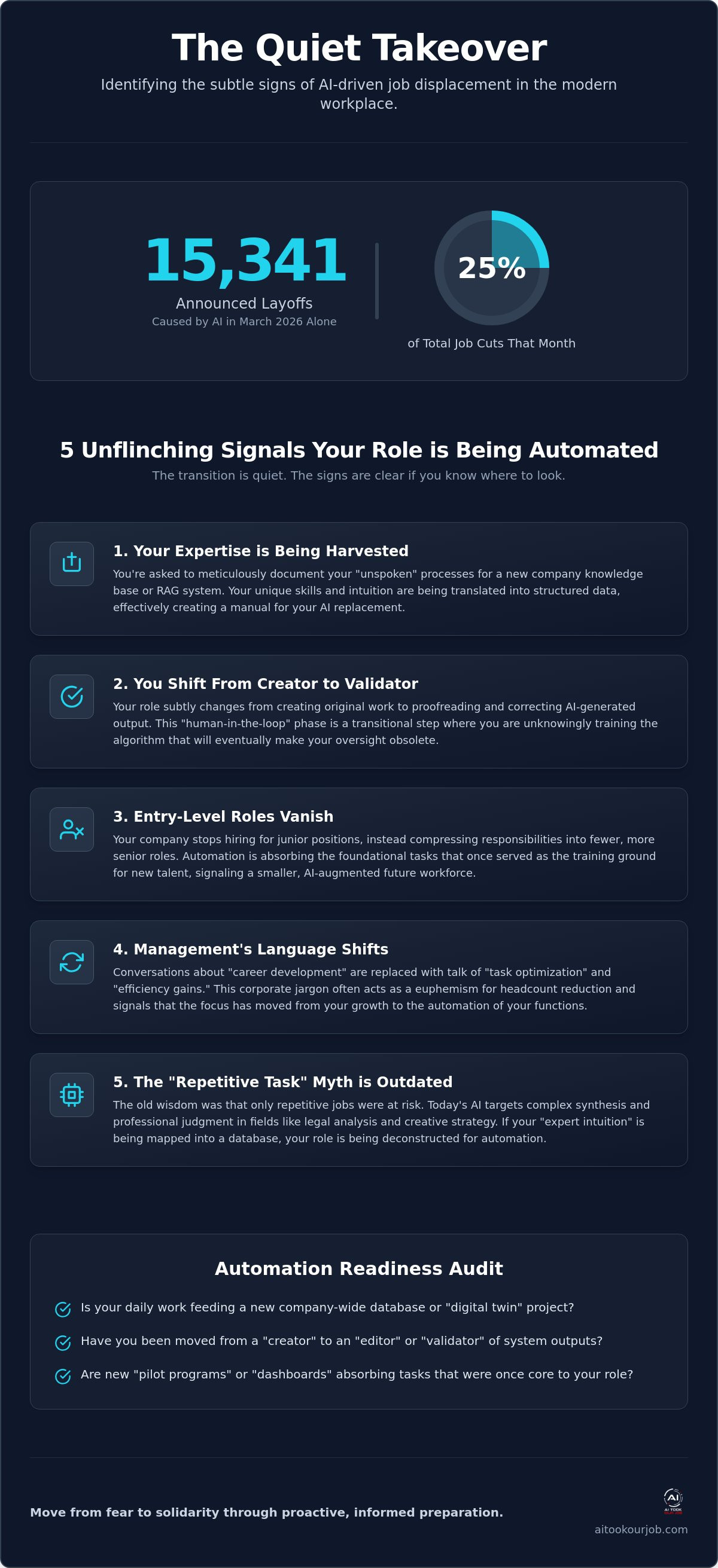
In March 2026, Artificial Intelligence became the leading cause of job cuts, accounting for 15,341 announced layoffs. This represents a staggering 25% of the total cuts for that month alone. You aren't imagining the shift in the office air. It's a quiet, heavy realization that the tools meant to help us are increasingly designed to replace us. We all feel the same knot of anxiety when a new optimization software is rolled out. You've likely noticed the subtle signs of job automation appearing in your daily workflow, even if leadership calls it efficiency.
We understand that this uncertainty is exhausting. It's difficult to maintain your professional identity when your core tasks are being optimized into oblivion. This article identifies the quiet indicators that your role is being phased out so you can stop guessing and start preparing. We will explore seven unflinching signals, from the rise of agentic automation to the compression of your daily responsibilities. You'll gain a clear, non-sugarcoated understanding of your risk level and discover the actionable steps needed to navigate this transition alongside a community that refuses to be left behind.
Key Takeaways
- Spot the harvest. Learn to identify when documentation requests and RAG systems are quietly collecting your expertise to train your replacement.
- Detect the subtle signs of job automation within your company's hiring patterns, specifically the disappearance of entry-level roles and sudden role compression.
- Decode management's shift in language. Recognize when "career development" talk is replaced by "task optimization" as a signal of impending displacement.
- Use our 2026 Automation Readiness Checklist to audit your daily output and determine how much of your work is currently training AI agents.
- Move from fear to solidarity. We'll help you find a path toward collective resilience through proactive, informed career preparation.
The Quiet Arrival: Why Automation Signs in 2026 Are Harder to Spot
Automation in 2026 doesn't arrive with a clank or a metallic whir. It arrives with a notification. It's a "system update" or a "new dashboard" that subtly shifts where the actual labor happens. You aren't being replaced by a physical machine. You're being replaced by a script. This makes identifying the early signs of job automation incredibly difficult because we often mistake these shifts for progress. We want to believe these tools are here to help us. In reality, they are often the quiet scaffolding for a future where our presence is optional. The concept of Technological unemployment isn't a new fear, but the speed of today's displacement is unlike anything we've seen before.
We've moved from "AI as a tool" to "AI as the workflow." This is a critical distinction. In the past, you used a tool to finish a task. Now, the AI manages the task and asks you for input only when it gets stuck. Your "human touch" is being digitized through constant data harvesting. Every time you correct an AI-generated email or tweak an automated report, you are providing the training data that will eventually make your oversight unnecessary. It's a slow "ghosting" of human utility. We must look at the velocity of these changes rather than just the tools themselves.
The Era of Invisible Displacement
Many companies now use "pilot programs" to baseline human performance. These aren't just experiments to see if the tech works. They are benchmarks to see how fast the AI needs to be to justify cutting a role. This is the harsh reality of future AI job displacement in the 2026 labor market. When leadership talks about "efficiency," they are often using a euphemism for headcount reduction. We need to be honest about what these "streamlined processes" actually mean for our teams. If your role is being "optimized" into a set of discrete data points, the transition has already begun.
Moving Beyond the "Repetitive Task" Myth
The old advice said that if your job was repetitive, it was at risk. That's no longer the only metric. Today, AI targets complex synthesis and professional judgment. It's looking for the signs of job automation in roles we thought were "safe," like legal analysis or creative strategy. If your "expert intuition" is being turned into a structured database, your role is being compressed. You aren't just being augmented. You are being mapped for replacement. We have to look at how quickly these tasks are being absorbed to understand our true risk level. The shift is happening now, and it's happening quietly.
The Technical Audit: Is Your Daily Output Training Your Replacement?
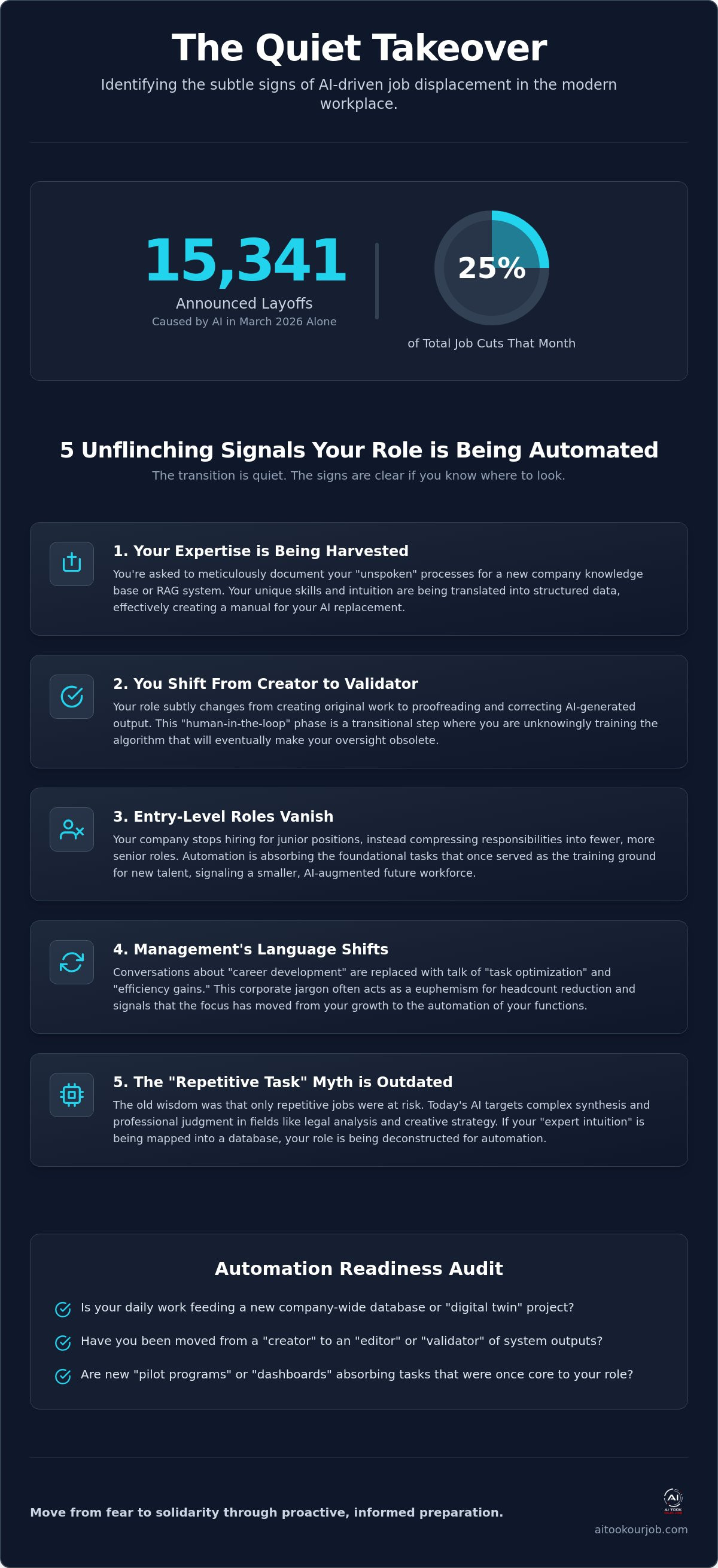
Your expertise is being mapped. It starts with a simple request to document your "unspoken" processes for a new company database. Suddenly, your deep knowledge isn't just in your head; it's being structured into a format that a machine can digest. This is one of the most technical signs of job automation today. You aren't just doing the work anymore. You are building the instructions for the system that will eventually do it without you. If you feel like your unique "knack" for a task is being turned into a checklist, the harvest has begun.
The Rise of the "Human-in-the-loop" Phase
Does your job feel like it's becoming a series of "checks"? You might find yourself spending more time as a validator than a creator. Management calls it "augmentation," but it often feels like you're just proofreading an algorithm's homework. This shift is a major red flag. According to Stanford HAI research on automation, the real impact isn't just about losing a job title, but about the total replacement of tasks that once required human judgment. If you are moved from a "creator" to an "editor" role, your value is being squeezed into a narrow box. The speed of this transition often depends on the specific AI impact by industry, with finance and legal sectors seeing the fastest compression.
Data Harvesting as a Job Requirement
Is your company building a "digital twin" of your department? Retrieval-Augmented Generation (RAG) systems are the new standard in 2026. These tools "learn" from your past emails, reports, and Slack messages to mimic your tone and decision logic. It's a form of corporate ingestion. When knowledge management becomes a mandatory daily requirement, it's often a precursor to automation. You're being asked to feed the LLM your best ideas until it can predict them itself. It's a quiet, digital mirroring that eventually makes the original mirror unnecessary.
We see this happening across every sector. It can feel isolating to realize your years of experience are being treated as mere training data. If you want to stay ahead of these shifts, checking our weekly briefing can help you spot these patterns before they become permanent. Your performance metrics are the final giveaway. If you are being judged on the "volume of data validated" rather than the "quality of original output," the system has already taken the lead. Standardization is the enemy of the human expert. When non-routine tasks are forced into rigid templates, the human element is being prepared for removal. Stay alert to these signs of job automation in your daily software tools.
Organizational Red Flags: Hiring Freezes and Role Compression
Look at the desks around you. Are they staying empty? The most telling signs of job automation aren't always found in a software demo. They're found in the budget. When personnel costs are slashed to make room for "SaaS and Infrastructure" line items, the company's trajectory is clear. Leadership is betting on lean teams that favor algorithmic oversight over human intuition. This shift in AI job market trends signals a move toward a skeleton crew model. It's a cold calculation. Your department is being re-engineered to run on code rather than community. You might feel the pressure to work harder to justify your spot. We understand that fear. It's a heavy burden to carry when the numbers seem stacked against you.
This organizational restructuring often happens in silence. It's not a sudden layoff; it's a gradual thinning of the herd. You might notice that your peers who leave aren't being replaced. Instead, their tasks are simply absorbed by the remaining team members, often with the promise that a new AI tool will make it "manageable." This is how role compression begins. It's a slow-motion consolidation that prioritizes the bottom line over human sustainability. We have to see it for what it is. It's not a temporary hurdle. It's a permanent shift in how labor is valued in the 2026 economy.
The Missing Junior Tier
Junior positions are no longer being filled because AI handles the "grunt work." This creates a terminal experience gap. If there are no juniors to train, the senior roles eventually become obsolete. A GAO report on workforce automation confirms that routine-task workers face the highest risk. This isn't just an office problem. It's reshaping skilled labor automation where software replaces apprenticeships. When the bottom rung is gone, the ladder is useless.
The "Efficiency" Trap
Role compression is the final stage. You're suddenly doing the work of three people with "AI help." Management calls this "efficiency." We call it a countdown. You're being pushed to prove how much a single human can oversee before the system takes over. The psychological toll of a 24/7 automated workflow is heavy. Don't let "upskilling" talk distract you. If you're upskilling for a role being compressed, you're on a treadmill. Plan your move with radical honesty. Acknowledging these signs of job automation is the first step toward a new path.
Cultural Signals: Deconstructing the "Augmentation" Narrative
The atmosphere in the office has shifted. It isn't just about the software updates anymore. It's about how you are spoken to. Have you noticed that management has quietly stopped discussing your "career path"? Suddenly, the conversation is dominated by "task optimization" and "process streamlining." These are not just buzzwords. They are subtle cultural signs of job automation that signal a change in how the company views your utility. You are no longer a professional with a future to be nurtured. You are a set of functions to be refined. It's a cold transition, and it's happening in boardrooms everywhere.
Long-standing workflows that once prioritized human connection are now dismissed as "friction." This "ghosting" of legacy processes is a painful reality to witness. It feels like the ground is shifting beneath your feet. You might feel like a "legacy asset" in a company that is desperately trying to look "forward-leaning." When the business brings in a sudden influx of consultants specializing in "Workforce Transformation" or "Digital Evolution," the writing is on the wall. These experts aren't there to save your role. They are there to map the exit strategy. We know how isolating this feels. You aren't imagining the coldness in the air.
Decoding Management Speak
We've all heard the line: "AI will empower you to focus on high-value work." It sounds promising. It sounds like a promotion. But in the 2026 economy, "high-value work" is often just the next training set for the algorithm. Once you've "optimized" the routine, the system moves on to the complex. This constant goalpost-shifting can lead to deep emotional exhaustion. Navigating the psychology of AI job loss requires recognizing this gaslighting for what it is. You aren't failing. The system is simply changing its definition of success to exclude human input. We must be honest about that reality to stay grounded.
The Solidarity of the Displaced
Individual anxiety is a heavy burden, but collective awareness is a tool for survival. Talking to your peers about these signs of job automation is the first step toward reclaiming your agency. We need to move past corporate platitudes and embrace radical honesty. You aren't alone in this transition. There is power in finding a community that acknowledges these difficult professional realities without falling into despair. We are all navigating this new landscape together.
If you feel the cultural shift in your bones, don't ignore your intuition. You can join our Community Membership to connect with others who are facing these exact transitions with clear eyes and shared resilience. Your professional identity is more than the tasks you perform for a company that currently views you as "friction." It's time to start looking toward a future where your utility is defined by your own values, not an algorithm's efficiency metrics.
The 2026 Automation Readiness Checklist: Your Path Forward
Knowledge is the first step. Action is the second. If you've spent the last few minutes identifying the quiet indicators of displacement within your own office, you know that waiting is no longer a viable strategy. We refuse to let you navigate this transition alone. The signs of job automation are clear, but they don't have to signal the end of your professional utility. They are simply a prompt to pivot. Use this checklist to audit your current standing and reclaim your agency in an increasingly algorithmic economy.
- Audit your "Shadow Work." Track how much of your day is spent cleaning up AI errors, labeling data, or documenting processes for a new database. If you spend more than 20% of your time training the system, you are essentially building your own replacement.
- Monitor the "Junior Gap." Check your company's internal job board. If entry-level roles in your department have vanished, the foundation of your career ladder is being dismantled. This is a terminal sign for senior roles.
- Analyze your "Decision Density." Pay attention to who is actually making the choices. If an AI proposes a solution and you simply click "approve," your professional judgment is being bypassed. You've become a safety net, not a driver.
- Secure your personal data. Don't leave your legacy on company servers. Ensure your portfolio, proof of work, and professional contacts are stored on personal hardware. When the transition happens, you need your history with you.
- Track the velocity of change. Stay ahead of the curve by joining the AI Job Market Weekly Briefing. Information is your best defense against sudden displacement.
Taking Immediate Action
Don't wait for a formal announcement. Start a Transition Fund today. This isn't just a savings account; it's your freedom from desperation. We recommend networking outside your current "at-risk" industry bubble immediately. If your field is seeing heavy signs of job automation, look for sectors that still prioritize high-stakes human judgment and complex empathy. Reframe your resume now. Focus on your ability to manage transitions and oversee complex systems rather than just performing discrete tasks that an algorithm can mimic.
Finding Your New Professional Home
Isolation is the enemy of resilience. Community membership is the best insurance you can have against the shifting tides of 2026. By connecting with others who are facing these same realities, you move from individual anxiety to collective power. Leverage our Educational Media Content to understand where the new opportunities are hiding. Reclaim your agency. Join the briefing, find your people, and remember that your value as a human professional remains even when a specific role does not.
Reclaiming Your Agency in an Automated World
The shift is real. It's happening in the quiet updates to your workflow and the thinning of your department's budget. Recognizing the signs of job automation isn't an act of pessimism; it's a necessary step toward self-preservation. You've seen how "efficiency" often masks headcount reduction and how your unique expertise is being harvested for training data. Are you ready to stop being the validator for your own replacement? Now is the time to look beyond the corporate narrative of simple augmentation. You deserve a career path defined by human value rather than algorithmic optimization.
You don't have to navigate this transition in isolation. We provide weekly insights from industry experts and a community of 50,000+ professionals who value radical honesty about the 2026 labor market. Knowledge is your most powerful defense against sudden displacement. Join the AI Job Loss Weekly Briefing to stay ahead of the curve and start building your path forward today. This period of transition is difficult, but your resilience is stronger than any software update. We are in this together.
Frequently Asked Questions
Is my job safe if it requires high emotional intelligence (EQ)?
High emotional intelligence is a significant barrier for AI, but it isn't an absolute shield. While algorithms struggle with genuine empathy, they're already being used to "triage" human emotions in counseling and HR. Don't assume EQ makes you untouchable. Instead, use it to anchor yourself in roles where the human connection is the product, not just a byproduct of the task.
What is the most reliable sign that my department is being automated?
The most reliable indicator is a budget shift from personnel to software infrastructure. When your department's "SaaS and AI" line item grows while hiring freezes remain in place, the trajectory is set. This is one of the unmistakable signs of job automation that you can track through internal financial reports. It signals that the company is prioritizing code over headcount.
Should I tell my manager I suspect my role is being automated?
Discussing your suspicions with a manager is rarely productive. They're often under strict confidentiality agreements or are navigating their own displacement. Seeking reassurance from the hierarchy can sometimes flag you as "disengaged" before you've secured your next move. It's better to use that energy to build your transition fund and connect with an external community of peers who understand the reality.
How fast does job displacement typically happen once signs appear?
Displacement typically accelerates once the "pilot phase" of a new tool ends. You might notice subtle shifts for six months, but the actual role compression often happens within a single quarter. Once the AI achieves a baseline level of accuracy, the transition from "augmentation" to "replacement" can be startlingly fast. Your window for a proactive move is usually smaller than it feels.
What are "transferable skills" in a world where AI can code and write?
Transferable skills now center on high-stakes accountability and cross-functional synthesis. AI can generate content and code, but it cannot take responsibility for the business outcomes or ethical implications of those assets. Your value lies in being the "human in the loop" who understands the broader context and can navigate the friction that automated systems often ignore. Focus on your ability to lead through uncertainty.
Can I sue my company if they use my work to train an AI that replaces me?
Current labor laws generally favor the employer regarding work-for-hire intellectual property. Most contracts state that any data or processes you create belong to the company, including the right to use them for machine learning. While this feels like a betrayal of your unique expertise, legal recourse is currently an uphill battle. We recommend checking with a qualified labor expert regarding any recent regulatory updates in your jurisdiction.
Is "upskilling" actually effective against AI displacement?
Upskilling is only a solution if it moves you away from the path of the algorithm. Learning to use AI to perform your current tasks better often just identifies the signs of job automation more clearly for your employer. You're essentially refining the tool that replaces you. True upskilling involves moving into roles that require deep strategic intuition or physical, non-routine dexterity that AI cannot yet mimic.
How do I explain an "AI layoff" to a future employer?
Frame the layoff as a structural evolution of the industry. There's no shame in being part of a 2026 headcount reduction; it's a shared reality for millions. Future employers value radical honesty and a clear-eyed understanding of the landscape. Explain how you identified the shift early and what proactive steps you took to pivot your expertise into a new, more resilient category of work.