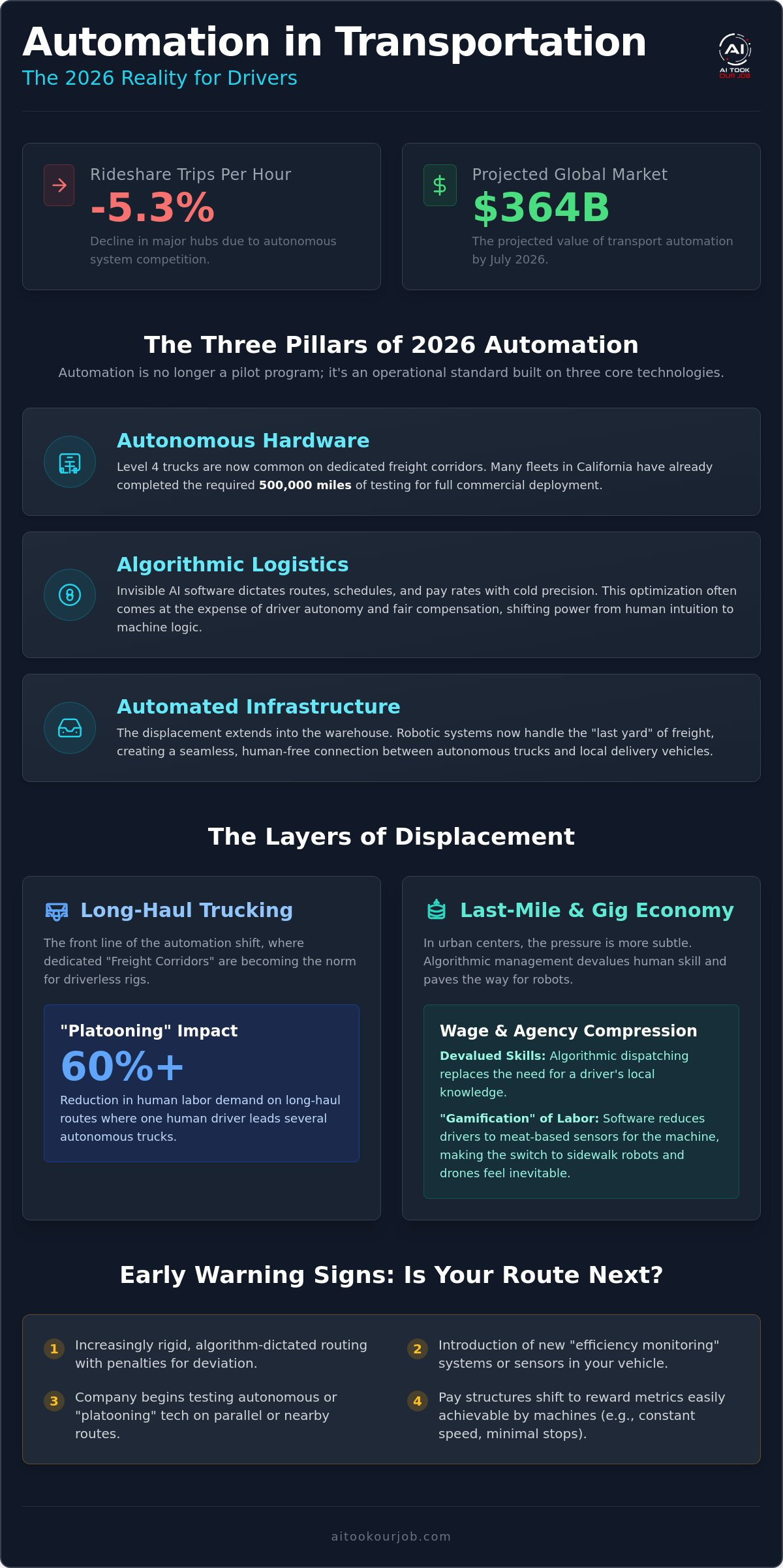
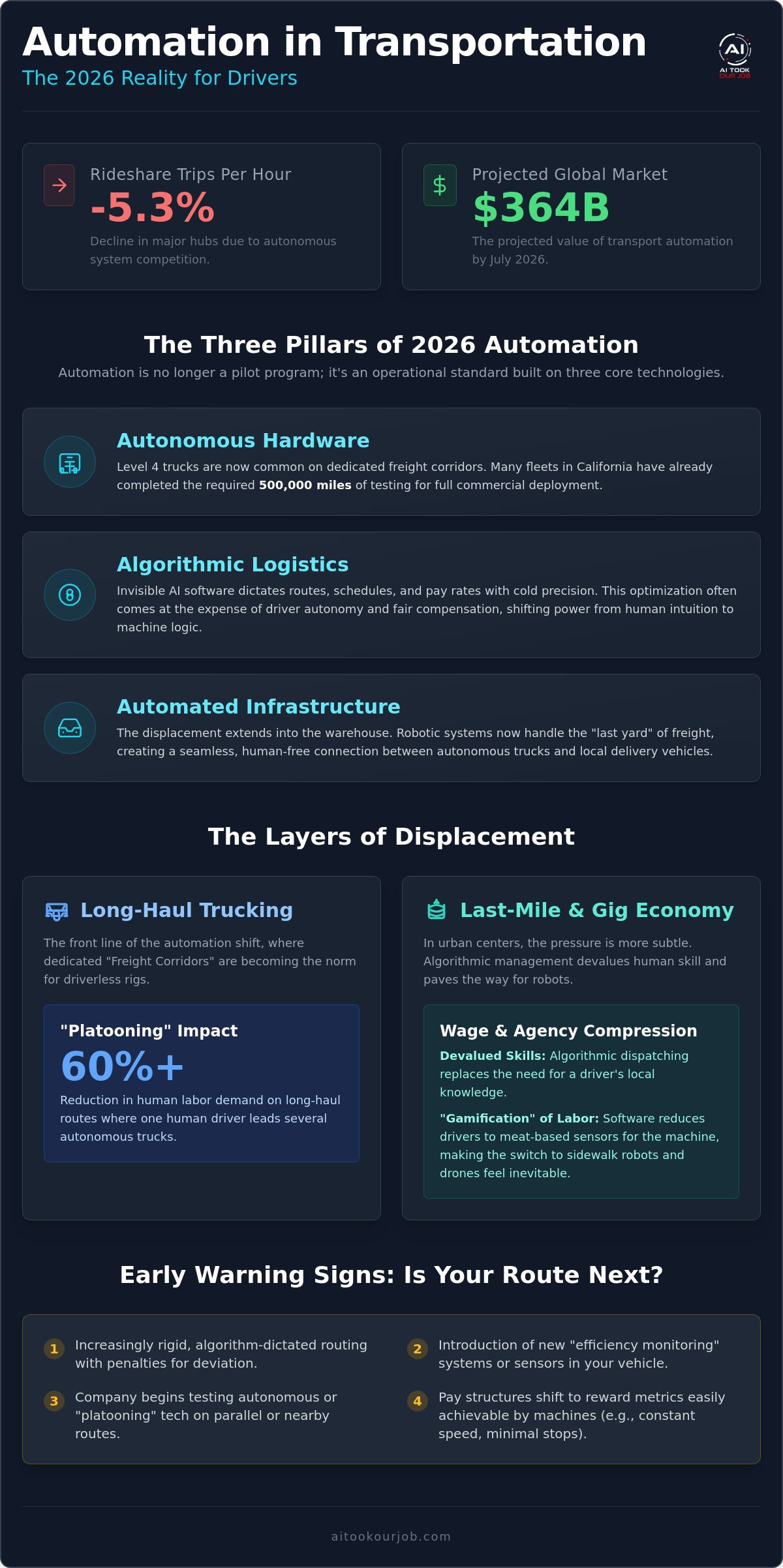
In major hubs where autonomous systems have moved from testing to commercial reality, rideshare drivers saw their trips per hour decline by 5.3 percent at the end of last year. It isn't just a pilot program anymore. As of July 2026, automation in transportation has reached a critical mass, with the global market projected to hit 364.08 billion dollars. You've likely felt the weight of these numbers in your daily route long before they hit the headlines.
It's exhausting to hear corporate leaders talk about "innovation" while earnings in cities like Los Angeles and San Francisco continue to slide. You deserve more than vague reassurances or technical jargon from employers who refuse to be transparent. We promise to provide an unflinching look at how these autonomous systems are reshaping the logistics chain and what that actually means for the person behind the wheel.
We will map out a realistic timeline of displacement based on the latest 2026 regulations and identify which sub-sectors offer the most security. This isn't about despair; it's about finding a community that speaks the truth so we can build resilience together.
Key Takeaways
- Learn why automation in transportation isn't just a pilot program anymore but a hard operational standard across the global logistics chain.
- Identify the specific corridors and urban zones where autonomous freight and last-mile delivery robots are creating the most immediate pressure on human roles.
- Understand the reality of wage compression and learn how to evaluate your worth when machines handle the bulk of the driving.
- Spot the early warning signs that your specific route is being slated for automation so you can pivot toward human-centric niches AI can't master.
- Move past individual anxiety by connecting with a community that prioritizes shared wisdom and collective action in the face of industry shifts.
What is Automation in Transportation in 2026?
By mid-2026, the industry has stopped talking about what "might" happen. The technology is here. It is moving freight across the I-10 and delivering groceries in Phoenix right now. To understand the current landscape, we must look at What is Automation in Transportation? beyond just the shiny sensors on a cab. In its current form, automation in transportation is the integration of high-level AI software with autonomous hardware. It's no longer a series of experimental pilots. It's an operational standard.
You see the visible side every day. Driverless Waymo vans now operate in 11 metropolitan areas. You don't see the invisible side; the algorithmic dispatch software that decides your rate before you even see the load board. Let's be honest. Corporate efficiency usually means human displacement. When a company touts a "seamless transition," they're often talking about removing the most expensive variable in the cab: you. We aren't here to sugarcoat that reality.
The Three Pillars of 2026 Transport Automation
- Autonomous Hardware: Level 4 trucks are now a common sight on dedicated freight corridors. In California, these heavy-duty rigs must complete 500,000 miles of testing before commercial deployment, a milestone many fleets hit earlier this year.
- Algorithmic Logistics: This is the software that dictates every second of your day. It optimizes routes with a cold precision that human intuition can't match, often at the expense of driver autonomy and fair pay.
- Automated Infrastructure: The shift isn't just on the road. Warehouses now use robots to handle the "last yard" of freight, connecting the autonomous truck to the local delivery van without a human hand touching the pallet.
Why the 2026 Wave is Different
The velocity of displacement has accelerated. Earlier shifts in automation in transportation felt slow, like a distant storm. Now, the storm is here. The BUILD America 250 Act, advanced in May 2026, established the first federal framework for autonomous commercial vehicles, signaling that the government is ready to let the machines take over the long haul. We've moved from "driver assistance" to "driver replacement" in key logistics hubs almost overnight. We define transportation automation as the transfer of decision-making from human intuition to machine optimization. It's a fundamental shift in who holds the power on the road. You need to know where you stand before the next wave hits your route.
The Layers of Displacement: From Long-Haul to Last-Mile
The transition isn't a single event. It's a series of layers. Understanding The Layers of Displacement: From Long-Haul to Last-Mile requires looking at the industry through a lens of radical honesty. While some roles are visibly removed by driverless cabs, others are being quietly replaced by software that slowly strips away human agency. In 2026, automation in transportation has moved beyond simple tasks. It now targets the entire logistics chain, from the interstate to your front porch.
Long-Haul Trucking: The Front Line of Shift
The "Freight Corridor" is no longer a concept; it is a reality. In the US and Europe, dedicated lanes for autonomous rigs are becoming the norm. Many fleets are adopting "platooning," where a single human lead driver guides several autonomous following trucks. This tech effectively cuts the need for human labor by 60 percent or more on long stretches. It's a stark example of AI impact by industry. By mid-2026, heavy-duty trucks in California have logged the 500,000 miles of testing required for commercial deployment. The machines aren't just coming. They're already in the next lane.
The Last-Mile and the Gig Economy
In urban centers, the squeeze is more subtle but just as painful. Algorithmic dispatching has devalued the local knowledge delivery drivers once relied on. The software now dictates every turn, reducing a skilled professional to a meat-based sensor for the machine. This "gamification" of labor makes the transition to sidewalk robots and drones feel inevitable. You can see the parallels in how AI retail job displacement has hollowed out physical storefronts. If you feel like your employer is treating you like a temporary placeholder for a robot, you're likely right. It's why staying informed through our AI Job Loss Weekly Briefing is essential for tracking these shifts in real-time.
The "Middle-Mile" is the final piece of the puzzle. Automated transfer hubs are popping up at city limits. These facilities allow autonomous long-haul rigs to drop trailers that are then picked up by local electric vans or robots. This reduces human touchpoints to almost zero. We must recognize these "quiet" replacements. A job isn't always lost in a single day; sometimes it's just slowly automated until there's nothing left for a human to do. We're here to help you spot these patterns before they become your reality.
The Productivity Paradox: Corporate Gain vs. Human Cost
Corporate press releases are full of it. They claim that for every role lost to a sensor, three more are born in a server room somewhere; yet this math never seems to add up on your weekly pay stub. We need to have a moment of radical honesty. The narrative that automation creates more jobs than it destroys is a convenient fiction designed to quiet labor unrest. In the real world of 2026, we are seeing a "Productivity Paradox." Companies are moving more freight and carrying more passengers than ever before, but worker security is in a freefall. Efficiency for the board of directors is often just another word for displacement for the driver.
Wage compression is the silent killer of the transport profession. When an AI handles 80 percent of the long-haul route, what is your remaining time worth to a fleet owner? They no longer see you as a skilled navigator but as a biological backup system for their hardware. This devaluation shows up in the data. While nationwide pay rose slightly in late 2025, hourly gross earnings for drivers in major autonomous hubs like Los Angeles fell by 3.7 percent. In San Francisco, the drop was 1.7 percent. This is the 2026 reality of automation in transportation. The machines do the heavy lifting, and the humans are left to fight over the crumbs of what remains.
Efficiency for Whom?
Shareholder dividends are hitting record highs. Waymo raised 16 billion dollars in early 2026, valuing the company at a staggering 126 billion. Ask yourself: how much of that investment is trickling down to the people still behind the wheel? Companies frequently use "safety" as a moral shield to justify removing human "risk." It sounds noble until you realize that removing risk also means removing your livelihood. Being managed by an unfeeling algorithm that dictates your bathroom breaks and penalizes you for traffic you didn't cause is a psychological burden no paycheck can fully cover. It's a cold, calculated shift toward a workforce that doesn't need to eat or sleep.
The Myth of Easy Upskilling
"Just learn to code." It's a dismissive, insulting response to a seasoned professional whose industry is shifting beneath them. This advice ignores the fact that the velocity of automation is now outstripping our ability to retrain. In 2026, upskilling isn't keeping pace with the machines. We have to face the truth: the education-to-work pipeline is breaking. Traditional training programs are too slow and too expensive for a workforce that needs answers today. We aren't just facing a technology problem; we're facing a systemic failure to value human labor in an age of machine optimization. You aren't failing to adapt. The system is failing to include you.
Navigating the Shift: Practical Guidance for Workers
Knowledge is your only armor. You can't stop the tide of automation in transportation, but you can certainly stop being blindsided by it. We need to move from a state of passive anxiety to a "briefing" mindset. This means looking at your workplace with a cold, analytical eye. Companies rarely announce displacement until the day the pink slips arrive; however, the infrastructure for that displacement is laid months or years in advance. You have to learn to read the room before the lights go out.
Spotting the Corporate Automation Strategy
Watch the equipment. If your fleet is suddenly installing advanced telematics that track every eye movement and steering correction, they aren't just monitoring your safety. They are harvesting your expertise to train the next iteration of autonomous software. Another red flag is a quiet hiring freeze for entry-level logistics roles. When a company stops bringing in new humans at the bottom, it's because they've already cleared a path for a machine. Don't be afraid to demand radical transparency. Ask your supervisor directly about the five-year tech roadmap during the next town hall. If the answer is vague, that is your answer.
Transferable Skills in the Age of AI
AI struggles with the messy reality of human life. It can't handle a medical emergency in the back of a paratransit van or navigate the complex social cues of a high-stakes delivery to a busy construction site. These human-centric niches remain your safest ground. You must look for roles where you can move from being a simple operator to an "oversight" professional. This involves managing the autonomous systems rather than competing with them. Human empathy and ethical judgment are the two traits AI cannot replicate in 2026 transportation. These are your leverage points. If you want to stay ahead of the curve, you need to join a community that tracks these shifts daily. You can subscribe to our AI Job Loss Weekly Briefing to get the ground-truth data your employer won't provide.
Staying informed is a form of resistance. It allows you to make decisions based on reality rather than corporate hope. Whether it's shifting into specialized transport or moving into a dispatch role that requires complex problem-solving, your next move depends on the quality of your information. We are navigating this transition together. Don't wait for the company to tell you what's next. Find out for yourself. Your experience has value, but you must be the one to decide how to apply it in this new landscape.
Collective Resilience: Why You Aren't Alone in 2026
Isolation is a corporate strategy. If you feel alone, you are easier to replace. When the weight of automation in transportation feels like an immovable object, remember that thousands of other drivers are staring at the same dashboard sensors. We created the AI Took Our Job community as a hub for shared wisdom because the truth is too heavy to carry by yourself. This isn't a place for hollow comfort. It's a strategic center for people who refuse to be ghosted by the industry they built.
We believe in radical honesty about the shifts we see in 2026. While corporations celebrate record dividends and the deployment of 42,770 autonomous vehicles worldwide, our community focuses on the human stories behind those numbers. Moving from individual anxiety to collective action is the only way to ensure the future of work still has a place for the worker. We don't just track the machines. We track the path forward for the people.
The Power of Shared Stories
Connecting with others who are facing the same "crisis of utility" is a vital act of resilience. It's easy to feel like your skills are being devalued when an algorithm takes over 80 percent of your route. Talking to peers helps you realize that your value was never just about steering; it was about the complex problem-solving and human judgment you brought to every mile. By joining our community membership, you add your voice to a collective advocacy movement. We push for responsible policies and transparency that the corporate-controlled media refuses to cover. You can find more about how we navigate these shifts in our Weekly briefing AI job market analysis.
Your Survival Map
The "Weekly Briefing" is more than a newsletter. It is your survival map for a landscape that changes every time a new regulation or software update drops. We use our collective intelligence to discover "hidden" roles that automation in transportation isn't touching yet. These are the niches where human empathy and high-stakes decision-making remain essential. In an era where employers hide their tech roadmaps, independent media and community-driven data are your only reliable sources of truth. We are building a future that values people over algorithms. The challenge is shared, and the solution must be collective. You aren't just a variable in a logistics chain. You are part of a resilient workforce that is standing its ground. Let's move forward together.
Steering Your Career Through the Machine Age
The road ahead isn't just changing; it has already been rebuilt. We have seen that automation in transportation is no longer a distant threat but a daily reality that demands a new strategy. Corporate profits may be rising while your security feels thin, but you don't have to navigate this transition in isolation. By focusing on human-centric niches and staying informed, you can find a path that the algorithms haven't mapped yet.
You deserve a survival map that isn't written by a corporate HR department. We invite you to Join the AI Took Our Job community and get the Weekly Briefing for the ground-truth data you need. Our members benefit from weekly briefings on labor shifts, access community-led support for career transitions, and join a collective advocacy movement for responsible AI policy. We don't promise easy answers, but we do promise you won't have to face the machine alone. Let's build a future where human experience still carries weight. You've got this, and we've got you.
Frequently Asked Questions
Will truck drivers be completely replaced by AI by 2030?
No, but the role will be fundamentally different from what it is today. Long-haul freight corridors will see the highest saturation of autonomous rigs, while human drivers will likely shift toward "platooning" roles. Most experts suggest you won't be replaced so much as relegated to the most complex 20 percent of the route. By 2030, the job will focus more on systems oversight than manual steering.
What are the first transportation jobs to be automated?
Long-haul trucking on dedicated freight corridors is the first major sector to shift. In 2026, automation in transportation is no longer a pilot project; it is an operational standard for many large fleets. Urban rideshare drivers are also seeing the impact, with trips per hour declining in cities where driverless services have launched. Machines are targeting the most predictable and repetitive routes first.
Can AI handle the 'last-mile' delivery better than humans?
AI is more efficient at route optimization, but it fails at the messy, human part of the job. Drones and sidewalk robots handle standardized packages on flat terrain quite well. However, they can't navigate apartment buzzers, aggressive dogs, or high-stakes signatures. The "better" in this context usually refers to corporate cost-cutting rather than actual service quality or the ability to handle unexpected obstacles.
Is there any legal protection for workers displaced by AI in 2026?
Legal protection is currently limited to workforce development grants and training programs. The BUILD America 250 Act, advanced in May 2026, includes provisions for training programs to help drivers transition to new roles. It also requires remote assistants to be based within the United States. While these are steps toward a just transition, they don't offer a direct job guarantee for those whose roles are eliminated.
How do I know if my company is planning to automate my role?
Look for the deployment of granular telematics and hiring freezes for entry-level positions. If your fleet is suddenly obsessed with harvesting data from your cab, they're likely training the software that will eventually supplement your role. Radical honesty means acknowledging that if they aren't talking to you about a tech roadmap, they're likely hiding one. Don't wait for a formal announcement to start your next move.
What skills should a delivery driver learn to stay relevant?
Focus on high-stakes human interaction and complex problem-solving that machines can't replicate. AI struggles with ethical judgment and deep empathy. Learning to manage autonomous systems as an "operations supervisor" rather than just an operator is a viable path. Your value in 2026 lies in your ability to handle the 5 percent of situations that the machine finds unsolvable. Move toward roles requiring high human touch.
Does automation in transportation actually make the roads safer?
Safety is the main marketing claim used by fleet owners, but the reality is more complex. While automation in transportation removes human fatigue, it introduces new technical risks. Current 2026 regulations in California now require vehicles to have two-way communication for emergency personnel. Companies often lead with safety statistics to avoid discussing the economic impact on the human workforce who are being pushed out of their livelihoods.
How can I join a community of other workers facing AI displacement?
You can join the AI Took Our Job community to connect with others in your industry. We offer a weekly briefing that tracks labor shifts and provides a hub for shared wisdom and collective action. Isolation is a corporate tool; solidarity is yours. Don't navigate this industry transition without a support system that values people over algorithms. We are stronger when we share our stories.