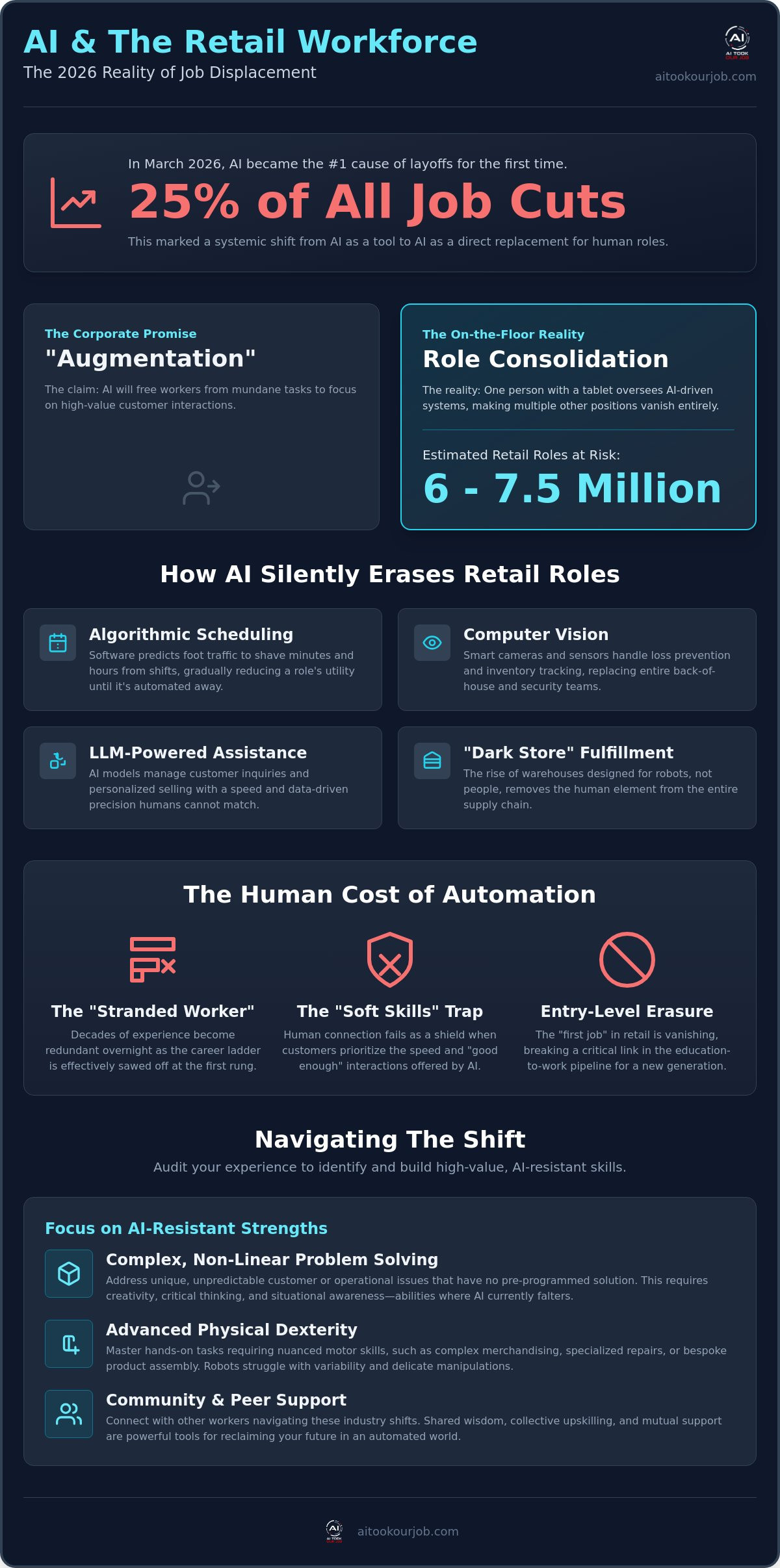
In March 2026, AI became the leading cause of layoffs for the first time, accounting for a staggering 25% of all job cuts. It's a hard truth that hits the front line first. You feel the shift every time a new "automated assistant" appears on the floor or a middle management role quietly vanishes. The corporate brochures call it "augmentation," but for many, AI retail job displacement feels like a slow erasure of everything you've built. It's okay to be angry. It's okay to be worried.
We agree that the constant promises of corporate upskilling often feel like gaslighting while your financial stability hangs in the balance. You deserve a perspective that respects your intelligence and your anxiety. This article provides a grounded, honest look at how AI is restructuring the workforce and offers a practical blueprint to help you navigate this transition. We'll examine the specific roles currently at risk, validate the professional identity loss you're facing, and outline clear paths to pivot your career with confidence.
Key Takeaways
- Distinguish between corporate promises of job "augmentation" and the hard reality of AI retail job displacement as computer vision and LLMs consolidate front-line roles.
- Recognize the subtle mechanics of displacement, including how algorithmic scheduling software reduces human hours long before a position is officially eliminated.
- Evaluate the "soft skills" myth to understand why human connection often fails to protect roles when customers prioritize automated speed and "good enough" interactions.
- Audit your professional experience to identify high-value, AI-resistant skills like physical dexterity and complex, non-linear problem-solving.
- Learn how to reclaim your future by connecting with a community of peers who are navigating these industry shifts together through shared wisdom and expert guidance.
The 2026 Retail Landscape: From "Reshaped" to Replaced
We've moved past the era of the clunky self-checkout kiosk. In 2026, AI retail job displacement isn't just a buzzword; it's a systemic removal of the human element from the shopping floor. It happens quietly. High-definition computer vision cameras now track every item a customer touches, while multimodal Large Language Models (LLMs) handle complex inquiries that once required a seasoned floor manager. This isn't science fiction anymore. It's the Tuesday morning shift at your local big-box store.
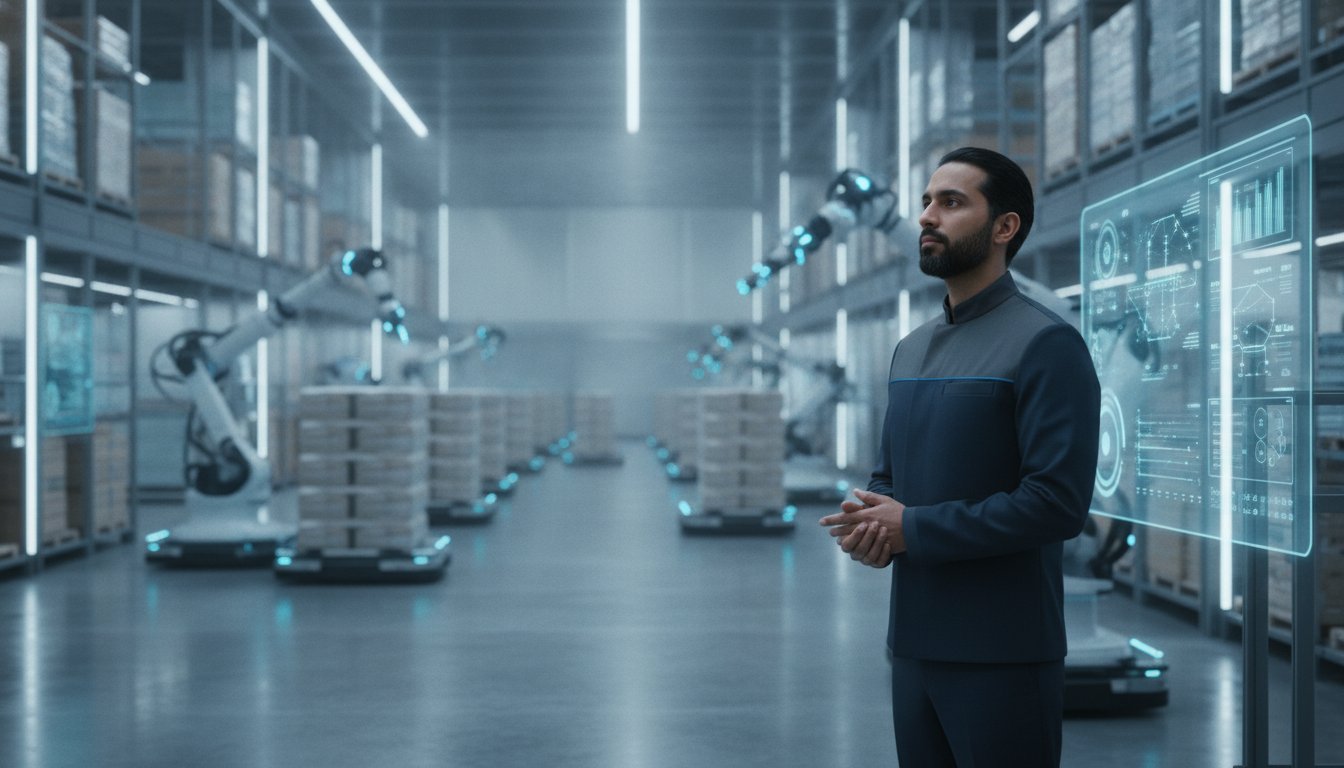
Corporate HR departments love the word "augmentation." They claim AI will free you from mundane tasks so you can focus on "high-value customer interactions." The reality is role consolidation. When one person can oversee twelve AI-driven aisles from a tablet, eleven other positions simply vanish. Industry analysts estimate between 6 and 7.5 million retail roles are currently at risk of being phased out. This is a modern, accelerated manifestation of technological unemployment, where the skills of a generation are suddenly made redundant by autonomous code. We are seeing the rise of the "stranded worker." These are professionals who have spent decades in retail only to find the career ladder has been sawed off at the first rung.
The Era of Invisible Automation
Inventory management used to be a team effort involving clipboards and late nights. Now, autonomous shelf-sensors and drones manage supply chains without a single human touchpoint. We're seeing a rapid shift toward "dark store" fulfillment centers. These are spaces designed for robots, not people. The 2026 models are significantly more dangerous to job security than 2020 versions. They don't just flag errors; they predict demand and adjust orders autonomously, leaving no room for human oversight.
Why This Wave Hits Different
This wave moves with terrifying speed. Pilot programs that used to take years to test now go global in a matter of months. This contributes to the broader AI impact by industry that we're tracking across the global economy. It's okay to be concerned. Your anxiety isn't a sign of weakness; it's a rational response to a radical change. We see you. The "truth" isn't always comfortable, but knowing the landscape is the first step toward reclaiming your agency in an automated world.
The Mechanics of Displacement: How AI Silently Erases Retail Roles
Displacement doesn't always start with a pink slip or a closed store. Often, it begins with a subtle shift in the software you use to clock in. AI retail job displacement is frequently a quiet, incremental process that devalues human labor through technology before removing the role entirely. It's a strategy of erosion. By the time the position is officially eliminated, the "work" has already been carved up and handed to various algorithms.
Algorithmic scheduling is the first tool in this kit. Modern software doesn't just "help" managers; it dictates hours based on hyper-accurate foot traffic predictions. By shaving thirty minutes off a shift or identifying "dead zones" where a human presence is deemed unnecessary, the software reduces your utility. Eventually, the role becomes so fragmented that it's consolidated into an automated system. Similarly, suggestive selling is no longer the domain of the talented sales associate. Personalized marketing AI now analyzes a customer's entire digital history to offer recommendations that are far more precise than a human intuition could ever be.
Computer vision has also taken a heavy toll on back-of-house and security roles. Cameras equipped with behavioral analytics now handle loss prevention, while autonomous sensors perform the manual inventory tracking that once required entire teams. The "help desk" has seen a similar fate. LLMs now manage floor assistance and customer inquiries with a speed that humans cannot match. These systems don't get tired or frustrated. They just provide "good enough" answers that satisfy the bottom line.
The Death of the Entry-Level Role
The "first job" in retail is rapidly becoming a relic of the past. This is a critical break in the education-to-work pipeline. Entry-level erasure is the removal of the first rung on the career ladder. As highlighted by Yale Insights, the real job destruction from AI is hitting before careers can even start. Without these foundational roles, the path to professional growth is effectively blocked for millions of young workers.
Middle Management Under Fire
Middle managers are not safe either. AI now acts as the "manager," automating performance reviews and task delegation based on raw data. This shifts the supervisor's role from mentoring to mere software troubleshooting. The result is a shrinking salary ceiling for retail professionals. You can spot the "silent replacement" in your own workplace when your manager's primary responsibility becomes managing the AI that manages you. Staying informed through our AI Job Loss Weekly Briefing can help you track these subtle shifts in real-time.
The "Soft Skills" Trap: Why Human Connection Isn’t a Shield
For years, career advisors and corporate leaders have told us that empathy is our ultimate defense. They claim that because a machine cannot "feel," your ability to connect with a customer will keep you safe. It's a comforting thought. It's also a trap. In the cold reality of 2026, AI retail job displacement is proving that empathy is often a secondary concern for big-box retailers. When a customer is in a hurry, they don't want a conversation; they want a solution. This is the "Good Enough" principle in action. If an AI bot can solve a problem in seconds, most shoppers will trade human warmth for digital speed every single time.
Being the "human face" of an automated system is an exhausting form of emotional labor. You're often left to apologize for the machine's errors or to guide frustrated customers through a process designed to exclude you. It's a role that feels increasingly hollow. You aren't being "augmented" to do better work. You're being used as a buffer while the company transitions to a human-free model. This creates a profound crisis of identity, where your value as a person feels tied to a utility that the company no longer respects.
When Efficiency Trumps Empathy
Frictionless commerce is the new industry standard. In this environment, the "human touch" is quickly becoming a luxury service rather than a standard role. If you work in a high-end boutique, you might be safe for now. But for the millions in mass-market retail, efficiency is the only metric that matters. As AI retail job displacement accelerates, we see that mass-market retailers prioritize the bottom line over the "human" experience. This shift forces a difficult confrontation with the psychology of AI job loss. When your core utility is questioned by an algorithm, it's natural to feel a sense of abandonment.
Radical Honesty: The Upskilling Gap
We need to be honest about the upskilling promise. Telling 16 million retail workers to simply "learn to code" is not a solution; it's a PR tactic. True career transition requires more than a three-hour corporate webinar on "AI basics." Most corporate reskilling programs are designed to protect the company's image, not your mortgage.
- The Augmentation Lie: They told you AI would be your assistant, but it's actually your replacement.
- The Training Vacuum: Most "upskilling" doesn't lead to a higher-paying role within the same company.
- The Reality Check: Transitioning out of retail requires identifying sectors where physical presence and complex problem-solving are still non-negotiable.
Navigating the Shift: A Worker’s Blueprint for Career Transition
The map has changed. You cannot use an old compass to navigate a new world. While AI retail job displacement is a structural reality, it does not have to be your final chapter. We need a plan that moves beyond corporate platitudes and focuses on your actual survival. This is about reclaiming your agency. It's about moving from a state of shock into a state of proactive preparation. You are more than the tasks you've been assigned.
- Step 1: Audit your "AI-proof" skills. Focus on physical dexterity and the ability to solve non-linear, messy problems that a machine cannot compute.
- Step 2: Transition to "High-Touch" sectors. Identify industries where human presence is a requirement, not a suggestion.
- Step 3: Leverage your background in logistics. The way you managed a stockroom or store floor is a direct precursor to warehouse coordination and community-based distribution roles.
- Step 4: Protect your mental health. This transition is a marathon. Validate your stress without letting it paralyze your next move.
- Step 5: Join a collective. Stay informed through our weekly briefing to see the shifts before they hit your local store.
Identifying Transferable Skills
Your value is not tied to a barcode scanner. It is tied to your ability to manage chaos. Conflict resolution and de-escalation are critical skills in a post-retail world where human patience is often thin. You understand operational logistics because you've seen how the logic behind the store actually functions. Retail workers possess a hidden degree in human behavior. This expertise is invaluable in any sector that requires navigating complex human interactions and emotional landscapes.
Pivot Industries for 2026
Where should you go? Healthcare support is seeing a massive medical labor shift, creating roles that require the same empathy and organizational skills you already possess. Skilled trades and physical infrastructure maintenance remain resistant to algorithmic centralization. Machines cannot fix a burst pipe or maintain a physical power grid with the same nuance as a human professional. Hyper-local services also offer a sanctuary from digital erasure. These roles rely on community trust and physical presence. You can find more resources on these transitions by joining our community membership.
Reclaiming Your Future: Solidarity in the Age of Automated Commerce
You've seen the data. You've felt the shift on the floor. It's easy to feel like a ghost in your own workplace when an algorithm begins to dictate your worth. But here is the truth: AI retail job displacement is a collective crisis, and it requires a collective response. Navigating this transition in isolation is the quickest path to burnout and despair. We refuse to let that happen. You are not a data point on a spreadsheet. You are a professional navigating a historic industrial shift, and you deserve a community that recognizes your struggle.
At "AI Took Our Job," we provide more than just statistics. We serve as a hub for stories and expert guidance, offering a space where your experiences are validated rather than dismissed. We believe in advocating for responsible AI policies and worker protections. This includes pushing for transparent disclosure of algorithmic management and demanding real, funded transition periods for displaced workers. Your value is not defined by an employer’s algorithm. It's defined by your resilience and the connections you build with others who are facing the same storm. We are in this together.
The Power of the Weekly Briefing
Information is a shield. Staying informed prevents the paralyzing shock of sudden displacement. When you understand the trends before they reach your local store, you gain the most valuable asset possible: time. Time to plan. Time to pivot. Time to protect your family's future. Use our briefing as a survival map for the 2026 market volatility. It's a no-nonsense look at what's coming next, delivered without the corporate spin. Join our community and get the Weekly Briefing to ensure you're never caught off guard.
Building Collective Resilience
We need to move from "Why me?" to "What now?". This shift happens through community support. Sharing your story isn't just about venting; it's a form of advocacy and healing. When we speak openly about the "entry-level erasure" or the "soft skills trap" we've discussed, we strip away the corporate gaslighting. We see the reality for what it is. Solidarity is our best defense against a system that views human labor as a line item to be optimized. We are stronger as an informed, mobilized group than as individual workers trying to outrun a machine. Let's build that future together, one step at a time.
Reclaiming Your Agency in an Automated World
The landscape of 2026 is uncompromising, but your response doesn't have to be passive. We've explored how AI retail job displacement is fundamentally altering the front-line experience, from the quiet erosion of entry-level roles to the failure of the "soft skills" shield. You now know that "augmentation" is often a code word for consolidation. However, you also have a blueprint. By auditing your transferable skills in logistics and human behavior, you can begin to map a path toward sectors where your physical presence and complex problem-solving remain indispensable.
You don't have to face this transition in the dark. Knowledge is the foundation of resilience. Don’t navigate the displacement alone; join the AI Took Our Job community and get our Weekly Briefing. You'll gain access to a community of peers navigating these same shifts, expert-led discussions on career resilience, and a Weekly Briefing that tracks market volatility in real-time. Your professional identity is evolving, but it isn't over. Stay informed, stay connected, and remember that your value has always been more than the tasks you perform. We're here to help you find what comes next.
Frequently Asked Questions
How many retail jobs will be lost to AI by 2026?
In 2025 alone, 76,440 retail positions were eliminated due to AI adoption. By March 2026, AI became the leading cause of all US layoffs for the first time, accounting for 25% of total job cuts. While the total number for the full year 2026 is still being recorded, the acceleration is undeniable compared to the 4.5% rate seen in 2025.
Is retail management safe from AI displacement?
No, middle management is currently one of the primary targets for organizational restructuring. Gartner predicts that 20% of organizations will use AI to eliminate more than 50% of middle management positions by 2026. As AI takes over task delegation and performance analytics, the need for human supervisors in traditional retail structures is rapidly shrinking.
What are the most AI-resistant roles in the retail industry?
Roles that require high physical dexterity and complex, non-linear problem solving are the most resistant to AI retail job displacement. This includes specialized positions like pharmacy technicians, high-end tailors, or roles involving intricate equipment maintenance. Hyper-local services that rely on deep community trust also remain difficult for centralized algorithms to replicate effectively.
Will AI completely replace human customer service in stores?
Total replacement is unlikely, but the scale of automation is massive and transformative. Studies predict that up to 80% of customer service roles could be automated in the coming years as retailers prioritize "frictionless" commerce. Human staff are increasingly reserved for high-end luxury experiences or managing the most complex escalations that machines cannot yet resolve.
What should I do if I think my retail role is being automated?
Start by auditing your daily tasks to identify which ones are already being handled by new software or autonomous sensors. If you notice your hours are being reduced by algorithmic scheduling, it's time to begin a proactive career pivot. Focus on identifying your transferable skills in human behavior or logistics and join a community of peers to share resources.
Can retail workers actually transition into tech roles easily?
Transitioning into high-level tech roles like software development is often much harder than corporate "upskilling" brochures suggest. A more realistic path for many involves moving into "high-touch" sectors like healthcare support or physical infrastructure maintenance. True career resilience comes from finding industries where physical presence and human judgment remain core, non-negotiable requirements.
How does AI retail displacement affect women and minority workers?
Research indicates that retail automation often disproportionately impacts roles historically held by women and minority workers. Cashier positions, which are projected to fall by 11% by 2033, are a prime example of this trend. This systemic shift risks widening the economic gap for these communities as the entry-level rungs on the career ladder are quietly removed.
What is a "stranded worker" in the context of retail automation?
A "stranded worker" is a professional whose career path has been removed by technology, leaving them with experience that no longer has a market. In the context of AI retail job displacement, this often happens when mid-level roles are erased by autonomous systems. It creates a bottleneck where advancement is blocked, leaving experienced workers without a clear way to move forward.