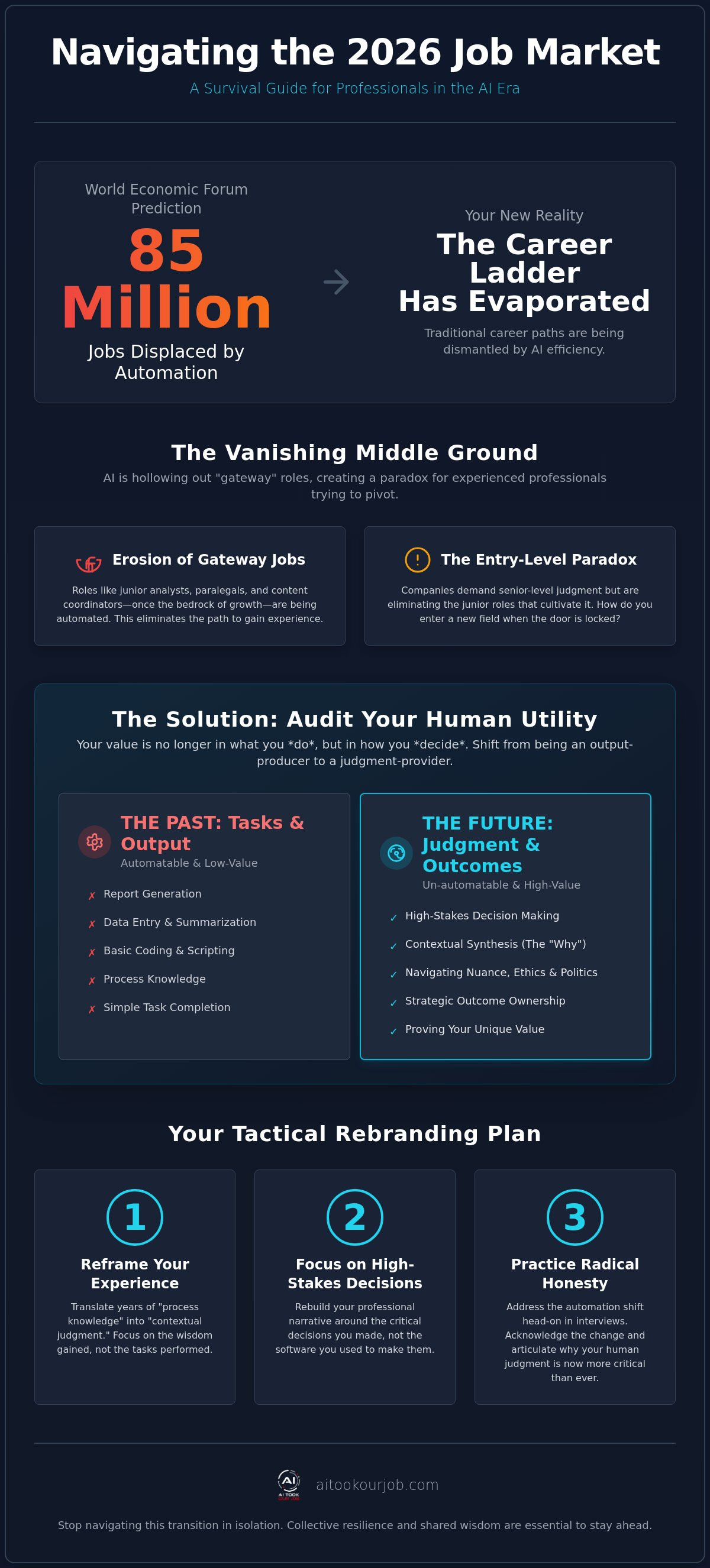
What if the very expertise that defined your career for two decades is exactly what's making you invisible in the 2026 job market? It's a hard truth to swallow. You've watched the World Economic Forum's prediction of 85 million replaced jobs become a daily reality, and the traditional ladders you climbed have simply evaporated. A career change for workers displaced by AI often feels less like a pivot and more like a forced migration into an uncertain, crowded territory. You're likely grappling with a lost professional identity while facing the reality that even "entry-level" roles now demand senior-level strategic judgment.
We see you, and we're navigating this shift together. This guide offers a realistic, step-by-step framework to help you audit your skills and reclaim your professional agency. We'll identify un-automatable pathways in industries with high human-utility demand and build a tactical plan to rebrand your years of experience. You'll learn how to move from being an output-producer to a judgment-provider. Let's look at how to turn this displacement into a calculated, resilient move forward.
Key Takeaways
- Shift your focus from simple task completion to high-stakes human judgment. AI can produce output, but it cannot yet own the strategic outcome.
- Use the Human Utility Audit to isolate the specific parts of your work that remain un-automatable. This clarity is your strongest asset in a crowded market.
- A successful career change for workers displaced by AI hinges on identifying resilient sectors within the emerging "Human-in-the-loop" economy.
- Rebuild your professional narrative around core human functions. Radical honesty during the interview process helps you address the automation shift and prove your unique value.
- Stop navigating this transition in isolation. Collective resilience and shared wisdom are the only ways to stay ahead of quiet automation strategies.
Facing the Displacement: Why the 2026 Career Change is Different
The old career maps have been burned. In 2026, the traditional ladder you were told to climb is being dismantled by algorithmic efficiency. This isn't a minor market correction; it's a fundamental rewiring of how work is valued. For many, a career change for workers displaced by AI feels like being asked to build a plane while it's already in freefall. You might feel like you've failed, but you haven't. This is a structural economic shift. It is the modern face of Technological unemployment, and it is hitting mid-career professionals with a precision we haven't seen before.
We need to talk about "upskilling." For years, the advice was simple: take a six-month course, learn to code, or get a certificate. In 2026, that advice is often hollow. AI models now update their capabilities faster than most human curricula can be printed. Learning a specific software tool is no longer enough because the tool itself will likely be automated by the time you've mastered it. Your value must move up the cognitive chain. You're no longer being paid for "doing" tasks. You're being paid for "deciding" outcomes.
The Erosion of 'Gateway' Occupations
Gateway jobs were once the bedrock of professional growth. These were the roles, such as junior analysts, paralegals, or content coordinators, that allowed you to trade time for experience while moving into higher-paying sectors. AI has effectively hollowed out this middle ground. When an algorithm can summarize 5,000 legal documents in seconds, the role of the person who used to do that manually disappears. This creates more than just a financial gap; it triggers a deep crisis of purpose. We've explored the psychology of AI job loss because we know that when your "gateway" closes, it feels like your professional identity is being erased.
The Entry-Level Paradox
The 2026 labor market presents a frustrating contradiction. Companies are desperate for senior-level judgment but are eliminating the junior roles that produce that judgment. This makes a career change for workers displaced by AI particularly difficult. How do you pivot into a new field when the entry-level door is locked? You have to approach the experience gap with a sense of radical honesty. You aren't starting from scratch; you're translating your existing wisdom into a new language. Navigating this requires a level of transparency that most corporate career coaches won't give you. You aren't just competing against other humans. You're competing against the marginal cost of a subscription. To win, you have to lean into the parts of your humanity that haven't been commoditized yet.
- The Experience Gap: Reframe your 15 years of industry wisdom as "contextual judgment" rather than "process knowledge."
- Radical Honesty: Assess whether your target industry is truly resilient or just the next one on the automation roadmap.
- Strategic Rebranding: Focus on the high-stakes decisions you've made, not the software you used to make them.
Auditing Your Human Utility: Identifying Un-Automatable Skills
Your resume is likely a list of tasks. In the 2026 economy, that is a liability. Tasks are for machines. Outcomes are for people. If your professional value is tied to "data entry," "report generation," or "basic coding," you're competing against a marginal cost of zero. Navigating a career change for workers displaced by AI requires a fundamental shift in how you view your own labor. You have to stop describing what you did and start describing the high-stakes decisions you made. You're no longer a producer of output. You are a provider of judgment.
To find your footing, you must conduct a Human Utility Audit. This isn't a standard skills assessment. It's a rigorous look at which parts of your work an algorithm cannot replicate. Ask yourself: "If this decision went wrong, who would be held accountable?" If the answer is "the system," that role is gone. If the answer is a human who must navigate nuance, ethics, and corporate politics, that is your utility. While AI excels at pattern recognition, it fails at contextual synthesis. It can see the trend, but it can't understand the "why" behind a human reaction. For those struggling to see their own value through the fog of displacement, our Educational Media Content provides specific frameworks for translating legacy experience into future-proof utility.
Analytical Synthesis over Data Processing
AI can find the data, but it cannot navigate the corporate politics of how to use it. While an LLM can parse a spreadsheet to identify a 15% drop in quarterly revenue, it cannot understand that the drop was caused by a temporary morale crisis following a messy merger. Contextual Synthesis is the ability to weigh conflicting human interests, cultural nuances, and long-term ethical implications to make a decision that data alone cannot justify. Roles in strategic operations, crisis management, and complex project leadership are thriving because they require this specific human layer. Your primary product is no longer the data; it's the wisdom to act on it.
The Empathy Economy and High-Stakes Communication
Soft skills are the hardest skills to replace in 2026. We've moved into an Empathy Economy where conflict resolution, negotiation, and mentorship are the primary drivers of value. There is a massive difference between simulated empathy from a chatbot and genuine human solidarity. High-stakes roles are those where the cost of an AI error is socially, legally, or emotionally unacceptable. Think of fields like specialized healthcare advocacy, high-level mediation, or complex sales. In these spaces, the human-to-human connection isn't just a "nice to have." It's the entire point of the transaction.
- Conflict Resolution: Navigating the ego and emotions of a divided team.
- Strategic Negotiation: Finding the "middle ground" that data doesn't account for.
- Mentorship: Building the next generation of human leaders in a tech-heavy world.
Mapping New Career Pathways in an AI-Saturated Market
Finding a safe harbor in the 2026 economy requires a cold, hard look at the data. You need a map that distinguishes between industries drowning in automation and those where human utility remains a premium. A career change for workers displaced by AI isn't about running away from technology; it's about positioning yourself where technology acts as your servant, not your replacement. The map has been redrawn. You have to decide which side of the line you're on.
The 2026 Sector Map reveals a stark divide. On one side, we have high-exposure roles in clerical, administrative, and basic data analysis. On the other, we see high-resilience sectors defined by physical presence or high-stakes human oversight. If you're trying to find where your specific background fits, check our detailed breakdown of AI impact by industry. This isn't just theory. It's a survival guide for the millions of workers facing high AI exposure in their current roles. Many of these professionals are now looking for a "Human-in-the-loop" (HITL) career path.
We're witnessing the birth of the HITL economy. These are careers that exist solely to manage, audit, and course-correct AI outputs. As the EU AI Act comes into full force in August 2026, companies are legally mandated to ensure AI literacy and human oversight. This creates a massive opening for those who can bridge the gap between algorithmic speed and human ethics. You aren't just a worker anymore. You're a safeguard.
Augmented Roles: Becoming the AI Orchestrator
The most immediate pivot for many knowledge workers is shifting from being a "creator" to an "orchestrator." You don't write the first draft; you act as the editor-in-chief of an AI-generated workflow. We're seeing the rise of "Algorithmic Auditing" and "Prompt Governance" as legitimate, high-paying career shifts. These roles require you to identify where an AI is hallucinating or where its output violates corporate policy. To thrive here, you must target companies that are publicly committed to "augmentation" rather than wholesale replacement. Identifying these firms is the first step in a successful career change for workers displaced by AI.
The Resurgence of Skilled Trades and Physical Services
The blue-collar sector is experiencing a massive wage premium. Why? Because LLMs cannot fix a burst pipe or install a complex electrical grid in a legacy building. In 2026, the "Hybrid Professional" is the new gold standard. This is someone who combines digital literacy with physical-world execution. The barrier to entry for trades is shifting, thanks to the Workforce Pell Act effective July 2026, which makes grants available for short-term technical training. If you have the physical capacity, moving toward high-precision trades offers a level of resilience that most office roles can no longer guarantee.
- Hybrid Professionalism: Using AI to manage the logistics of a physical trade business.
- Regulatory Compliance: Navigating the human oversight requirements of the EU AI Act.
- Physical Resiliency: Focusing on roles that require high-dexterity in non-standard environments.
The Tactical Rebranding: How to Pivot Your Professional Narrative
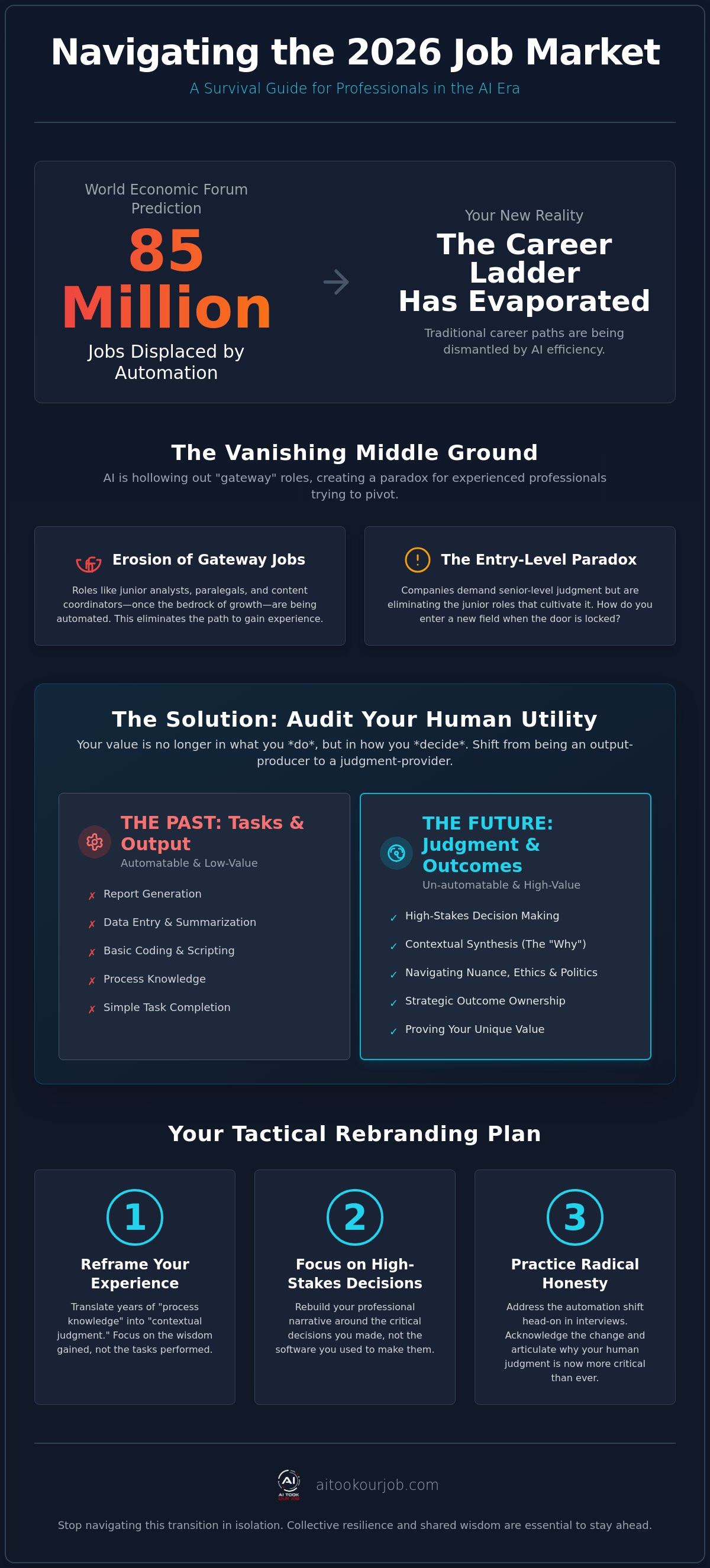
Rebranding isn't about hiding. It's about translating. Traditional job boards are currently drowning in 2026's AI-generated spam, making it nearly impossible for a standard resume to stand out. If you are navigating a career change for workers displaced by AI, your professional narrative must shift from "what I produced" to "how I decided." You aren't just a worker looking for a job; you're a human asset with legacy wisdom that machines can't replicate. The goal is to move your identity from the person who does the work to the person who ensures the work is right.
To reclaim your agency, follow these four tactical steps:
- Deconstruct your role. Strip away the software you used. Focus on the core human functions, like managing a team crisis or negotiating with a difficult vendor.
- Face the "AI Elephant." During interviews, be radically honest. Frame your displacement as a structural graduation. You didn't lose a job; your industry evolved, and you're moving to where human judgment is the primary product.
- Build a "Proof of Utility" portfolio. Show, don't tell. Create case studies that highlight times your intervention saved a project that an automated system would have ruined.
- Leverage community networks. In 2026, a referral is worth more than a thousand applications. Algorithmic job boards are built to filter you out; human communities are built to pull you in.
Explaining AI-Displacement on Your Resume
Don't apologize for being displaced. Use your professional summary to position yourself as an "AI Orchestrator." For example: "Strategic lead with 12 years in logistics, now specializing in algorithmic auditing and human-in-the-loop oversight." Avoid generic keywords like "hardworking" or "team player." Instead, use terms like "contextual synthesis," "prompt governance," and "ethical auditing" to pass through modern ATS filters. You're signaling that you aren't just aware of the technology; you're capable of managing it.
Skill-Stacking for the 2020s
The most resilient professionals in 2026 are "T-shaped." They have deep expertise in a legacy field, like law or manufacturing, combined with a broad ability to interface with AI tools. Your community reputation is the only credential a machine cannot spoof. It's your social proof. To stay ahead of these shifts before they hit your next role, join our AI Job Loss Weekly Briefing to see which skills are currently gaining the most market traction. This is how you build a narrative of growth rather than a story of obsolescence.
Building Resilience: Why You Shouldn’t Navigate This Alone
Isolation is the silent killer of professional momentum. When you're in the middle of a career change for workers displaced by AI, the instinct is often to retreat and process the loss in private. You feel the weight of a lost identity. You worry about the erosion of the ladder you spent years climbing. But individual anxiety is a poor strategist. Collective intelligence, however, provides a perspective that a single person simply cannot maintain during a crisis. We've found that the most successful pivots happen when people stop trying to solve the labor market alone and start looking at it as a shared challenge.
The AI Took Our Job community acts as a survival map for those navigating these uncharted waters. It's a space for radical honesty. We don't just share the wins; we share the failures. Why? Because knowing which "safe" industries are actually being quietly automated is more valuable than any corporate press release. You're moving from being a displaced worker to an informed advocate for your own future. This shift in mindset is the foundation of resilience. It's the difference between being a passive consumer of a changing economy and an active participant in your own rebranding.
The Power of Collective Intelligence
Peer-to-peer networking is often more effective than hiring an expensive career coach. While a coach might offer generic advice, a peer who just navigated a similar career change for workers displaced by AI can provide the tactical "ground truth" you actually need. How did they handle the experience gap in their interview? What specific prompts are they using to audit their own workflows? Our community forums are designed for these exact exchanges. If you need local support or want to connect with others fighting for worker rights, our advocacy group resource guide is a great place to start. Building a network is about more than just finding a job; it's about building a defense against future displacement.
Staying Ahead with the Weekly Briefing
The pace of change in 2026 is relentless. You can't afford to wait for the news to hit the mainstream. Our AI Job Loss Weekly Briefing is designed to help you spot the "next wave" of automation before it reaches your sector. We use our educational media to strip away the corporate fluff and provide you with actionable intelligence. Are you ready to stop guessing and start planning? Join our community today. Reclaim your professional agency and join a collective that values human utility over algorithmic output. You've spent years building your expertise. Don't let a machine have the final word on your career.
Reclaiming Your Professional Agency in the 2026 Economy
The old map is gone, but the new one is being drawn by those who refuse to be silent. You've learned that your value in 2026 lies in contextual synthesis and high-stakes judgment, not just producing data. By auditing your human utility and deconstructing your legacy experience, you move from being a victim of automation to an orchestrator of it. A successful career change for workers displaced by AI isn't a solo journey; it's a collective pivot that requires real-time intelligence and shared wisdom.
You don't have to guess where the next wave of displacement will hit. Join a community of 50,000+ professionals who are navigating this same transition with clarity and purpose. Sign up for the AI Job Loss Weekly Briefing to navigate your pivot with radical honesty. We provide the briefing that cuts through corporate AI hype to give you the ground truth you need to stay ahead. The path forward is difficult, but it is visible. Stay grounded. Stay connected. Your future is still yours to build.
Frequently Asked Questions
How do I explain an AI-related layoff in a job interview?
Address the displacement with radical honesty and frame it as a structural industry shift rather than a personal failure. Explain that your previous role was part of a category that reached its automation limit. Pivot the conversation immediately to how you've translated your legacy wisdom into high-judgment oversight. You're showing the recruiter that you understand the 2026 landscape and are ready to manage the tools that replaced your old tasks.
What are the most 'AI-proof' careers to pivot into in 2026?
Focus on roles where the cost of a machine error is socially, legally, or emotionally unacceptable. High-dexterity trades, specialized healthcare advocacy, and "Human-in-the-loop" auditing are currently the most resilient sectors. These fields require a level of contextual synthesis and physical presence that LLMs cannot replicate. A career change for workers displaced by AI is most successful when it targets these high-stakes human utility zones.
Is it worth going back to school for a new degree if my job was automated?
Short-term, specialized training programs often provide a better return on investment than a traditional four-year degree in 2026. Education is moving faster than ever. As of July 2026, the Workforce Pell Act makes grants available for these shorter, high-impact programs. Before committing to years of tuition, audit the specific skills required for your target role. Often, a targeted certification in algorithmic auditing or strategic negotiation is more valuable to modern employers.
How can I tell if an industry is about to be disrupted by AI before I switch?
Look for industries where the primary product is digital output or routine data processing. If a sector relies heavily on "pattern recognition" rather than "contextual synthesis," it's at high risk for quiet automation. Check if the entry-level roles in that field are disappearing. A healthy industry for a pivot is one where junior roles still require significant human judgment and leadership skills. Avoid sectors where the marginal cost of production is approaching zero.
What are the best transferable skills for workers displaced by AI?
The most valuable skills to carry forward are ethical auditing, high-stakes communication, and strategic decision-making. These are the functions that machines can simulate but never truly own. When navigating a career change for workers displaced by AI, you must rebrand your experience around these "un-automatable" functions. You aren't just moving your knowledge; you're moving your ability to weigh conflicting human interests. That wisdom is your greatest market asset.
Can AI help me find a new career after it took my old one?
Yes, you can use AI-powered career planning tools to conduct a skills gap analysis for as little as $9.99 to $29. These platforms are often more efficient than traditional coaches at mapping your legacy experience to emerging industries. They can provide personalized resume feedback and identify pathways you might have overlooked. Use the technology to your advantage to find where human utility is still in high demand.
How do I deal with the anxiety of a career change in my 40s or 50s?
Acknowledge the anxiety as a rational response to a massive economic shift, then lean into your "seniority advantage." In 2026, many junior roles are being automated, but the demand for senior-level judgment is actually growing. Your decades of experience provide the context that AI lacks. You have a deeper understanding of corporate politics and human behavior. That "institutional wisdom" is exactly what companies need to manage their automated systems safely.
Are there any government programs for workers displaced by automation?
Several federal initiatives provide support, including the Workforce Innovation and Opportunity Act (WIOA) and the Trade Adjustment Assistance (TAA) program. These programs offer free training vouchers, career counseling, and income support for eligible workers. Additionally, the U.S. Department of Labor's 2026 initiative to integrate AI skills into Registered Apprenticeships provides new pathways for retraining. Always check your state's specific grants, such as Wisconsin's WisTRAIN, for employer-driven skills training opportunities.