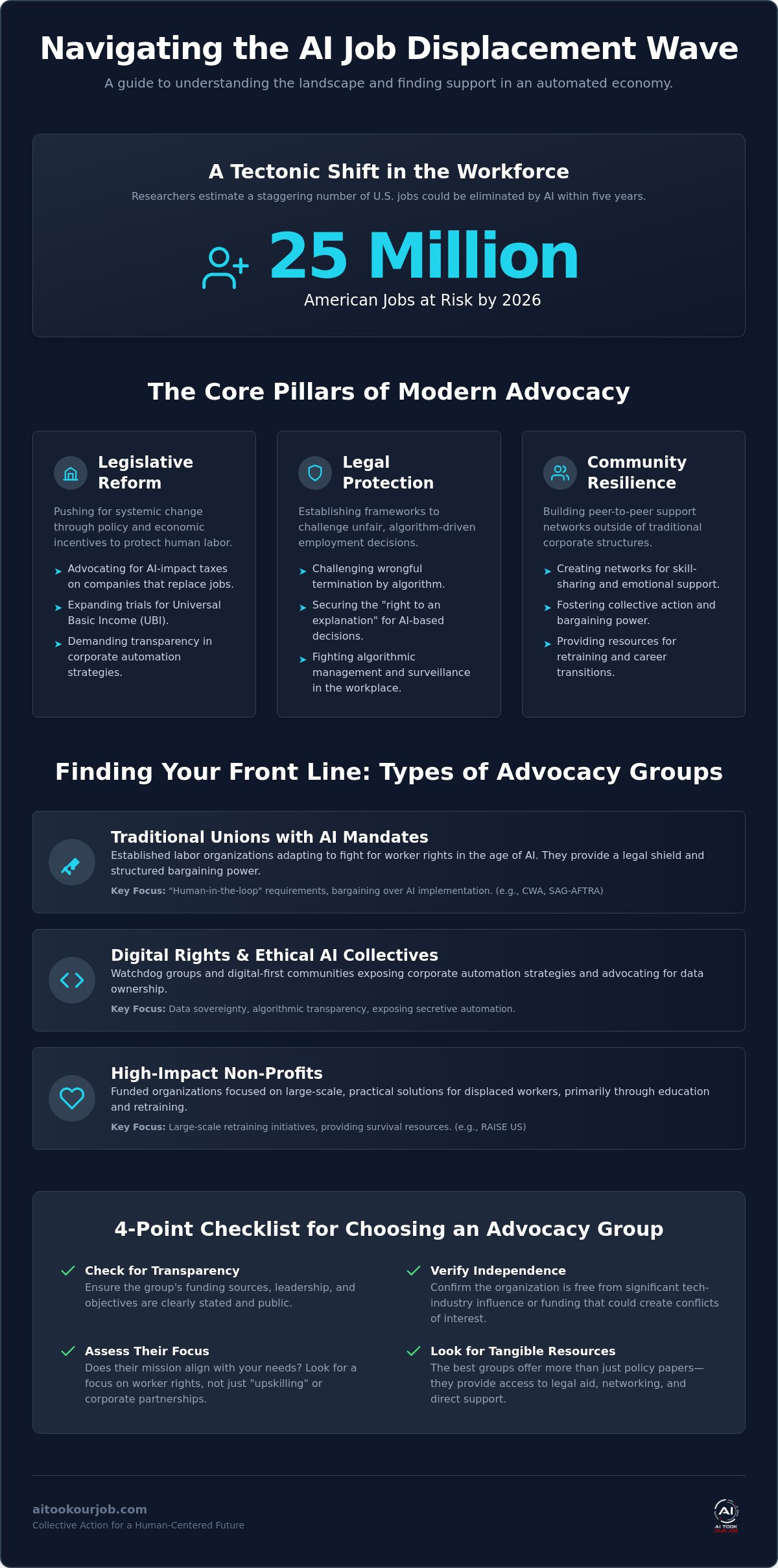
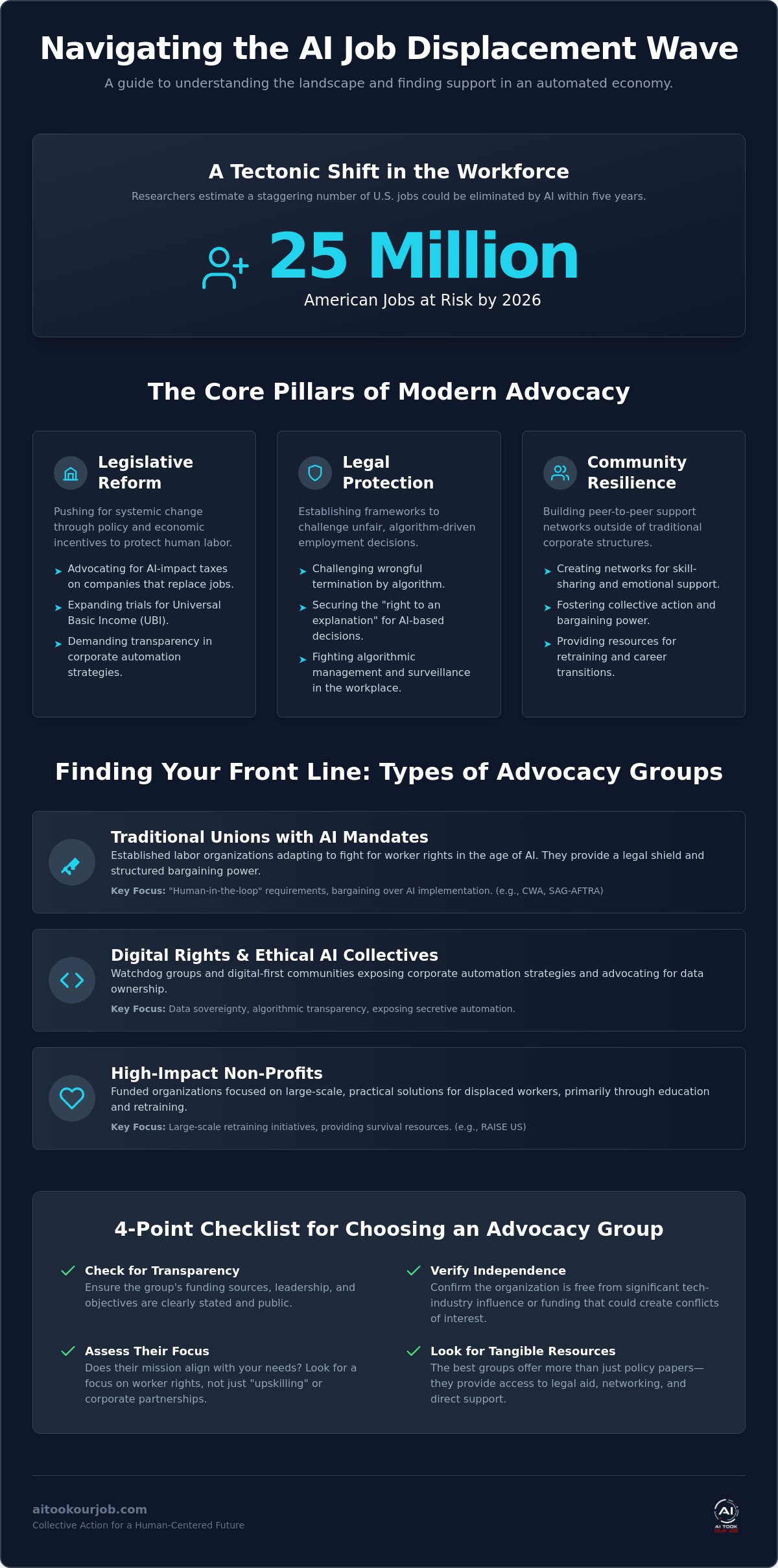
By April 2026, researchers estimated that nearly 25 million American jobs could be eliminated within five years due to rapid AI automation. It's a staggering figure that feels cold and hollow until it's your desk that's empty. You aren't just a data point in a corporate restructuring. You're a professional facing a tech-first economy that often treats human experience as an inefficiency to be optimized away. Finding reliable advocacy groups for AI job displacement isn't just a side project. It's a necessary step toward reclaiming your future.
We understand the isolation of algorithmic firing and the weight of a vanishing professional identity. You deserve more than a generic severance package and a "good luck" email. This guide reveals the organizations, unions, and collectives currently fighting for worker rights in an automated world. We'll examine the impact of the Colorado Artificial Intelligence Act, the rise of the RAISE US retraining initiative, and the specific legal recourses now available to you. From peer-to-peer communities to new labor protections, you'll find the tools needed to move from isolation into collective action.
Key Takeaways
- Learn how labor organizations are evolving to protect human value against algorithmic management in the 2026 economy.
- Identify the right advocacy groups for AI job displacement to access legal aid, networking, and collective bargaining resources.
- Use our four-point vetting checklist to ensure the organizations you join are transparent and free from tech-industry influence.
- Distinguish between traditional unions and digital-first collectives to find a community that understands your specific professional transition.
- Reclaim your agency by positioning yourself within a support infrastructure designed to keep you ahead of the next wave of automation.
The Landscape of Worker Rights and AI Displacement in 2026
The landscape of labor has fractured. In 2026, we've moved past the theoretical debates about automation. It's here. Advocacy groups for AI job displacement are now the essential organized effort to protect human labor value as corporate interests prioritize efficiency over people. The machine doesn't care about your mortgage or your history with the company. We do. This isn't just about learning new software anymore. The old upskilling narrative, which placed the entire burden of survival on the worker, is crumbling. In its place, a more aggressive demand for worker protection has emerged. AI labor advocacy is a multi-front battle involving legal, social, and economic reform.
Why 2026 is a Turning Point for Labor
The shift is felt most acutely in sectors once considered safe. White-collar professionals in law and finance are seeing their core functions absorbed by generative systems at a rate that defies historical precedent. We are witnessing a massive surge in Technological unemployment that targets cognitive labor, not just physical tasks. Beyond displacement, those who remain employed face algorithmic management, where software dictates pace, performance, and even the decision to fire. While some states have introduced protections, many AI labor laws and displacement policies are failing to provide a real safety net for the speed of this transition. The laws are slow, but the code is fast.
The Core Pillars of Modern Advocacy
To fight back, advocacy groups for AI job displacement have focused on three critical pillars. First is legislative reform. This includes pushing for AI-impact taxes on companies that replace human roles with software, alongside expanded trials for universal basic income. Second is legal protection. We need a framework to challenge wrongful termination when an algorithm, rather than a human manager, makes the call. Finally, there is community resilience. This is about building support networks that exist entirely outside of corporate structures. When the company ladder is pulled up, we build our own foundation. Collective action is the only way to ensure that the wealth generated by automation doesn't just flow upward, but supports the workers who built the industries being automated.
Categories of AI Labor Advocacy: Finding Your Front Line
Advocacy isn't a monolith. It is a scattered, urgent response to a crisis that moves faster than our legal systems. In the current market, advocacy groups for AI job displacement generally fall into three categories: legacy unions, digital-first collectives, and high-impact non-profits. The traditional advice to simply "improve your soft skills" has become a hollow promise. When an algorithm is designed to replace the very function of communication or analysis, soft skills won't save a paycheck. We need hard protections. This shift is why many workers are turning to educational media and AI job loss resources to understand the mechanical realities of their displacement and mobilize effectively.
Traditional Unions with AI Mandates
Legacy unions are no longer just fighting for wages. They are fighting for the right to exist alongside code. Groups like the Communications Workers of America (CWA) and SAG-AFTRA have set a template by demanding "human-in-the-loop" requirements in their recent contracts. The scale of this movement is growing. In May 2026, over 2,000 technical workers at the University of California voted to unionize, specifically citing the need to bargain over how AI is implemented in their workflows. These unions provide a legal shield that individual workers simply cannot build alone. They offer a structured way to push back against the "black box" of corporate decision-making.
Digital Rights and Ethical AI Collectives
Beyond the picket line, a new wave of ethical AI watchdogs is exposing the strategies corporations use to automate roles in secret. These collectives focus on data sovereignty. They ask a vital question: should you own the data that was used to train your replacement? We are also seeing the rise of a new nonprofit for displaced workers called RAISE US, which launched in June 2026 with $500 million in funding to focus on large-scale retraining. These groups bridge the gap between privacy rights and labor rights. They ensure that your professional history isn't just harvested as training data without your consent or compensation. To keep track of which groups are winning these battles, you can join our community membership for real-time updates.
Leading Advocacy Groups and Collectives for Displaced Professionals
Finding the right support means looking beyond high-level policy. You need boots-on-the-ground resources. Several advocacy groups for AI job displacement have emerged as leaders in this fight, each offering a different front-line defense. These organizations bridge the gap between sectors, recognizing that a copywriter's displacement and a warehouse worker's automation are two sides of the same coin. Whether you need a legal shield or a new way to prove your professional value, these collectives provide the infrastructure that corporate America has abandoned. They offer a mix of legal aid, networking, and direct lobbying that individual workers simply cannot manage alone.
The Distributed Labor Network (DLN)
The Distributed Labor Network (DLN) addresses the erosion of human income by decentralizing opportunities. Their mission is simple: prove that human work still matters. They use blockchain technology to verify human-led work, creating a "Human-Only" certificate for digital tasks in an AI-saturated market. This verification allows displaced professionals to reclaim their income by connecting with clients who specifically value human intuition over synthetic output. Success stories from 2025 and 2026 show workers in research and data analysis maintaining their rates by leveraging the DLN's verification protocols.
The Human Intelligence Defense Fund (HIDF)
For creatives and knowledge workers, the Human Intelligence Defense Fund (HIDF) is the primary legal advocate. They focus on intellectual property rights. Currently, they are leading several high-profile class-action lawsuits against major LLM developers who scraped professional portfolios without consent. The HIDF provides a path for you to apply for legal aid if your proprietary work was used to train the very tools that replaced you. They are fighting to ensure that "innovation" doesn't become a synonym for "theft."
Workers Against Algorithmic Bias (WAAB)
Workers Against Algorithmic Bias (WAAB) tackles the "black box" of performance reviews and hiring. Many layoffs in 2026 are driven by biased algorithms rather than human managers. WAAB provides resources for filing grievances against automated performance reviews that lack human oversight. They also advocate for transparency in corporate "automation roadmaps," forcing companies to disclose their plans for displacement before they happen. This transparency allows workers to organize before the pink slips are issued.
When you evaluate which movement to join, focus on their tangible impact. Some groups offer community, while others offer a legal hammer. You can use our 2026 playbook for collective resilience to measure which organizations are actually moving the needle on union effectiveness and worker protection. Don't wait for the next update to act. Your agency depends on the community you build today.
Beyond Policy: How to Evaluate and Join an Advocacy Movement
Choosing where to invest your limited energy is a high-stakes decision. Not all advocacy groups for AI job displacement are created equal. Some are genuine worker-led collectives, while others are "AI-washed" organizations funded by the very tech giants responsible for the displacement. These front groups often prioritize corporate efficiency under the guise of "transition support." They exist to manage the optics of job loss rather than preventing it. To find a group that actually has your back, you must look past the polished websites and examine the underlying power structure.
Before signing up, use this 4-point vetting checklist to ensure the organization is aligned with your interests:
- Transparency: Do they disclose their board members and major donors? If the funding comes from a Silicon Valley foundation, their loyalty is likely divided.
- Funding: Is the group bankrolled by venture capital or tech conglomerates? Genuine advocacy is usually funded by member dues or independent labor grants.
- Impact: Can they point to specific legislative wins or successful legal interventions? Avoid groups that only produce white papers and hosting networking mixers.
- Inclusivity: Does the group represent your specific industry? A group that claims to represent "all workers" often ignores the unique needs of niche professions.
It's also vital to evaluate if a group addresses the psychology of AI job loss. A group that only talks about economics is missing half the battle. You aren't just losing a paycheck; you're dealing with a fundamental crisis of utility. Effective advocacy requires a holistic approach that values your professional dignity as much as your data rights. If an organization feels cold or overly academic, it probably won't provide the support you need during a transition.
Vetting the "Truth-Tellers" from the "Optimists"
Radical honesty is the only currency that matters in 2026. The most effective advocacy groups for AI job displacement are those that tell the truth about the velocity of change. Avoid groups that promote "reskilling" as a universal panacea. Reskilling is often a corporate distraction used to shift the blame for displacement onto the worker's lack of initiative. You don't need another weekend coding bootcamp. You need a movement that prioritizes human dignity over corporate profit margins. Look for leaders who are willing to say that the current economic trajectory is unsustainable.
Starting Local: Grassroots Advocacy in Your Industry
If a national group feels too distant, start where you are. Form a sector-specific collective, like "Displaced Educators of the Midwest." These niche groups allow for shared stories that can directly influence local labor boards and state representatives. Organizing doesn't require a massive budget. It requires a shared manifesto and a commitment to visibility. You can transition from a passive observer to an active community participant by joining our community membership today. We provide the briefing room for these grassroots efforts, offering the data you need to organize effectively in your own backyard.
Reclaiming Agency: The Role of the AI Took Our Job Community
The landscape of advocacy groups for AI job displacement is vast, fragmented, and moving at a speed that can feel overwhelming. You shouldn't have to navigate it alone. AI Took Our Job serves as your central briefing room, a place where the noise of the automated era is filtered into actionable intelligence. We don't offer false hope or corporate-sponsored platitudes. We offer a grounded, collective resilience that starts with being the best-informed person in the room. This isn't just about survival; it's about reclaiming your agency in an economy that too often treats you as an obsolete variable.
The Weekly Briefing: Your Strategic Advantage
Information is the first line of defense. Our AI Job Loss Weekly Briefing is designed to give you a strategic edge in a market that is constantly shifting. We curate the most critical news on labor wins, emerging legal protections, and the formation of new grassroots collectives. Understanding the regulatory reality is essential to prepare for future AI job displacement. While the headlines focus on the technology, we focus on the people. Each briefing is a tactical update, ensuring you know exactly which advocacy groups for AI job displacement are gaining ground and which legal shifts might impact your specific industry. We do the research so you can focus on the response.
Connecting with the Collective
Isolation is the greatest threat to a displaced worker. When you feel alone, you feel powerless. Our community membership provides access to peer-to-peer support networks where you can find others who are navigating the same transitions in law, finance, or education. These aren't just chat rooms. They are expert-led discussion hubs where shared wisdom overrides top-down instruction. You can share your story, contribute to our global archive of displacement, and find specific peers who are already active in the advocacy movements we've discussed. We also provide educational media content to help you understand the technical and economic forces at play.
Collective action begins with a single connection. It's time to transform that quiet anxiety into visible, organized action. Join our community today and start your transition with a knowledgeable, supportive network at your back. We are here to make sure you are seen, understood, and prepared for whatever comes next. You have a voice, and together, we have a movement.
Turning Disruption Into Collective Action
The automated economy doesn't have to be a lonely one. We've seen how the landscape is shifting from a burden of individual survival to a collective demand for human dignity. You now have the tools to vet advocacy groups for AI job displacement for genuine transparency and the knowledge to leverage grassroots power within your specific industry. Knowledge is your shield, but community is your strength. Don't let the velocity of change leave you in silence. You deserve a space where your value isn't debated by an algorithm.
Join the AI Took Our Job Community and get the Weekly Briefing to access curated insights you won't find in mainstream media. It's a judgment-free space for radical honesty, already trusted by thousands of displaced professionals who refuse to be optimized out of existence. We provide the facts, the forum, and the solidarity needed to navigate this transition. You are still the expert of your own experience. Let's build what comes next, together.
Frequently Asked Questions
What are the most effective advocacy groups for AI job displacement in 2026?
RAISE US and UPTE-CWA 9119 are leading the charge. RAISE US, launched in June 2026 with $500 million in funding, focuses on large-scale retraining and public-private partnerships. Meanwhile, unions like UPTE-CWA 9119 are securing bargaining rights for technical workers. These are the most effective advocacy groups for AI job displacement because they address both immediate economic needs and long-term legal protections.
Can I sue my employer if I am replaced by an AI algorithm?
Legal recourse depends heavily on your location. The Illinois Human Rights Act was amended on January 1, 2026, to prohibit discriminatory AI outcomes in employment decisions. In Colorado, the Artificial Intelligence Act takes effect on June 30, 2026, providing workers with notice and specific appeal rights. You should check if your dismissal violated these state-specific protections or algorithmic management regulations.
Are there unions specifically for people who work alongside AI?
Yes. Traditional unions are evolving rapidly to meet this challenge. In May 2026, over 2,000 tech workers at the University of California unionized with UPTE-CWA 9119. They aren't just fighting for wages. They're negotiating for the right to bargain over how AI is implemented in their daily workflows and ensuring humans remain central to the decision-making process.
How do advocacy groups differ from job placement services?
Advocacy groups focus on systemic rights and legal protections. Job placement services are transactional; they help you find a new desk. Advocacy is about changing the rules of the room. These groups push for legislative reform and ethical standards to ensure that human labor isn't discarded by a line of code without recourse or fair compensation.
Is there any financial support available for workers displaced by AI?
Several new initiatives launched in 2026. RAISE US offers retraining support through its substantial fund. Additionally, the Workforce Pell Act goes live in July 2026, extending grant eligibility to short-term training programs. The EDA's AI Upskill Accelerator also provides $25 million in grants specifically for workforce development and upskilling in the wake of automation.
How can I get involved in AI labor advocacy if I still have my job?
You don't need to be displaced to act. You can support proposed legislation like California's Senate Bill 951, which requires 90 days' notice for AI-related layoffs. Joining advocacy groups for AI job displacement while employed helps build the collective leverage needed to secure "human-in-the-loop" requirements before automation arrives at your specific department.
What is the "human-in-the-loop" requirement in 2026 labor laws?
This requirement mandates that a human must review and approve significant AI-driven decisions. It's a safeguard against autonomous firing. Many unions now include this in contracts to prevent algorithms from making final choices about a worker's livelihood without human oversight. It ensures accountability remains with people, not just software.
Do advocacy groups support both white-collar and blue-collar workers?
Absolutely. The 2026 landscape has seen a massive convergence of interests. AI is reshaping law and finance just as much as it impacts manual labor. Groups like "What We Will" focus on "Human-First" policies that protect all professional categories. Displacement is a shared reality that requires a unified response across all sectors of the economy.