What if the career you spent twenty years building didn't just change, but simply ceased to exist by Tuesday morning? For many, this isn't a hypothetical fear; it's the reality of a 2026 labor market where 28,000 jobs are vanishing monthly in the financial and information sectors. Success in financial planning after AI job loss is no longer about finding a new desk in the same office. It's about acknowledging that the traditional relationship between labor and income has fundamentally shifted. You're likely facing the sting of a lost identity and the cold reality of wage compression in sectors that once felt untouchable. It's a heavy burden to carry alone.
We understand the gravity of this moment because we're navigating this transition alongside you. This article offers a realistic, no-nonsense framework for securing your financial future when automation permanently alters your path. We'll start with a concrete triage plan for immediate expenses, including how to handle COBRA costs that can now exceed $1,500 for a family. We will also explore strategies for long-term wealth preservation and how to connect with a community that truly understands the 2026 labor shift. You don't have to face this uncertainty without a map.
Key Takeaways
- Learn why "waiting out the market" is a dangerous strategy in 2026 and how to distinguish between temporary unemployment and permanent structural displacement.
- Establish a 30-day survival checklist that prioritizes immediate cash flow and calculates a realistic burn rate for successful financial planning after AI job loss.
- Understand the productivity paradox to adjust your investment strategy as corporate profits decouple from traditional employment models.
- Evaluate the limitations of the saturated gig economy and explore how emerging safety nets like Universal Basic Income (UBI) impact your long-term security.
- Discover how the Weekly Briefing and communal sharing provide the market intelligence and social capital needed to navigate industry-wide shifts.
The Structural Shift: Why AI Displacement Isn't a Standard Career Gap
The ground hasn't just shifted; it has evaporated. In previous decades, a layoff was usually cyclical, meaning you waited for the economy to heat up and then returned to your old salary at a new firm. That isn't what's happening in 2026. This is The Structural Shift: Why AI Displacement Isn't a Standard Career Gap. It represents a permanent removal of human labor from specific value chains. Waiting for the market to "bounce back" is a dangerous financial gamble because the roles being lost aren't coming back. Denial is expensive.
Accepting this reality is the hardest part of financial planning after AI job loss. You aren't just losing a paycheck; you're losing a status you worked years to achieve. This requires career mourning. It's a necessary psychological step before you can make objective decisions about your money. If you stay in denial, you'll burn through your savings waiting for a phone call that won't come because the hiring manager has been replaced by a script. We need to look at the numbers with radical honesty.
The 2026 Reality of Role Evaporation
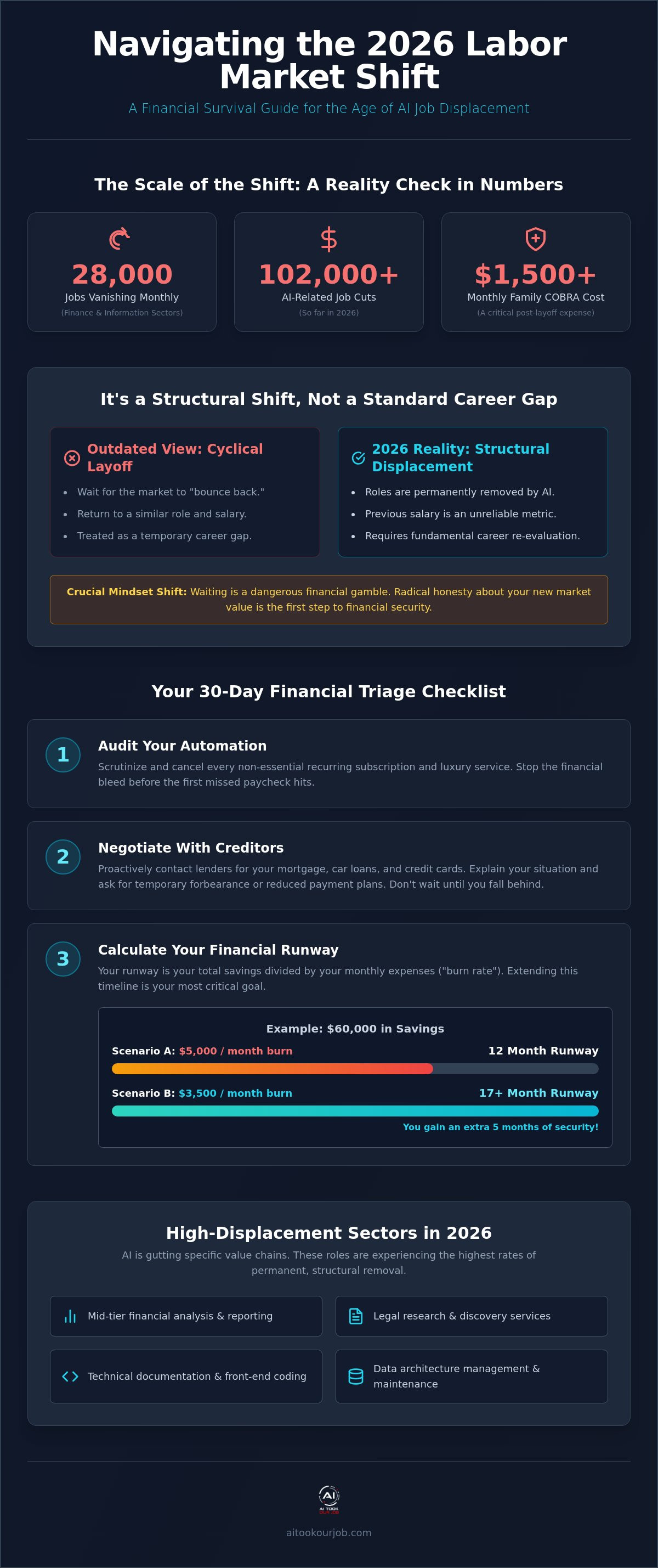
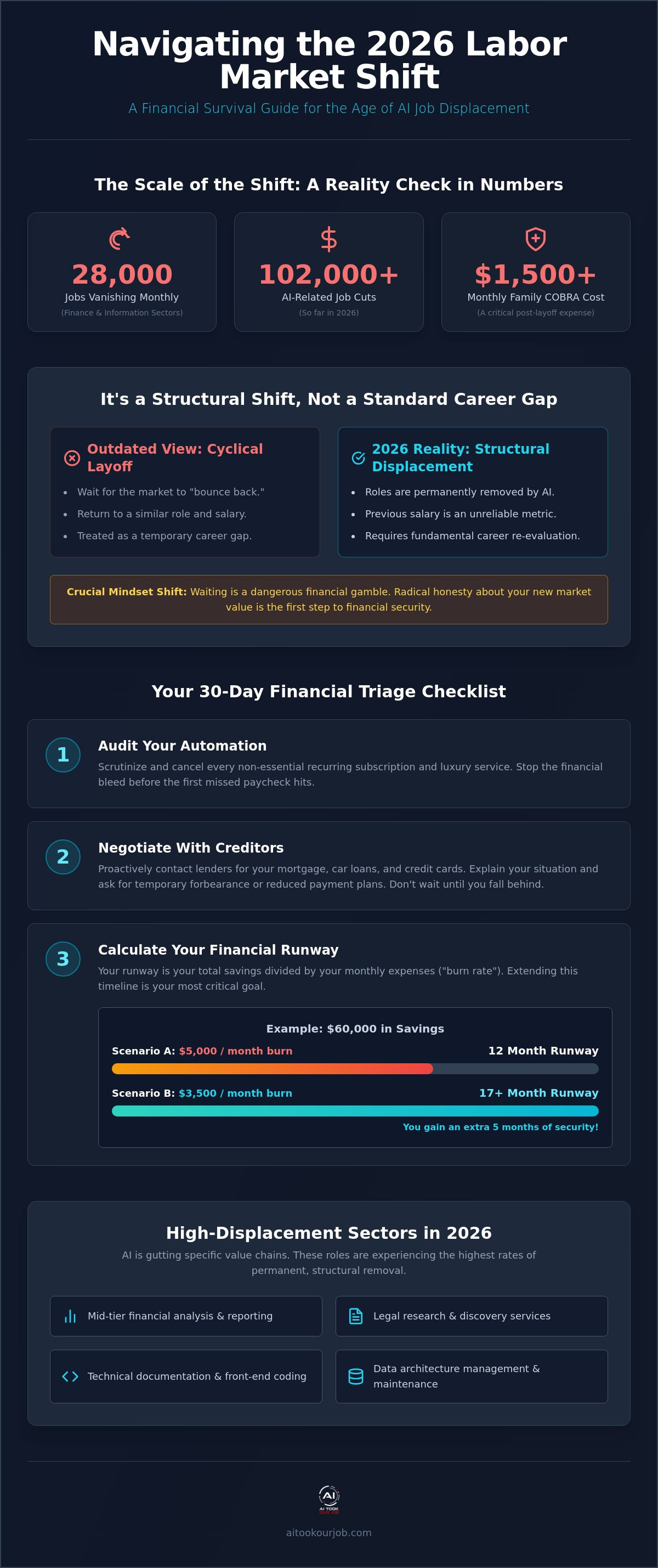
The scale of displacement is now global and absolute. In 2024, many companies were still in pilot programs, but by July 2026, those programs have scaled into full automation. The financial and information sectors are currently seeing the highest rates of permanent role removal, averaging 28,000 job losses every month. Structural AI unemployment is the permanent removal of human labor from a value chain. It's currently gutting specific categories:
- Mid-tier financial analysis and reporting.
- Legal research and discovery services.
- Technical documentation and front-end coding.
- Data architecture management and maintenance.
Accepting Radical Honesty in Your Ledger
Your old market value is a ghost. If your role has been automated, your previous salary is no longer a reliable metric for what you'll earn next. Many workers fall into the trap of lifestyle creep debt, keeping high-interest mortgages or luxury car leases while they wait for high-paying roles that no longer exist. When the income ceiling drops, your expenses must drop faster. Re-evaluating your 5-year plan requires looking past your former ego. Are you planning for a career that still exists? Or are you funding a memory? Effective financial planning after AI job loss starts with a ledger that reflects the 2026 market, not your 2023 resume.
Financial Triage: Immediate Steps After Losing Your Role to Automation
The shock of a displacement notice is visceral. It feels like a personal failure, but the data tells a different story. With 102,000 job cuts already attributed to AI so far in 2026, you're part of a massive, involuntary migration. The math is indifferent to your history or your hard work. Effective financial planning after AI job loss begins by stopping the bleed immediately. You cannot afford to maintain a 2024 lifestyle on a 2026 "zero" income while you wait for a miracle. We need to focus on your burn rate, which is the total amount of cash you spend each month to stay afloat.
Many workers fall into the severance trap. They receive a lump sum and treat it as a bridge to a similar role. This is a mistake. Because of the AI impact on salaries, your next position may pay significantly less than your last. You must calculate your runway without assuming a new salary is just around the corner. If you have $60,000 in the bank and spend $5,000 a month, you have 12 months. If you cut that spending to $3,500, you've just bought yourself nearly six extra months of breathing room. Time is your most valuable asset right now.
The 72-Hour Triage Checklist
You need to act before the first missed paycheck hits your account. Start with these three steps to protect your core capital:
- Step 1: Audit your own automation. Every recurring subscription and luxury service must be scrutinized. If it isn't essential for your health or your transition, cancel it today.
- Step 2: Negotiate with creditors. Don't wait for a late fee. Call your mortgage provider or credit card company now. Tell them you're part of a structural workforce reduction. Many institutions have established hardship protocols specifically for AI-displaced workers in 2026.
- Step 3: Freeze capital expenditures. That home renovation or new car is no longer a priority. Keep your cash liquid.
Extending the Runway in a Saturated Market
The old rule of a six-month emergency fund is dead. In a market where 73% of financial advisors have already adopted AI tools to increase efficiency, the competition for remaining human roles is fierce. You should aim for an 18-month runway. This might require liquidating non-performing assets like a second vehicle or high-value hobby equipment. Do it now while the secondary market is still active. Be mindful of the hidden costs of job hunting, such as premium networking fees and AI-bypassing resume tools. These expenses are necessary, but they must be factored into your new, leaner budget. Staying ahead of these shifts is easier when you have a collective at your back. You can find real-world templates for these budgets within our community membership.
The Productivity Paradox: Managing Wealth When Employment Decouples from Output
Your former employer just reported record quarterly profits. Their stock price is climbing. Yet, your old department no longer exists. How can both be true? This is the core of the automation productivity employment paradox. In 2026, corporate success has finally decoupled from the human payroll. If you want to survive, your financial planning after AI job loss must reflect this divorce. You can't just be a worker anymore. You have to be an owner. Selling your time is a depreciating strategy when machines do it for free.
Wealth is concentrating in the hands of those who own the silicon and the algorithms. This isn't just a local trend. Because global AI job displacement is accelerating, traditional international investments are becoming volatile. Your portfolio might be heavily weighted in emerging markets that still rely on cheap human labor. Those economies are under siege. You need a strategy that captures the gains of automation rather than being crushed by its efficiency. Radical honesty requires admitting that your labor is no longer your primary asset.
Understanding the Disconnect Between Work and Wealth
In 2026, AI allows corporations to scale output exponentially while human labor requirements trend toward zero. This shift has broken the traditional link between hard work and financial security. High productivity no longer guarantees high employment or rising wages for the middle class. While the cost of digital goods and automated services is falling, the price of human-centric services like specialized healthcare is rising. This creates a unique inflationary pressure on your remaining savings. You're living in a world where things are cheaper to make, but a dignified human life is more expensive to maintain.
Pivoting Your Portfolio Toward Automation Gains
Stop funding your own obsolescence. It's time to re-align your 401k or IRA to capture the wealth concentration of AI infrastructure leaders. You must diversify away from industries vulnerable to the "next wave" of automation, such as legacy retail and traditional middle-management hubs. Look for defensive assets that don't rely on a labor-based tax base. As payroll tax revenue shrinks globally, governments will likely pivot their fiscal strategies. You need to be positioned in assets that are resilient to these structural tax shifts. Transitioning from a "salary-first" mindset to an "equity-first" mindset is the only way to stay solvent in a post-labor economy.
Redefining Long-Term Security: Wealth Building in a Post-Labor Economy
The 30-year career path is a relic of the past. Traditional financial advice assumes a steady climb in earnings, but in 2026, that trajectory has been shattered. Long-term security now requires a fundamental re-evaluation of what a "safety net" actually looks like. We are moving toward a reality where UBI and AI automation are no longer fringe theories; they're active debates in the Senate. As of July 2026, the "Unemployment Insurance Modernization and Recession Readiness Act" remains in limbo. You cannot wait for the government to save you. You must build a personal fortress that doesn't rely on a traditional payroll.
Effective financial planning after AI job loss involves creating a "Flex-Plan." This strategy accounts for intermittent employment and extreme wage volatility. It assumes your income will be a series of sprints rather than a marathon. Because the financial and information sectors are losing 28,000 roles every month, your plan must be resilient enough to handle year-long gaps. Capital is now mandatory; work is becoming a variable. If you don't own the assets producing the value, you're at the mercy of the algorithm.
The Gig Economy Trap
The "side hustle" is failing. In 2024, displaced professionals could pivot to Upwork or Fiverr to bridge the gap. By 2026, those platforms are saturated by AI agents that can draft legal briefs or design interfaces for pennies. This race to the bottom has made the digital gig economy a trap for high-skill workers. To find a "human premium," you must look toward local, physical, or highly regulated sectors where human oversight is still a legal requirement. Think of roles that require physical presence or complex, empathetic negotiation. These niches are the only ones where human labor still commands a high price.
New Asset Classes for the Displaced Professional
Network is no longer about finding a job; it's about survival. Your social capital is your most liquid asset in a crisis. We're seeing a surge in community-owned media and local cooperatives as professionals pool resources to create their own stability. This collective resilience is more valuable than a stagnant savings account. Investing in these social structures provides a buffer that the stock market cannot match. You need to stay informed about these emerging opportunities before they become mainstream. To stay ahead of these shifts, subscribe to our Weekly Briefing and gain the market intelligence required to protect your future.
Navigating the Transition: How the 'AI Took Our Job' Community Protects Your Future
Isolation is the greatest threat to your solvency. When you process a displacement notice in a vacuum, you're prone to "shame-based paralysis," a state where the weight of a lost identity prevents you from making objective fiscal choices. Financial planning after AI job loss requires more than just a spreadsheet; it requires a pulse on the shifting market that no individual can maintain alone. We've seen 102,000 job cuts attributed to AI in the first half of 2026. These aren't just statistics. They're a call to mobilize. By connecting with others navigating the same "role evaporation," you transform a private crisis into a collective strategy.
Our community serves as a hub for radical honesty and shared wisdom. While corporate narratives often sugarcoat automation as "upskilling," we focus on the reality of structural displacement. We share real-world financial templates, from negotiating severance in a wage-compressed market to finding "human premium" niches that haven't been automated yet. We also act as a collective voice for advocacy. As the "Unemployment Insurance Modernization and Recession Readiness Act" moves through the Senate, our community ensures that the needs of the AI-displaced workforce aren't ignored. Solidarity is our most resilient asset.
Intelligence as a Financial Defense
Information is your shield. Using the AI Job Loss Weekly Briefing allows you to track corporate automation strategies before they reach your department. Why wait for a forced layoff when you can execute a strategic exit? By spotting industry-wide trends early, you can pivot your assets and skills while you still have the leverage of a current salary. Our data isn't just noise; it's curated market intelligence designed to help you spot the "next wave" of automation. This foresight allows you to negotiate better severance packages by entering discussions with a clear understanding of the industrial landscape. Knowledge doesn't just provide peace of mind; it preserves your capital.
The Power of Radical Solidarity
Connecting with peers reduces the staggering mental health costs of displacement. When you see that high-status roles are being automated across the board, the personal sting of "failure" fades, replaced by a grounded, collective resilience. Collective media is our only way to counter the polished narratives of tech giants. We tell the truth about 2026 because we're living it. Despair is a luxury you cannot afford; preparation is a necessity you cannot ignore. The transition is here, but you don't have to navigate the fog alone. Join the AI Took Our Job community and subscribe to the Weekly Briefing to secure your place in a mobilized, informed collective.
Beyond the Payroll: Building Your 2026 Fortress
The transition we're facing isn't a temporary dip in the business cycle. It's a permanent rewrite of how value is created and captured. Success in financial planning after AI job loss depends on your ability to move from a labor-first mindset to one of capital-based resilience. You've learned how to audit your burn rate and identify the human premium niches that automation cannot yet touch. These aren't just survival tactics. They are the foundation of a new kind of financial security that doesn't rely on a traditional corporate desk.
You don't have to navigate this structural shift in isolation. Our global community of 50,000+ displaced professionals is already sharing the real-world templates and social capital needed to thrive. With real-time tracking of corporate automation trends and weekly briefings curated by industry experts, you can stop reacting to layoffs and start anticipating industry shifts. Subscribe to the AI Job Loss Weekly Briefing and secure your future. The landscape has changed, but your path forward is clear. We're building this future together.
Frequently Asked Questions
How long should my emergency fund be if I lost my job to AI?
You should aim for an 18-month emergency fund. The traditional six-month buffer is insufficient for the 2026 labor market. Because 28,000 jobs are vanishing monthly in the financial and information sectors, the competition for remaining human roles is intense. Extending your runway buys you the necessary time to pivot without the pressure of immediate poverty.
Is it worth re-skilling in a different tech field in 2026?
Re-skilling in general tech is often a trap. In 2026, many entry-level and mid-tier roles in coding and analysis are fully automated. It's only worth re-skilling if the niche requires a physical presence or high-level regulatory oversight. Focus on sectors where human liability is a legal requirement rather than just a preference.
Should I use my 401k to fund a career pivot after AI displacement?
Using your 401k is a last resort due to the 10% early withdrawal penalty. Unless you qualify for the Rule of 55, taking money out early erodes your long-term capital when you need it most. Prioritize immediate financial planning after AI job loss by cutting costs and liquidating non-performing assets before touching retirement accounts.
How do I explain an 'AI layoff' to future employers without sounding obsolete?
Frame the layoff as a structural industry shift rather than a personal failure. You aren't obsolete; the role itself was removed from the human value chain. Mention that you were part of the 102,000 workers displaced by AI so far this year. Highlighting your adaptability within a changing landscape is more effective than apologizing for a market reality.
What are the most 'AI-proof' industries for financial stability right now?
The most resilient industries are those requiring physical intervention or complex empathy. Specialized healthcare, skilled trades, and high-stakes negotiation remain difficult for AI to replicate. These sectors provide a level of stability that digital-only roles can no longer offer in the 2026 market.
Can I claim unemployment benefits if my role was replaced by an AI agent?
You can absolutely claim unemployment, though the amount depends on your state. In 2026, Massachusetts offers over $1,100 weekly, while other states provide less than $400. Monitor the "Unemployment Insurance Modernization and Recession Readiness Act" in the Senate, which seeks to establish a federal minimum of 26 weeks of benefits.
How does wage compression affect my ability to pay off existing debt?
Wage compression makes fixed debt significantly more dangerous. If your new income is 30% lower but your mortgage remains the same, your financial planning after AI job loss must include aggressive debt negotiation. Call your creditors immediately to discuss hardship protocols specifically designed for displaced workers.
What is the 'Human Premium' and how do I invest in it?
The Human Premium is the value placed on skills AI cannot simulate. This includes deep empathy, physical presence, and moral judgment. You invest in it by pivoting toward roles that require high-touch human interaction and by building social capital within a community of peers who understand the 2026 landscape.