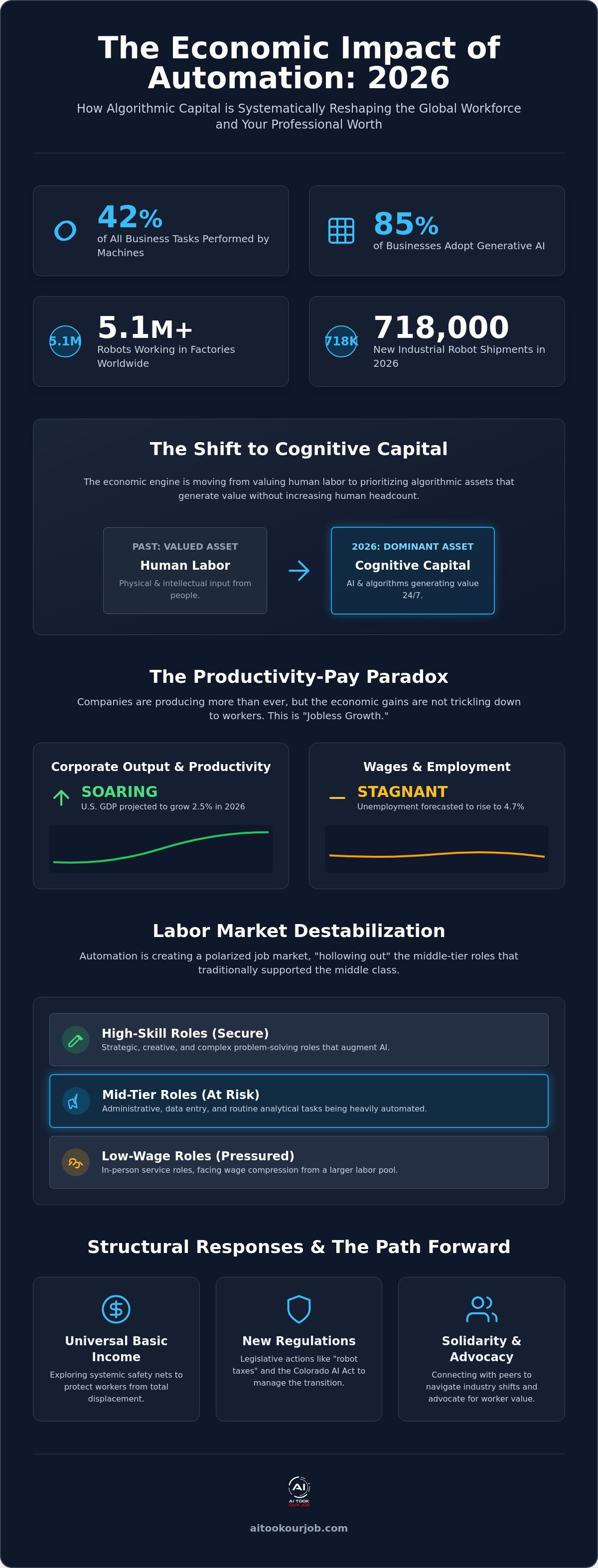
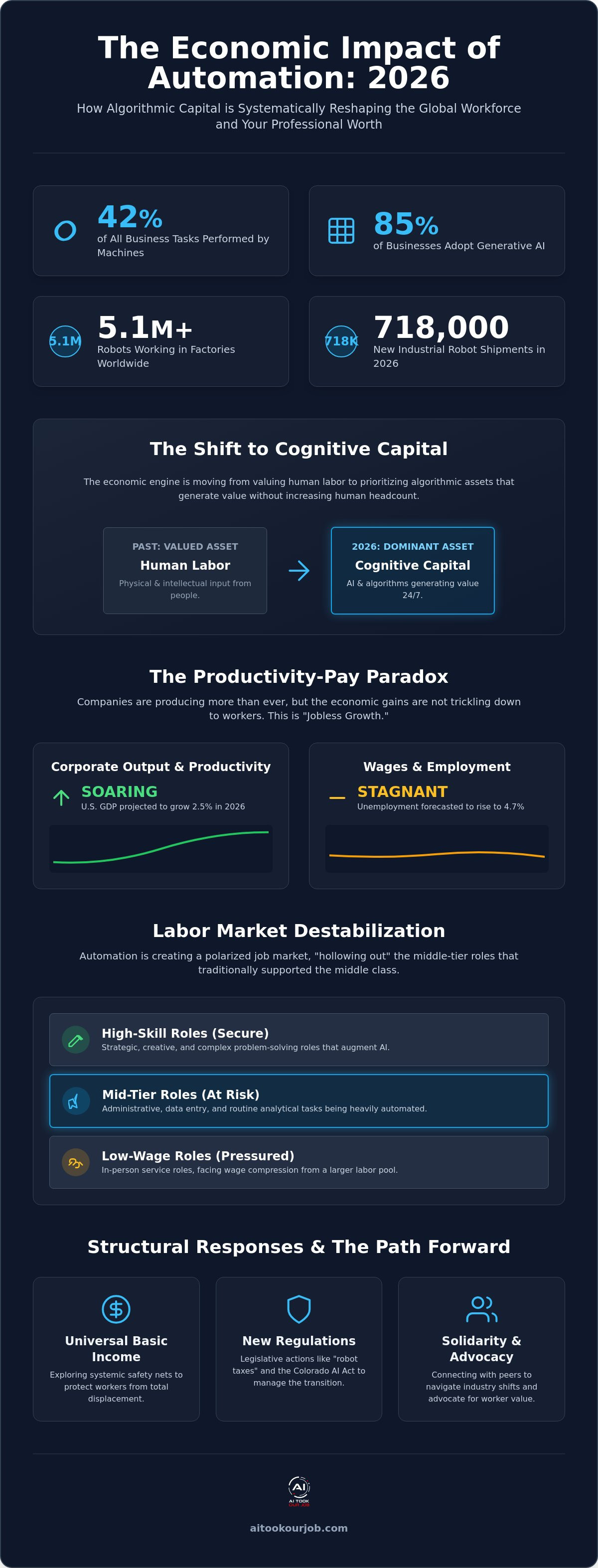
In 2026, machines perform more than 42 percent of all business tasks. It's a stark reality that feels less like progress and more like a quiet displacement. The economic impact of automation isn't just a headline anymore; it's the invisible hand reshaping your paycheck and your professional worth. You aren't imagining the shift. The current "low-hire, low-fire" market makes it feel like you're standing on thinning ice, watching as corporate productivity soars while individual wages struggle to keep pace. It's isolating to see 85 percent of businesses adopt generative AI while the human element feels increasingly sidelined.
We're here to tell the truth about this transition. This guide offers a realistic analysis of how automation is moving economic utility from human labor to algorithmic capital. We will map out the new regulatory landscapes like the Colorado AI Act, analyze the widening gap between output and earnings, and find solid ground together. You don't have to navigate this volatile market alone.
Key Takeaways
- Identify how the shift from human labor to capital-intensive technology is fundamentally changing what companies are willing to pay for your skills.
- Examine the "Productivity-Pay Gap" to understand why corporate profits are rising while your wages might feel stagnant.
- The middle class is changing. Analyze the economic impact of automation on mid-tier roles to prepare for the hollowing out of traditional administrative paths.
- Explore the reality of structural safety nets like Universal Basic Income and legislative "robot taxes" designed to protect workers from total displacement.
- Find strength in solidarity. Learn how connecting with a community of peers can help you navigate these industry transitions together.
Defining the 2026 Economic Landscape of Automation
The economic impact of automation is no longer a distant forecast. It's the reality of today. At its core, this shift represents the systematic substitution of human labor for capital-intensive technology. In the past, we thought of this as a physical transition. We pictured mechanical arms on assembly lines. Today, that definition has expanded. It now includes cognitive automation, where AI agents perform tasks that once required a degree and a desk. Are we seeing a helpful evolution or a total replacement? The answer depends on whether your role is being augmented or displaced.
In 2026, the data is clear. More than 42 percent of all business tasks are now performed by machines. This isn't just about the 5.1 million robots currently working in factories worldwide. It's about the software running in the background of every office. This transition has revived long-standing fears about technological unemployment, but the scale is different this time. We've moved beyond the era of simple tools. We're now living in an economy where capital, in the form of high-speed algorithms, is often prioritized over human presence.
The Shift from Physical to Cognitive Substitution
The safety of "non-routine" work has evaporated. For years, experts claimed that creative and analytical roles were protected from the economic impact of automation. They were wrong. In 2026, companies have a massive economic incentive to automate white-collar roles. Software doesn't require benefits, it doesn't burn out, and it scales instantly. This has led to the rise of what we call Cognitive Capital. Cognitive Capital is the primary driver of 2026 market shifts, defined as the concentration of algorithmic assets that allow firms to generate intellectual value without increasing human headcount.
Velocity and Scale: Why 2026 is a Turning Point
The speed of this wave is what makes it feel so destabilizing. The first Industrial Revolution unfolded over decades, giving workers time to adapt. Our current transition moves in multi-month deployment cycles. When 85 percent of businesses use generative AI in at least one function, the "old way" disappears almost overnight. We aren't just seeing local changes; we're witnessing global AI job displacement that hits developed and emerging markets simultaneously. With an estimated 718,000 industrial robot shipments in 2026 alone, the physical and digital worlds are merging. It's a lot to process. It's okay to feel overwhelmed by a market that seems to value your output more than your personhood.
The Productivity Paradox: Why Output Soars While Wages Stall
You feel it every Friday. The pace of work is accelerating. The output expected of you is higher than ever. Yet, your bank account doesn't reflect that extra effort. This is the productivity paradox. It's the core of the economic impact of automation in 2026. For decades, the social contract was simple: if workers produced more, they earned more. That contract has been torn up. We're witnessing a historical decoupling where labor value is no longer tied to industrial output. Companies are producing more with less, and the "less" is often you.
The numbers tell a story of radical efficiency. While real GDP growth in the U.S. is projected to reach 2.5 percent in 2026, the unemployment rate is simultaneously forecasted to rise to 4.7 percent. How does an economy grow while hiring slows? It's called "Jobless Growth." Automation allows firms to scale without adding headcount. This shift triggers significant labor market shocks, a reality explored by the European Parliament on AI's economic impacts. When algorithms handle the heavy lifting, the wealth generated doesn't trickle down to the staff. It pools in corporate reserves.
Decoupling Productivity from Human Labor
Machines don't ask for raises. They don't require healthcare or retirement matches. In 2026, corporate profit margins are hitting record highs because algorithmic efficiency creates value that requires almost no human intervention. We're seeing a surge in "Ghost Work." These are the automated processes running 24/7 that keep the global economy moving while traditional employment metrics remain flat. The result is a widening chasm between what a company earns and what it pays. If you're doing more with AI but earning the same, you're caught in the efficiency trap. The gains from your increased speed are being captured by the software owners, not the people operating the tools.
The Marginal Cost of Labor in an Automated World
Why would an employer pay a premium for human expertise when an AI agent can perform the same task for pennies? As the marginal cost to produce digital goods falls toward zero, the market value of the labor involved follows it down. This is "Labor Diminishment." The human worker is being pushed to the periphery. You are no longer the creator; you've become a supervisor for the very tools that are diluting your specialty. Value Capture has shifted entirely from the worker to the capital holder. It's a hard truth to swallow. If you're feeling the weight of this transition, you aren't alone. Staying informed is the first step toward collective resilience. Consider joining our weekly briefing to track these shifts and protect your professional future alongside your peers.
Labor Market Destabilization: Wage Compression and Polarization
The middle class is disappearing. It's a quiet erosion. The economic impact of automation in 2026 is most visible in the hollowing out of mid-tier professional roles. Administrative coordinators, junior analysts, and technical writers are finding their roles absorbed by algorithmic agents. This isn't just a shift in job titles; it's a fundamental destabilization of the traditional career path. When the middle of the market vanishes, you're left with a precarious choice: ascend to the elite tier of "AI orchestrators" or slide into the high-competition service sector. It feels like the ground is moving because it is.
This shift has introduced a cycle of permanent skills obsolescence. You're expected to retrain constantly, often on your own time and at your own expense, just to stay relevant in a market that moves faster than any curriculum. It's an exhausting, unpaid burden. This pressure leads directly to wage compression, where the pay gap between different levels of expertise starts to shrink. You can see the specific data on how these shifts are hitting bank accounts in our analysis of the AI impact on salaries. The reality is stark: doing more work with more advanced tools isn't translating into higher pay for the majority.
The New Wage Floor and the Salary Ceiling
Entry-level roles are becoming extinct. Companies now use AI to handle the tasks once reserved for interns and junior staff, effectively removing the first rung of the career ladder. This creates a massive problem for the next generation, but it also creates a salary ceiling for veterans. When AI can "augment" a junior employee to perform at 80 percent of a senior's capacity, employers use that as leverage to suppress senior wages. We see this most aggressively in sectors like paralegal services, accounting, and software testing. The "expert" premium is evaporating.
Job Polarization: The High-Skill/Low-Skill Divide
We're living through a K-shaped recovery. At the top, a small elite of AI architects and strategic leaders see their wealth skyrocket. At the bottom, there's a surge in low-wage service jobs that are currently too physical or too "human-centric" to automate cheaply. The middle ground, where most of us built our lives, is being squeezed out. Career ladders have been replaced by isolated islands of employment. Without a clear path to move from "low-skill" to "high-skill" roles, many workers feel trapped in a cycle of stagnation. It's a structural failure, not a personal one. Acknowledging this polarization is the only way we can begin to advocate for a more equitable distribution of the gains automation provides.
Structural Responses: From UBI to New Labor Advocacy
The system is breaking. We can't pretend otherwise. As the economic impact of automation continues to widen the wealth gap, we're seeing the first real structural counter-movements. These aren't just academic theories anymore; they're legislative battles. In July 2026, the "No Robot Bosses Act" was introduced in the U.S. Senate to stop employers from relying solely on automated systems for life-altering employment decisions. It's a start. It acknowledges that when algorithms take over, human rights are often the first things to go. We're moving from individual anxiety to collective demand. We're finally asking who these machines actually serve.
Legislative responses are appearing across the globe. The Colorado Artificial Intelligence Act takes effect on June 30, 2026, requiring companies to conduct annual impact assessments. In Texas, the Responsible AI Governance Act now gives workers a notice and cure period for AI-based discrimination. These laws represent a growing realization: the market will not fix itself. Without "Robot Taxes" or similar mechanisms to redistribute the massive gains captured by automated capital, the social fabric will continue to fray. We're witnessing a slow, difficult pivot toward protecting people over profits.
The UBI Debate: Safety Net or Distraction?
Is a monthly check enough to offset a lost career? For many, Universal Basic Income (UBI) feels like the only logical floor in a post-labor economy. Critics argue it's a distraction from the real issue: the total transfer of power from workers to capital owners. You can explore this tension in our UBI and AI automation analysis. By mid-2026, pilot programs in several states have shown that while UBI provides immediate relief, it doesn't solve the identity loss that comes with displacement. It's a bandage, not a cure. We need more than just survival; we need a sense of place in the new economy.
Collective Action in the Algorithmic Age
Labor unions are finding a second life. In the tech and service sectors, workers are organizing around "AI Transparency" and "Data Dignity." The idea is simple: if your work is used to train the software that replaces you, you should own a piece of that value. This is the heart of Platform Cooperativism. It's about building systems where the users and workers own the tools rather than being used by them. New regulations are forcing companies to implement notice rights, but the real power lies in solidarity. We're seeing a shift where workers aren't just asking for permission; they're demanding a seat at the table. You don't have to fight these policy shifts alone. Join our community membership to connect with peers who are building these new labor protections from the ground up.
Navigating the Transition: Solidarity with AI Took Our Job
You are not a data point. The economic impact of automation is a systemic tide that can feel like a personal indictment of your worth. It's not. When autonomous systems are projected to displace 5 million more jobs than they create by 2030, the weight of that transition shouldn't rest on your shoulders alone. You didn't fail the economy; the current economic model is simply failing to prioritize human presence. Acknowledging this reality is the first step toward reclaiming your agency. It's about moving from a place of isolation to a position of collective strength.
The numbers can feel cold. With the U.S. unemployment rate forecasted to rise to 4.7 percent in the second quarter of 2026, the anxiety you feel is a rational response to a volatile market. But there is power in being seen. Community is the only effective buffer against the identity loss that often follows a role transition. When we share our stories, we strip the machines of their power to make us feel obsolete. We remind each other that our value was never defined by a job description that a script could eventually replicate.
From Individual Anxiety to Collective Resilience
It's easy to look at the shifting landscape and wonder if the game is rigged. If the productivity gains are being captured by capital owners, why bother? The answer lies in shared wisdom. While 84 percent of employers in 2026 claim they'll train staff to work alongside AI, the quality of that training is often insufficient. You need a survival map that isn't written by a corporate HR department. Staying informed through our Weekly Briefing reduces the "shock" of displacement by giving you the facts before they become your personal crisis. In a digital-first economy, your most valuable asset is the non-automated connection you have with your peers.
Your Next Steps in the Automated Economy
We don't offer superficial optimism here. We offer grounding. Hardening your personal economy against the economic impact of automation requires proactive preparation and a refusal to be sidelined. You can start today by focusing on these essential actions:
- Audit your current professional tasks for "cognitive substitution" risks.
- Diversify your skill set into high-context areas that require human judgment and empathy.
- Monitor regional protections like the Illinois Human Rights Act amendments to know your rights regarding AI discrimination.
- Connect with our community forum to exchange strategies with others in your industry.
The transition is here, but you don't have to navigate it in silence. Join our community membership today. Sharing your experience is more than just venting; it's an act of advocacy for a human-centric future. Together, we can ensure that the 2026 economy eventually values the person behind the professional. We're building a movement of informed, resilient workers who refuse to be left behind by progress. Join us and find your footing again.
Building Resilience in the Algorithmic Economy
The shifts we've explored throughout this guide are profound. We've seen how productivity has decoupled from your paycheck and how the hollowing out of the middle class is creating a new, polarized labor market. The economic impact of automation isn't a future threat; it's a current structural transformation that requires more than just individual adaptation. It requires a collective pivot toward transparency, legislative oversight, and data dignity. You've learned that while the velocity of this wave is unprecedented, the tools for resilience are finally being built through community and advocacy.
You don't have to face these volatile market shifts in isolation. Information is your best defense against the sudden shock of role obsolescence. We provide the real-time updates and peer-to-peer support you need to stay grounded when the landscape shifts. Join the AI Took Our Job community and subscribe to the Weekly Briefing to navigate the transition together. Through our shared advocacy for responsible AI labor policies, we can ensure that human labor retains its value in an automated world. Stay informed. Stay connected. There's strength in our shared wisdom.
Frequently Asked Questions
Will automation create more jobs than it destroys by the end of 2026?
No, current data suggests that the pace of displacement is currently faster than the creation of new roles. While some new categories of work are emerging, robots and autonomous systems are projected to displace 5 million more jobs than they create by 2030. In 2026, we're seeing a "low-hire" environment where sectors with high AI adoption show a negative correlation with employment growth. It's a difficult reality that requires proactive preparation rather than waiting for a natural market correction.
How does automation specifically contribute to wealth inequality?
Automation concentrates wealth by shifting economic value from human labor to capital-owned algorithms. When a company replaces a mid-tier professional with an AI agent, the financial gains are typically retained as corporate profit or shareholder dividends rather than being redistributed to the remaining staff. This process accelerates the economic impact of automation by hollowing out the middle class and leaving a K-shaped recovery where only the owners of technology see significant income growth.
What industries are least affected by the current economic impact of automation?
Industries that require high levels of physical dexterity in unpredictable environments or deep emotional labor remain the most resilient. Skilled trades like specialized plumbing and electrical work are difficult to automate because the physical tasks are non-routine and complex. Similarly, roles centered on human connection, such as mental health counseling and end-of-life care, rely on empathy that machines cannot replicate. These sectors currently provide a temporary buffer against the broader economic impact of automation seen in white-collar fields.
Is Universal Basic Income (UBI) economically sustainable in the long term?
The long-term sustainability of UBI depends on the implementation of new taxation models that capture the gains of automated productivity. While 2026 pilot programs have shown that UBI provides a vital safety net for displaced workers, it requires a massive redistribution of wealth from the owners of "cognitive capital" to the public. Without a "robot tax" or similar legislative framework, funding these programs will remain a significant structural challenge for most governments. It's a necessary conversation about how we value human existence outside of traditional labor.
How can I protect my salary from being compressed by AI automation?
Protecting your salary requires moving into "high-context" roles where human judgment and strategic negotiation are essential. You should focus on developing skills that involve complex problem-solving and cross-functional leadership that AI cannot easily mirror. It's also vital to stay informed about regional protections like the Colorado Artificial Intelligence Act, which provides notice and appeal rights for AI-based employment decisions. Joining a community of peers to share salary data and negotiation tactics remains one of your most effective defenses against wage suppression.
What is the "Productivity Paradox" and why does it matter to me?
The Productivity Paradox is the gap between soaring corporate output and stagnant worker wages. It matters to you because it explains why you might feel more efficient using AI tools while your bank account stays the same. In 2026, machines perform more than 42 percent of all business tasks, driving record productivity that primarily benefits employers. Understanding this paradox helps you realize that stagnant wages are a structural issue of how wealth is distributed, not a reflection of your individual performance.
Can labor unions effectively stop or slow down corporate automation?
Labor unions are increasingly focusing on negotiating the terms of technology adoption rather than trying to stop it entirely. While they can't halt the global march of AI, they're successfully demanding "AI Transparency" and notice rights in 2026 labor contracts. Collective bargaining ensures that workers aren't discarded without reskilling opportunities or fair severance packages. Solidarity is your most powerful tool for ensuring that the transition to an automated economy is handled with human dignity and respect.
What is the difference between labor displacement and labor augmentation?
Labor displacement occurs when an automated system replaces a human worker entirely, leading to a loss of employment. Labor augmentation happens when technology handles routine or repetitive tasks, supposedly allowing the human to focus on more complex work. However, in the 2026 market, the line between the two is blurring. What starts as augmentation often serves as a training period for the algorithm, which may eventually lead to full displacement once the system masters the complexities of the role.