Most career advice you're hearing right now is already obsolete. The "AI gurus" promise that a few new prompts will save your livelihood, but you know the reality is far more complex. It's exhausting to watch the skills you spent a decade perfecting become automated in a matter of months. How do you plan for a future that seems to rewrite itself every week? This constant state of flux makes reskilling for the age of AI feel like trying to build a house on shifting sand. We understand that fear because we're standing on the same ground.
You deserve a strategy that doesn't expire by next quarter. We've developed a radical, step-by-step framework designed to transition your career from easily automated tasks to high-humanity utility. In this guide, we'll strip away the noise to identify the specific human-centric skills that algorithms cannot replicate. You'll gain a clear roadmap for a career pivot that prioritizes long-term resilience over temporary fixes. Let's look at how we can rebuild together. We'll focus on the roles where your human perspective remains the most valuable asset in the room.
Key Takeaways
- Shift your professional focus from "algorithmically predictable" tasks to "human-essential" roles that require moral accountability and high-stakes empathy.
- Implement a realistic framework for reskilling for the age of AI by auditing your current role for tasks that are already 80% automatable.
- Prioritize "just-in-time" learning over traditional credentials to ensure your new skills don't expire before you have the chance to use them.
- Identify why blue-collar roles and complex physical dexterity often provide more career security than mid-level data analysis in the 2026 landscape.
- Leverage collective resilience through peer-to-peer wisdom and real-time market briefings to navigate the psychological weight of a career pivot.
The Hard Truth About Reskilling in 2026
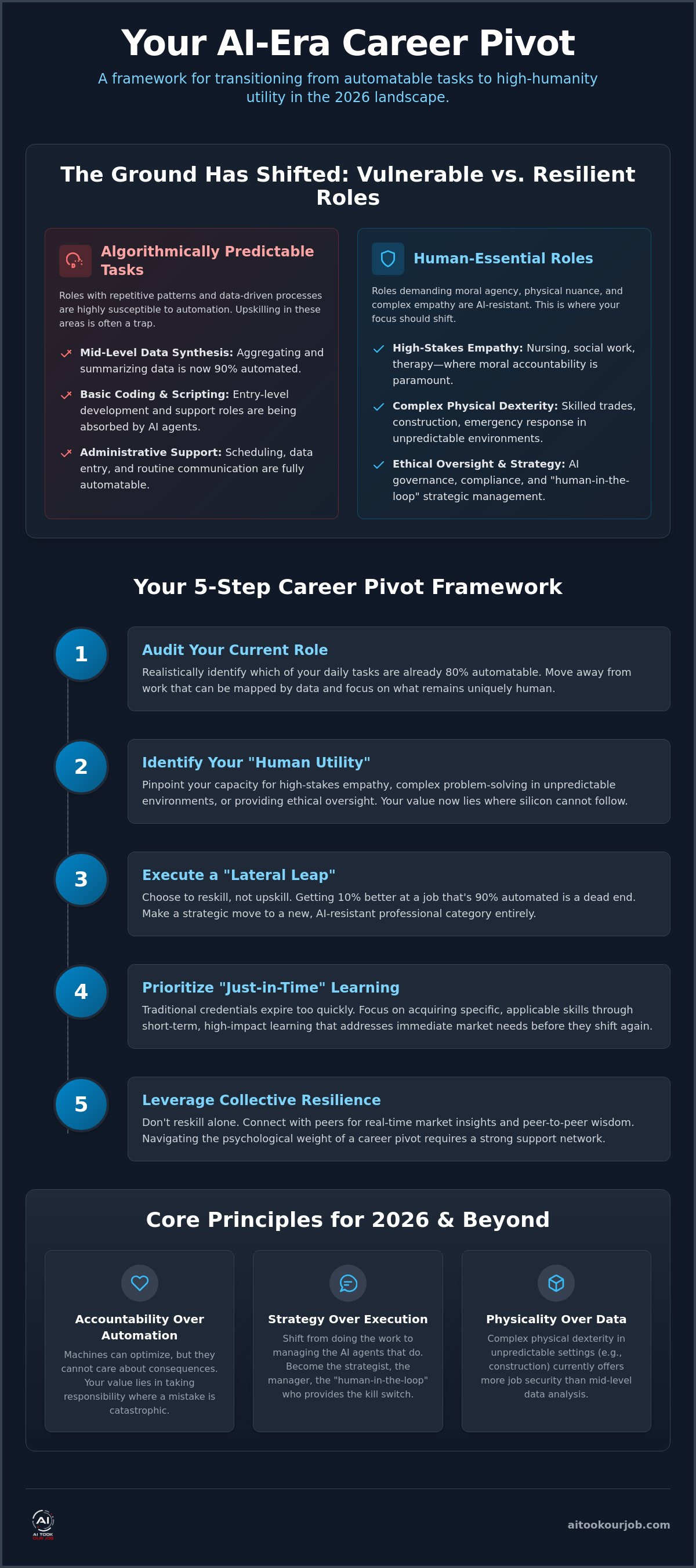
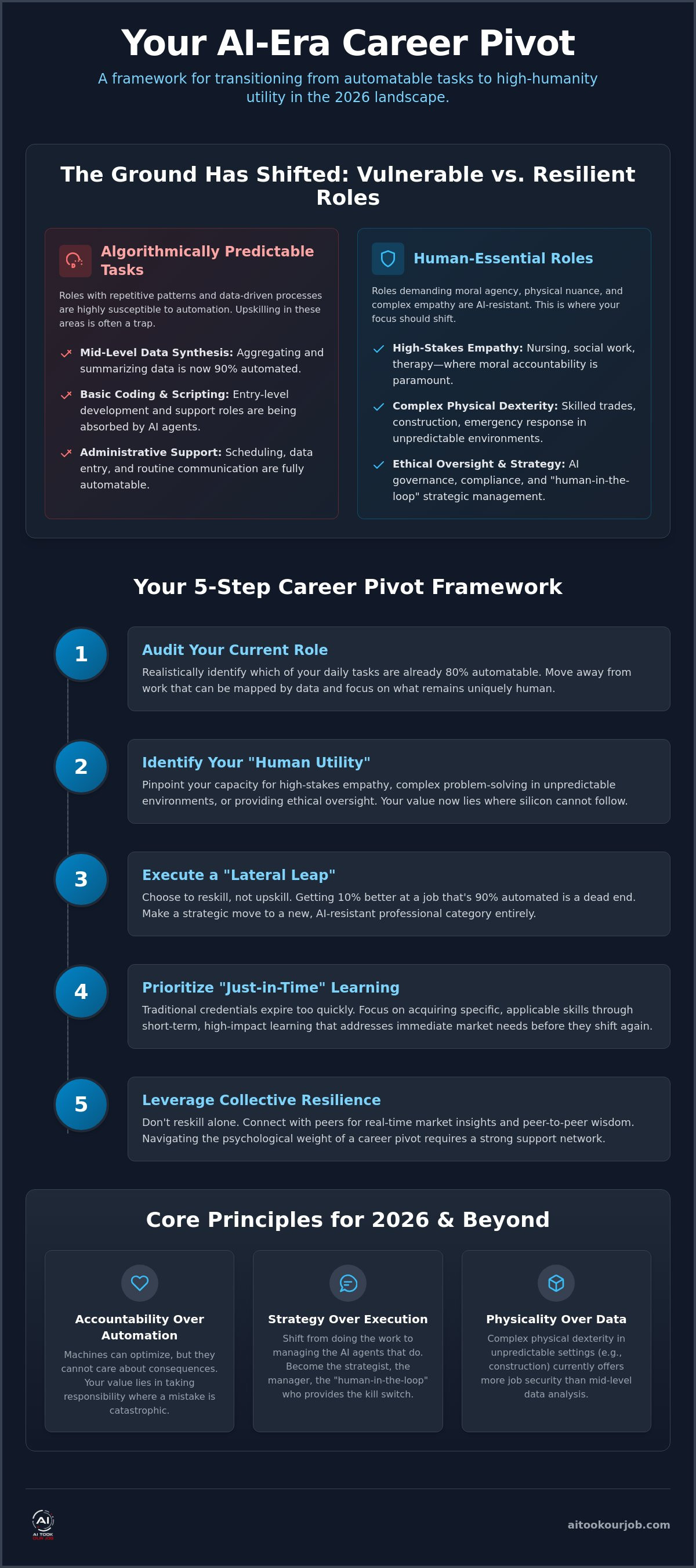
The ground isn't just moving; it's gone. In 2026, reskilling for the age of AI isn't a professional development choice you make on a slow Tuesday. It's the only way to stay visible in a market that is rapidly automating anything predictable. We define reskilling today as the intentional migration from "algorithmically predictable" tasks to "human-essential" roles. It's a hard shift. It requires moving away from work that can be mapped by data toward work that requires moral agency, physical nuance, and complex empathy. This is no longer optional. It is the new baseline for career survival.
The velocity of displacement has broken our traditional systems. AI models now evolve in weeks, while a university semester takes months. This mismatch creates a terrifying gap. You might finish a course only to find the skill you learned is already handled by a plugin. This cycle fuels a broader history of Technological unemployment, but this time, the speed is unprecedented. Before you can learn a new tool, you have to manage the crisis of utility. Who are you when the machine does your job better than you did? Reskilling starts with that psychological weight. It's about accepting that your value has to move where the silicon cannot follow.
Reskilling vs. Upskilling: Choosing Your Path
Upskilling is often a trap. Getting 10% better at a job that is 90% automated won't save you. If your industry is fundamentally collapsing, sharpening your tools is just busywork. Reskilling for the age of AI requires a "lateral leap." You aren't just climbing the ladder; you're jumping to a different building. A career pivot is a strategic move toward AI-resistant sectors where human judgment is the primary product. It's about finding a new professional category entirely.
The 2026 Labor Landscape: Where the Jobs Are Vanishing
The entry-level role is effectively dead. Administrative support, basic coding, and mid-level data synthesis have been absorbed by localized AI agents. This isn't just a white-collar problem. Even logistics and basic assembly are seeing a massive shift. To understand the scale, you should review our briefing on Future AI Job Displacement: The Reality of the 2026 Labor Shift. The jobs aren't just changing; they're being restructured from the bottom up. Survival means finding the gaps the machines haven't filled yet. It requires a clear-eyed look at what roles are truly human-essential.
Decoding Human Utility: Identifying AI-Resistant Skills
Finding your place in the new economy means looking for the gaps in the code. AI can mimic a sympathetic voice, but it cannot bear the legal weight of a medical decision or the moral burden of a social work intervention. This is what we call High-Stakes Empathy. It's the difference between a chatbot suggesting a bandage and a nurse managing a patient's post-surgical trauma. When things go wrong, a human must be there to take responsibility. Accountability is a human-only product. It's a quality that no amount of processing power can generate.
Similarly, we're seeing a massive resurgence in blue-collar roles. While mid-level data analysis has been swallowed by algorithms, complex physical dexterity remains a human stronghold. A robot still struggles to navigate a cluttered, unpredictable construction site or repair antique plumbing. These environments are too chaotic for current training models to master. If you're considering the five paradigm shifts in reskilling, the move toward physical or ethical complexity is among the most vital. It's a strategic move from the screen back to the physical world.
Your value now lies in metacognition. It's not about doing the work yourself; it's about managing the agents that do. You are the strategist. You are the "human-in-the-loop" who provides the kill switch when an automated system drifts into error. In roles where a mistake means a catastrophic financial or safety failure, the human remains the ultimate authority. Machines can optimize, but they cannot care about the outcome. They lack the context of consequence.
The Three Pillars of 2026 Human Utility
We see three main areas where human labor remains indispensable. First, Emotional Intelligence and Conflict Resolution. Roles like nursing, social work, and high-level sales require deep intuition and the ability to navigate volatile human emotions. Second, Unpredictable Physical Environments. Skilled trades and emergency response rely on spatial awareness and rapid adaptation that hardware hasn't perfected. Finally, Ethical Oversight and AI Governance. Compliance officers and AI auditors ensure that systems remain within legal and moral bounds. These pillars are the foundation of reskilling for the age of AI.
Why 'Soft Skills' Are Now Your 'Hard Skills'
The hierarchy has flipped. Coding and technical writing are now "soft" because they're easily automated. Negotiation, storytelling, and ethical reasoning are the new "hard" skills because they're difficult to replicate. High-Humanity Utility is the inverse of algorithmic predictability. If your job relies on being unpredictable, empathetic, or physically adaptive, you're on the right track. To stay ahead of which industries are shifting next, check our AI Job Loss Weekly Briefing for real-time updates. We're all learning this in real time, and staying informed is the first step toward resilience.
A 5-Step Framework for Your AI-Era Career Pivot
The time for theoretical worry is over. You need a functional plan that works as fast as the market moves. Transitioning your career in 2026 isn't about finding a new title that sounds safe; it's about identifying the specific units of value you provide that a machine cannot. Applying this framework is the most practical way to begin reskilling for the age of AI. It moves you from a state of reactive fear to proactive preparation. We've broken this down into five essential steps to help you find your footing.
- Step 1: The Task Audit. Deconstruct your current job into specific daily tasks. Forget your job title. Titles are becoming meaningless as roles are restructured. Focus on what you actually do from 9 to 5.
- Step 2: The Automation Filter. Be brutally honest. Identify which of those tasks are 80% or more automatable by current 2026 models. If a task involves routine data entry, basic synthesis, or predictable scheduling, it's already gone.
- Step 3: The Adjacency Map. Look for industries that desperately need the non-automatable skills you have left. If you're a project manager whose job was 70% scheduling, your remaining 30% in conflict resolution is highly valuable in healthcare or community leadership.
- Step 4: Micro-Credentialing. Stop looking at four-year degrees. They're too slow for this cycle. Focus on three-month "sprint" certifications that provide immediate, specialized utility in human-centric sectors.
- Step 5: The Proof-of-Work Portfolio. Don't just list "AI knowledge" on a resume. Everyone does that. Show a portfolio of what you actually did with AI to solve a complex human problem. Results are the only currency that matters now.
Conducting Your Own Task Audit
Open a simple spreadsheet tomorrow morning. Track your output every hour. You need to differentiate between "Information Processing" and "Decision Making." Information processing is what the AI does. Decision making, especially when the stakes are high, is your territory. Look for "Hidden Automation" in your workflow. These are the small, repetitive tasks you do out of habit that an AI agent could handle in seconds. Once you clear that noise, you can see the real human work you're capable of doing.
Choosing Your New Sector Wisely
Don't jump from a sinking ship to a burning one. Use our AI Impact by Industry guide to verify which sectors are actually resilient. We're seeing a massive rise in "Local-First" economies. These are businesses that focus on physical presence and community connection, which are inherently resistant to global AI scaling. The "Human Cost" of a sector is a great indicator of its longevity. If a role requires a person to be physically or emotionally present for the safety of others, it has a high-humanity utility that will last. This is where your reskilling for the age of AI should be focused.
Navigating the 2026 Learning Landscape Without the Hype
The education market is flooded with noise. In 2026, credential inflation has turned "AI Prompt Engineering" certificates into the digital equivalent of a participation trophy. Everyone has one. No one is impressed. Employers have realized that these surface-level courses don't translate to actual problem-solving in a volatile market. This is the uncomfortable reality of reskilling for the age of AI. You cannot simply buy a badge and expect it to protect your career. You need a different approach to acquiring knowledge that focuses on utility over optics.
Stop trying to master everything at once. The "Just-in-Time" learning model is your only defense against skill expiration. Only learn what you need for the next six months. Why invest years into a specialization that might be automated by the time you graduate? This strategy keeps your cognitive load manageable and your skills relevant. It allows you to pivot quickly as the landscape shifts. You aren't a student in a traditional sense; you're a tactical learner navigating a shifting front line.
Theory is failing us. Peer-to-peer wisdom is now more valuable than any textbook. Real stories from workers who have successfully transitioned provide the nuance that academic theories lack. They share the messy, unpolished truths about what actually works on the ground. This shared resilience helps manage the collective anxiety that often paralyzes progress. You're not alone in this transition. We're all figuring out the best ways to approach reskilling for the age of AI together.
Evaluating Learning Providers in 2026
Be wary of expensive bootcamps. Many are just cash grabs designed to exploit your fear of displacement. Look for red flags like "guaranteed job placement" or "master AI in a weekend." These are empty promises. Prioritize applied learning where you build real, tangible projects that solve human problems. If you're looking for support, check our guide on Advocacy Groups for AI Job Displacement. These organizations often provide subsidized training and a network of peers who understand your specific challenges.
The Productivity Paradox of Reskilling
Learning takes time. Your output will likely drop while you're acquiring new skills. Don't hide this from potential employers. Use radical honesty on your resume to explain your learning gap. Frame it as a strategic investment in high-humanity utility. In 2026, "more output" is a machine's job. Your goal is "more value." Focus on the quality of your judgment rather than the volume of your work. To keep your strategy sharp, you can get our Weekly Briefing to see which skills are currently in highest demand across resilient sectors.
Collective Resilience: Why You Shouldn't Reskill Alone
Isolation is a side effect of displacement. When you're staring at a screen, trying to figure out which part of your career the algorithm will claim next, it's easy to feel like you're the only one drowning. You aren't. But you should also know that individual effort has its limits in a systemic shift this large. Reskilling for the age of AI isn't just a personal project; it's a collective necessity. Corporations often view your transition as a line item on a balance sheet. We view it as the survival of our community. We need each other to bridge the gap between what was and what comes next.
Information is your first line of defense. You need a map that updates as fast as the code does. This is why we prioritize the AI Job Market Weekly Briefing. It provides the real-time market volatility data you need to spot the next wave of automation before it hits your sector. Beyond data, you need stories. Learning from the successes and failures of those who moved before you provides the tactical nuance no corporate HR manual will ever offer. Their setbacks are your lessons. Their successes are our collective blueprint for reskilling for the age of AI.
We believe that intentional learning is a political act of labor preservation. It's a refusal to be rendered obsolete. By choosing to move toward high-humanity utility, you are asserting the value of human presence in an increasingly automated world. AI Took Our Job acts as the communal hub that provides the support network that corporations lack. We are a space for radical honesty, shared wisdom, and proactive preparation. We don't just watch the shift happen. We navigate it together.
Building Your Personal Board of Directors
Mentors matter. They have walked this fire before. Find peers who successfully navigated the "2020s Velocity of Displacement" to help guide your path. Use our educational media content to maintain a growth mindset when the transition feels heavy. Once you have successfully pivoted, come back. Contribute your story to the community. Your wisdom might be the lifeline someone else needs to start their own journey toward resilience.
Your Next Steps for Today
The transition starts with a single, informed decision. Don't let the scale of the change paralyze you. Take these three actions to begin your pivot:
- Sign up for the Weekly Briefing to identify your next opportunity before the market saturates.
- Download the Task Audit template from our community portal to see exactly where your human utility lies.
- Join the conversation. Ask your first question in our community forum and find the solidarity you've been missing.
Secure Your Human Future Today
The transition ahead is significant. We've seen that success in this new landscape requires a ruthless audit of your daily tasks and a strategic migration toward high-humanity utility. By focusing on roles that require moral accountability and complex empathy, you move beyond the reach of algorithmic automation. You've learned that reskilling for the age of AI isn't a solitary burden; it's a collective journey that relies on shared wisdom and real-time market data. We're here to ensure you don't navigate this shift in the dark.
It's time to move from uncertainty to action. Join 50,000+ workers who use our community as their survival map for 2026. You'll find real stories from the front lines of automation and the data you need to stay ahead of the curve. Subscribe to the AI Job Loss Weekly Briefing to claim your place in the resilient workforce of tomorrow. You have the tools and the roadmap. Now, let's build your next chapter together.
Frequently Asked Questions
Is it too late to start reskilling for AI in 2026?
It is never too late, but the window for proactive transition is narrowing. Starting now allows you to stay ahead of the next wave of structural displacement. While many industries have already been reshaped, the labor market remains in a state of constant flux. 2026 is a critical moment to move from automated tasks toward high-humanity utility before competition in those sectors increases. You're not behind; you're just starting at a more urgent pace.
What are the best free resources for AI reskilling?
Focus on government-funded advocacy groups and open-source platforms that prioritize human-centric skills over tool-specific hype. Many local workforce boards now offer subsidized training for those facing technological displacement. Our community portal maintains a curated list of verified resources that focus on ethical oversight and complex spatial reasoning. Avoid "free" courses from big tech companies that only teach you how to use their proprietary software. Seek knowledge that builds your independent utility.
How do I explain an AI-related layoff on my resume?
Use radical honesty to frame your layoff as a strategic career pivot. State clearly that your previous role was restructured due to industry-wide automation. Then, immediately highlight the specific human-essential skills you've cultivated since then. Employers in 2026 value transparency and the ability to adapt to shifting landscapes. Showing that you recognized the trend and took action to evolve is a sign of professional maturity and resilience. It's a strength, not a weakness.
Which jobs are 100% safe from AI automation?
No role is entirely immune, but jobs requiring moral agency and complex physical dexterity are the most resilient. Roles like emergency response, skilled trades, and high-stakes nursing are difficult for current models to replicate. These environments are too chaotic and the consequences of error are too high for full automation. Reskilling for the age of AI means moving toward these human-in-the-loop positions. If a machine cannot bear the legal or emotional responsibility for an outcome, the job remains human.
Can I reskill without a technical or coding background?
Yes, because the most valuable skills in 2026 are no longer technical. Coding and data entry are increasingly handled by AI agents. Your human utility lies in metacognition, negotiation, and ethical governance. Reskilling for the age of AI is actually easier for those with strong "soft" skills because these are the hardest for algorithms to mimic. You don't need to learn how to write code; you need to learn how to manage the systems that do. Your perspective is your power.
How long does it typically take to complete a career pivot in the AI age?
A realistic career pivot typically takes three to six months of focused, "just-in-time" learning. Traditional multi-year degrees are often obsolete by the time you finish them. Focus on 90-day sprints that result in a tangible proof-of-work portfolio. This timeframe allows you to acquire specialized micro-credentials while staying responsive to market changes. It's a marathon of short bursts. Rapid adaptation is more valuable than long-term academic theory in this high-velocity environment.
What is the 'Productivity Paradox' in the context of learning?
The productivity paradox is the temporary drop in your output while you are learning new systems. It's frustrating. You'll feel slower and less effective as you move away from your old expertise. This is a natural part of the transition. You have to accept a short-term decline in efficiency to achieve a long-term increase in human utility. Don't let the temporary dip in performance stop your progress. Resilience requires enduring the discomfort of being a beginner again.
How do I find a community of workers in the same situation?
Seek out communal hubs that value radical honesty over corporate talking points. Traditional networking sites often mask the reality of displacement with superficial optimism. Joining a community like AI Took Our Job provides a space to share peer-to-peer wisdom and access real-time market data. You'll find solidarity with others who are navigating the same psychological weight. Shared stories are the best defense against the isolation of a shifting career landscape. You don't have to do this alone.