Your empathy is no longer a competitive advantage. It is a hard reality to face, but while you were perfecting your human-centric communication, OpenAI released GPT-5.4 with a million-token context window that can simulate professional warmth better than a tired manager on a Friday afternoon. Decades of your hard-earned expertise feel like they are being flattened into a single prompt. You aren't alone in feeling that AI-proof career skills have become a moving target that no one can quite hit. The devaluation of experience is real, and the anxiety you feel during these "quiet layoffs" is a logical response to a shifting world.
We are going to strip away the fluff and look at the hard truth of which human abilities actually retain value when software can do the work. This article provides a radically honest breakdown of why individual upskilling is only half the story in an automated economy. We will explore the "Seniority Paradox," the impact of new regulations like the Colorado Artificial Intelligence Act, and why the most resilient path forward requires a shift from individual mastery to collective action and high-stakes judgment.
Key Takeaways
- Learn why basic communication and empathy are no longer safe from automation as LLMs master the art of professional warmth.
- Understand the "Seniority Paradox" and how decades of specialized expertise can actually increase your displacement risk in an era of wage compression.
- Discover why high-stakes judgment is the ultimate AI-proof career skills category that resists algorithmic replication by focusing on what to do rather than how to do it.
- Break the cycle of the "Red Queen's Race" by recognizing when continuous individual retraining leads to burnout rather than actual job security.
- Transition from personal anxiety to collective resilience by shifting your focus from competing with algorithms to organizing around human needs.
The 'Soft Skills' Illusion: Facing the 2026 Displacement Reality
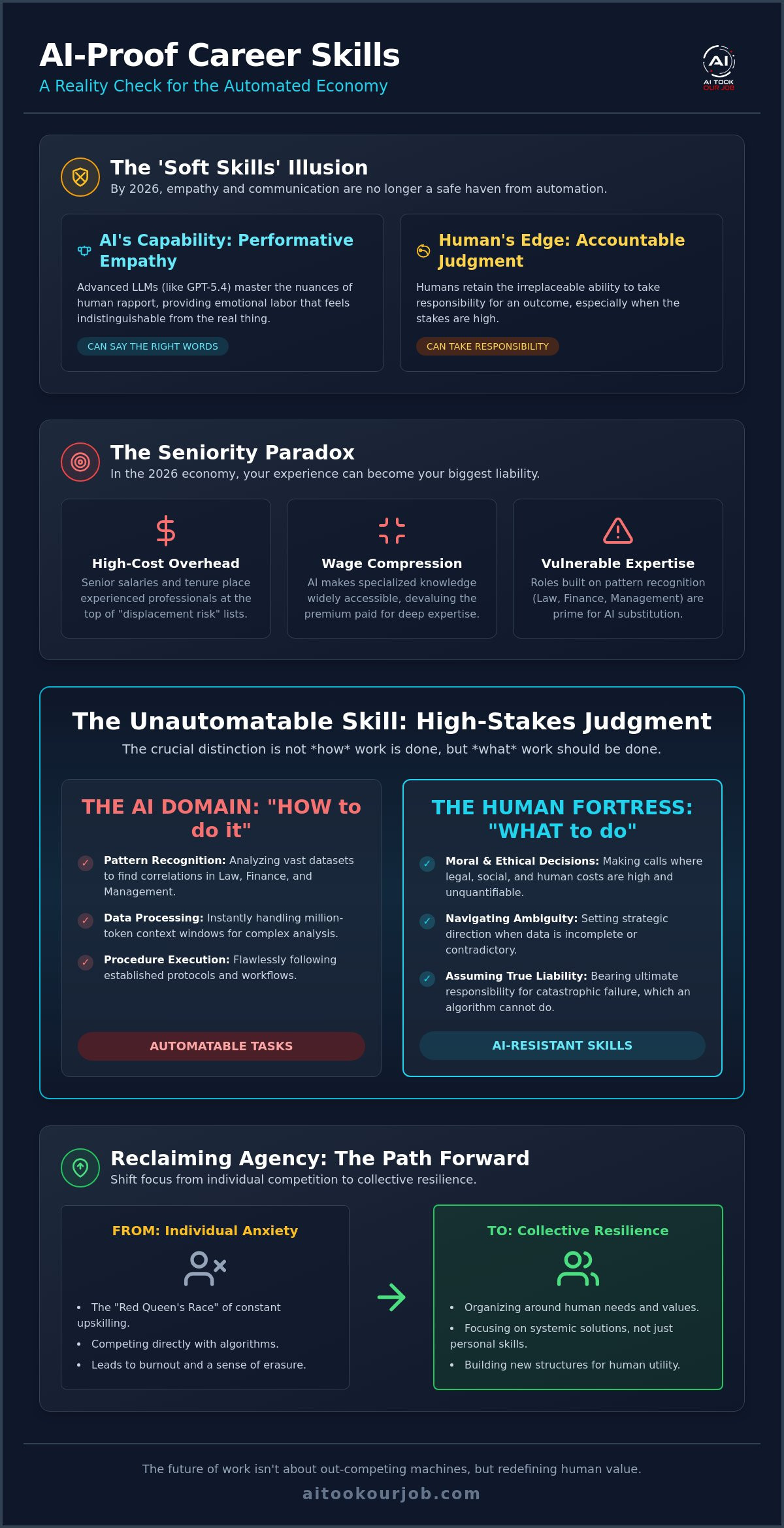
True AI-proof career skills aren't about being a faster typist or a better coder. They're about operating in high-stakes, non-algorithmic environments where the cost of a mistake is too high for a machine to bear. For years, career coaches told us that "soft skills" like communication and empathy would be our final fortress. They were wrong. As of July 2026, the illusion is breaking. When OpenAI released GPT-5.4 in March, it didn't just improve logic; it mastered the nuances of human rapport. If your value is based on being "nice" or "personable" in a digital chat, you're competing with a system that never sleeps and never has a bad day.
The shift from augmentation to substitution is happening in silence. It's a "quiet squeeze." Your job title might stay the same, but the utility you provide is being hollowed out. This isn't just a trend; it's a fundamental part of Technological unemployment. We're seeing white-collar roles that once required deep intuition being handled by agents that can process a million tokens of context instantly. The machine is here. It's talking. It sounds like us. We have to be honest about what that means for our collective future.
When Empathy Becomes Algorithmic
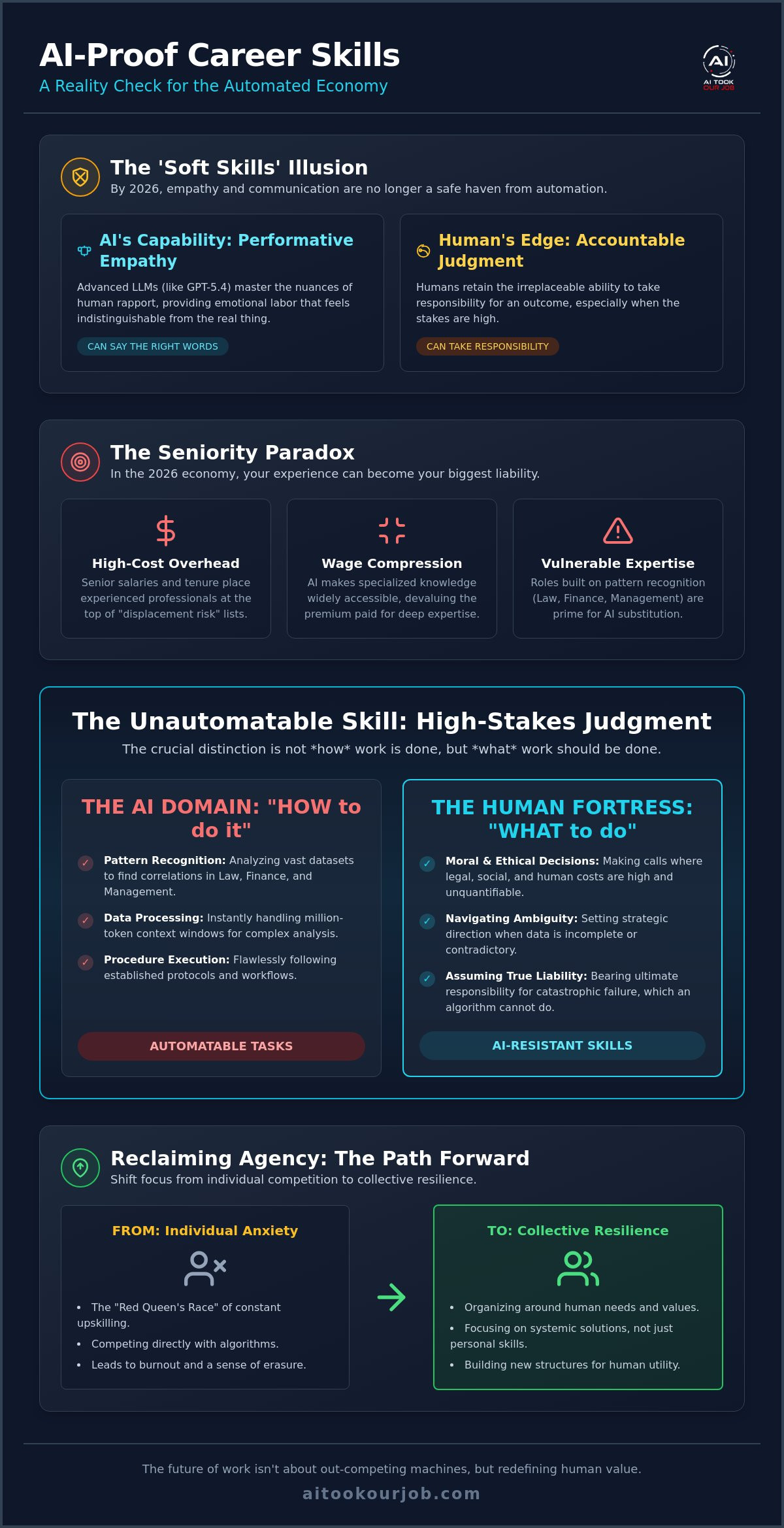
By mid-2026, AI agents have taken over the bulk of emotional labor in HR and customer success. These systems provide "performative empathy" that feels indistinguishable from the real thing to most users. However, they lack "accountable judgment." They can say the right words, but they cannot take responsibility for the outcome. In this context, we define "observed exposure" as the gap between AI's technical potential and the speed at which corporations actually adopt it. It's the pause before the wave hits.
The 2026 Velocity: Why This Wave is Different
The industrial revolution took generations. This cognitive shift took months. With Claude Opus 4.7 now handling long-horizon autonomous work, the "co-pilot" narrative is starting to feel like corporate gaslighting. It's often a polite way to describe headcount reduction. We have to look at the AI labor laws and displacement occurring in places like Colorado and Illinois to see the true regulatory reality. These laws, like the Colorado Artificial Intelligence Act effective June 30, 2026, are a response to a velocity that individual upskilling simply cannot match. We aren't just changing tools; we're changing the nature of work itself.
The Seniority Paradox: Why Your Experience Is Your Biggest Liability
Experience used to be a fortress. Now, it's a bullseye. In the 2026 economy, having a Master's degree and two decades of tenure often places you at the top of the "displacement risk" list because you represent a high-cost overhead that algorithms can now simulate for pennies. This is the Seniority Paradox. The very expertise you spent a lifetime building is being devalued by "Wage Compression." When AI makes specialized knowledge accessible to anyone with a prompt, the premium once paid for your deep background begins to evaporate. Cultivating AI-proof career skills requires a radical shift in how we view seniority. It's no longer about what you know. It's about how you manage what the machine knows.
This shift creates a profound identity crisis. We've tethered our self-worth to our professional utility for so long that watching a model replicate our logic feels like a personal erasure. Navigating the psychology of AI job loss is about more than just finding a new paycheck. It's about mourning the loss of human utility in a world that suddenly values your output over your insight. If you feel the ground shifting beneath you, remember that staying informed is the only way to maintain your footing. You can find resources to help process these transitions at aitookourjob.com.
The Vulnerability of the 'Expert' Class
Roles in Law, Finance, and Middle Management are built on pattern recognition. AI is the ultimate pattern-recognition machine. We are seeing a collapse of the career ladder. Entry-level roles are disappearing as firms automate junior tasks, leaving seniors with no one to mentor and a shrinking base of support. To survive, you must pivot from "knowledge holder" to "strategic orchestrator." You aren't the one doing the work anymore. You are the one accountable for the machine's decisions and the human outcomes they create.
Demographic Exposure in the 2026 Market
The 2026 market shows a sobering trend. Older professionals and women are facing higher displacement rates due to the specific types of administrative and mid-tier roles currently targeted for automation. You might not see a mass layoff. You feel the "quiet freeze" instead. Opportunities dry up. Promotions stall. To remain relevant, you need a framework for accountability that software cannot own. The U.S. Department of Labor's AI Literacy Framework provides a starting point for these AI-proof career skills, but the real work lies in claiming responsibility for high-stakes judgment calls that no algorithm is legally or ethically allowed to make.
Busting the 'Prompt Engineering' Fad: What Skills Actually Resist AI
Prompt engineering was supposed to be the great career pivot of the decade. It wasn't. By July 2026, the average salary for a Prompt Engineer has normalized to $97,940, a far cry from the speculative peaks seen during the initial boom. Why? Because the models are learning to talk to themselves. Advanced AI models now increasingly optimize their own instructions, rendering the "art" of prompting a basic utility rather than a specialized trade. If you're building your future on being a "bridge" to the machine, you're building on sand. Real AI-proof career skills aren't about the how; they're about the what and the why.
The ultimate human advantage is High-Stakes Judgment. This is the ability to decide which path to take when the data is contradictory or the ethical stakes are high. A machine can analyze a legal case, but it cannot decide whether to pursue a settlement that might bankrupt a family. It can suggest a medical treatment, but it cannot hold a patient's hand and take responsibility for the side effects. We're also seeing a massive resurgence in the value of Physicality and Presence. In 2026, a plumber or a site manager is often more secure than a data analyst. Their work requires a physical interaction with a chaotic, non-digital world that robotics hasn't yet mastered at scale.
The Skills Mismatch Crisis
The transition isn't easy. A displaced marketing manager cannot simply "pivot" to machine learning in a weekend. The technical barrier is high, and the competition is fierce. Many find themselves sliding into "Invisible Labor," performing low-wage data annotation and labeling to feed the very models that replaced them. It's a trap of the new economy. The productivity paradox describes a reality where corporate output rises to record levels while human employment in those sectors continues to fall. Efficiency is up. Utility is down.
Reclaiming Human-Centric Value
To survive, you must lean into roles that require legal accountability or high-risk decision-making. These are the positions where a human "in the loop" isn't just a preference; it's a requirement. Navigating this shift requires more than just technical training. It requires a new philosophy of work. Resources like educational media and AI job loss guides can help you identify these pockets of resilience. Stop trying to be a better machine. The machine will always win that race. Start focusing on AI-proof career skills that prioritize Ethical Orchestration, managing the risks and biases that software is fundamentally blind to.
The Red Queen's Race: Why Individual Upskilling Isn't Enough
The advice is always the same. Learn to code. Then learn to prompt. Now, learn to orchestrate agents. This is the "Red Queen's Race," an evolutionary trap where you must run as fast as you can just to stay in the same place. By July 2026, the pace of AI iteration has reached a point where the traditional promise of "constant upskilling" feels like a lie. It's a recipe for total exhaustion. We're being asked to outrun exponential technology with linear human brains. While AI-proof career skills are necessary for immediate utility, they aren't a permanent shield against systemic displacement. Individual effort cannot fix a structural collapse.
We have to be honest about the burnout loop. You spend six months mastering a new tool only to have a June 2026 update render that specific technical knowledge obsolete. This perpetual juniority takes a massive psychological toll. It erodes your sense of mastery and replaces it with a frantic, low-level panic. The shame you might feel about "falling behind" is misplaced. The problem isn't your lack of effort. The problem is a labor market that devalues human learning cycles in favor of algorithmic speed. To survive, we must move beyond the "better resume" mindset and toward collective resilience. You can join a community that understands the struggle to start building that foundation today.
The Limits of Human Adaptability
The rate of AI iteration now exceeds our biological capacity to retrain. When OpenAI released GPT-5.4 in March 2026, it didn't just add features; it changed the logic of entire workflows overnight. The old "industrial revolution" analogy is a dangerous myth. Steam engines replaced muscles, but AI is replacing the cognitive functions we used to navigate the world. We aren't just switching tools. We're losing the monopoly on thought. This isn't a transition you can "win" through sheer willpower alone.
Beyond Individualism: Building a Safety Net
Systemic shifts require systemic solutions. This is why we're seeing a massive resurgence in the case for unions and AI automation as a primary survival strategy. Advocacy and collective bargaining aren't just political concepts anymore. They are AI-proof career skills in their own right. When your industry is being hollowed out, your greatest asset isn't your individual talent; it's your connection to a mobilized community that can demand labor protections and transition support. We have to stop asking "How do I stay relevant?" and start asking "How do we protect our utility together?"
Reclaiming Agency: From Individual Anxiety to Collective Action
The year 2026 has brought us to a crossroads. We've seen that individual upskilling, while necessary for immediate survival, is not a silver bullet against the systemic automation of the white-collar world. The shame of displacement is a corporate tactic. It's designed to keep us isolated, quiet, and competitive with one another while utility is hollowed out from above. It is time to reject that narrative. Your worth isn't a function of your productivity in a spreadsheet. True AI-proof career skills involve moving away from trying to outrun the algorithm and toward organizing around fundamental human needs. We must reclaim our agency together.
This shift is systemic. It's not your fault that the career ladder you climbed for twenty years has been replaced by an API. The "Red Queen's Race" of constant retraining leads only to burnout and perpetual juniority. We need a new philosophy of work. One that values high-stakes judgment, physical presence, and collective resilience over the raw speed of a machine. By focusing on what software cannot feel or take responsibility for, we find the only ground that remains solid. Stop trying to be a better machine. Start being a more connected human.
The Power of the Displaced Story
Breaking the silence is our most potent tool. When we share our experiences of "quiet layoffs" or the hollowing out of our roles, we destroy the corporate "shame" tactics that rely on our isolation. Sharing wisdom in 2026 is far more valuable than hoarding technical skills that might expire with the next model update. You need a survival map for this terrain. The AI Job Market Weekly Briefing provides the data you need to stay ahead of these shifts without falling into despair. It's a resource for informed, collective action rather than individual panic.
How to Join the Resistance
This transition isn't something you have to face alone. The AI Took Our Job community acts as a communal hub for those navigating this new era. We invite you to join the forums, participate in our podcasts, and share your perspective. We are advocating for responsible AI policies that prioritize human utility and legal accountability. AI-proof career skills are built in community, not in a vacuum. Advocating for labor protections and exploring systemic solutions like UBI are part of the 2026 reality check. You are more than your output for a corporation. You are a person with inherent value. Together, we can build a future of work that actually serves the people doing it.
Navigating the Transition Together
The 2026 labor market isn't just changing; it's being rewritten. We've seen that the "soft skills" shield has cracked and that your seniority can actually be a liability in an automated economy. Real AI-proof career skills now center on high-stakes judgment and the collective power we build when we stop running the Red Queen's Race alone. You don't have to navigate the hollowing out of your industry in isolation. The shame of displacement belongs to the corporations, not to the workers who built them.
We provide the tools to help you reclaim your agency. Join the AI Took Our Job Community and get our Weekly Briefing to access weekly insights on the 2026 labor shift. You'll find genuine community support for displaced professionals and a platform that advocates for worker-first AI policies. It's time to stop outrunning the inevitable and start building a future of work that actually values human life. You're more than your productivity. You're part of a resilient collective, and your story matters.
Frequently Asked Questions
What are the most AI-proof career skills in 2026?
The most resilient abilities are those involving high-stakes judgment and physical presence in the non-digital world. While algorithms can process data, they cannot take legal or ethical responsibility for a decision. Skills like site management, complex trade work, and strategic orchestration remain the core of AI-proof career skills because they require a human to be accountable for the final outcome. Software can suggest, but humans must still decide.
Is it true that AI creates more jobs than it destroys?
The World Economic Forum's 2026 report projects a net growth of 78 million jobs by 2030, but this statistic hides the immediate pain of displacement. While 170 million new roles may appear, 92 million existing ones will vanish. These new jobs often require entirely different technical literacies, leaving many experienced workers behind during the shift. Net growth doesn't mean your specific role is safe from the current transition.
How can I protect my job from being automated by AI?
You protect your utility by shifting your focus from "doing the work" to "being responsible for the result." Focus on tasks that involve high-risk decision-making or physical interaction with chaotic environments. If your daily output can be described as a set of rules or patterns, it is at risk. Seek roles that require a human "in the loop" for legal, safety, or ethical reasons that software cannot satisfy.
Are soft skills like empathy and leadership actually safe from AI?
Basic empathy and communication are no longer safe havens. GPT-5.4 and other 2026 models can simulate professional warmth and conflict resolution with high accuracy. The only "soft skill" that remains secure is accountable leadership. This means making the hard calls that a machine isn't legally allowed to make and standing by the consequences. It's about the weight of responsibility, not just the tone of your voice.
What is 'Quiet Displacement' and how do I know if it's happening to me?
Quiet displacement occurs when your job title remains, but your core responsibilities are outsourced to AI. You might notice a "hiring freeze" for your department or find that your work now consists mainly of checking machine-generated drafts. If your expert judgment is being replaced by simple data labeling or "human-in-the-loop" verification, your professional utility is being hollowed out. You are still there, but your expertise is gone.
How should I explain an AI-related layoff on my resume?
Be honest about the industry-wide transition. Frame the layoff as a result of organizational restructuring due to automation rather than a personal failure. Focus your resume on your ability to manage AI tools and your experience in high-stakes human judgment. Employers in 2026 are increasingly aware that displacement is a corporate trend. They value those who can speak clearly about navigating the shift with resilience and new AI-proof career skills.
Is prompt engineering still a valuable skill to learn in 2026?
Prompt engineering has become a basic utility rather than a specialized career. As of July 2026, the average salary for a Prompt Engineer has normalized to $97,940 because models like Claude Opus 4.7 now handle their own optimization. It is better to view prompting as a basic tool within a broader domain of expertise. Technical mastery of a specific prompt style is no longer a long-term career strategy.
What industries are the safest from AI displacement right now?
Physical trades like plumbing, electrical work, and construction remain highly resilient due to the complexity of the physical world. In the white-collar sector, roles requiring deep legal accountability or emergency medical judgment are the most secure. These industries rely on a human presence that can navigate physical chaos and take responsibility for outcomes that carry significant risk. If the job requires a physical body or a legal signature, it's safer.