What if the algorithm that replaced your job is currently being refined by someone sitting in the exact same position you just left? It's a bitter irony. The human cost of AI data isn't just an abstract statistic or a line item in a tech giant's budget. It's the invisible, often traumatic reality of millions of people who are powering the very machines that displaced them. You aren't alone if you feel the weight of this systemic extraction; it's a shared burden in our changing workforce.
We understand the anxiety of navigating a digital gig economy that seems to value your data more than your dignity. It's exhausting to feel invisible in a tech revolution that claims to be human-centric. This article uncovers the reality of the "Ghost Work" economy and the psychological toll of cleaning datasets. We'll explore the legislative shifts of 2026, like the new transparency requirements under the EU AI Act, and show you how to find a community of peers ready to advocate for better labor standards. It's time to look at the machine for what it really is.
Key Takeaways
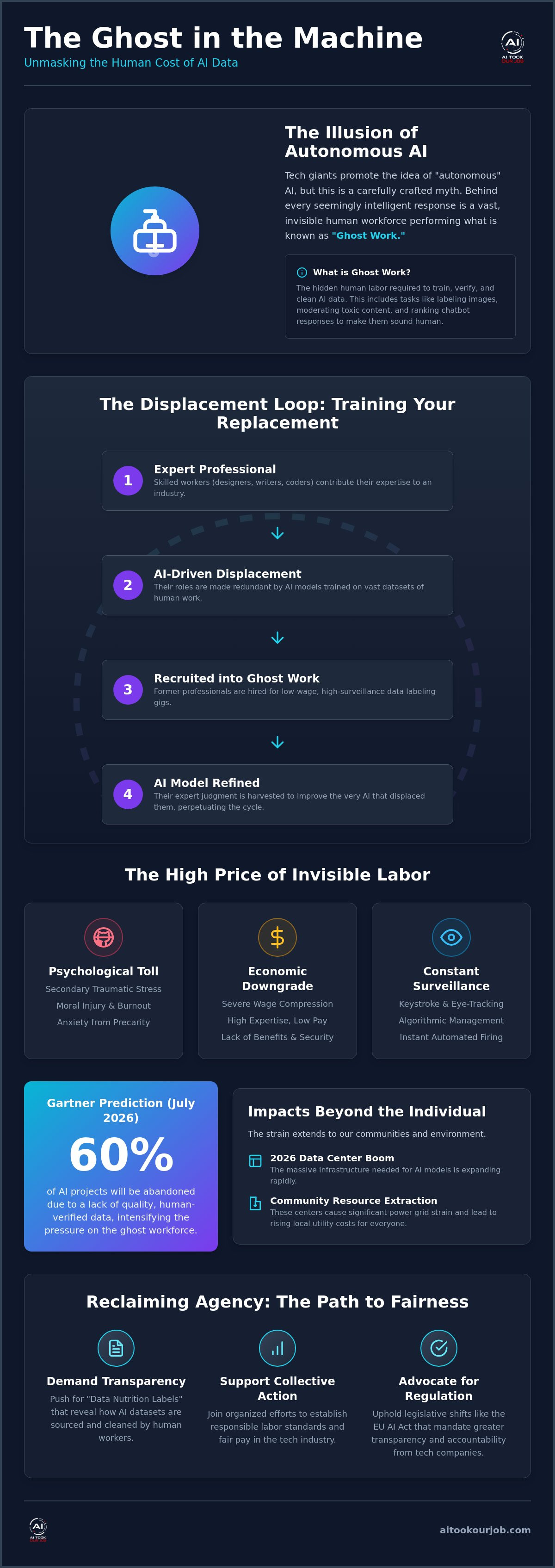
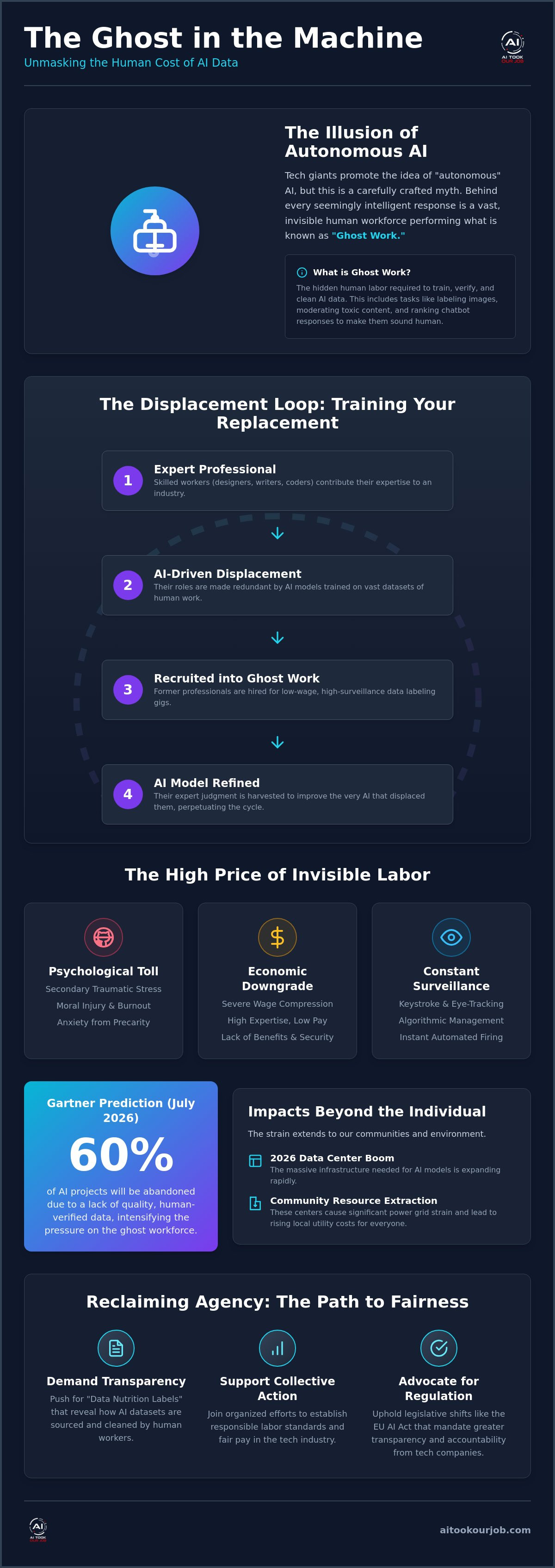
- Understand the reality of "Ghost Work" and how tech giants use invisible human labor to maintain the illusion of fully autonomous artificial intelligence.
- Uncover the "Displacement Loop" where former professionals are recruited into high-surveillance gig work to train the models that replaced them, exposing the true human cost of AI data.
- Identify the psychological risks of data labeling and content moderation, including secondary traumatic stress and the moral injury of supporting harmful systems.
- See the connection between the 2026 data center boom and the extraction of local community resources, from power grid strain to rising utility costs.
- Learn how to move toward collective resilience by demanding "Data Nutrition Labels" and joining organized efforts to establish responsible labor standards in the tech industry.
The Myth of the Clean Algorithm: Defining the Human Cost of AI Data
The tech industry loves the word "autonomous." It suggests a machine that thinks, learns, and acts without us. But this is a carefully crafted illusion. Behind every seamless interaction with a generative model, there is a massive, invisible infrastructure of human labor. We call it the human cost of AI data. Tech giants deliberately hide this work because acknowledging it ruins the "magic" of the algorithm. They want you to see a digital brain; they don't want you to see the millions of people sorting through digital trash to make it work.
This hidden labor is often referred to as ghost work. It functions like a modern-day Mechanical Turk. Just as the famous 18th-century "chess-playing machine" hid a human operator inside its cabinet, today's AI systems hide a global workforce under layers of APIs and digital platforms. By 2026, this economy has grown to include millions of workers. They are the ones labeling images, correcting text, and cleaning the messy datasets that AI requires to function. Without them, the machines would hallucinate into oblivion.
The Invisible Workforce: Who is Feeding the Machine?
The roles are varied, but the precarity is constant. Data annotators label objects for self-driving cars while content moderators filter out graphic violence. RLHF (Reinforcement Learning from Human Feedback) trainers rank chatbot responses to ensure they sound "human." Much of this labor is outsourced to the Global South or regions facing economic crisis. As of July 2026, Gartner predicts that 60% of AI projects will be abandoned due to a lack of AI-ready data. This reality puts immense pressure on this invisible workforce to produce more, faster, and for less. They are the engine, but they are never invited to the victory lap.
Why "Data Work" is Not Just Data Entry
Don't mistake this for simple clerical work. Machines are remarkably bad at nuance. They don't understand sarcasm; they can't grasp cultural context; they struggle with the shifting nature of human language. Humans must bridge that gap. Content moderators, in particular, perform the grueling task of keeping our digital spaces "sanitized" by absorbing traumatic content daily. It's high-stakes, emotionally draining work that requires constant, split-second human judgment. Ultimately, human judgment is the actual product being sold to you as "AI Intelligence."
The Displacement Loop: When Professionals Become Ghost Workers
There's a cruel irony unfolding in the 2026 labor market. Professionals who spent decades honing their craft are finding themselves recruited to train the very models that made their roles redundant. This isn't just a career shift. It's a fundamental downgrade in human agency. We're seeing the human cost of AI data manifest as a "Displacement Loop." It's a cycle where your previous expertise is harvested to ensure you are never needed in that capacity again. You aren't just losing your job; you're being asked to build the shovel that buries it.
The Commodification of Expertise
Take the case of a senior graphic designer in mid-2026. After a decade of creative direction, they now spend eight hours a day tagging "aesthetic" versus "non-aesthetic" images for pennies per click. Their career has been pulverized into a series of micro-tasks. Paralegals, junior coders, and writers are similarly "tagging" their own former outputs to refine LLMs. This commodification leads to severe wage compression. When high-level reasoning is reduced to a binary "yes/no" data point, the financial floor drops out. This transition often triggers a deep crisis of identity, which we explore in our guide on the psychology of AI job loss. It's the feeling of being a ghost in your own industry.
Algorithmic Management and Surveillance
The environment of these labeling platforms is often a digital sweatshop. Keystroke monitoring and eye-tracking software ensure you never look away from the screen. If your "accuracy" score dips because you took a moment to breathe, the algorithm can "fire" you instantly without a human ever reviewing the decision. It's a stark reality documented in the report The Hidden Human Cost of Content Moderation and Data Labelling. The human cost of AI data is measured in these hours of uncompensated surveillance and the mental fatigue of meeting impossible quotas. This lack of protection is why staying informed through our weekly briefing is essential for anyone navigating these shifts. Traditional safeguards don't apply here. While some states are catching up, as seen in the AI labor laws displacement landscape, the gap remains dangerously wide for the average gig worker.
The Psychological Toll: Trauma Behind the Screen
The screen is your only witness. While the tech industry celebrates the speed of model iterations, the human cost of AI data is quietly measured in the erosion of the mind. Ghost work is fundamentally isolating. There is no water cooler to congregate around; no union to provide a collective voice; only a relentless feed of data points. This solitude amplifies the weight of the tasks at hand, leaving workers to process the darker corners of the internet without a safety net.
Corporate wellness programs are often presented as a solution. In reality, they are inadequate band-aids for systemic exploitation. Offering a meditation app subscription to someone who spent eight hours sorting through graphic imagery is a hollow gesture. It ignores the structural reality that the work itself is designed to be extractive. Investigative reports into the hidden human cost of AI reveal a pattern of psychological neglect that spans the globe. We aren't just talking about stress; we're talking about the fundamental breaking of the human spirit for the sake of a cleaner dataset.
The Content Moderation Crisis
AI cannot "auto-moderate" itself. It requires a human buffer to absorb the most disturbing content before the machine can even begin to recognize it. This exposure leads to Secondary Traumatic Stress (STS), a condition where the moderator experiences the trauma of the content as if it were their own. By 2026, the long-term effects of this labor are becoming undeniable, with many former workers reporting symptoms of PTSD and permanent desensitization. Despite these risks, most major tech contracts in 2026 still lack a mandatory "trauma cap" policy to limit exposure hours.
Moral Injury and Identity Crisis
There is a specific pain in participating in your own obsolescence. This is moral injury: the damage done to one's conscience by performing actions that transgress deeply held moral beliefs. For a displaced professional, training an AI to mimic their expertise feels like a betrayal of their own craft. It creates a profound identity crisis. Navigating the shame of moving from a high-agency career to what is often dismissed as "unskilled" data work is an immense burden. Reclaiming a sense of self requires more than just a new job; it requires a community that understands the struggle. Resources like our guide on educational media AI job loss are designed to help you navigate this survival landscape without losing your humanity in the process.
Beyond the Screen: Environmental and Community Extraction
The human cost of AI data doesn't stop at the edge of your monitor. While we focus on the psychological toll of labeling, a physical extraction is happening in our backyards. The massive computing power required to process human-labeled datasets demands an infrastructure that often competes with local communities for basic survival needs. It's a trade-standing trade-off that pits megawatts against people; it prioritizes server cooling over residential stability.
Data Centers: The Modern Factory Town
Data centers are the industrial hubs of 2026. They occupy vast tracts of land but offer very few long-term jobs compared to the traditional factories they replaced. Instead, they consume staggering amounts of water and electricity. In November 2025, Virginia's State Corporation Commission was forced to create a separate utility rate tier for large energy users demanding 25 megawatts or more. These centers must now sign 14-year contracts and pay for infrastructure costs. As of February 2026, over 300 data center-related bills have been filed across 30 U.S. states to protect residents from rising utility prices. The 2026 movement for data center moratoriums has become a vital form of community defense. Local residents are refusing to let their resources be drained to power an algorithm that offers them nothing in return.
The Global Resource Extraction Chain
There is a direct line from the data labeler in the Global South to the rare earth mineral miner. This is the "Digital Colonialism" of our era. The hardware required to run these models relies on minerals extracted under precarious conditions, often in the same regions where workers are underpaid to clean the data. The "human cost" is a global chain of extraction. It starts with the miner, moves to the labeler, and ends with the resident living near a server farm's heat exhaust. Current regulations are failing to address this lifecycle. We've analyzed these gaps in our overview of AI labor laws displacement, which highlights how slow policy is to react to physical extraction. To stay ahead of these shifts and protect your local community, you can join our community membership to access collective advocacy tools.
Reclaiming Agency: Moving Toward Collective Resilience
We've spent this article looking into the shadows of the machine. We've seen the trauma, the displacement, and the environmental extraction that define the human cost of AI data. It's a heavy reality. But acknowledging these facts is the first step toward reclaiming our agency. The narrative of the "inevitable" AI revolution depends on your silence; it relies on the idea that you are a passive victim of progress. The truth is far more powerful. You aren't a bystander. You are the essential human power that makes the machine function. Without human judgment, human nuance, and human labor, the "magic" of AI disappears instantly.
The transition from feeling invisible to becoming an advocate requires a shift in how we view our utility. Tech giants spend billions to convince the world their models are autonomous. We must counter that by demanding transparency. We need "Data Nutrition Labels" that disclose exactly how much human labor was used to train a model and under what conditions that labor was performed. Gartner forecasts that spending on AI governance platforms will reach $492 million in 2026. That investment must include the protection of the people powering the data, not just the security of the code.
Advocacy and Legislative Action
2026 is a pivotal year for labor defense. As of August 2, 2026, the transparency duties under Article 50 of the EU AI Act are officially in effect. This provides a rare lever for workers to demand clarity on how their data work is being utilized. There is a growing push for "Ghost Work" minimum wage standards and mandatory mental health protections for content moderators. Collective bargaining is the only meaningful defense against the algorithmic management we discussed earlier. You can find organizations leading this charge in our Advocacy Groups for AI Job Displacement resource guide. Individual resilience is important, but collective power is what changes the law.
Building a Community-Centric Future
Isolation is the greatest tool of the extraction machine. When you feel alone in your displacement, it's easy to succumb to shame. We combat this through radical honesty. Share your story. Acknowledge the irony of your current role. By participating in community hubs like AI Took Our Job, you help build a network of peers who understand the specific "moral injury" of this era. We also encourage you to explore the unions and AI automation playbook to see how traditional labor structures are evolving to meet digital challenges. We are the intelligence in Artificial Intelligence. It's time we were treated like it. Support your peers in the labeling trenches and remember that your expertise has value, even if the current market is trying to commodify it into a binary choice.
Turning the Tide on Digital Extraction
The myth of the autonomous machine is crumbling. We've uncovered how the human cost of AI data is built on the backs of displaced professionals and exhausted moderators. It's a system that thrives on making your labor invisible. But now you know the truth. The intelligence in these models isn't artificial; it's human. By demanding transparency and shifting our perspective from victims to essential power sources, we can begin to reshape the industry on our own terms. Radical honesty is our best defense against algorithmic extraction.
You don't have to navigate this transition in isolation. Finding a community that understands the irony of training your replacement is vital for your long-term resilience. Join the AI Took Our Job Community and reclaim your narrative. Our members get direct access to the 2026 Weekly Briefing to track labor shifts in real time. You'll also benefit from expert-led discussions on labor rights and compassionate peer support for career transitions. The landscape is changing fast. Let's make sure we're the ones leading the way. You are seen. You are valued. Together, we can build a future that respects the humans behind the machine.
Frequently Asked Questions
What exactly is the human cost of AI data?
The human cost of AI data represents the physical, psychological, and economic toll on the millions of workers who train and refine artificial intelligence. It includes the trauma of content moderation, the loss of professional identity for displaced experts, and the environmental strain on local communities. This cost is often hidden from view to maintain the illusion of seamless automation. It's the invisible labor that powers every "smart" interaction you have online.
Is data labeling a viable career path for displaced workers in 2026?
Data labeling often serves as a temporary survival mechanism rather than a sustainable career. While the work is plentiful, it's characterized by high surveillance, low wages, and a lack of traditional labor protections. Displaced professionals often find the transition from high-agency roles to repetitive micro-tasking to be emotionally and financially draining. It's a stopgap that rarely provides the stability or benefits required for long-term security.
How much are data labelers typically paid?
Pay is highly volatile and often depends on the complexity of the task and the worker's location. As of July 2026, the market price for an AI-resolved customer support ticket ranges from $0.49 to $2.00, which reflects the razor-thin margins passed down to human labelers. In many regions, workers earn significantly less than the local minimum wage when accounting for unpaid time spent waiting for tasks. It's a piece-rate system that prioritizes speed over human welfare.
Why do tech companies hide the human labor behind their AI?
Concealing human labor allows tech companies to market their products as "magical" and fully autonomous, which drives higher investor valuations. If the public realized that humans were manually correcting thousands of errors every hour, the technology would appear less revolutionary. It's a strategic choice to emphasize "artificial" intelligence while downplaying the massive human infrastructure required to make it function. They sell the algorithm; they hide the humans.
What is the "Moral Injury" associated with AI data work?
Moral injury occurs when you're forced to perform tasks that violate your conscience or professional ethics. For a displaced writer or coder, this often means training an AI to mimic their expertise, effectively contributing to the obsolescence of their own craft. This creates a deep sense of betrayal and psychological distress. It's a specific type of trauma that comes from participating in a system you know is socially or economically harmful.
Can AI eventually label its own data without humans?
AI still requires human "ground truth" to avoid a phenomenon known as model collapse. When AI labels its own data without human oversight, it eventually begins to reinforce its own errors and hallucinations. Humans are essential for providing the nuance, cultural context, and ethical judgment that machines cannot replicate. While "synthetic data" is a growing trend, the need for a human buffer remains a permanent requirement for safe and accurate systems.
How can I support ethical AI labor practices as a consumer?
You can support ethical practices by demanding transparency and supporting companies that disclose their labor supply chains. Look for organizations that comply with the August 2, 2026, transparency deadlines under the EU AI Act. Advocate for "Data Nutrition Labels" that show the human labor involved in training a model. Your voice helps push for a market where "responsible AI" isn't just a marketing slogan but a commitment to fair wages and worker safety.
Where can displaced workers find support for mental health issues related to AI?
Peer support is often the most effective defense against the isolation of ghost work. Community hubs like AI Took Our Job provide a safe space to share stories and process the human cost of AI data with others who understand the struggle. Seeking professional counseling that specializes in secondary traumatic stress is also vital for those in high-exposure moderation roles. Don't try to carry the weight of this transition alone; collective resilience is our strongest tool.