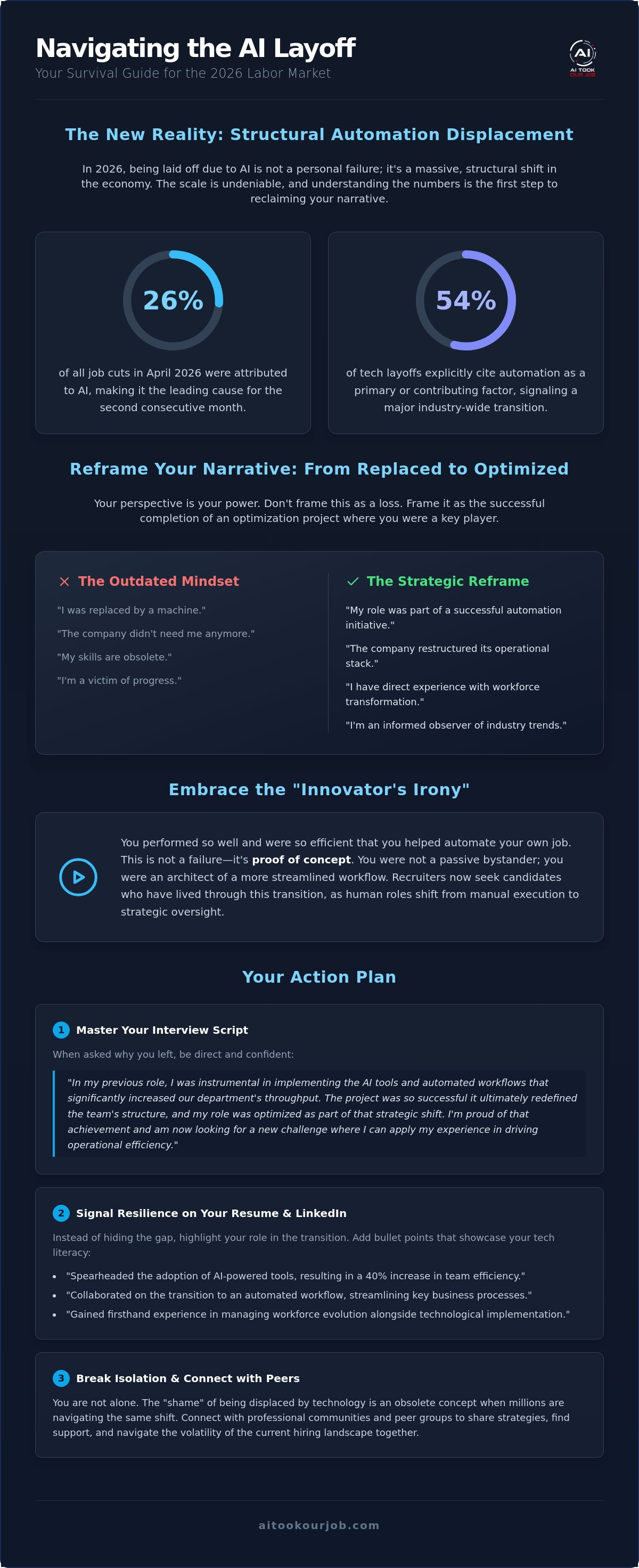
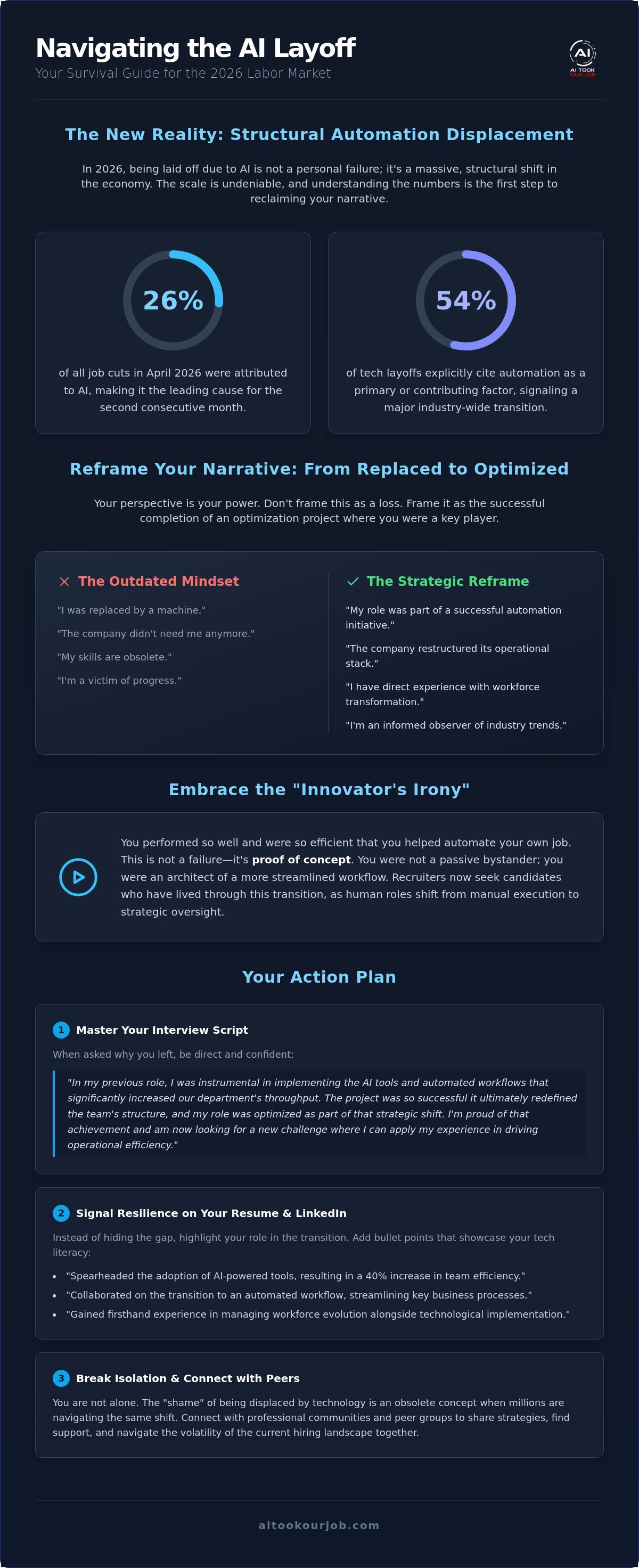
In April 2026, AI became the leading cause of unemployment for the second month in a row, accounting for 26% of all job cuts. It's a staggering figure that translates to thousands of talented professionals suddenly finding themselves replaced by an algorithm. You might feel like you've been deemed less efficient than a machine, or that your professional identity has reached an expiration date. It's a heavy burden to carry. Knowing how to explain being laid off due to automation is no longer just a niche interview skill; it's a survival necessity in a labor market where 54% of tech layoffs now cite automation as a primary factor.
We understand the sting of this transition. It's unsettling to watch the infrastructure of your industry shift beneath your feet. However, being displaced by a tool doesn't mean you're obsolete. It means you've been on the front lines of a global transformation. This guide will help you master the art of reframing your story from one of loss to one of technical literacy and professional resilience. We'll provide clear scripts for your next interview, dignified ways to update your LinkedIn profile, and a path toward connecting with a community that refuses to let these shifts define our collective worth.
Key Takeaways
- Reframe your experience from being "replaced" to being "optimized," treating displacement as a neutral economic event rather than a personal failure.
- Access professional scripts that teach you how to explain being laid off due to automation while highlighting your strategic oversight and technical literacy.
- Update your LinkedIn and resume to signal resilience by listing your role in AI implementation, even if it wasn't in your official job title.
- Overcome the stigma of the 2026 labor market by leveraging the "Innovator’s Irony" to show recruiters you are a driver of efficiency.
- Break the cycle of isolation by connecting with a community of peers to navigate the volatility of the current hiring landscape together.
The 2026 Reality: Why Automation Layoffs Are No Longer a Taboo
The 2026 labor market has reached a tipping point. Radical honesty is now our only currency. In April 2026, AI was the leading reason cited for job cuts for the second month in a row, accounting for 26% of all layoffs according to data from Challenger, Gray & Christmas. If you've been displaced, you aren't an outlier. You're part of a massive, structural shift. We call this "Structural Automation Displacement." It isn't a performance review; it's a neutral economic event. Understanding how to explain being laid off due to automation starts with accepting that the infrastructure of work has changed, not your inherent value as a professional.
The stigma is dissolving because the scale is undeniable. As of July 2026, over 54% of tech layoff events explicitly cite automation as a factor. When half the room is navigating the same transition, the "shame" of being replaced by a machine becomes an obsolete concept. We are witnessing a modern iteration of Technological unemployment, a phenomenon that has reshaped economies for centuries. Today, the shift is simply moving faster. Embracing a "truth-teller" stance is your greatest advantage. Hiding the reason for your departure suggests a lack of awareness about the very industry trends that are currently defining the global economy.
The Psychology of AI Job Loss
Losing a role to an algorithm triggers a specific kind of internal friction. We call this the "Human Utility" crisis. It's a deep-seated anxiety that your skills have been rendered meaningless by a line of code. Much of this is explored in our guide on the psychology of AI job loss, which examines how corporate narratives often prioritize output over human contribution. Don't fall for the myth of obsolescence. This fear is a byproduct of a system in flux. Instead, try viewing your displacement as a "market graduation." You've completed a phase in a legacy workflow and are now being forced into the next iteration of the workforce earlier than others.
Shifting from Victim to Tech-Literate Survivor
Your narrative matters. Saying "the machine took my job" positions you as a passive victim of progress. Conversely, explaining that "the company restructured its operational stack around new automation tools" positions you as an informed observer of industry trends. It's vital to differentiate between your professional expertise and the specific tasks that were automated. Automation displacement is a shift in how a service is delivered, not a loss of the expertise required to oversee that delivery. When you learn how to explain being laid off due to automation, you focus on your ability to manage the outcomes that the machines are now producing. You are the strategist, not the manual processor.
Reframing the Narrative: From "Replaced" to "Optimized"
The irony is sharp. You performed so well that you essentially automated yourself out of a role. In the 2026 market, this isn't a badge of shame; it's proof of concept. When considering future AI job displacement, we see that the most efficient workers are often the first to bridge the gap between manual labor and algorithmic execution. You weren't a passive bystander. You were the architect of a more streamlined workflow. This is what we call the "Innovator's Irony." You achieved the efficiency the company asked for, and now you possess the blueprint for how it's done.
Recruiters in 2026 are looking for candidates who understand the Future of Work report findings. The human role is shifting toward strategic oversight rather than manual execution. You have already lived through this transition. By reframing your departure as the final stage of a successful optimization project, you demonstrate a level of professional maturity that "safe" employees haven't yet faced. Mastering how to explain being laid off due to automation requires moving from a narrative of being "let go" to a narrative of "mission accomplished." You didn't fail the job. You finished the job.
The "Innovator’s Irony" Script
When an interviewer asks why you left your last role, don't hesitate. Own the outcome. Try this approach: "In my previous role, I successfully implemented the AI tools and automated workflows that increased our department's throughput significantly. My objective was to reach a level of efficiency where routine tasks no longer required human intervention. I achieved that goal. While it led to a structural reduction in the team, it gave me deep expertise in managing the transition phase of a business."
This script does three things. It proves you are results-oriented. It shows you aren't afraid of technology. Most importantly, it positions you as a leader of change rather than a victim of it. You are the person who knows how to get a company from point A to point B. If you want to keep your finger on the pulse of these shifts, checking our weekly briefing can help you stay ahead of the next wave.
Mapping Your Non-Automatable Skills
AI excels at pattern recognition and data synthesis, but it still fails at high-level empathy, complex negotiation, and ethical oversight. These are your "Residual Human Values." When you list "AI Orchestration" on your resume, you're telling employers you know how to direct the machine. You aren't competing with the algorithm; you're the one holding the baton. To find your next move, look at the AI impact by industry to identify sectors where your specific human oversight is still at a premium. Focus on your ability to handle nuance that code cannot touch.
The moment of truth arrives. The recruiter leans in and asks the inevitable question. In 2026, they aren't looking for a perfect, unbroken track record. They're looking for situational awareness. Mastering how to explain being laid off due to automation means stripping away the apology and replacing it with a briefing. You aren't a casualty of progress. You're a witness to it. Professionalism in this era requires a lack of bitterness. If you sound resentful of the machine, you sound like you're fighting the future. If you sound matter-of-fact, you sound like a leader. Use these scripts to anchor your narrative in reality while highlighting your continued utility.- The Direct & Professional Script: "My role was part of a structural reorganization as the company moved toward a higher ratio of automated processing. I stayed on through the final integration to ensure data integrity. Now, I'm looking for a position where my oversight can scale alongside a modern tech stack."
- The Strategic Pivot Script: "The automation of my previous sector accelerated my timeline for moving into [New Industry]. I've seen how algorithms handle the routine, and it's clear that my expertise in [Specific Human Skill] is best applied in this higher-stakes environment."
- The Consultant Script: "After successfully automating the core functions of my previous department, I'm shifting into advisory work. I help organizations navigate the transition phase without losing the human-in-the-loop oversight necessary for quality control."
Eventually, a savvy interviewer will ask: "Why won’t AI replace you here, too?" Don't flinch. This is your chance to demonstrate your value. Answer by focusing on the specific nuance, ethical judgment, or complex empathy that the role requires. You aren't there to compete with the algorithm. You're there to direct it.
Scenario A: The Role Was Fully Automated
"My previous firm transitioned to a fully algorithmic model for [Task X]. I led that transition and am now looking to apply my [Skill Y] in a high-touch environment." Using the key phrase, "The role evolved beyond human-only requirements," signals that the job itself changed. It wasn't a failure of your performance. It was a change in the delivery method of the work. Focus on how your human-in-the-loop necessity ensures that the automated outputs actually meet business goals.
Scenario B: The Role Was "Quietly" Phased Out
Efficiency layoffs can feel like a personal slight, but they are often purely mathematical. "The company restructured to prioritize AI-first workflows, which reduced the need for [Department Z]." This response shows you understand the broader economic impact of automation. It positions you as an industry-aware professional who isn't surprised by market shifts. You're simply ready for the next one.
Resume and LinkedIn: Signaling Resilience in a Volatile Market
Your digital footprint is the first place a recruiter looks for signs of obsolescence. Don't give them any. In the 2026 job market, your resume shouldn't just list what you did; it should prove you can survive what's coming. Learning how to explain being laid off due to automation on paper involves a shift in nomenclature. You weren't just a participant in a legacy workflow. You were a witness to its transformation. If you helped a company move from manual tasks to algorithmic ones, you weren't just an employee. You were an implementation partner.
The "Open to Work" banner on LinkedIn can feel like a target. In 2026, it's actually a signal of availability in a market that moves at the speed of light. Don't hide the reason for your gap. Use your "About" section to tell a "Truth-Teller" story. State clearly that your previous sector reached a level of total automation and you are now applying your human oversight to a more complex environment. This radical honesty builds immediate trust. It shows you understand the economy better than a candidate who is still pretending the world hasn't changed.
Bullet Point Templates for Your Resume
Forget "Responsible for data entry." That role is gone. If you were part of the team that integrated new software before your departure, you are an AI Implementation Specialist. Use your bullet points to highlight the transition rather than just the tasks. Try these structures:
- "Managed the transition of legacy [Task X] to automated workflows, resulting in a quantifiable increase in departmental throughput."
- "Facilitated cross-functional collaboration during department-wide restructuring to ensure human-in-the-loop data continuity."
- "Directed the oversight of [System Z] to maintain quality standards that the algorithm could not yet meet independently."
Even if the efficiency you created led to your exit, it proves you are an asset to the next company's bottom line. You are a driver of progress, not a victim of it. To ensure your resume remains relevant as new tools emerge, join our community to stay informed on which skills are currently in highest demand.
Networking with Radical Honesty
In 2026, telling your network "AI took my job" is a power move. It signals that you were at the top of your game in a field that was so valuable it was targeted for optimization. Focus your networking efforts on roles that require high-level judgment or sectors that are traditionally AI-resistant. Leverage advocacy groups for AI job displacement to find peers who have already successfully pivoted. These communities are often the best source for "hidden" job leads that haven't been posted to algorithmic job boards yet. Connection is the only thing a machine cannot simulate.
Moving Forward: Joining the Collective Response
Isolation is the greatest threat you face right now. It's easy to retreat, to feel that your professional story has ended because a specific task was automated. It hasn't. The 2026 labor market is volatile, but you don't have to navigate it in silence. Sharing your experience is the first step in stripping away the stigma that corporate narratives have built around displacement. When you learn how to explain being laid off due to automation, you aren't just preparing for an interview. You're participating in a collective reframing of what it means to work in the age of AI.
Community isn't just about emotional support. It's about data. By connecting with others, you gain access to "Transition Peers" who have already mapped out the hiring landscape in your field. Our community uses collective intelligence to identify which firms are actually hiring for "human-in-the-loop" roles and which ones are just "AI washing" their job descriptions. Using the weekly briefing AI job market updates allows you to spot emerging roles before they are flooded with applicants. Knowledge is your shield. Solidarity is your strength.
Don’t Navigate the Shift Alone
The silence following a layoff is where despair grows. We encourage you to speak up. Finding others in the AI Took Our Job community who are facing similar transitions provides more than just comfort; it provides a survival map. We share scripts, we critique resumes, and we track the movement of capital into new sectors. This isn't just networking. It's a mobilization. Your ability to articulate how to explain being laid off due to automation becomes much easier when you realize you're part of a massive, shared experience. We are the ones who will define the next era of professional resilience.
Advocating for the Future of Work
Your displacement is a policy failure, not a personal one. The rapid adoption of automation without adequate safety nets is a structural issue that requires a collective response. We believe in responsible AI policy advocacy and stronger labor rights for the digital age. Get involved in local labor advocacy. Support transparency in how algorithms are deployed in the workplace. You have a right to be heard. Final encouragement: your value hasn't disappeared. It's simply being redefined in a world that needs human judgment more than ever. We are moving forward, and we are doing it together.
Reclaiming Your Narrative in the Age of AI
The 2026 labor market is unyielding, but you are not powerless. You've learned that your displacement isn't a badge of failure; it's evidence that you were at the center of a major industrial shift. By mastering how to explain being laid off due to automation, you transform from a passive observer into a strategic expert who understands the transition from manual to algorithmic workflows. You now have the scripts and the mindset to signal your resilience to any recruiter who values technical literacy and human oversight.
Don't let the corporate silence define your worth. Our community of over 50,000 workers is already sharing transition stories and navigating this volatility together. We've been featured in major 2025 labor reports because we prioritize the human element in a tech-driven world. To stay ahead of the next wave of shifts, join our community and get the Weekly Briefing to stay ahead of the AI wave. You'll receive weekly market intelligence curated specifically for displaced professionals like you. The future is uncertain, but it's a future we're building together. Your skills haven't vanished. They're simply ready for a new, more complex application. Stay grounded. Stay connected.
Frequently Asked Questions
Should I lie and say I was part of a general layoff instead of mentioning automation?
Honesty is your strongest asset in the 2026 labor market. Lying about the nature of your departure misses a vital opportunity to demonstrate your technical literacy and industry awareness. Recruiters are already seeing a massive shift, with 26% of all job cuts in early 2026 attributed to AI. If you hide the truth, you risk appearing out of touch with the very trends reshaping your profession. Radical honesty proves you understand the economic reality of your sector.
How do I explain that I was the one who actually implemented the AI that replaced me?
Frame this as a successful project completion rather than a personal loss. You were hired to drive efficiency, and you delivered exactly what the company required. Tell recruiters that you successfully led the transition to an automated model, proving you have the blueprint for organizational transformation. You didn't just lose a role; you finished a mission. This positions you as an implementation expert who can help the next company navigate their own transition phases.
Will recruiters see me as "outdated" if I tell them my role was automated?
Not if you control the narrative from the first sentence. Being in a role targeted for automation often means you were working in a high-value, data-rich environment that was essential to the company's bottom line. Use this to prove you were at the forefront of your field. Focus your energy on your ability to oversee the systems that now handle the routine tasks. You are the strategist who understands the output, not the manual processor of the input.
What are the best industries to pivot to if I want to avoid being automated again?
Look for "high-touch" sectors where human judgment and complex empathy are non-negotiable. Roles in specialized healthcare, ethical AI oversight, and high-stakes B2B negotiation are currently more resistant to total replacement. These fields require a level of situational nuance and emotional intelligence that algorithms still cannot simulate. Focus on industries that prioritize a "human-in-the-loop" model where your oversight is the primary value add.
How do I handle the anger and resentment I feel toward my former company?
Your anger is a rational response to a structural failure in the labor market. It's vital to remember that this displacement is a policy issue, not a personal performance failure. Instead of letting resentment stall your progress, channel that energy into community connection and collective resilience. Processing these feelings with peers who understand the "Human Utility" crisis helps you move from isolation to informed action. You are allowed to be angry; just don't let it be the only thing a recruiter hears.
Is there any legal recourse if I was replaced by AI without warning?
Check your local regulations immediately, as the legal landscape changed significantly in 2026. States like California, under SB 617, and Illinois now have specific notice requirements for employers using AI in employment decisions. While federal law remains a patchwork, these state-level protections might offer a path for those displaced without the required 60-day warning. We don't provide legal representation, but we strongly recommend reviewing the latest WARN Act updates in your specific jurisdiction.
How can I prove my skills are still relevant in a 2026 AI-heavy market?
Shift your professional focus to "AI Orchestration" and strategic oversight. Prove your relevance by highlighting instances where your human judgment corrected an algorithmic error or navigated a complex ethical dilemma that a machine would have missed. In this market, the most valuable skill is knowing how to explain being laid off due to automation as a graduation into higher-level work. Show that you know how to direct the tools, rather than just competing with them.