What happens to a ladder when the bottom rung is simply gone? In 2026, we're no longer speculating about a distant future. We're living through a structural shift where AI entry level job displacement is actively erasing the traditional starting line for millions of graduates. With 40 percent of chief executives now planning to reduce junior roles in favor of automated systems, that degree you worked so hard for can feel more like a relic than a ticket to a career. It's exhausting to be told you need three years of experience for an entry-level role that's currently being handled by a script. You're right to feel like the game is rigged.
We're going to take an unflinching look at this new reality and provide a roadmap for navigating a workforce that no longer offers a clear front door. This isn't about superficial optimism. It's about grounded resilience and collective action. You'll discover how to bypass the automated gatekeepers that have been ghosting your applications and learn how to build a career when the old rules have been rewritten. We're in this together, and it's time to find a new way up.
Key Takeaways
- Learn how the "unbundling" of junior tasks into automated prompts is dismantling the traditional training grounds for professional intuition and growth.
- Explore the long-term consequences of AI entry level job displacement, including a looming talent crisis that leaves companies without a future leadership pipeline.
- Shift your career focus from basic technical skills to "high-agency" roles that require the human-centric negotiation and cross-functional judgment AI can't replicate.
- Gain actionable insights on using collective resilience and community-led advocacy to bypass automated recruitment systems and reclaim your professional path.
The 2026 Reality: Why the Junior Career Ladder is Crumbling
The career ladder isn't just missing a step. The bottom has been sawed off entirely. This is the "Missing Rung" theory, a structural shift where foundational roles that once allowed graduates to trade enthusiasm for expertise are being permanently automated out of existence. Today, AI entry level job displacement means those entry points aren't just crowded; they're disappearing. We have to be honest. The path your parents took is gone. What happens when the entry point becomes a dead end?
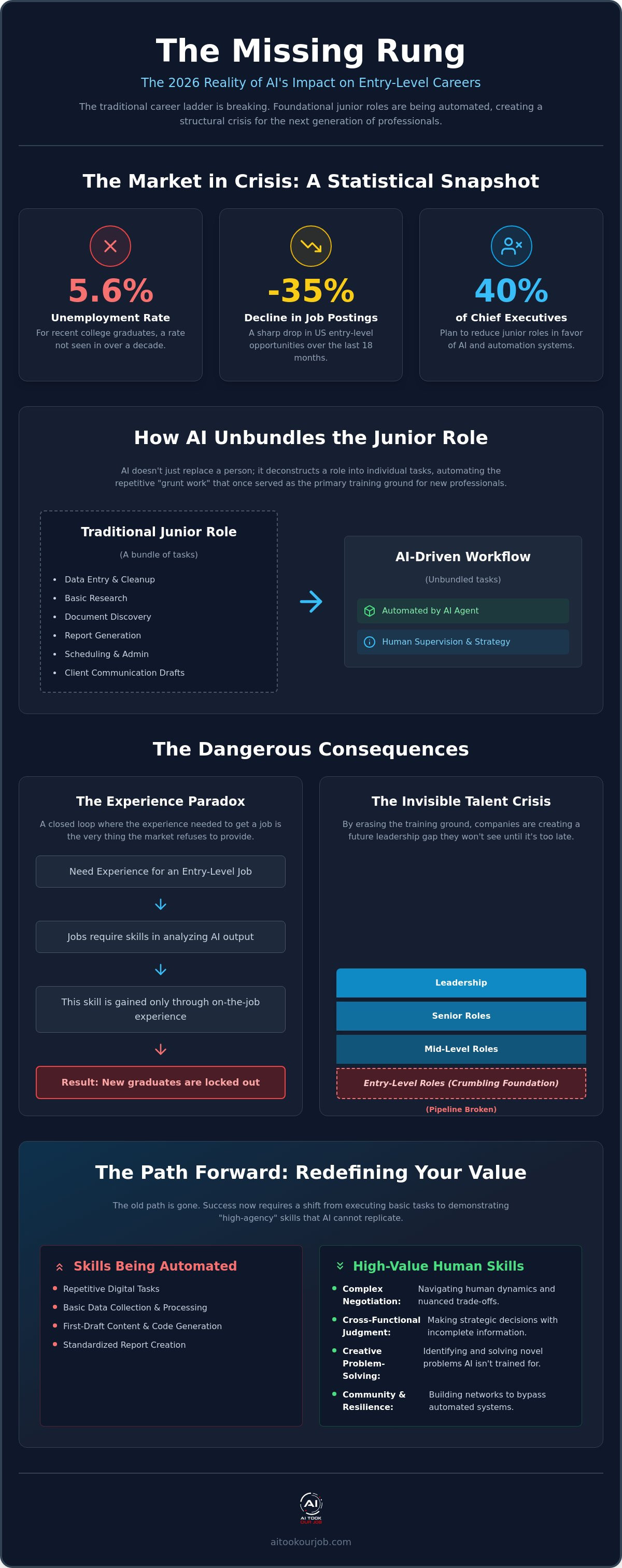
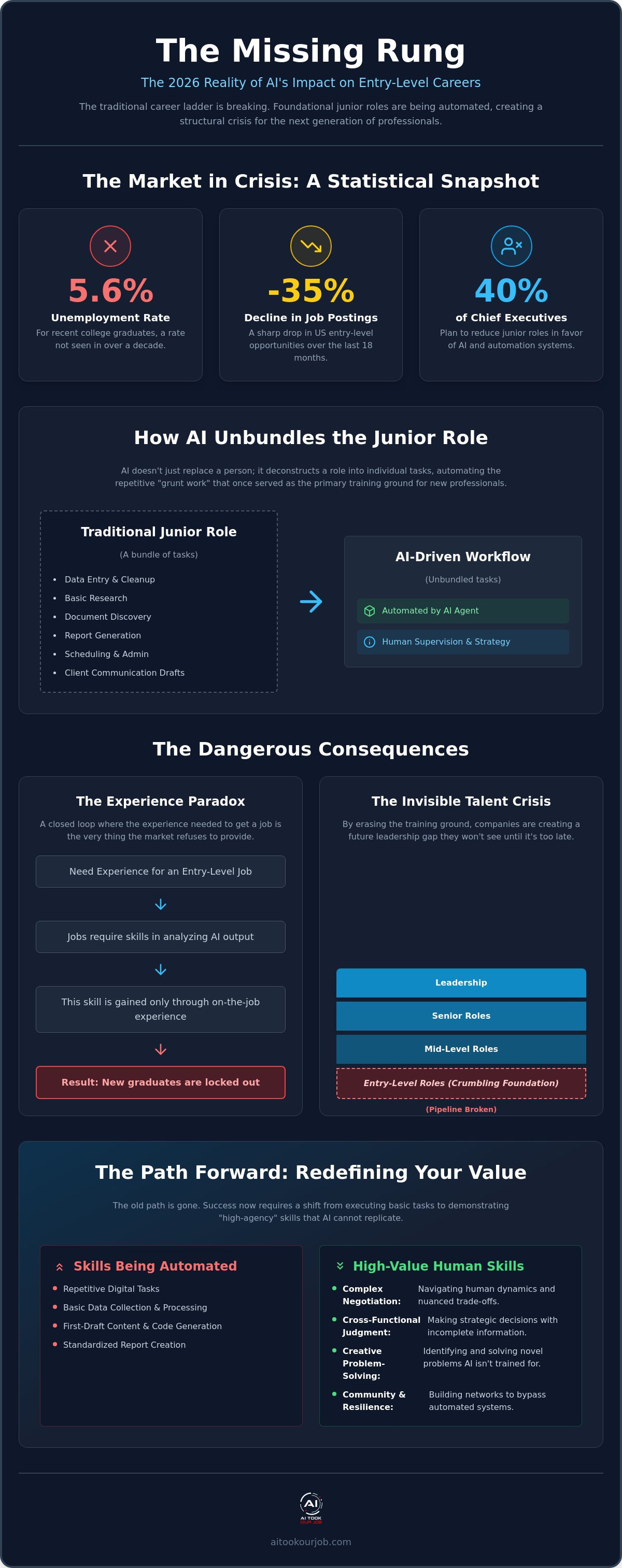
Look at the numbers. While general economic headlines might seem stable, the reality for those aged 22-27 is stark. The statistics from March 2026 paint a clear picture of how AI entry level job displacement is reshaping the market:
- 5.6 percent: The unemployment rate for recent college graduates, one of the highest rates in over a decade.
- 35 percent: The decline in entry-level job postings in the US over the last 18 months.
- 40 percent: The portion of chief executives who plan to reduce junior roles in favor of automation within the next two years.
The Death of the "Foot in the Door"
Internships used to be the sacred space for "learning by doing." You'd mess up a spreadsheet, get corrected, and grow. Now, those roles have shifted toward "monitoring the machine." Instead of building skills, juniors are often relegated to low-paid AI-supervision tasks. You aren't learning the craft; you're auditing an algorithm. This shift turns the traditional 22-year-old career start into a historical relic. How do you develop professional intuition when you never get to do the work yourself?
The 2026 Hiring Freeze: A Silent Displacement
Displacement doesn't always look like a pink slip. Often, it's a vacancy that's never filled. This silent freeze is how future AI job displacement manifests for the next generation. Companies aren't necessarily firing their entire junior staff; they are simply letting the roles expire as AI agents take over repetitive digital tasks. This process is deeply tied to the broader history of Technological unemployment, but with a faster, more aggressive timeline. Automated screening systems now act as invisible walls, ghosting any candidate who doesn't already possess the "senior-lite" skills that used to take years to acquire. If you have 0-2 years of experience, you're increasingly viewed as a liability rather than an investment.
This creates the "Experience Paradox." Employers now demand junior workers who can already evaluate and analyze AI outputs, a skill set that requires the very experience the market is refusing to provide. It's a closed loop. We're seeing a world where you're expected to be a finished product before you've even had your first day. This isn't your fault, and it isn't a lack of ambition. It's a structural erasure of the training ground. Acknowledging this reality is the first step toward finding a different way through the void.
The Mechanism of Displacement: How AI Swallows Junior Tasks
It starts with a prompt. For decades, the entry-level role was a bundle of small, repetitive tasks that, when taken together, taught a newcomer the rhythm of an industry. In 2026, this bundle has been ripped apart. AI entry level job displacement isn't just about replacing a person; it's about the "unbundling" of the role itself. Companies no longer see a "Junior Analyst." They see twelve distinct data processing tasks. If ten of those can be handled by an autonomous agent, the human role simply evaporates. This isn't a gradual transition. It's a structural demolition of the first step in your career.
We've moved beyond the era of simple chatbots. Today, we face Agentic AI. These systems don't just suggest text; they execute workflows. They can navigate software, pull reports, and cross-reference legal precedents without human intervention. While this looks like a victory for efficiency, it's a disaster for professional development. The "grunt work" was never actually about the output. It was the essential training ground for professional intuition. When you manually entered data, you noticed the anomalies. When you did the basic legal research, you absorbed the logic of the law. Without that foundation, how can you ever expect to lead?
Consider the sectors where this displacement is most aggressive:
- Legal: Junior associates no longer spend weeks on document discovery. Agents summarize thousands of pages in minutes, removing the need for a human to learn the case from the ground up.
- Software Development: Entry-level coders spend more time debugging AI-generated blocks than writing original logic, stunting their growth as architects.
- Data Entry: Headcounts in these roles have dropped by 30-40 percent as agentic systems now bridge software gaps that used to require a human touch.
Automating the Apprenticeship Model
The traditional apprenticeship model is being hollowed out from the inside. In many technical fields, the ai impact by industry varies, but the loss of contextual wisdom is universal. By removing the foundational work, organizations are inadvertently reshaping the career ladder into a cliff. If you aren't doing the work, you aren't learning the "why" behind the "what." This creates a generation of workers who can audit a machine but can't think for themselves.
The Efficiency Trap
CFOs are currently caught in an efficiency trap. They see higher output per person and lower overhead, which looks great on a quarterly report. However, this creates a "Productivity Paradox" where the workforce produces more, but fewer people are allowed to participate in the value creation. Task unbundling is the corporate strategy of decomposing a multi-faceted junior role into a series of discrete, low-context data processing events that can be assigned to specialized AI agents. This leaves no room for the messy, human process of growth. It's why staying connected with a community of peers is becoming the only way to track these shifts in real-time. We must recognize that being "efficient" isn't the same as being "prepared."
The Invisible Talent Crisis: Why Erasing Entry-Level Roles Backfires
Companies are currently trading their future for a better quarterly report. It's a dangerous bargain. By allowing AI entry level job displacement to hollow out the bottom of the organizational pyramid, businesses are inadvertently burning the seeds of their own long-term survival. We're witnessing the erosion of institutional memory. When you stop hiring juniors, you stop the natural transfer of culture, unwritten rules, and the "way we do things here" that defines a resilient brand. Short-term efficiency is creating a long-term rot that most boards haven't even begun to calculate.
This structural erasure creates a looming "Senior Gap." If no one is being trained in 2026, who will be ready to lead in 2036? Organizations are setting themselves up for a massive, unsustainable bidding war for the few remaining seniors who managed to slip through the gate before it closed. This scarcity will drive up costs for specialized talent while the economic impact of automation simultaneously suppresses the wage ceilings for everyone else. It's a pincer movement that leaves the average worker squeezed and the average company fragile.
The Leadership Pipeline Void
Leadership isn't a technical skill you can download. It's a set of "soft skills" forged in the fires of junior-level collaboration, conflict, and mentorship. When those roles vanish, the pipeline for future managers vanishes with them. We're already seeing the rise of "hallucinated leadership," where mid-level managers rely too heavily on AI-driven data because they never developed the human-centric judgment that comes from years of entry-level experience. Our AI job market weekly briefing has been tracking these pipeline failures across the tech and finance sectors, where the lack of "human-in-the-loop" training is already leading to a decline in creative problem-solving.
Corporate Short-Sightedness vs. Long-Term Survival
The pressure to cut junior headcount often comes from the top down. CFOs see a line item they can replace with a subscription fee. This is a survival strategy for the next six months, not the next six years. Eventually, the "Great Re-hiring" will become a necessity as companies realize that automated agents can't innovate or build relationships. However, by the time that realization hits, the talent pool may have moved on or lost the foundational skills required to step up. We must advocate for mandates that protect junior training as a public good. If we don't protect the entry point today, there will be no one left to hold the keys tomorrow. It's time to ask the hard question. Is your company building a future, or just managing a decline?
Beyond "Upskilling": Redefining Your Value in an Automated Market
Stop chasing the prompts. If you spend your time trying to master the latest AI interface, you're building your career on shifting sand. By the time you've perfected a specific workflow, the next update has likely automated that very skill away. In 2026, AI entry level job displacement has made traditional upskilling feel like a treadmill. You're running faster just to stay in the same place. We need to look beyond technical proficiency and toward high-agency roles. These are positions that don't just execute tasks but negotiate outcomes across human teams.
The shift is from being task-oriented to being strategy-oriented. Companies no longer need a junior who can follow instructions to build a deck; they need a partner who can interpret why the deck is needed and how it impacts a client's emotional state. This is where you find the "Human Premium." The Human Premium is the only non-depreciating asset in 2026, consisting of your ability to apply ethics, empathy, and physical-world intervention where an algorithm simply can't reach. It's the difference between generating a report and understanding the political implications of its findings.
The Hybrid Professional
Being a "digital native" isn't enough anymore. Every graduate is a digital native. The real competitive edge lies in becoming a hybrid professional. This means combining deep domain expertise with the ability to orchestrate AI tools. If you're a junior marketer, don't just learn the AI tool; learn the psychology of why people buy. Conflict resolution, cross-functional negotiation, and the ability to say "no" to a machine-generated suggestion are the skills that will keep you relevant. You aren't just a user of the machine; you are its strategic governor. Expertise in a specific field will always trump generalist digital skills in a world where the generalist tasks are already handled.
Navigating the "Identity Crisis"
There is a profound weight to entering a market that feels like it doesn't want you. It's easy to tie your self-worth to your productivity, but when your productivity is overshadowed by an automated script, that identity begins to fracture. You are more than your output. Finding solidarity in the psychology of AI job loss is essential for maintaining your mental health during this transition. You're not alone in this feeling of obsolescence. It's a collective experience, and reclaiming your identity starts with acknowledging that your value as a human isn't dictated by a hiring algorithm. If you're feeling the pressure of this shift, join our community to connect with others who are building a future on their own terms.
Navigating the Void: Collective Resilience and the Path Forward
Facing the void of AI entry level job displacement alone is a recipe for burnout. We've spent this article looking at the harsh mechanics of how the ladder is crumbling. Now, we must look at how we build a new structure. Individual effort, while admirable, isn't enough to fight a systemic erasure of junior roles. We need collective media. We need shared intelligence. We need a community that refuses to accept the "Missing Rung" as an inevitable law of nature. Radical honesty is our starting point. If we don't name the problem, we can't solve it together.
We must advocate for responsible AI policies that recognize the "entry-level" phase as a public good. If companies are allowed to harvest the benefits of automation without investing in the next generation of human talent, the entire economic ecosystem collapses. This is where advocacy groups for AI job displacement come in. By joining forces, we can push for training mandates and "Human-in-the-Loop" requirements that ensure the career ladder remains accessible. This isn't just about saving jobs; it's about protecting the future of human expertise.
The Power of the Briefing
Information is your survival map in 2026. Staying informed about corporate automation strategies prevents you from being blindsided by the next wave of task unbundling. Our AI Job Loss Weekly Briefing is designed to keep you ahead of these shifts. When you know which junior tasks are being targeted for automation in your specific sector, you can pivot your strategy. You can use community-led wisdom to negotiate for roles that emphasize the Human Premium. Staying informed isn't just about awareness; it's about reclaiming your agency in a market that feels increasingly opaque.
Reclaiming the Future
Transitioning from a victim of automation to an architect of the next economy requires a shift in perspective. We have to admit the old ways are gone to see the new opportunities clearly. Solidarity is the only thing an algorithm cannot simulate. It's the shared wisdom found in our community stories and the peer-led support that helps us reclaim our professional identities after displacement. You are more than a line item on a spreadsheet, and your value as a human is non-negotiable.
You don't have to navigate this transition in silence. Share your story. Find your peers. Our Community Membership and Educational Media Content are here to provide the grounding you need when the industry feels like it's shifting beneath your feet. Join us at AI Took Our Job. Let's find a new way forward, together. The ladder might be broken, but we can still build a bridge.
Reclaiming Your Career in the Age of Automation
The ladder isn't coming back. We've explored how the unbundling of tasks has turned junior roles into automated scripts, leaving a void where the first step used to be. While the structural reality of AI entry level job displacement is stark, it doesn't have to be the end of your story. By focusing on the Human Premium and high-agency roles that require cross-functional negotiation, you can find a path that an algorithm cannot follow. How will you choose to adapt when the old rules no longer apply?
You don't have to find the answer alone. We're building a space where radical honesty meets collective action. Our platform offers weekly briefings for the automated era, peer-to-peer community support for those navigating these shifts, and expert-led discussions on the changing labor landscape. It's time to move from being a passenger in this transition to being an active participant in what comes next.
Join the AI Took Our Job community and get the Weekly Briefing to stay ahead of market volatility and find your footing alongside a group that understands exactly what you're facing. The future is uncertain, but we can face it together. Stay grounded. Stay informed. We've got your back.
Frequently Asked Questions
Is AI really replacing entry-level jobs, or just changing them?
It's doing both, but the unbundling of tasks is leading to a structural erasure of many junior roles. While some positions are transforming, the overall headcount for entry-level work is shrinking as agentic AI takes over repetitive digital workflows. We have to face the fact that many of these "missing rungs" aren't coming back in their traditional form. It's a permanent shift in how companies view foundational labor.
How can a recent graduate compete with AI for a junior role in 2026?
You don't compete with AI on efficiency; you compete on agency and human-centric judgment. Focus on demonstrating your ability to manage complex cross-functional relationships and ethical decision-making. Employers in 2026 are looking for "Hybrid Professionals" who can orchestrate AI tools while providing the contextual wisdom that a machine lacks. You aren't just a user of the machine; you're its strategic governor.
What industries are seeing the highest rates of junior job displacement?
Sectors like data entry, legal discovery, and basic software development are seeing the most aggressive AI entry level job displacement. These industries rely on pattern recognition and rule-based tasks that autonomous agents now handle with ease. Data entry roles alone have seen a 30-40 percent reduction in human staff since 2024 as companies automate their foundational workflows to save on overhead costs.
Does a college degree still matter if AI can do the entry-level work?
A degree still signals your ability to commit to a long-term goal, but it's no longer the "golden ticket" it once was. Degrees are becoming a baseline requirement while the real differentiator is your ability to handle "High-Agency" tasks. You need to prove you have the professional intuition that a four-year curriculum often fails to teach in an automated world. The piece of paper is just the start.
How can I explain an "AI-related layoff" or hiring freeze on my resume?
Use radical honesty when describing an AI-driven hiring freeze or layoff. Frame it as a market-wide structural shift rather than an individual failure. Highlight how you spent that time building resilient skills or managing the very automation that displaced the role. Transparency about the 2026 labor shift shows you're an informed and proactive professional who understands the reality of the current market.
What are the best "AI-proof" skills for young professionals to learn today?
The most resilient skills are those that involve empathy, ethics, and physical-world intervention. We call this the "Human Premium." Focus on mastering conflict resolution, strategic negotiation, and the ability to interpret the political or emotional context of data. These are the non-depreciating assets that AI entry level job displacement cannot touch. Machines can calculate, but they can't care or navigate human politics.
Can collective action or unions help stop the displacement of junior workers?
Solidarity is the only force capable of pushing for systemic protections like "Human-in-the-Loop" junior training mandates. Individual resilience is important, but collective action through advocacy groups can force a conversation about protecting the entry-level as a public good. We need organized voices to ensure the next generation isn't locked out of the economy entirely. It's about building a collective resilience that an algorithm can't simulate.
What happens to the career ladder if there are no entry-level rungs?
Without entry-level roles, the ladder becomes a cliff, creating a massive talent gap for the future. Companies that cut their junior headcount today will have no one ready to step into leadership roles in ten years. This short-sightedness will eventually force a "Great Re-hiring," but only after industries face a significant loss of institutional memory and creative innovation. The entire pipeline of human expertise is at risk.