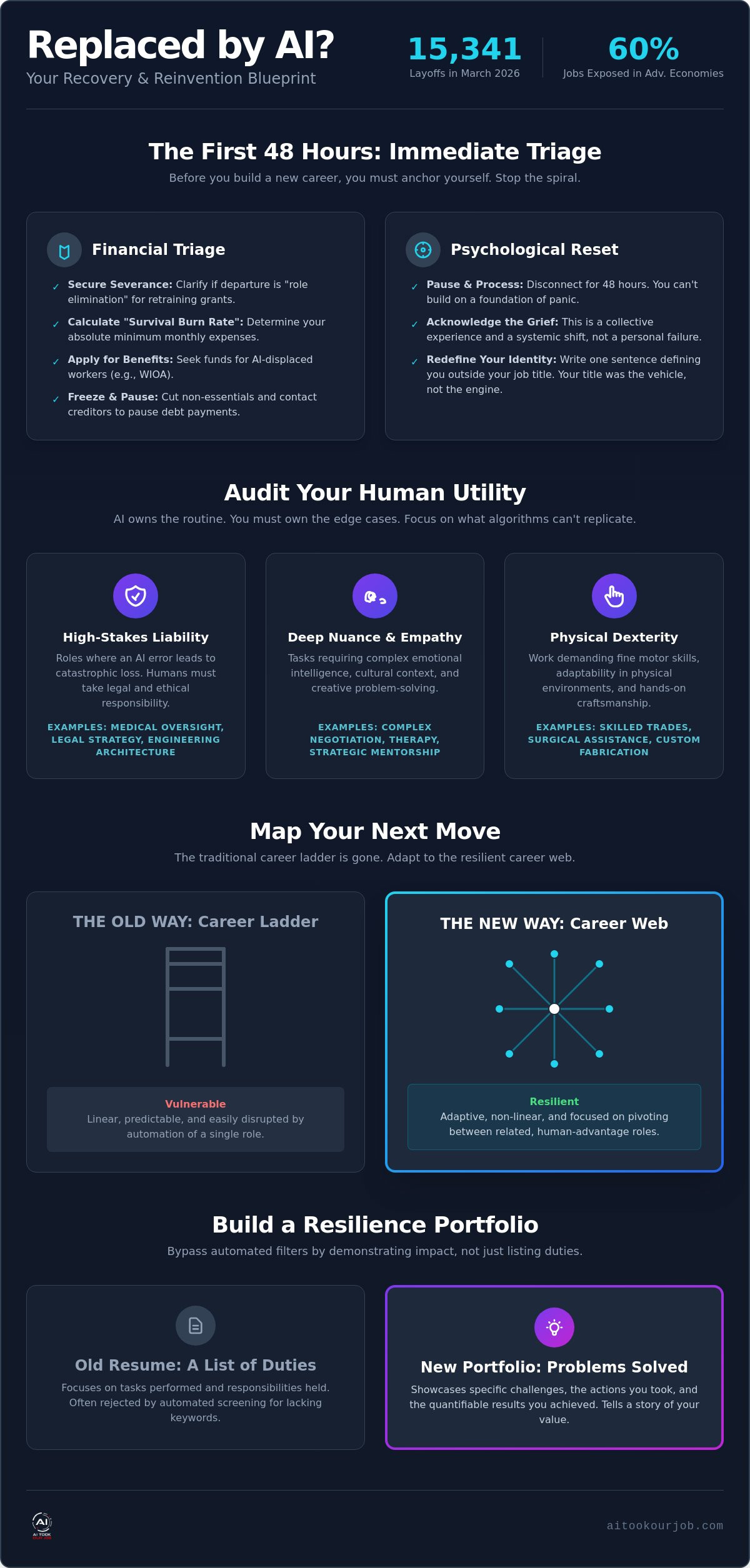
You closed your laptop on Friday as a senior analyst and woke up Monday to an automated severance email. It's a cold, hollow feeling that 15,341 Americans felt in March 2026 alone when AI was cited as the primary reason for their layoffs. The shock is real. The fear that your skills have suddenly hit an expiration date is even more real. You are likely wondering what to do after being replaced by AI when the very ground beneath your career seems to be shifting every hour. It's okay to feel winded. Displacement isn't just a financial hurdle; it's a fundamental crisis of identity in a world where the IMF projects 60% of jobs in advanced economies are now exposed to disruption.
We aren't here to offer hollow platitudes or tell you to just learn to code. We are here to build a bridge. This guide provides a realistic, 90-day framework to stabilize your finances using 2026 resources like the Workforce Pell Act and the AI Dividend stipend. You'll learn how to identify human-advantage roles that algorithms can't touch and how to pivot without losing your professional soul to the machine. We will walk through the immediate steps to reclaim your worth and connect with a community that refuses to be left behind.
Key Takeaways
- Stabilize your situation immediately. Secure your severance and define the exact nature of your displacement to leverage state-funded retraining programs.
- Identify your "Human-in-the-Loop" utility. Focus on high-stakes tasks where human liability and nuance remain non-negotiable for 2026 employers.
- Map your next move using industry impact data. The traditional ladder is gone, so you'll need to look for resilient roles within the emerging "Career Web."
- Build a portfolio of problems solved instead of a list of duties. This helps you bypass the automated filters that often reject traditional resumes.
- Discover exactly what to do after being replaced by AI by joining a collective intelligence hub that offers real-world transition blueprints.
The First 48 Hours: Stabilizing After the AI Layoff
The desk is empty. The algorithm is running. Your first job is to stop the spiral. It's a heavy, disorienting moment when you realize a piece of software is now performing the tasks you spent years mastering. Before you update your resume or scroll through job boards, you must anchor yourself. Understanding what to do after being replaced by AI starts with a pause. Disconnect from the "hustle" for at least 48 hours. You cannot build a new career on a foundation of panic. While economists have long theorized about Technological unemployment, the academic debate feels irrelevant when it's your livelihood on the line. Take this time to process the psychological impact of human utility loss. It’s a systemic shift, not a personal failure.
Secure your severance immediately and clarify the terms of your departure. Ask specifically if your departure was categorized as "role elimination" or "automation restructuring." In 2026, these definitions often dictate your eligibility for specific government retraining grants or private stipends like the AI Dividend. Audit your liquidity with a cold, hard eye. AI-driven market shifts are different from 20th-century layoffs because the entire sector might be contracting simultaneously. This requires a longer financial runway than a traditional job hunt. You aren't just looking for a new office; you are navigating a landscape where the roles themselves are being rewritten. You need to know exactly how much time your savings can buy you.
Immediate Financial Triage
Calculate your "Survival Burn Rate" based on the current 2026 economy. This is the absolute minimum you need to keep the lights on and food on the table. Apply for displacement benefits specifically tied to automation if your jurisdiction offers them. Many states have now activated funds through the Workforce Innovation and Opportunity Act (WIOA) specifically for AI-displaced workers. Freeze non-essential subscriptions and contact creditors to pause high-interest debt payments. Every dollar you save now buys you another hour of transition time later. Don't wait for the bank to call you. Be proactive in protecting your remaining capital.
The Psychological Reset
Acknowledge the crisis of human utility. It’s a deep, existential grief to feel replaced by a machine. Remember that this is a collective experience. You aren't alone in this transition. You might find it helpful to read about the psychology of AI job loss to understand the shared nature of this trauma. Try to write a single sentence that defines who you are outside of your former job title. You are a strategist, a communicator, or a craftsman. Your title was just the vehicle. It wasn't the engine that makes you valuable.
Auditing Your Human Utility: Identifying AI-Resistant Skills
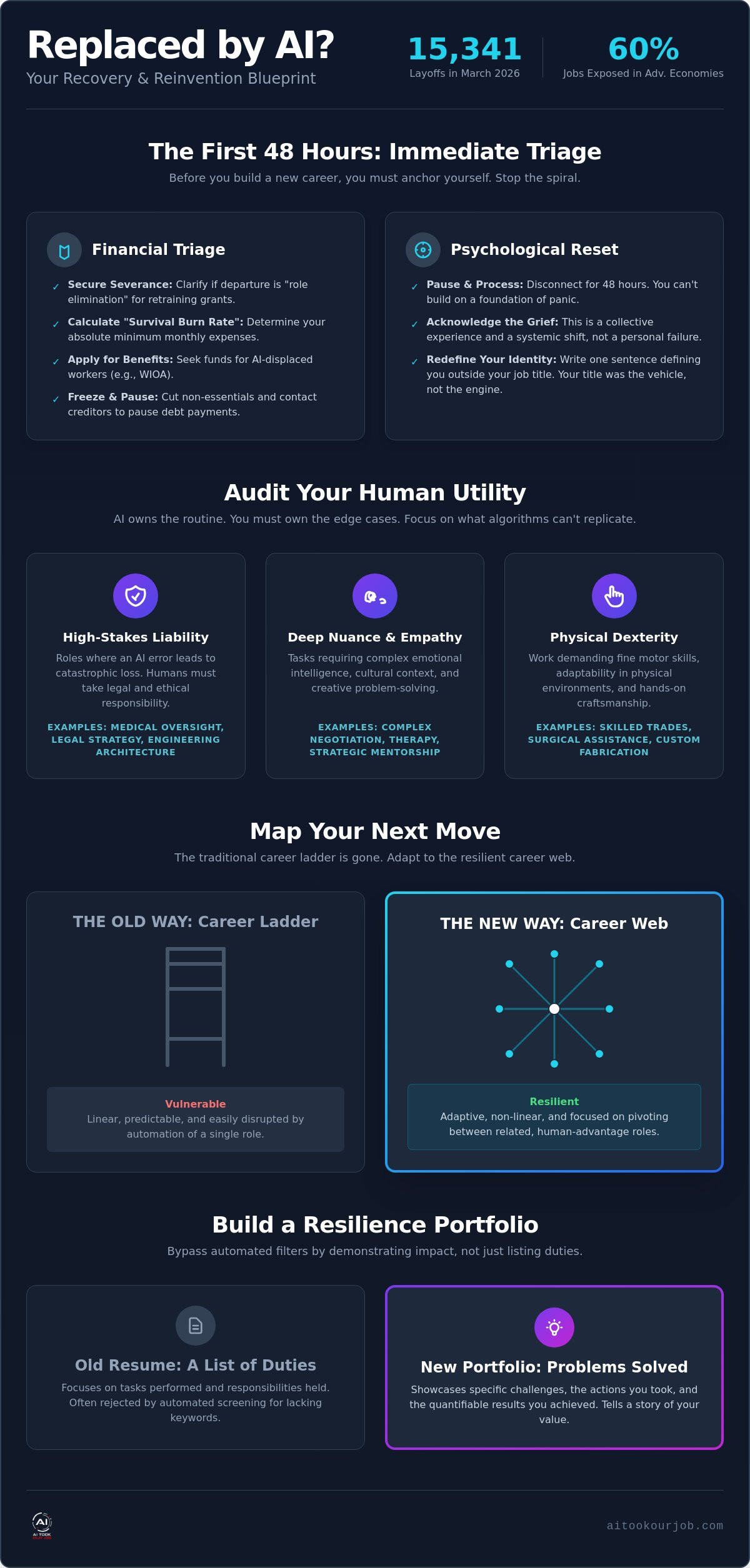
AI excels at the predictable. It thrives on the average. If your previous role consisted of synthesizing data or generating standard reports, you've seen how quickly those tasks can be absorbed. When considering what to do after being replaced by AI, you must shift your focus from the middle to the extremes. This means identifying where high stakes, deep nuance, or physical dexterity create a barrier that software can't cross. The machine owns the routine; you must own the edge cases.
The labor market is undergoing a massive shift in skills employers prioritize, moving away from cognitive routine and toward human-in-the-loop (HITL) oversight. Liability is the ultimate human moat. Algorithms can suggest a medical diagnosis or a structural design, but they can't take legal or ethical responsibility for the outcome. Employers in 2026 are looking for professionals who can sign off on these high-stakes decisions, standing between the algorithm and the real-world consequences.
The 3 Pillars of AI-Resistance
Understanding your utility requires looking at three specific areas of labor that machines struggle to replicate. These aren't just job titles; they're functional categories of human work that remain resilient.
- High-Stakes Liability: These are roles where an AI hallucination results in millions of dollars in losses or the loss of life. Legal strategy, medical oversight, and engineering architecture fall into this category.
- Complex Physicality: Non-routine manual dexterity in unpredictable environments remains a human stronghold. Skilled trades and emergency response require physical problem-solving that's difficult to automate.
- Deep Empathy: Genuine emotional resonance can't be faked. High-level leadership, therapeutic roles, and complex negotiations require a level of trust that only another human can provide.
Inventorying Your 'Invisible' Skills
Map your current skills against the 2026 Automation Index. Which of your daily tasks are now 90% automated? Which ones remain at 10%? Focus your energy on the latter. Look back at your last job and identify the edge cases you solved. These are the moments where the standard procedure failed and you had to apply human judgment. These moments are your most valuable assets because they represent the limits of algorithmic logic.
You also need to audit your social capital. Trust is a currency that an algorithm can't mint. Who trusts you, and why? Identifying these invisible contributions is essential when you're figuring out what to do after being replaced by AI. Your focus should be on Transferable Humanism, emphasizing skills like empathy and complex negotiation that move with you regardless of the industry. If you're feeling overwhelmed by these shifts, our community membership offers a space to share these blueprints with others navigating the same path. Your value hasn't disappeared; it's simply migrated to the edges where the machine can't reach.
Mapping Your Transition: Strategic Career Paths in 2026
The linear career path is a relic of the pre-automation era. Instead of a vertical climb, we are now forced to navigate a "Career Web" where lateral movements into resilient niches are the only way to survive. When you're staring at an empty calendar and wondering what to do after being replaced by AI, you can't simply look for the same job at a different company. You need to analyze the AI impact by industry to avoid jumping from one automated frying pan into another. The goal is to find sectors where human judgment is a requirement, not a luxury.
Consider the "Hybrid Pivot." You already possess deep domain expertise from your previous role. Use it. Companies are currently desperate for consultants who understand the nuances of a specific sector and can oversee AI implementation. You aren't competing with the algorithm; you're the one identifying its blind spots. Beyond the office, evaluate "The New Trades." From renewable energy technicians to high-end, human-centric hospitality, the physical world is reasserting its value. These roles demand a level of dexterity and real-time problem solving that software simply cannot replicate.
The 'Bridge' Role Strategy
Don't look for a role that ignores technology. Look for one that's 50% automated. This allows you to use AI to 10x your output while you spend the other half of your time retraining for your long-term pivot. Search for "AI Auditor" or "Prompt Governance" roles within your existing vertical. These positions value your industry knowledge but focus on the liability side of automation. Avoid entry-level content or data roles. In the current market, these are the first to be fully subsumed by the next model update.
High-Touch and Physical Pivots
Explore the resurgent demand for artisanal, "human-made" services. There is a growing "Human Premium" market where clients pay specifically for human interaction and the lack of algorithmic interference. Before you commit to a new path, evaluate the future AI job displacement forecasts for the manufacturing and trade sectors. Knowing what to do after being replaced by AI means looking toward fields like specialized healthcare or complex infrastructure maintenance. These are the areas where the "Human Premium" isn't just a marketing slogan; it's the foundation of the business model.
Building a Resilience Portfolio: Beyond the Traditional Resume
Your resume is being ghosted by a machine. In 2026, the traditional application process has become a closed loop where AI writes a CV only to have it scanned and rejected by another AI. If you are struggling with what to do after being replaced by AI, the first step is to stop feeding the black hole. You must bypass the algorithm entirely. To get hired now, you need to present a Resilience Portfolio. This is not a list of duties. It is a curated collection of problems you solved that required human judgment, ethical nuance, or physical intervention. Machines can list tasks; only humans can prove impact.
You have to develop a "Proof of Humanity." This is your digital and physical footprint that shows original thought, community leadership, and real-world presence. When you interview, use the economic impact of automation data to justify your value. Show them that while an LLM can produce the "average" result for pennies, your human oversight prevents the million-dollar hallucinations that sink companies. You aren't just an employee anymore. You are a risk-mitigation specialist for an automated world.
Reframing Your 'AI Layoff'
Stop hiding your displacement. In this market, being automated is a badge of experience, not a mark of failure. Use this script: "My role was automated, which allowed me to strategically transition into this field where human judgment is the primary value driver." This framing shows you understand the market shifts and were prepared for them. Prove your AI literacy by showing you can work with the machines without being replaced by them. Employers want people who can steer the technology, not people who are afraid of it.
The 2026 Networking Protocol
LinkedIn has become a sea of synthetic noise. To find the "hidden" job market, you must focus on Deep Networking. This means fewer digital connections and more in-person industry advocacy. Join advocacy groups for AI job displacement to find peers who are sharing real-world leads. Offer "Human Audit" sessions to your network to build your reputation as a transition expert. You can start building this collective resilience today by checking out our community membership for shared wisdom. Resilience is a team sport. You don't have to navigate this transition in isolation.
From Individual Displacement to Collective Action
You cannot win a war against an algorithm alone. Isolation is the greatest threat to your professional recovery. When you're deciding what to do after being replaced by AI, your instinct might be to retreat and rebuild in private. That's a mistake. The scale of this transition is too vast for individual solutions. You need a community that functions as a labor intelligence network. This isn't just about venting or finding a shoulder to cry on. It's about data. It's about knowing which companies are quietly automating their entire middle management and which ones are doubling down on human oversight. We are moving from a period of individual career paths to a period of collective resilience.
The "AI Took Our Job" community serves as a hub for this shared wisdom. Your displacement isn't a personal failure; it's a data point in a global shift. Contributing your story helps build the evidence needed for responsible AI policy advocacy. This isn't just theory. It's about supporting legislative efforts for human quotas or automation taxes that protect the future of your industry. We are shifting the narrative from being victims of automation to being the architects of the post-AI workforce. An architect doesn't just survive the building. They design the structure. You can help define the ethical guardrails for how AI is used in your next role.
Leveraging the Community for Intelligence
Information is your only leverage in a shrinking market. Use the Weekly Briefing to spot hiring freezes before they hit your sector. This allows you to pivot your search before a specific niche becomes oversaturated with other displaced workers. Within the community, you can participate in "Skill Swaps" to lower your retraining costs. Why pay for a high-cost bootcamp when you can trade your deep industry knowledge for someone else's prompt governance expertise? Crowdsourcing "AI-Safe" company lists from other professionals helps you target employers who genuinely value the human premium. These lists are often more accurate than any public job board because they're built on real-world experience.
Becoming an Advocate
Share your transition story to provide a blueprint for others. Your specific path through the 2026 labor market can save a peer weeks of uncertainty. Supporting legislative efforts is no longer optional. With the Workforce Pell Act now in effect, your voice matters in shaping how retraining funds are allocated. Sign up for a community membership to stay informed and mobilized. Knowing what to do after being replaced by AI means realizing that our collective intelligence is stronger than any single algorithm. Stop the spiral. Join the hub. Let's build the next chapter together.
Reclaiming Your Future in the Post-Automation Era
The transition from a displaced worker to a resilient professional begins with a shift in perspective. You have audited your human utility and mapped a path through the 2026 career web. Now, the work of rebuilding begins. Understanding what to do after being replaced by AI is no longer a theoretical exercise; it's a practical roadmap for survival. By focusing on high-stakes liability and human-in-the-loop oversight, you're positioning yourself where the algorithm cannot follow. You aren't just looking for a job. You're architecting a career that values your original thought and human nuance.
You don't have to navigate this shifting landscape alone. We invite you to Join the AI Took Our Job Community and get the Weekly Briefing to stay ahead of market shifts. You'll join 50,000+ workers who are using our weekly market intelligence briefings and expert-led career transition workshops to find their next chapter. Shared wisdom is our greatest defense against systemic displacement. Your skills haven't lost their value. They've simply found a new, more vital context. Take the next step with us and turn this disruption into your most powerful pivot yet.
Frequently Asked Questions
Is it worth retraining for a new career if AI might automate that too?
Yes, but you must choose your next path with precision. Focus on "human-advantage" fields that require high emotional intelligence, physical dexterity, or complex ethical judgment. IBM estimates that 40% of the global workforce will need to acquire new skills within three years. Don't just learn a new trade; learn how to lead the AI tools within that trade to ensure your long-term relevance.
How do I explain an AI-related job loss to a future employer?
Frame the layoff as a strategic market shift rather than a personal failure. Be direct and explain that your previous role was automated, which prompted you to pivot into a sector where human judgment is the primary value driver. This shows you are self-aware and proactive. Highlighting your AI literacy during this explanation proves you can work alongside technology rather than being replaced by it.
What industries are safest from AI displacement in 2026?
Skilled trades, healthcare, and high-level strategy roles remain the most resilient options. Fields like therapy, education, and cybersecurity architecture are considered highly AI-resistant because they require complex critical thinking and emotional resonance. While 60% of jobs in advanced economies face exposure, these human-centric sectors prioritize the nuance and liability that algorithms currently lack.
Should I lower my salary expectations because of AI productivity gains?
Not necessarily, but you must shift your value proposition to justify your pay. While AI handles repetitive tasks, the "Human Premium" for oversight and liability is actually increasing in many sectors. Instead of charging for volume, charge for the risk you mitigate and the judgment you provide. Use 2026 data on the economic impact of automation to justify a salary based on high-stakes human utility.
How can I tell if my current job is about to be automated?
Audit your daily tasks for high levels of repetitive cognitive work. If more than 50% of your duties can be performed by an LLM without human sign-off, your role is at high risk. Watch for "automation restructuring" within your company or the introduction of tools that significantly augment your peers' output. Early detection gives you more time to plan what to do after being replaced by AI.
Are there any government grants for workers replaced by AI?
Several programs are active as of 2026. The Workforce Pell Act allows you to use Pell Grants for short-term job training programs. Additionally, the U.S. Department of Labor has directed WIOA funds specifically toward AI literacy and retraining. Some workers may also qualify for the "AI Dividend," a private $1,000 monthly stipend designed for those displaced by automation.
What are the best 'human-centric' skills to learn right now?
Focus on empathy, complex negotiation, and ethical judgment. These are the "invisible" skills that software cannot replicate. Developing physical-world dexterity or learning to manage algorithmic teams are also vital. Employers are looking for "Human-in-the-Loop" professionals who can take legal and ethical liability for AI-generated outputs in high-stakes environments like law, engineering, or medicine.
How do I deal with the depression of being replaced by a machine?
Acknowledge that your grief is a valid response to a systemic crisis. This is not a personal failure; it's a fundamental shift in the global labor market that is affecting millions. Connect with others in the same situation to combat isolation. Finding what to do after being replaced by AI is easier when you have a community of peers who provide the emotional grounding and collective resilience needed to move forward.